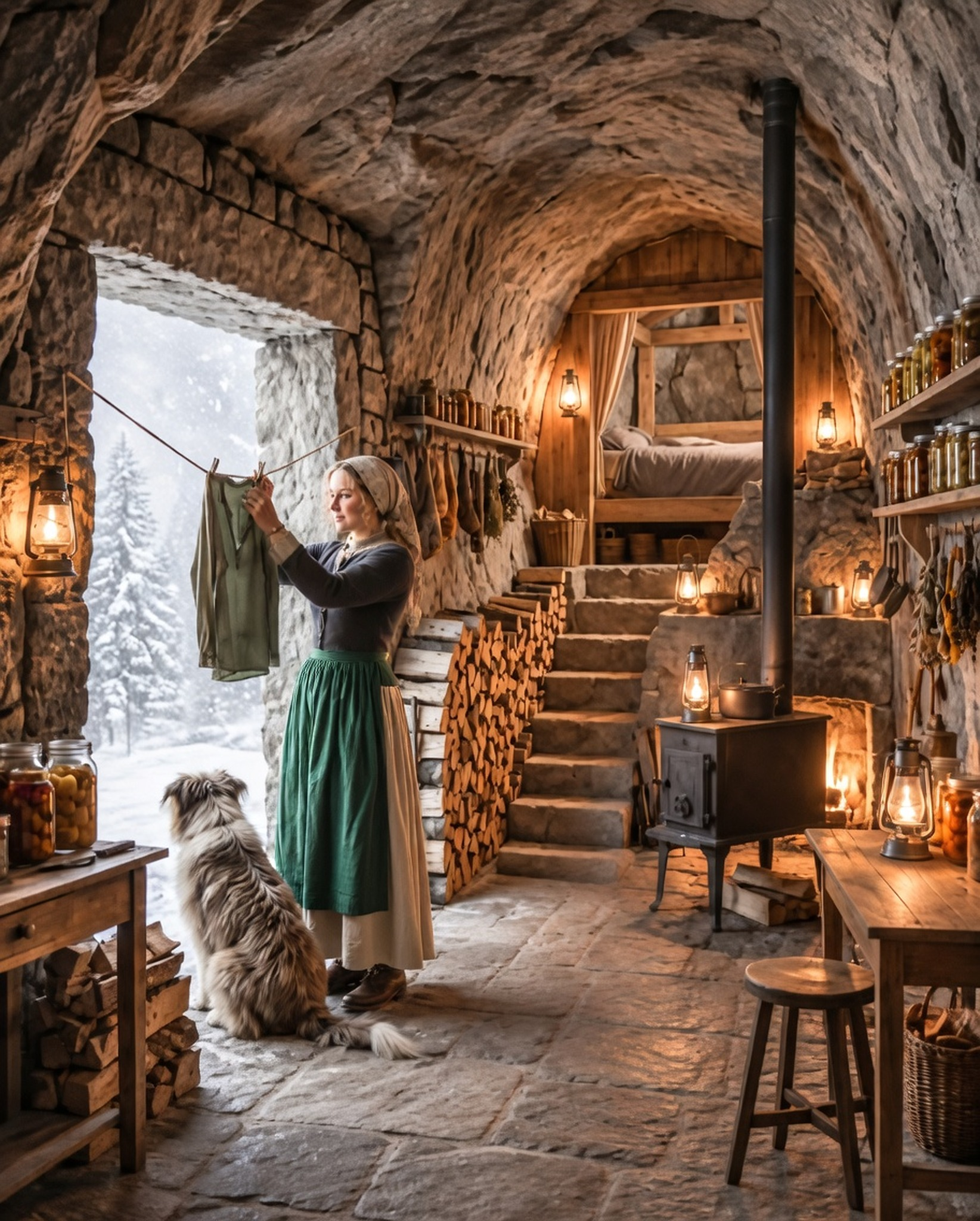
The attorney placed the document on my wooden table.
"Your husband signed this agreement before his death," he said. "It gives Mr. Griffin certain rights concerning the northern portion of your property."
I stared at the paper.
For a moment, I could not hear the stove crackling behind me.
Adrian's signature appeared at the bottom.
I knew that handwriting. I had watched those hands write grocery lists, repair instructions, birthday notes, and the occasional letter to his family. I knew how he formed the capital A in Abbott. I knew how the final stroke of his name curved beneath the other letters.
But something about the document troubled me.
"When did he sign it?"
The attorney adjusted his collar.
"That is not relevant to the immediate matter."
"It is relevant to me."
"The agreement was executed as part of a property arrangement."
"Before or after he died?"
His eyes moved briefly toward Deputy Carter.
"Mrs. Ellison, I suggest you read the document before making accusations."
I did not touch it.
Instead, I looked at the children.
Fiona stood with her brothers near the staircase. Her face had gone pale. The youngest was holding his wooden horse against his chest, while the older boy watched the men with a seriousness that made him look much older than eight.
"Take your brothers upstairs," I told Fiona.
"But Mama—"
"Go with them. Stay together."
She hesitated.
I squeezed her hand.
"Everything is going to be all right."
I did not know whether that was true.
But I needed my children to believe that their mother still knew what she was doing.
Fiona led the boys toward the sleeping alcove. I waited until they were out of sight before turning back to the attorney.
"Show me the agreement."
He pushed the paper across the table.
I looked at the signature first.
Adrian Abbott.
It was convincing.
Too convincing.
The date appeared near the top, but a fold ran through the ink. I could not read the final digit clearly.
"May I keep this?"
"No."
"Then let me examine it."
"You may read it here."
I studied the first paragraph.
The document referred to a proposed timber access arrangement involving the northern ridge. It mentioned an inspection corridor and certain rights of entry. The language was complicated, but the meaning seemed simple enough.
Someone wanted access to our land.
Someone had apparently obtained Adrian's agreement.
And now they were using it to make claims against me.
"Did my husband sign this in front of witnesses?"
The attorney did not answer immediately.
"Yes."
"Who?"
"The necessary witnesses are recorded."
"Names."
He closed the folder.
"That information can be provided through the proper legal channels."
I looked at the deputy.
"Is this why you brought a court order to take my children?"
"That is a separate matter," he replied.
"Then why did you bring his agreement?"
The attorney stepped between us.
"Mr. Griffin has made considerable efforts to resolve this matter peacefully. Your refusal to cooperate has created unnecessary difficulties."
I looked down at the document again.
Five hundred dollars.
Three different men.
A warning hidden in my husband's handwriting.
And now a paper claiming Adrian had given away rights to the very land he had told me to protect.
I slowly lifted my eyes.
"My husband told me never to sell that ridge."
The attorney's expression changed.
"Did he?"
"Yes."
"Perhaps you misunderstood his intentions."
"I don't think I did."
The deputy shifted his boots.
The attorney returned the document to his folder.
"We will be back."
I watched the three men retreat toward the entrance.
The man with the crowbar looked over his shoulder once.
Then the heavy door closed.
For several seconds, I remained perfectly still.
Only after I heard their footsteps disappear did I allow myself to breathe.
Fiona came down the stairs.
"Mama?"
I turned toward her.
"Are they coming back?"
I looked at the closed door.
"Yes."
She lowered her eyes.
"Are they going to take us?"
I knelt and pulled her close.
"Not if I can help it."
But when she returned to her brothers, I found myself looking at the empty space where the attorney's document had rested.
Adrian's signature.
I needed to know why it was there.
And I needed to find the original letter.
Three months earlier, I had not understood the significance of that letter.
I had only known that my husband had left me a warning.
It had been an ordinary afternoon when I discovered it.
The cabin was quiet. The children were outside collecting small pieces of firewood, and I was sorting through Adrian's tools.
I had been avoiding that work since the funeral.
Every object reminded me of him.
His hammer still had a small dent near the handle. His measuring tape was stained with sawdust. His leather gloves remained folded beside the workbench.
I could almost hear him moving around the cabin.
Sometimes I would turn toward the door because I expected him to walk through it.
Then I would remember.
He was not coming home.
I picked up his old carpenter's level.
It was a sturdy wooden instrument, worn smooth from years of use. Adrian had owned it long before we married. He used it when building shelves, repairing doors, and checking the supports of our unfinished cabin.
I turned it over in my hands.
Something rattled inside.
At first, I thought a small piece of wood had come loose.
I shook it gently.
The sound came again.
I examined the handle and noticed a narrow seam near one end. The wood had been fitted carefully, so the opening was almost invisible.
I found a thin metal tool and worked it into the seam.
A small section loosened.
Inside was a tightly folded piece of oilcloth.
My heart began beating faster.
I carefully removed it.
The cloth was dry and slightly yellowed. It had been wrapped around something thin enough to fit inside the handle.
A letter.
I knew the handwriting before I unfolded it.
Adrian.
I sat down on the edge of the workbench.
For a long time, I simply stared at his name.
Then I opened the paper.
"Alana, should I fail to come home, be careful of the timber owners. Keep the north ridge, whatever anyone offers."
That was all.
No explanation.
No signature.
No date.
Just those words.
I read them again.
Then I looked toward the window.
The north ridge rose behind our cabin, covered with grass and scattered stones. A few trees stood near its upper edge. It did not look particularly valuable.
There was no visible timber worth a fortune.
No obvious mineral deposit.
No large stream.
Nothing that would explain why my husband had hidden a warning inside a carpenter's tool.
I turned the paper over.
The back was blank.
I checked the folds, looking for another message.
There was nothing.
My first thought was that Adrian had written it during one of his ordinary business disagreements.
He had occasionally complained about timber buyers and the way they negotiated with small landowners.
Perhaps someone had offered him a poor price.
Perhaps he had refused.
But the words should I fail to come home made the letter different.
He had not written, if I decide to leave.
He had not written, if something happens.
He had written as though he expected danger.
I folded the paper carefully and slipped it into the pocket of my dress.
Then I heard the children returning.
I put the carpenter's level back on the workbench.
When Fiona entered, she was carrying a small basket of sticks.
"Mama, can we have the last of the apples tonight?"
I looked at her.
"Of course."
She smiled faintly.
I wished I could have given her a world in which she never needed to ask such questions.
But the flour tin was nearly empty, and the money in my small purse would not last through another month without careful spending.
I needed to find work.
I needed to repair the cabin.
And now I needed to understand why Adrian had warned me about the timber owners.
The first visitor arrived two weeks later.
He introduced himself as a buyer representing a timber company.
He was polite, well dressed, and careful with his words.
He asked whether I had considered selling the northern portion of our property.
I told him I had not.
He explained that timber companies were interested in expanding their holdings in the county. He said the land might be worth more than I imagined.
I asked why.
He smiled.
"Access, Mrs. Abbott. Future development. There are several possibilities."
"What possibilities?"
"That is difficult to say without an agreement."
I refused to sign anything.
He left a business card on the table.
I kept it.
The second visitor arrived several days later.
He did not mention timber immediately.
Instead, he spoke about my circumstances.
He said a woman raising three children alone would have difficulty maintaining the property.
He mentioned the approaching winter.
He suggested that selling a portion of the ridge might provide enough money to secure a more suitable home.
I thanked him for his concern.
Then I asked him to leave.
He did not seem surprised.
The third visitor was Damon Griffin.
Unlike the others, he did not send a representative.
He came himself.
His black carriage stopped outside the cabin, its brass lamps shining in the afternoon light.
He entered carrying the confidence of a man accustomed to being welcomed.
I offered him a chair.
He declined.
Instead, he placed five hundred dollars on the kitchen table.
The money was more than I had seen together in months.
For a brief moment, I could not stop looking at it.
Five hundred dollars could change everything.
It could buy flour, meat, warm clothing, medicine, and proper building supplies. It could pay for repairs and give the children a little security.
Damon noticed my expression.
"You could start over with this," he said. "Find a decent house somewhere back east. Give those children something better."
I remembered Adrian's letter.
I remembered the words hidden inside the carpenter's level.
Keep the north ridge, whatever anyone offers.
I looked at Damon.
"I'm keeping the ridge."
His expression changed.
It was not dramatic.
His smile simply disappeared.
"You've noticed the season changing, I assume."
"Yes."
"Then consider what you're asking three children to survive. There's no husband here, and this cabin isn't fit for winter."
I said nothing.
He gathered his money.
Before leaving, he leaned toward me.
"Pride won't mean much if you lose someone else."
I watched him walk to his carriage.
The moment he disappeared down the road, I went to the workbench and retrieved the letter.
I placed it beside the business card.
The names were different.
The message was the same.
The timber owners wanted the ridge.
Adrian had known it.
And he had believed the matter was serious enough to hide a warning for me.
I spent the following days examining the property.
I walked along the northern boundary and studied the ground.
I looked for signs of recent digging, unusual marks, or anything that might explain the interest.
I found nothing obvious.
But I noticed something I had never paid attention to before.
The hillside remained strangely free of deep frost.
Even when the grass around the cabin was stiff with cold, certain patches along the ridge seemed softer beneath my boots.
I knelt and pressed my palm against the earth.
It was not warm.
Not exactly.
But it did not feel as cold as the surrounding ground.
I returned the next morning with a small shovel.
I dug several inches into the soil.
The earth beneath the surface was darker and slightly damp.
I found a thin layer of stone.
Then another.
I remembered my father.
He had spent his working life underground in Ohio coal mines. When I was young, he used to explain how the earth could protect people from harsh temperatures if the space was properly designed.
He had also warned me that underground construction could be dangerous.
Drainage mattered.
Ventilation mattered.
Gas could collect where people least expected it.
A careless person could build a room that became a trap.
But a careful person could build something useful.
I returned to the cabin and opened my father's old notebook.
Several pages contained rough sketches of underground storage spaces and ventilation arrangements.
I studied them until the light faded.
For the first time, I began to see the ridge as something more than a piece of land.
It might be the answer to our winter problem.
The idea frightened me.
Digging beneath a hillside with three children depending on me was not a small undertaking.
I would need timber supports, proper drainage, separate air passages, insulation, and a safe heating arrangement.
I would have to spend nearly everything.
But the alternative was remaining in a cabin that the coming winter could make unlivable.
I looked at Fiona sleeping beside her brothers.
Their blankets were thin.
Their faces were peaceful.
I made my decision.
The first shovel struck the hillside in September.
Fiona stood beside me holding two buckets.
My older son collected stones and arranged them in a small pile.
The youngest sat near an overturned barrel, watching the tools while holding his wooden horse.
I worked until my palms blistered.
The earth was stubborn, and the stones were heavier than I expected.
By evening, my back ached and my fingers had begun to bleed.
But I had made progress.
The next day, I worked again.
Then the day after that.
People began noticing.
Some stopped to ask what I was doing.
Others simply watched.
A woman from church told me that an underground home would be unhealthy.
A neighbor asked whether I had considered that the roof might collapse.
I listened.
I checked my measurements.
I studied the ground.
I refused to allow embarrassment to make decisions for me.
Then Grant Rhodes arrived.
He was the county's most respected carpenter, a man whose work could be found in barns, stores, and several well-built homes throughout the area.
He watched me strike the earth with my shovel.
"You're digging yourself a grave," he said.
I stopped.
He looked down into the excavation.
"Four coffins would fit nicely."
I wiped the dirt from my hands.
"Then I suppose you'll have to come back and count them."
He laughed.
I did not.
Grant walked away shaking his head.
I returned to work.
By the first frost, I had made enough progress to begin installing the heavy timber supports.
The structure was beginning to take shape.
And although the neighbors continued to whisper, I had started to feel something I had not felt since Adrian's funeral.
Hope.
That night, after the county men left my underground home, I could not sleep.
I waited until the children were resting before retrieving the carpenter's level from the storage chest.
I had brought it with me when we moved beneath the hillside.
The letter remained inside its wooden handle.
I removed it and placed it beside the new court papers I had copied from my notes.
Adrian's warning looked different now.
It was no longer simply a frightened husband's message to his wife.
It was evidence that he had known something.
Something about the ridge.
Something about the timber owners.
Something that might have cost him his life.
I ran my fingers over the folded paper.
Then I remembered the agreement the attorney had shown me.
Adrian's signature.
I had never seen him sign an agreement giving away the northern ridge.
I had never heard him mention a timber access arrangement.
And if he had signed such a document, why had he hidden a letter telling me to keep the property?
I opened the wooden box where I kept our important papers.
Inside were the marriage certificate, the children's birth records, the property deed, and several letters Adrian had received before his death.
I searched through every document.
Nothing.
No timber agreement.
No written permission.
No record of any arrangement with Damon Griffin.
I returned to the carpenter's level.
For a long moment, I held it in both hands.
Then I noticed something I had overlooked.
Inside the narrow wooden handle, beneath the oilcloth, there was a second folded piece of paper.
It was smaller than the first.
And unlike the letter, it had not been written in Adrian's handwriting.
I carefully pulled it free.
The paper was old, creased, and marked with a dark stain along one edge.
There were only three lines.
The first contained a date.
The second contained a number.
The third contained a name.
I brought the lantern closer.
My hands began to tremble.
The name was not Damon Griffin.
It was the name of the man who had officially declared my husband dead.
And beneath it was a date that came four days after Adrian's funeral.
I heard a floorboard creak behind me.
I turned.
Fiona was standing at the entrance to the sleeping alcove.
"Mama," she whispered.
I quickly covered the paper.
"What's wrong, sweetheart?"
She looked toward the entrance.
"There's someone outside."
I held my breath.
Then came three slow knocks against the heavy wooden door.
A man's voice followed.
"Mrs. Ellison? We know you're awake."
I recognized the voice.
It belonged to Grant Rhodes.
But he was not alone.
Someone beside him spoke through the door.
And when I heard the name he called out, the paper nearly slipped from my hands.
"Alana, open up. We found something that belonged to Adrian."






Comments 0