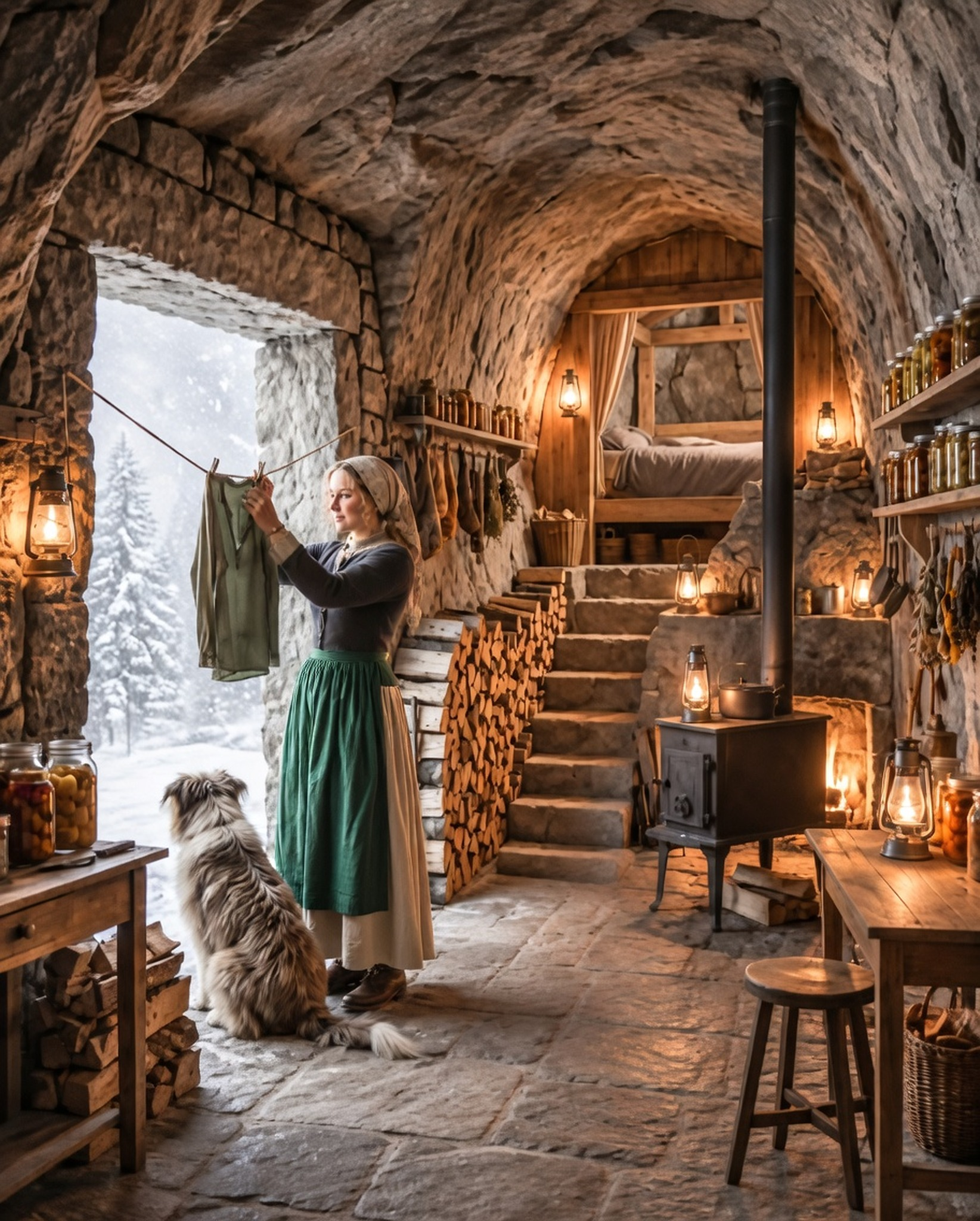
"Alana, I know you have my husband's papers."
Damon Griffin's voice came through the heavy wooden door.
I stood beside the table, holding Adrian's small leather strip in one hand and the folded note in the other.
Behind me, Grant Rhodes had gone completely still.
Samuel Price was already closing the wooden box.
Nobody spoke.
Then Damon knocked again.
"Mrs. Ellison, I would prefer not to make this unpleasant."
I looked toward the staircase.
Fiona stood halfway down, holding her youngest brother's hand. My older boy was behind them, clutching the wooden horse's empty reins as though it were a real animal.
I raised one finger to my lips.
They understood.
"Take your brothers upstairs," I whispered.
Fiona shook her head.
"Mama, I want to stay."
"Please, sweetheart."
She looked at the door.
Then she led the boys toward the sleeping alcove.
I waited until their footsteps disappeared before turning to Grant.
"How does he know about the papers?"
Grant shook his head.
"I don't know."
Samuel held the wooden box against his chest.
"He must have been watching my workshop."
"Or someone followed you here."
Neither man answered.
The knocking stopped.
For a moment, the silence was worse.
Then Damon's voice returned.
"I know Samuel Price is inside. I also know Grant Rhodes has been helping you."
Grant looked toward me.
I felt something cold settle in my stomach.
Damon knew exactly who was inside my shelter.
He knew about the box.
He knew about Adrian's papers.
And he had somehow learned that I possessed something he wanted.
I moved toward the entrance.
"Mr. Griffin, this is my home. You have no reason to enter."
A quiet laugh came from the other side.
"Your home? You should read the property documents before making such a claim."
"I have."
"Then perhaps you should read them again."
I placed my hand against the door.
"Leave."
There was a pause.
Then he spoke in a different tone.
"Your husband made an agreement with me. You are interfering with a lawful arrangement."
"Show me the original."
"I have already shown you the relevant document."
"You showed me a copy."
"That is sufficient for now."
"Not for me."
Another silence followed.
Then I heard the sound of a boot scraping against the stone entrance.
"Alana," he said quietly, "you have three children. I would think very carefully before turning this into a battle you cannot win."
I looked toward the sleeping alcove.
Three children.
That was exactly why I could not surrender.
I turned to Samuel.
"Hide the box."
He nodded and carried it toward the storage shelves.
Grant remained beside the table.
I opened the small wooden compartment beneath the workbench and placed Adrian's letter and the mysterious note inside.
Then I covered them with folded blankets.
I had barely straightened when Damon spoke again.
"One final opportunity, Mrs. Ellison."
I did not answer.
He waited.
Then his voice became colder.
"You have until tomorrow morning to reconsider."
His footsteps moved away from the door.
I heard the crunch of snow.
A carriage door opened.
Then the wheels began rolling down the hillside.
I did not move until the sound disappeared.
Grant was the first to speak.
"That man shouldn't have come here."
I turned toward him.
"He seems to believe he can."
"He's used to people stepping aside."
Samuel placed the wooden box beneath a stack of supplies.
"He knew I had the papers. Someone must have told him."
"Who?"
"I don't know."
I looked at the entrance.
The shelter felt different now.
It had always been a place of protection, a place where the cold could not reach my children.
But the danger outside was no longer simply winter.
It had learned our names.
It knew where we slept.
It knew what Adrian had hidden.
"Why does he want the papers?" I asked.
Grant leaned against the table.
"Because they may prove something he doesn't want anyone to know."
"What?"
He looked toward the floor.
"That the ridge contains something valuable."
I thought of the warmth rising from the fissure beneath the stone.
I thought of the thermometer.
Eighty-six degrees.
I thought of Adrian's measurements and the marks he had made near the northern boundary.
"Could it be the heat?" I asked.
Samuel nodded slowly.
"Your husband was investigating something underground."
"Something that could explain the warmth?"
"Possibly."
Grant rubbed his jaw.
"Natural heat can make land valuable. Especially if someone can use it."
I looked at the three of us.
For months, I had believed I was building a shelter simply to keep my children alive.
Now I wondered whether I had unknowingly built it above the very thing powerful men wanted to control.
"Did Adrian discover the source?"
Samuel shook his head.
"I don't know how far he got."
"Then why did he hide those measurements?"
"Perhaps because he was afraid."
The words settled between us.
I looked at the letter.
Adrian had never been a man who frightened easily.
He was cautious, practical, and stubborn.
If he had hidden something, he had believed there was a reason.
And if he had been afraid, then the danger had been real.
Grant and Samuel left shortly before midnight.
They promised to return the following day with more information.
I did not ask them to promise anything else.
Promises were easy to make when a person stood safely on the other side of a door.
I locked the entrance and checked the inner supports.
Then I examined the stove.
The fire was burning steadily.
I checked the ventilation openings and the small thermometer mounted near the wall.
Eighty-six degrees.
Everything inside the shelter was functioning as it should.
Yet I could not stop thinking about Damon's voice.
He had sounded confident.
Not like a man trying to purchase land.
Like a man who believed the land already belonged to him.
I climbed the stairs.
Fiona was awake.
She sat beside her brothers, watching the entrance.
"Did he leave?"
"Yes."
"Was it Mr. Griffin?"
I sat beside her.
"Yes."
She looked at me carefully.
"Why does he keep coming?"
I brushed her hair away from her forehead.
"Because he wants something that belongs to our family."
"Money?"
"Perhaps."
"Then why doesn't he just buy it?"
I looked at her.
"Because some things aren't for sale."
She thought about that.
Then she glanced toward the younger boys.
"Is he going to take us away?"
I felt my throat tighten.
"No one is taking you anywhere."
"But the men had papers."
"I know."
"Can papers make someone take children?"
I considered my answer.
"Sometimes people use papers to make others believe they have the right to do something. That doesn't always mean they're right."
Fiona looked toward the wooden horse in her youngest brother's arms.
"Papa wouldn't let them."
I lowered my eyes.
"No," I whispered. "He wouldn't."
She leaned against me.
For several minutes, neither of us spoke.
Then she asked a question that I had been avoiding since Adrian's funeral.
"Mama, did Papa know he was going to die?"
I looked at her.
The lantern light reflected in her eyes.
"Why do you ask that?"
"Because you keep finding things he left behind. The letter. The papers. The box."
I took her hands.
"I don't know, sweetheart."
"Was he trying to tell you something?"
"Yes."
"What?"
I looked toward the workbench.
"That we had to protect the ridge."
Fiona frowned.
"But why?"
"I haven't figured that out yet."
She lowered her head.
"I wish he were here."
I pulled her close.
"So do I."
The next morning, I woke before the children.
I checked the stove, prepared breakfast, and warmed water for washing.
The youngest complained that his socks were uncomfortable.
My older boy asked whether he could help Grant with the timber supports if the carpenter returned.
Fiona said little.
She watched me as I moved around the shelter.
I knew she was waiting for me to explain what had happened.
But I had no explanation that would make sense to an eleven-year-old girl.
After breakfast, I gathered the children near the table.
"I need you to listen carefully."
Fiona looked at me.
Her brothers stopped playing.
"Some people may come here again. They may tell you things that frighten you. They may say we have to leave."
The youngest tightened his grip on the wooden horse.
"Are we going somewhere?"
"No."
I knelt so that I was looking directly at them.
"Whatever happens, you stay together. Fiona, you keep your brothers close. If I ask you to go into the sleeping room, you go without arguing."
Fiona nodded.
"Where will you be?"
"Right here."
"Promise?"
I placed my hands over hers.
"I promise I will do everything in my power to keep this family together."
She looked at me for a long moment.
Then she nodded.
I turned toward the boys.
"Your job is to listen to your sister."
The older boy straightened.
"I can help protect her."
I almost smiled, but the expression never fully formed.
"You can help by staying safe."
He nodded seriously.
The youngest raised his wooden horse.
"Papa made this."
"Yes, he did."
"I'm keeping it."
"Always."
They returned to their games.
I remained beside the table.
The promise I had made was simple.
But keeping it would require more than courage.
I needed proof.
After the children settled down, I retrieved the documents.
I spread Adrian's measurements across the table.
The first drawing showed the northern slope.
The second contained several depth calculations.
The third showed a narrow underground passage marked with a small cross.
I studied it carefully.
The cross was near the place where we had discovered the fissure beneath our floor.
I brought the thermometer closer.
Its glass tube still rested near the eighty-six-degree mark.
I remembered the first day I had found the warmth.
At first, I had thought the heat came from the stove.
But the stove had been cold.
The warmth had risen through the stone itself.
I placed my palm against the floor.
There it was again.
A faint current of warm air.
I moved my hand slowly across the stone until I found the narrow crack.
The warmth was stronger near the center.
I looked at Adrian's drawing.
Then at the brass key.
Could the key open something beneath the floor?
I examined its shape.
It was small, old, and slightly bent near the teeth.
I searched through the wooden box again.
There was nothing else.
I considered asking Grant.
But he had already seen enough to understand that the ridge contained something unusual.
I did not want to involve more people until I knew what I was looking for.
I placed the key beside the drawing.
Then I noticed a small handwritten note along the bottom edge.
Three words.
Follow the warm stone.
I read them twice.
Adrian had left me instructions.
Not an explanation.
Not a complete map.
Just enough to lead me toward something.
I stared at the floor.
For the first time, I wondered whether our shelter had been built directly above an entrance my husband had discovered before his death.
By afternoon, Grant returned.
He carried a bundle of timber measurements and a small leather notebook.
Samuel came with him.
They both looked tired.
"Did something happen?" I asked.
Grant removed his coat.
"Someone visited the workshop this morning."
"Who?"
"A representative from Griffin's company."
Samuel set his notebook on the table.
"He wanted to know what Adrian had asked me to build."
"What did you tell him?"
"Nothing."
Grant looked toward the children.
I understood.
We needed to speak privately.
I led them to the far end of the shelter.
"What did the man want?"
Samuel opened his notebook.
"He asked whether Adrian had ordered any special metal fittings. He specifically mentioned a narrow brass key."
I felt my blood turn cold.
"The key?"
He nodded.
"Did you show him?"
"No."
"Did you tell him where it was?"
"No."
I looked down at the brass key on the table.
Damon had not simply come looking for the papers.
He knew about the key.
He knew Adrian had been investigating the ridge.
And he knew the object was important.
Grant leaned closer.
"Alana, I think you need to understand something."
I looked at him.
"Tell me."
"Whatever Adrian discovered, Griffin believes it is valuable enough to threaten your family over."
Samuel nodded.
"And if the county is helping him, we may not be dealing with a simple property disagreement."
I glanced toward Fiona.
She was sitting with her brothers, repairing a loose button on the youngest boy's coat.
I had promised them I would keep them together.
I could not allow men like Damon to turn our home into a battlefield.
But I also could not pretend that nothing was happening.
"Can you help me understand the drawings?" I asked.
Grant nodded.
"Yes."
"Can you help me determine whether the shelter is structurally safe?"
"Absolutely."
"And can you help me prove that Adrian never signed away the ridge?"
His expression became serious.
"That will be harder."
"Why?"
"Because proving a signature false is not the same as proving it was never signed. We need the original agreement, witnesses, and the county records."
I looked toward the door.
"Then we find them."
That evening, I took the children to the sleeping alcove.
I checked their blankets and made sure the youngest had his wooden horse beside him.
Fiona was still awake.
"Mama?"
"Yes?"
"Are we going to have enough food?"
I sat beside her.
"Yes."
"Are we going to be warm?"
I smiled faintly.
"Look at the thermometer."
She turned her head toward the wall.
Eighty-six degrees.
She nodded.
"Then we're okay."
I kissed her forehead.
"Get some sleep."
When I returned to the main room, Grant and Samuel had gone.
The wooden box was hidden beneath the storage shelves.
Adrian's papers were secure.
The stove was burning.
Everything appeared ordinary.
But I knew the truth.
Damon Griffin had not come to offer another payment.
He had come because he believed something on my land belonged to him.
And he was prepared to use the county to obtain it.
I picked up Adrian's letter.
"Keep the north ridge, whatever anyone offers."
I whispered the words to myself.
Then I unfolded the smaller note and examined the date again.
Four days after the funeral.
The physician's name.
And the number.
I turned the paper over, hoping to find another clue.
This time, I noticed something near the bottom corner.
A tiny impression.
Almost invisible.
It looked like the mark left by a seal pressed into paper.
I tilted it toward the lantern.
The impression became clearer.
A circle.
Inside it were the initials of a local medical office.
I knew the place.
It was the same office where Adrian's death certificate had been filed.
I had never questioned the physician's report because I had been too consumed by grief.
Now I wondered whether the certificate itself was part of the deception.
I placed the note beside the property documents.
Then I heard a sound from outside.
Not a carriage.
Not footsteps.
A horse.
It stopped near the entrance.
I moved toward the door and listened.
Someone dismounted.
A moment later, a small object struck the wooden entrance.
It slid beneath the lower edge.
I picked it up.
A folded envelope.
There was no return address.
Only my name.
I opened it carefully.
Inside was a single sentence written in unfamiliar handwriting:
"Your husband was alive when they buried him."
I read the words once.
Then again.
My hands began to shake.
Beneath the sentence was another line.
A location.
And a time.
Tomorrow morning.
Before I could read the final word, three hard knocks shook the entrance.
Then a familiar voice called from outside.
"Mrs. Ellison, don't believe that letter. I can explain what happened to Adrian."
It was the physician who had signed my husband's death certificate.






Comments 0