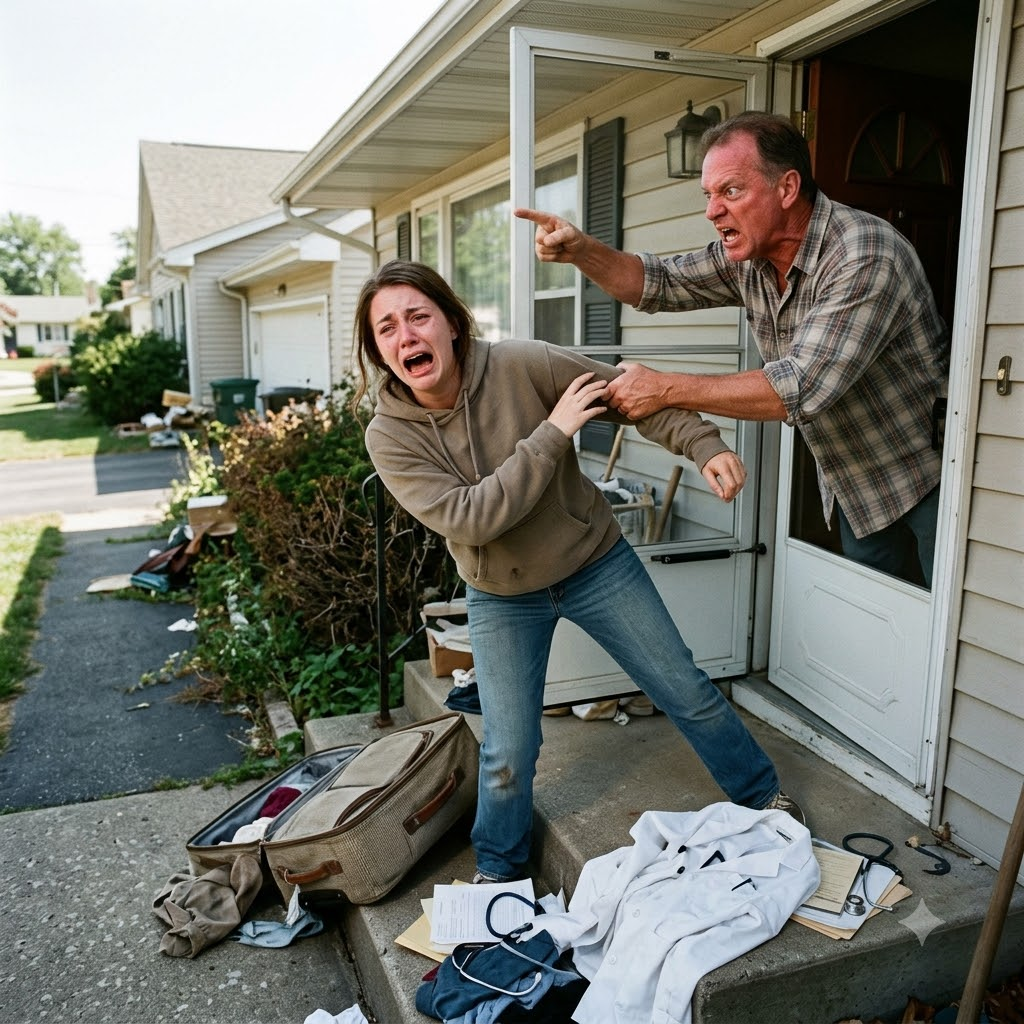
"Claire Bennett?"
My father's voice echoed through the ballroom.
I stood just beyond the backstage entrance, one hand resting against the side of my dress.
For a moment, nobody moved.
The host looked toward my father.
My mother stood beside the front table, her fingers gripping the back of her chair.
Martin Hale watched from the opposite side of the ballroom.
And hundreds of guests waited to see what would happen next.
I took one breath.
Then I walked onto the stage.
The applause began slowly.
A few people recognized me from the photograph.
Others followed their lead.
Within seconds, the entire ballroom was clapping.
I approached the host and shook his hand.
"Thank you for having me."
He smiled.
"Claire, congratulations. This is an extraordinary commitment."
"Thank you. It's an honor to support the foundation."
My father remained beside the microphone.
He looked at me as though he were seeing someone he had never met.
I turned toward him.
"Hello, Dad."
He swallowed.
"Claire."
I smiled politely.
Not because I was happy.
Not because everything was suddenly forgiven.
But because I had decided that I would not let his reaction determine how I carried myself that evening.
The host stepped forward.
"Dr. Bennett, I believe this is a wonderful opportunity for the two of you to share the stage."
My father forced a smile.
"Of course."
He moved aside.
I stood beside him.
The audience applauded again.
A photographer raised his camera.
The flashes illuminated the stage.
My father leaned toward me.
"Why didn't you tell me?"
His voice was barely audible.
I kept looking toward the audience.
"I tried."
He stiffened.
The host began speaking about Meridian Health Systems.
I listened.
He described the company's work with community clinics and the challenges that had inspired its development.
Then he introduced Maya.
She joined us onstage.
I reached for her hand.
She smiled.
The audience applauded again.
For the first time that evening, I felt completely comfortable.
This was the person who had worked beside me through every difficult year.
The person who had stayed up until sunrise fixing software problems.
The person who had believed in our idea when we had almost nothing.
We stood together.
The host continued.
"Claire and Maya have demonstrated that healthcare innovation doesn't always begin in a major hospital or research center. Sometimes it begins with two people who recognize a problem and refuse to ignore it."
I looked at Maya.
She nodded.
Then the host invited me to speak.
I approached the microphone.
"Good evening."
The room became quiet.
"Three weeks ago, I was sitting in a room with my closest friend, discussing how we could make healthcare more accessible to people who often struggle to get appointments."
A few people smiled.
I continued.
"We started Meridian because we believed that patients shouldn't have to fight an outdated administrative system before they could receive medical care."
I paused.
"Some people told us it was too ambitious. Others thought it was too small to matter."
I looked toward the audience.
"But we kept going."
Maya stood beside me.
"Over the years, we worked with clinics, administrators, physicians, and healthcare professionals who understood that better systems could make a real difference."
I glanced toward the photographs on the screen.
"Those people deserve recognition too."
The audience applauded.
I waited.
"Tonight's eight-million-dollar commitment is not about celebrating one successful company. It's about helping organizations that are already doing difficult work with limited resources."
I looked toward the representatives seated near the front.
"The clinics receiving this support understand their communities. They know which patients need help. They know where the gaps are."
My voice remained steady.
"Our responsibility is to give them the resources to do more."
The applause grew louder.
I stepped back.
The host thanked me.
Maya received a microphone next.
She spoke briefly about the early days of Meridian.
She mentioned our first clinic partner and the nights we spent building the platform.
The audience laughed when she described our first software launch.
"We learned very quickly that enthusiasm does not replace testing."
Even my father smiled.
But I noticed that his expression changed whenever someone congratulated me.
He seemed caught between pride and disbelief.
And I wondered whether he was finally seeing me as his daughter.
Or whether he was simply realizing how important I had become.
After the announcement, the ballroom returned to its usual noise.
Guests approached the stage.
Several hospital executives wanted to congratulate Maya and me.
The foundation chairperson introduced us to representatives from neighborhood clinics.
One physician told me that the grant would help his organization expand its appointment capacity.
Another explained that her clinic had been struggling to replace an outdated scheduling system.
I listened carefully.
These conversations mattered more than the photographs.
I wanted to understand exactly how the money would help.
At one point, Peter Lawson approached.
"Claire, congratulations again."
"Thank you, Peter."
He shook Maya's hand.
"Your work is impressive."
Maya smiled.
"We're fortunate to have had good people supporting us."
Peter turned toward me.
"I have to admit, I didn't realize you were the founder when we met at your parents' house."
I smiled.
"That's understandable."
He glanced toward my father.
"Richard certainly seems surprised."
I followed his gaze.
Dad was standing near the front table, speaking with two hospital executives.
His smile looked strained.
"Yes," I said.
Peter lowered his voice.
"I hope everything is all right between you."
I considered the question.
"We're working through some things."
He nodded.
"Well, congratulations on the achievement. The foundation is fortunate to have you."
Then he moved away.
Maya touched my arm.
"Are you okay?"
"Yes."
"Really?"
I looked at her.
"I think so."
She smiled.
"Good. Because Evelyn wants to introduce us to the clinic representatives."
We walked toward the other side of the ballroom.
Behind us, my father watched.
My mother approached me shortly after eight-thirty.
She looked beautiful.
Her dark green dress caught the light whenever she moved.
But her expression was different from the one she had worn when she arrived.
"Claire."
I turned.
"Hi, Mom."
She reached for my hands.
"That was wonderful."
"Thank you."
"I'm so proud of you."
I looked at her.
For a moment, I couldn't find an answer.
She squeezed my fingers.
"You were incredible up there."
I managed a small smile.
"Thank you."
She glanced toward Maya.
"May I speak with my daughter for a minute?"
Maya nodded.
"Of course. I'll be with Evelyn."
She walked away.
Mom led me toward a quieter corner near the ballroom windows.
The city lights stretched across the glass.
For a few seconds, we simply stood together.
Then she said:
"Your father is very upset."
I looked at her.
"Why?"
"He feels humiliated."
I took a breath.
"Mom, I didn't humiliate him."
"I know."
"I didn't announce the acquisition to embarrass him. I didn't mention what happened at home. I didn't even discuss the argument."
She nodded.
"But you have to understand how surprised he was."
I looked toward the ballroom.
"Was he surprised that I was successful?"
Mom didn't answer.
I continued.
"Or was he surprised that I had become successful without his permission?"
Her eyes filled slightly.
"Claire, please."
I softened my voice.
"I'm not trying to hurt you."
"I know."
She looked down at her hands.
"Your father has always wanted you to have a good life."
"I know what he wanted."
"Then why does everything have to become a disagreement?"
I turned toward her.
"Because I made a different decision, Mom. That's all."
She shook her head.
"He was afraid you were throwing away your education."
"I wasn't throwing away my future."
"I understand that now."
I studied her face.
"Do you?"
She nodded.
"Yes."
Then she said something I hadn't expected.
"When your father dragged your suitcase outside, I wanted to stop him."
I felt my chest tighten.
"Why didn't you?"
She looked away.
"I thought he would calm down."
"He didn't."
"I know."
Her voice trembled.
"I should have said something."
For the first time that evening, I saw genuine regret in her expression.
I wanted to hug her.
I wanted to tell her that everything was fine.
But everything wasn't fine.
"I needed you that day," I said quietly.
She closed her eyes.
"I know."
I waited.
Then she stepped forward and hugged me.
I let her.
It was not a complete reconciliation.
But it was the first moment in weeks when I felt that she understood what had happened.
When she released me, she wiped her eyes.
"Your father wants to speak with you."
I nodded.
"I expected that."
My father found me near the ballroom entrance.
He approached without smiling.
"Claire."
"Dad."
"Can we talk?"
I glanced toward the stage.
"All right."
He led me into a small reception room.
The door remained open.
Several people were moving through the hallway outside.
He stood near a table covered with folded programs.
I remained by the doorway.
For a moment, he looked at me without speaking.
Then he said:
"You should have warned me."
I frowned.
"About what?"
"About tonight."
I almost laughed.
"Warned you that I was the donor?"
"Yes."
"Why?"
"Because I was introducing you."
I looked at him.
"Would that have changed your speech?"
He didn't answer.
I continued.
"You were already talking about family traditions and medical education before you knew who the donor was."
His jaw tightened.
"I was trying to make the introduction meaningful."
"But you didn't know anything about the donor."
"I knew the foundation's mission."
"That's not the same thing."
He looked toward the open door.
Then back at me.
"Claire, I don't think you understand how this appears."
I folded my arms.
"How does it appear?"
"People are going to ask questions."
"About what?"
"About why I didn't know."
I stared at him.
That was the problem.
Not the fact that he had thrown me out.
Not the fact that he had dismissed my work.
Not even the fact that he had failed to recognize what I had built.
He was worried about what other people might think.
"Then tell them the truth," I said.
His expression hardened.
"And what truth is that?"
"That you didn't know about Meridian because you never took the time to understand what I was doing."
He looked away.
"That's unfair."
"Is it?"
"I was trying to guide you."
"You were trying to control my decision."
He shook his head.
"You're making this sound much worse than it was."
I looked at him.
"Three weeks ago, you told me to get out and never come back."
He went silent.
I continued.
"You said people who quit didn't belong in your house."
"I was angry."
"You took my future and reduced it to a medical degree."
"That's not what I meant."
"Then what did you mean?"
He stared at me.
For a moment, I thought he might finally answer honestly.
Instead, he said:
"I think we should put this behind us."
I felt a strange sadness.
He still wanted the consequences to disappear before he had acknowledged them.
I took a slow breath.
"Maybe someday."
He looked surprised.
"Someday?"
"Yes."
"Claire, I'm your father."
"I know."
"Family should forgive each other."
I looked at him.
"Family should also respect each other."
He didn't respond.
I stepped toward the door.
Then he said:
"Wait."
I turned.
He looked at me carefully.
"There's something I want to ask."
"What?"
"Would you consider helping the hospital with a separate funding initiative?"
I stared at him.
He continued.
"We've been discussing a new program. It could benefit from someone with your experience."
I waited.
"Your connections could be valuable."
I felt my expression change.
"Are you asking me for money?"
"No. I'm asking whether you'd consider helping."
"Why?"
"Because you have the resources and experience."
I nodded slowly.
"Send me the proposal."
He looked relieved.
"Really?"
"I'll review it."
He smiled.
For a moment, he seemed to believe that things were returning to normal.
But I added:
"And I'll make the decision based on the project's merits, not because you're my father."
His smile disappeared.
"Of course."
I left the room.
The rest of the evening passed quickly.
The foundation announced the initial list of participating clinics.
Maya and I met several physicians.
Evelyn introduced us to a group of healthcare administrators who wanted to discuss future collaborations.
Martin joined us near the reception area.
He held a glass of sparkling water.
"Quite an evening."
I smiled.
"Thank you for everything."
He nodded.
"You handled yourself beautifully."
Maya laughed.
"She always does when she isn't being interrupted."
I smiled.
Martin looked toward my father.
"How is Richard?"
I followed his gaze.
Dad was speaking with a group of guests.
"He seems busy."
Martin nodded.
"I imagine he has a lot to think about."
I looked at him.
"Do you think he understands what happened?"
Martin considered the question.
"I think he understands that you are successful."
I waited.
"But understanding why you left medical school, why you built Meridian, and why you needed him to listen may take longer."
I looked down.
"That's what worries me."
Martin touched my shoulder.
"Don't rush him. But don't let his timeline become yours."
I nodded.
At nine-thirty, the host announced that the formal program had concluded.
Guests began moving toward the reception area.
I was speaking with a clinic director when I noticed my father approaching the stage.
He had a microphone in his hand.
I frowned.
The host appeared beside him.
They exchanged a few words.
Then Dad stepped forward.
The room gradually became quiet.
"May I have everyone's attention for a moment?"
Several guests turned.
I looked at Maya.
She looked equally confused.
Dad smiled toward the audience.
"I would like to say something before we conclude this evening."
He glanced toward me.
"Tonight has been a remarkable occasion for our family."
My stomach tightened.
He continued.
"As many of you now know, my daughter Claire has achieved extraordinary success in healthcare technology."
The audience applauded politely.
I remained still.
Dad raised his hand.
"I have always believed that children should have the freedom to pursue their dreams while remembering the values that shaped them."
I looked at Maya.
She whispered, "What is he doing?"
I shook my head.
Dad continued.
"Claire's achievement is a wonderful reflection of the importance of family, education, and perseverance."
My jaw tightened.
He was doing it again.
Taking my work and placing it inside his own narrative.
He looked toward me.
"Claire, would you come up here for a moment?"
The audience began applauding.
I didn't move immediately.
Maya touched my arm.
"You don't have to."
I knew.
But I also knew that walking away would become another story my father could tell.
So I approached the stage.
He smiled broadly.
Then he put one arm around my shoulder.
The cameras flashed.
"Thank you, Dad," I said quietly.
He leaned toward the microphone.
"Tonight, I think we can all agree that the Bennett family has much to celebrate."
The audience applauded.
Then he added:
"And I hope this is only the beginning of many opportunities for us to work together."
I looked at him.
He was already smiling toward the photographers.
I gently stepped out from under his arm.
Then I took the microphone.
"Thank you, everyone."
The applause faded.
I looked toward the audience.
"I want to clarify one thing."
My father turned toward me.
"The eight-million-dollar grant is a commitment to the foundation and the participating clinics. It isn't a family project or a personal business arrangement."
The room became quiet.
I continued.
"Maya and I built Meridian independently, and the foundation's work will remain independent as well. Every funding decision will be based on the needs of the clinics and the patients they serve."
A few people nodded.
I looked toward the foundation chairperson.
"That's the reason we're here."
Then I handed the microphone back to the host.
The audience applauded.
My father stood beside me.
His smile had become rigid.
When the guests began leaving, Martin approached me.
"Claire, may I speak with you for a moment?"
"Of course."
He glanced toward my father.
Then he lowered his voice.
"I received a call from someone at the foundation earlier."
"Who?"
"Evelyn."
"What did she want?"
"She asked whether I had seen the original correspondence regarding the donor introduction."
I frowned.
"What original correspondence?"
Martin opened his leather folder.
He removed a printed email.
"I think you should read this."
I took the page.
The date was two months earlier.
The sender was my father.
The recipient was a foundation executive.
I read the first paragraph.
Then the second.
My father had requested an opportunity to introduce the anonymous donor.
That wasn't surprising.
But the final paragraph made my hands go cold.
He had suggested that the foundation present him as a representative of the Bennett family's longstanding medical legacy.
I looked up.
"Why is that a problem?"
Martin pointed toward the bottom of the page.
"Look at the attachment."
There was a second document.
A proposed speech outline.
My father had prepared it before the donor's identity was known.
I scanned the first few lines.
Then I reached the final section.
It contained a sentence about his daughter.
A daughter who had supposedly abandoned medical school but was now returning to support the family tradition through philanthropy.
I stared at the page.
My father had written that before he knew I was the donor.
Before he knew I had made the eight-million-dollar commitment.
Before he knew I was worth fifty million dollars.
I looked toward him.
He was standing across the ballroom, speaking with two hospital executives.
Then my phone vibrated.
A message from Evelyn appeared.
EVELYN: Claire, please don't leave the hotel yet. We just discovered an additional document attached to Dr. Bennett's original proposal. It contains a request that could affect the foundation's donor agreement.
I read the message twice.
Martin looked at my face.
"What happened?"
I slowly turned the phone toward him.
He read it.
Then he looked across the ballroom.
My father had just finished speaking to the executives.
He was walking directly toward us.
And in his hand was a document bearing my signature.






Comments 0