"Claire, the application was approved using a document from your medical school."
Laura's words were still echoing in my mind when I arrived at her office the following morning.
I had barely slept.
For hours, I had stared at the ceiling of my penthouse, trying to understand how my father could have gone so far without telling me.
A credit facility of $1.2 million.
An account connected to my name.
A company registered under his ownership.
And somehow, my medical school withdrawal record had been used to support the application.
I sat across from Laura.
Maya was beside me.
"Have you received the complete file?" I asked.
Laura opened her laptop.
"Yes. We received it late yesterday afternoon."
She turned the screen toward me.
The application contained my personal information, my former university details, and a declaration describing my educational expenses.
But something was wrong.
The document stated that I had requested financial assistance to cover outstanding tuition and living expenses.
I had never requested such assistance.
In fact, I had paid my tuition independently.
I looked at Laura.
"Who submitted this?"
"The initial application came through a financial consulting company associated with your father's business."
"And the withdrawal record?"
"It was attached as supporting documentation."
I stared at the screen.
My father's company had received $1.2 million through a credit facility associated with my identity.
"Was the money transferred to him?"
Laura nodded.
"The receiving account belongs to Bennett Healthcare Consulting."
I leaned back.
For several seconds, I couldn't speak.
Maya finally asked the question I had been avoiding.
"Did your father use Claire's name to borrow the money?"
Laura answered carefully.
"The records suggest that the application was made using Claire's information without her authorization. We are requesting a formal investigation and have advised the financial institution that she disputes the application."
I looked at the document again.
There was a section marked GUARANTOR.
My father's name appeared beneath it.
Then I noticed something else.
The application had been approved only after the financial institution received additional documentation.
I pointed toward the attachment.
"What's this?"
Laura opened it.
It was a letter from my medical school.
The letter confirmed that I had withdrawn from the program.
But beneath that confirmation was a statement claiming that my withdrawal had created a financial obligation requiring immediate settlement.
I frowned.
"That's not true."
Laura nodded.
"We have contacted the university. They confirmed that the letter was altered."
I looked at Maya.
She shook her head in disbelief.
My father hadn't simply used my name.
Someone had changed an official document to make the application appear legitimate.
Laura closed the file.
"Claire, this is no longer simply a family disagreement. We need to let the appropriate investigators examine the evidence."
I nodded.
"Do whatever is necessary."
The first person I called was the registrar at my former medical school.
Her name was Susan Miller.
She remembered me immediately.
"Claire Bennett. It's been a while."
"Hello, Susan. I need your help with something."
I explained the situation.
She listened carefully.
Then she said something that made me sit upright.
"Our records show that you withdrew voluntarily. There was no outstanding tuition balance."
"None?"
"None. Your account was settled."
I closed my eyes.
"Did the university ever issue a letter claiming I owed money?"
"No."
"Did anyone request a financial verification document?"
She paused.
"Let me check."
I waited.
Several minutes later, she returned.
"There was an inquiry from an outside representative about your educational status."
"Who?"
"The request came from an individual who identified himself as a family representative."
My hands tightened.
"Did he have permission to represent me?"
"According to the paperwork we received, he claimed that he did."
I looked at Laura.
She was taking notes.
"Can you send us a copy of the request?"
"We'll need to follow our privacy procedures, but I can refer this to our compliance department."
"Please do."
Susan hesitated.
"Claire, may I ask something?"
"Of course."
"Are you all right?"
The question caught me off guard.
For a moment, I couldn't answer.
Then I said:
"I'm getting there."
She spoke gently.
"You were always a hardworking student. I hope everything works out."
"Thank you."
After the call, I sat quietly.
My father had used the one thing he had always demanded from me—my medical education—as part of a financial arrangement I had never approved.
The irony was almost unbearable.
Two days later, Laura arranged a meeting with the financial institution.
Representatives from its compliance department attended.
My father was not present.
The institution confirmed that it had received the disputed application through Bennett Healthcare Consulting.
It also confirmed that the loan proceeds had been transferred into the company's account.
The account records showed that the money had been used for several purposes.
A business debt repayment.
An office lease.
Two outstanding vendor invoices.
And a substantial transfer to another account associated with Richard Bennett.
The institution agreed to suspend collection activity against me while the disputed identity documentation was investigated.
Laura explained that I would not accept responsibility for the debt.
I signed the necessary dispute notices.
Then I asked the question that had been bothering me.
"Can my father claim that I authorized the application?"
The compliance officer answered carefully.
"He may make that claim, but the institution will evaluate the supporting evidence, including the original application, signature records, account access history, and communications."
Laura added:
"We have already supplied authenticated examples of Claire's signature. We will also provide her statement denying authorization."
I nodded.
"Good."
For the first time, I felt that something was finally moving in the right direction.
The truth was no longer buried inside my father's office.
It was being examined by people who had no reason to protect his reputation.
My father called that evening.
I almost let it go to voicemail.
But I answered.
"Hello, Dad."
"Claire, I heard from the bank."
I remained silent.
"They're asking questions about the company account."
"I know."
"Why did you involve lawyers?"
"Because an application was submitted using my identity."
He sighed.
"You're making this sound like a criminal matter."
I looked toward the window.
"Did you borrow $1.2 million using my information?"
He didn't answer.
"Did you use my medical school withdrawal record?"
"Claire, the money was for business purposes."
"That isn't what I asked."
He became irritated.
"Your name was included because you were connected to the healthcare project."
"I never worked for Bennett Healthcare Consulting."
"You could have."
I closed my eyes.
"Could have?"
"Your medical background would have been useful."
I almost laughed.
I had never worked for his company.
I had never agreed to become involved.
And I had certainly never agreed to guarantee its debts.
"Dad, did you know the university letter had been altered?"
Silence.
Then he said:
"I didn't prepare that letter."
"Did you know it was altered?"
"I trusted the people handling the paperwork."
I took a slow breath.
"That's not an answer."
He raised his voice.
"Claire, I was trying to keep the business alive. There were obligations. Employees. People depending on me."
I listened.
For the first time, I understood that there might have been genuine financial pressure behind his decisions.
But pressure didn't excuse what he had done.
"You should have asked for help."
He laughed bitterly.
"From you?"
"Yes."
"You would have refused."
I looked down.
"Maybe. But at least it would have been my decision."
He became quiet.
Then he said:
"I thought you would eventually understand."
I felt tears gathering in my eyes.
"That's what you keep saying."
"Because it's true."
"No, Dad. You keep confusing your intentions with my permission."
He didn't respond.
I continued.
"You wanted me to become a doctor. You wanted me to follow your idea of success. When I built something different, you dismissed it. When I became financially independent, you tried to involve yourself in my business. And when I refused to follow your plan, you threw me out."
My voice trembled slightly.
"But you never once asked what I wanted."
He remained silent.
Then I said:
"I hope you understand that this is not about the money anymore."
I ended the call.
The investigation took several weeks.
Thomas provided the original emails.
The foundation preserved the disputed agreement.
The medical school supplied its authentic withdrawal records.
The financial institution provided the application history and transfer records.
My lawyers submitted a formal report regarding the suspected misuse of my identity.
My father eventually hired his own attorney.
Through the legal process, he acknowledged that he had authorized the preparation of documents containing my personal information.
He also acknowledged that he had submitted the foundation proposal without obtaining my written approval.
He claimed that he had believed I would agree.
But the records showed that he had repeatedly been told not to represent my interests without direct authorization.
The investigation also established that the university letter had been altered during the preparation of the financial application.
My father's company was required to address the outstanding loan independently.
The financial institution removed me from responsibility for the disputed debt after completing its review of the application.
I never had to repay the $1.2 million.
The foundation formally rejected the proposed advisory agreement.
The original eight-million-dollar grant remained intact.
And my father's attempt to obtain an official role within the program ended.
There were consequences.
His professional reputation suffered.
Several organizations suspended their relationships with his consulting company while the investigation continued.
He eventually agreed to cooperate with the relevant authorities and resolve the outstanding financial matters through his legal representatives.
I didn't celebrate any of it.
I hadn't wanted my father to lose his business.
I had wanted him to respect my independence.
Those were two very different things.
Three months after the gala, I received a letter from my father.
It arrived in a plain white envelope.
No company logo.
No legal letterhead.
Just my name.
I left it on the kitchen counter for several hours before opening it.
The first page was handwritten.
Claire,
I have spent a long time thinking about everything that happened.
I sat down.
For most of your life, I believed that being a good father meant preparing you for a future I understood. I believed that medicine would give you security, respect, and a meaningful career.
I continued reading.
When you started Meridian, I dismissed it because I didn't understand it. Instead of asking questions, I assumed you were making a mistake.
My throat tightened.
When you left medical school, I felt that I had failed to guide you. I became angry, and I allowed that anger to control my decisions.
I paused.
Then I reached the next paragraph.
I told myself that I was protecting the family. I told myself that the financial documents were temporary arrangements and that you would eventually agree.
I looked down.
But I never asked you.
The next lines were shorter.
I used your name without permission. I allowed your mother to become involved in paperwork she did not fully understand. I put my professional ambitions ahead of your right to make your own decisions.
My eyes filled.
Then came the sentence I had wanted to hear since I was a little girl.
I am sorry.
I read it several times.
The letter continued.
I cannot ask you to forgive me simply because I am your father. I cannot expect everything to return to the way it was. I know that trust must be earned.
At the bottom, he had written:
I am proud of what you built, Claire. Not because of the money. Because you believed in something, worked for it, and made it real.
I folded the letter.
For a long time, I sat without moving.
It wasn't a perfect apology.
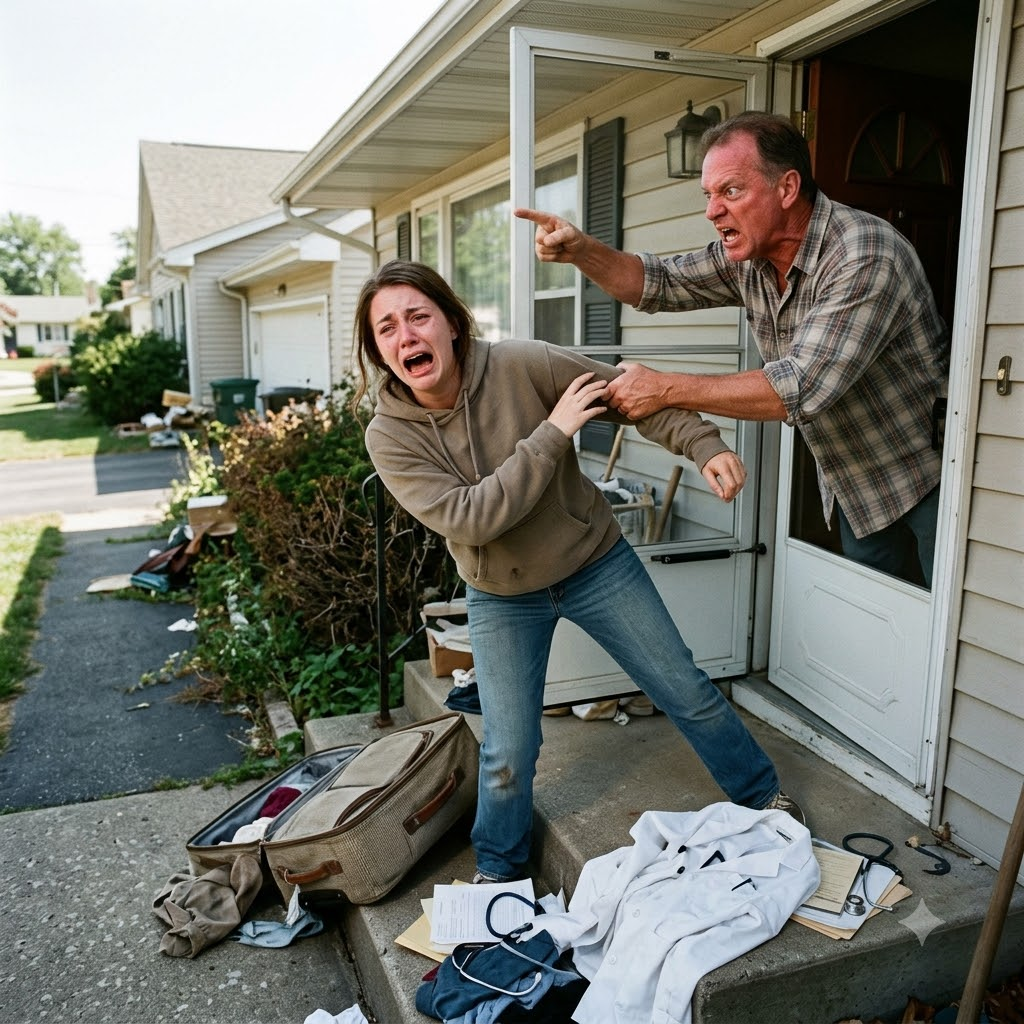
It didn't erase the porch.
It didn't erase the documents.
It didn't erase the nights I had waited for a phone call that never came.
But it was the first time my father had acknowledged what he had done without blaming me.
And that mattered.
My mother called the next day.
"Did you receive his letter?"
"Yes."
"What did you think?"
I looked toward the kitchen.
"He apologized."
She exhaled.
"I know."
We remained quiet.
Then she said:
"Claire, I owe you an apology too."
I sat down.
"I should never have submitted that document. I trusted your father when I should have asked you directly."
I listened.
"I was afraid of disagreeing with him. I thought keeping the peace was the same as keeping the family together."
Her voice broke.
"It wasn't."
I closed my eyes.
"No, Mom."
"I am sorry I didn't stand beside you when he threw you out."
That was the apology I had needed.
Not an explanation.
Not a defense.
Just an acknowledgment.
I began crying.
So did she.
We talked for nearly an hour.
We didn't resolve everything.
But we agreed to meet for lunch the following weekend.
Without Dad.
Without business discussions.
Without expectations.
Just the two of us.
The following six months changed my life in ways I hadn't anticipated.
The foundation began distributing the eight-million-dollar grant.
Twelve neighborhood clinics received funding for technology upgrades, staff training, and patient scheduling improvements.
Maya and I established an independent initiative to help smaller healthcare facilities access affordable software.
We called it the Meridian Community Access Project.
The goal was simple.
No clinic should have to choose between serving patients and managing an outdated administrative system.
We hired a small team.
We partnered with local healthcare organizations.
We also created a program offering free implementation support to clinics serving low-income communities.
I visited the first participating clinic in person.
The director, Dr. Angela Morris, greeted us at the entrance.
"Claire, we're grateful you're here."
I smiled.
"Thank you for having us."
She walked us through the building.
The waiting room was busy.
Several patients were checking in.
A receptionist showed us the new scheduling system.
Appointments were being confirmed automatically.
Cancellations were filled more quickly.
The staff no longer had to spend hours calling patients manually.
Dr. Morris looked at me.
"This has made an enormous difference."
I watched an elderly woman receive her appointment confirmation.
She smiled at the receptionist.
Something inside me settled.
This was why I had started the company.
Not for a headline.
Not for a valuation.
Not for a penthouse.
For moments like this.
Maya stood beside me.
"Remember our first clinic?"
I laughed.
"The one where the printer caught fire?"
She burst out laughing.
"That was your fault."
"It was not."
"It absolutely was."
We walked through the clinic together.
And for the first time in a long while, I felt completely at peace with the direction my life had taken.
My relationship with my mother slowly improved.
We began meeting every Sunday.
Sometimes we had lunch.
Sometimes we walked along the lake.
Sometimes we simply sat in my apartment and talked.
She never asked about my money.
She started asking about my work.
She wanted to know what the clinics needed.
She asked how Maya was doing.
She even learned the names of several employees.
One afternoon, she brought an old photograph.
It showed me at twelve years old, standing beside my father at a school science fair.
I was holding a small homemade computer project.
My father was smiling.
I looked at the photograph.
"I remember this."
"He kept it," Mom said.
I turned it over.
On the back, someone had written:
Claire's first invention.
I smiled sadly.
"Maybe he understood more than I thought."
Mom looked at me.
"Maybe he did. But understanding something and supporting it are not always the same."
I nodded.
She placed the photograph in my hands.
"Keep it."
I did.
My father and I met for the first time after the investigation had been resolved at a small restaurant downtown.
He arrived early.
He stood when I entered.
"Claire."
"Hi, Dad."
We shook hands.
The gesture felt strange.
But neither of us commented on it.
We ordered coffee.
For several minutes, we discussed ordinary things.
The weather.
The city.
My mother's health.
Then he looked at me.
"I've been thinking about your company."
I smiled faintly.
"It's doing well."
"I read about the community project."
"Yes."
He nodded.
"It's good work."
"Thank you."
He looked down at his cup.
"I wish I had understood it earlier."
I didn't rush to comfort him.
He continued.
"I used to believe that if you didn't become a doctor, you were wasting your potential."
I listened.
"But I see now that I was measuring your potential using the wrong standard."
I looked at him.
"What standard should you have used?"
He considered the question.
"Whether you were doing something meaningful. Whether you were happy. Whether you were becoming the person you wanted to be."
I felt something loosen inside me.
"That's a good place to start."
He nodded.
Then he said:
"I don't expect you to forget what happened."
"Good."
He looked surprised.
I smiled gently.
"I don't want us to pretend it never happened. I want us to build something better."
He nodded slowly.
"I'd like that."
We finished our coffee.
Before leaving, he asked whether I would consider having dinner with him and Mom the following week.
I agreed.
Not because everything was repaired.
But because I could finally see that he was willing to begin repairing it.
One year after the night I had been introduced at the gala, I returned to the same ballroom.
This time, I wasn't the anonymous donor waiting backstage.
I was there to announce the next phase of the community healthcare initiative.
Maya stood beside me.
The foundation chairperson greeted us.
Several clinic directors had returned.
The program had expanded beyond the original twelve clinics.
Our technology was now helping more facilities coordinate appointments and reduce administrative delays.
The new initiative included another substantial funding commitment, supported by a group of independent donors and healthcare partners.
I stepped onto the stage.
The applause filled the room.
I looked toward the front row.
My mother was there.
Beside her sat my father.
He stood when I approached the microphone.
He didn't try to join me onstage.
He didn't ask for recognition.
He simply smiled.
I began speaking.
"Last year, I stood in this room believing that the most important part of my story was what I had built."
I paused.
"But I've learned that success isn't measured only by what we create. It's also measured by what we make possible for other people."
The screen behind me showed photographs of the clinics.
Patients.
Doctors.
Nurses.
Receptionists.
Families.
I continued.
"Healthcare should be accessible. Technology should make people's lives easier. And every patient deserves to be treated with dignity."
The audience applauded.
I looked toward Maya.
She smiled.
Then I finished.
"Thank you to everyone who believed that a better system was possible."
When I stepped away from the microphone, the applause grew louder.
My mother wiped her eyes.
My father stood quietly.
And I realized that I no longer needed his approval to feel proud of myself.
After the event, my father approached me.
"Claire."
I turned.
"Yes?"
He held out a small box.
"Your mother thought you might like this."
I opened it.
Inside was the old silver medical school pin I had received during my first year.
I stared at it.
"I thought you had lost this."
He shook his head.
"Your mother kept it."
I looked at her.
She smiled.
My father continued.
"I know you chose a different path. I understand that now. But I thought you might want to keep it as a reminder of where you began."
I held the pin carefully.
"Thank you."
He nodded.
Then he said:
"I'm proud of you, Claire."
This time, the words didn't hurt.
They didn't feel like something I had to earn by becoming the daughter he wanted.
They were simply words.
I smiled.
"I'm proud of myself too."
My father nodded.
And for once, he didn't argue.
Later that evening, I returned to my penthouse.
The city lights stretched across the windows.
Lake Michigan reflected the glow of the buildings.
I placed the silver medical school pin beside the old photograph of my childhood science project.
Then I opened my laptop.
There was a message from Maya.
MAYA: Tomorrow, ten o'clock. New clinic partnership meeting. Don't be late.
I laughed.
ME: I'll be there.
Another message appeared.
MAYA: Proud of you, partner.
I smiled.
Then I walked toward the window.
A year earlier, I had stood in my parents' house believing that losing their approval meant losing my home.
I had been wrong.
Home wasn't the place where someone allowed me to stay only if I followed their expectations.
Home was the life I had built through my own decisions.
It was the people who respected my choices.
It was the work that gave me purpose.
And it was the freedom to become someone my parents had never imagined.
I had not become a doctor.
I had not followed the future my father had designed.
But I had helped thousands of people access healthcare more easily.
I had built a company with my best friend.
I had supported clinics that needed help.
I had found a way to forgive without pretending the past never happened.
My father and I were rebuilding our relationship slowly.
My mother and I were closer than we had been in years.
And I had finally learned that forgiveness did not mean surrendering my boundaries.
I turned off the lights.
Then I looked once more at the city.
For the first time in my life, I wasn't waiting for anyone to tell me I had made the right choice.
I already knew.
I had chosen my own future.
And it was a future I loved.






Comments 0