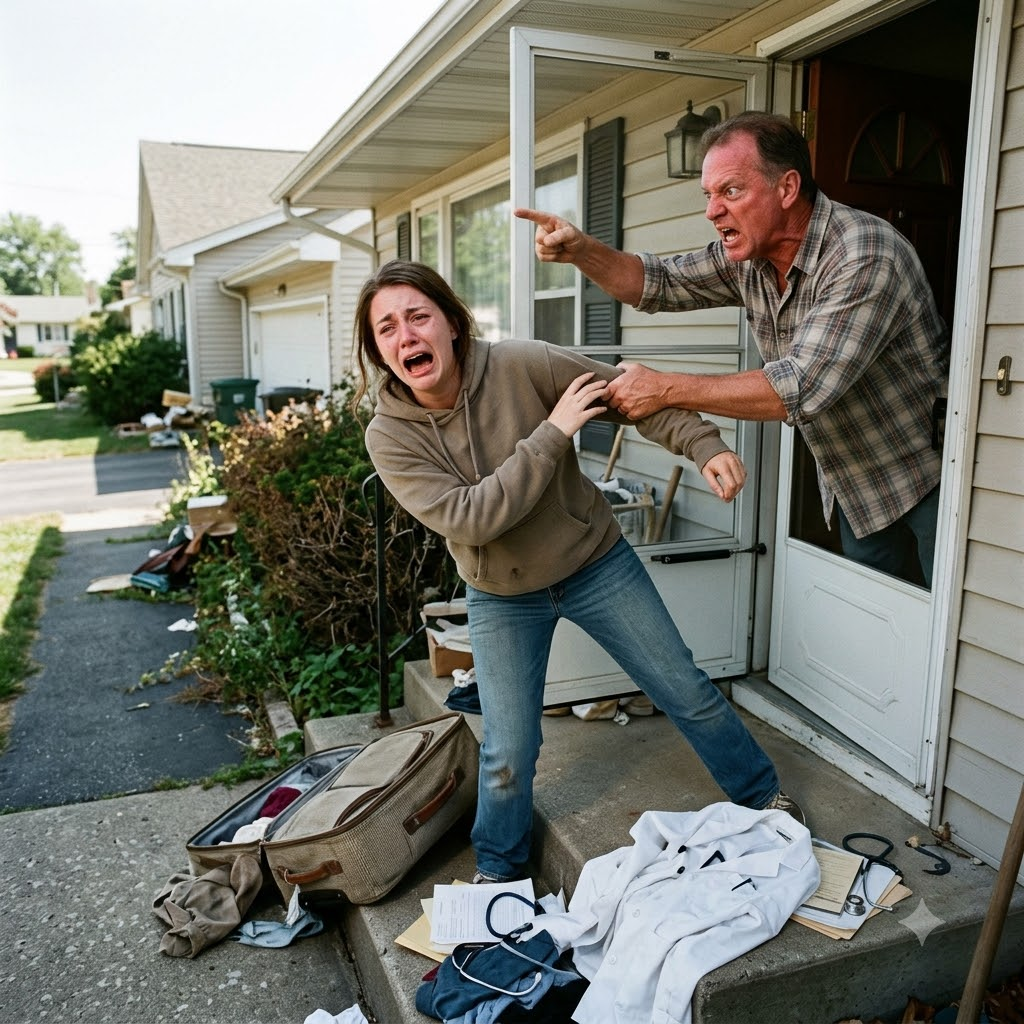
I was dragging my suitcase toward the front steps when my father grabbed my arm.
"GET OUT OF THIS HOUSE AND NEVER COME BACK!"
My mother stood behind him, holding my house key.
On the porch lay my beige suitcase, a folded sweater, and several papers that had fallen from my bag.
My father, Richard Bennett, had one hand pointed toward the sidewalk.
But there was something he didn't know.
The daughter he was throwing away had just become worth more than fifty million dollars.
Three weeks earlier, I had signed the final documents that changed my life.
He would learn about that later.
That afternoon, however, I was still standing outside the only home I had known for most of my life, listening to my father explain why I no longer deserved to live there.
And somehow, the worst part wasn't his shouting.
It was that my mother didn't ask him to stop.
"Claire, say something!" Dad demanded.
I looked at him.
Then I looked at the suitcase.
"I'm leaving," I said.
He seemed almost disappointed by how quietly I answered.
He had expected an argument. Perhaps tears. Maybe an apology.
He wanted me to beg.
Instead, I bent down and picked up my sweater.
That was when I realized my life had already changed, even if neither of my parents understood it yet.
The argument had started less than twenty minutes earlier.
I had arrived home carrying a folder from my medical school and a small paper bag containing dinner.
It was supposed to be an ordinary family evening.
My mother had asked me to come over because she wanted to discuss the holidays. Dad had mentioned that he wanted to talk about my academic progress.
I had spent the entire drive rehearsing what I would say.
I was twenty-eight years old.
I had been enrolled in medical school for several years, but the truth was that my heart had gradually moved in another direction.
I still believed in medicine.
I still believed that patients deserved better healthcare.
What I no longer believed was that becoming a traditional physician was the only way I could make a meaningful difference.
For six years, I had been building something else.
Something my parents had never taken seriously.
But before I could explain it, I needed to tell them that I was withdrawing from medical school.
I placed my folder on the dining table.
Dad was sitting in his usual chair.
He had already removed his reading glasses and was looking at me with the expression he used whenever he believed I was about to disappoint him.
Mom was arranging plates in the kitchen.
"How was your week?" she asked.
"Busy."
"Your father says you haven't been attending some of the optional clinical sessions."
I took a breath.
"That's actually what I wanted to talk about."
Dad leaned back.
"Good. Because we need to discuss your future."
I opened the folder.
"I'm withdrawing from medical school."
The silence lasted perhaps two seconds.
Then Dad stood.
"What?"
"I'm withdrawing. I've made my decision."
He stared at me as though I had just announced that I was leaving the country.
"You're quitting?"
"Yes."
"After everything?"
I nodded.
Mom stopped moving in the kitchen.
"Claire, don't joke about something like this."
"I'm not joking."
Dad pushed his chair backward.
"You have spent years working toward this. Do you understand what you're throwing away?"
"I understand."
"No, you don't!"
His voice rose.
"Do you have any idea how many people would do anything to have your opportunity?"
I looked at the folder.
"I've thought about it for a long time."
"Then you've thought about it incorrectly."
He began pacing beside the table.
My father had always believed that life was a sequence of achievements. Good grades, prestigious universities, respectable careers, impressive titles.
In his mind, a person's worth could be measured by what they put after their name.
He was especially proud of being known as Dr. Richard Bennett.
Although he had spent years moving into hospital administration, he still introduced himself with the title whenever he attended a professional event.
He had built his identity around medicine.
And he had expected me to continue it.
"You're going to throw away your future because you're tired?" he asked.
"I'm not tired."
"Then what is it?"
"I want to work on something different."
He laughed.
Not because he found anything funny.
It was the kind of laugh people use when they refuse to take someone seriously.
"Something different? What does that even mean?"
I hesitated.
I could have told him everything.
I could have explained the company, the acquisition, the contracts, and the work my business partner and I had spent six years building.
But I knew what would happen.
He would interrupt.
He would question every detail.
He would tell me that technology was unstable and that medicine was a respectable profession.
He would reduce six years of work to another childish distraction.
So I kept my explanation simple.
"I want to focus on healthcare technology."
He shook his head.
"That little computer hobby again?"
There it was.
The phrase I had heard for years.
That little computer hobby.
Six years of long nights, difficult negotiations, missed vacations, failed prototypes, and impossible deadlines.
All reduced to a hobby.
I felt something tighten in my chest.
"It's not a hobby, Dad."
"Then what is it?"
"A business."
He waved his hand.
"You're not going to build a career playing with computers."
Mom finally came into the dining room.
"Claire, maybe you should think about this for another year."
"I've already thought about it."
"You can't just walk away from medical school."
"I can. It's my decision."
Dad slammed his palm onto the table.
"Not while you're living under my roof!"
The sound made me flinch.
He noticed.
For one brief moment, I saw satisfaction in his expression.
He believed he had finally regained control of the conversation.
"Your mother and I have spent years supporting you," he continued. "We gave you every opportunity."
I stared at him.
"I paid my tuition myself."
His expression hardened.
"That's not the point."
"It matters to me."
"You're missing the point entirely!"
He turned toward Mom.
"Do you hear this? She thinks she owes us nothing."
Mom looked uncomfortable.
But she didn't disagree.
"Doctors run in this family, Claire," she said. "You were supposed to continue something meaningful."
I wanted to ask her why the meaning of my life had to be decided before I was allowed to live it.
Instead, I said nothing.
Dad stepped closer.
"If you refuse to become a doctor, you can find somewhere else to live."
I looked at him.
He wasn't threatening me.
He had already decided.
"Are you serious?"
"Completely."
Mom walked to the dining table and picked up my house key.
It was a small silver key attached to a faded blue keychain.
She had given it to me when I moved into my first college apartment, explaining that I would always have a place to return to.
Now she held it between her fingers.
"Maybe it's better this way," she said.
I looked at her.
"Mom?"
She placed the key on the table.
"Your father and I cannot keep watching you throw your future away."
I waited for her to say something else.
For her to explain that she was angry but still loved me.
For her to remind Dad that I was their daughter.
Nothing came.
Then Dad walked toward the hallway.
I heard the closet door open.
A moment later, he returned carrying my beige suitcase.
It was the same suitcase I had used during my last medical conference.
He dropped it onto the porch.
"Get your things."
I followed him outside.
The afternoon sunlight fell across the concrete steps.
My suitcase had landed on its side.
One of the front pockets was open, and a few documents had slipped out.
Dad stood in the doorway.
"People who quit don't belong in this house."
I looked at the papers.
Then I looked at him.
I could have told him that the company he dismissed had just been acquired by a national healthcare corporation.
I could have told him that the final transaction had closed three weeks earlier.
I could have told him that my personal share, after taxes and closing expenses, was worth just over fifty million dollars.
I could have told him that I owned a penthouse overlooking Lake Michigan.
That I had lawyers, financial advisers, and an entirely different future waiting for me.
But something stopped me.
For years, I had wanted my father to be proud of me.
I had wanted him to ask about my projects.
I had wanted him to understand that helping people didn't require wearing a white coat.
If I told him about the money now, would he suddenly understand?
Would he apologize because I was his daughter?
Or would he apologize because I was wealthy?
I didn't want to spend the rest of my life wondering which answer was true.
So I picked up my suitcase.
"Then this isn't my home," I said.
Dad stared at me.
For a moment, he seemed unable to process the fact that I wasn't going to argue.
I stepped down onto the walkway.
Mom remained inside the doorway.
"Claire," she called.
I turned.
She looked at me, then at Dad.
"At least call us when you've found somewhere to stay."
I almost laughed.
Somewhere to stay.
If only she knew.
"I'll be fine, Mom."
Dad shook his head.
"Don't come back expecting us to rescue you."
I nodded once.
Then I walked toward the street.
I didn't look back.
I reached my car and placed the suitcase in the trunk.
My hands were shaking.
Not because I was afraid of being homeless.
Not because I didn't know how I would pay my bills.
I was shaking because I had just discovered something painful.
I had spent years preparing to become the daughter my parents wanted.
I had worked through exhaustion.
I had sacrificed friendships.
I had rearranged my entire life around a future that belonged more to them than to me.
And when I finally chose something different, they had thrown me out.
I sat behind the steering wheel.
For several minutes, I didn't start the engine.
My phone vibrated.
It was a message from Maya.
Maya was my co-founder, my closest friend, and the person who had believed in our company long before anyone else considered it a serious business.
MAYA: How did the conversation go?
I stared at the screen.
Then I typed:
ME: They told me to leave.
Her reply came almost immediately.
MAYA: Claire, are you serious?
ME: Yes.
MAYA: Are you okay? Where are you?
I looked through the windshield.
My parents' front door was still open.
Dad had stepped back inside.
Mom was standing behind him.
Neither of them came outside.
ME: I'm okay. I'm going to the penthouse.
Maya called immediately.
I answered.
"Tell me what happened," she said.
I tried to speak.
Nothing came out.
Then, for the first time that afternoon, I cried.
Not loudly.
Not dramatically.
I simply covered my face with one hand and let the tears fall.
Maya didn't interrupt.
She waited.
When I finally explained everything, she was quiet for a moment.
Then she said something I would remember for the rest of my life.
"Claire, you don't have to earn the right to be loved by people who already know you."
I closed my eyes.
"I know."
"And you don't have to tell them about the acquisition."
"I know."
"Then go home."
I looked at the road.
For the first time, the word home felt complicated.
"Okay," I whispered.
I ended the call and started the engine.
The drive downtown took less than forty minutes.
During that time, I received no messages from my mother.
No apology from my father.
No question about whether I had somewhere to sleep.
At one point, I opened my contacts and considered calling them.
I imagined Dad answering.
I imagined him asking whether I had reconsidered medical school.
I imagined myself telling him that I had made more money from the company than he would earn in several lifetimes.
But I didn't call.
I had no desire to turn my pain into a financial negotiation.
By the time I reached downtown Chicago, the sun was beginning to lower behind the buildings.
My penthouse was on the thirty-eighth floor of a modern residential tower overlooking Lake Michigan.
I had purchased it before the acquisition was announced.
The purchase had been made possible through an earlier share sale and years of careful financial planning.
I had planned to tell my parents after the holidays.
I had imagined inviting them over.
I had imagined Mom admiring the kitchen and Dad standing beside the windows, looking at the city.
I had even imagined him asking how I had managed to buy such a place.
I had rehearsed the conversation many times.
Now the thought made my chest hurt.
The building's concierge greeted me when I entered.
"Good evening, Ms. Bennett."
"Good evening."
He looked at my suitcase.
"Would you like someone to help you with that?"
"No, thank you. I've got it."
I entered the elevator.
The doors closed.
For the first time that day, there was no one shouting at me.
No one demanding an explanation.
No one telling me what I was allowed to become.
Just silence.
When the elevator opened, I walked into my apartment.
Floor-to-ceiling windows overlooked the lake.
The kitchen was still immaculate.
A few unopened boxes remained beside the living room wall.
The apartment smelled faintly of fresh paint and cedar.
I set my suitcase down.
Then I stood in the middle of the living room.
I had everything I needed.
Money.
Security.
A successful business.
A beautiful home.
And more freedom than I had ever imagined.
But I still felt like the little girl who had brought home a report card and waited for her father to say he was proud.
I walked toward the windows.
Lake Michigan stretched into the distance.
The city lights began to appear.
I placed my hand against the cool glass.
Then I whispered the words I had been afraid to say for years.
"I am allowed to choose my own life."
My phone vibrated again.
This time, it was an email from our legal team.
The subject line read:
FINAL ACQUISITION DISTRIBUTION — CONFIRMED.
I opened it.
The closing statement was attached.
My name appeared beneath the final distribution figure.
$50,000,000.
I stared at the number.
It was real.
The money was real.
The company was real.
The life I had built was real.
And yet, all I could think about was the empty space beside the dining table at my parents' house.
I closed the email.
Then I put my phone on the kitchen counter.
That evening, I ordered dinner for one.
I ate beside the windows without turning on the television.
At midnight, I checked my phone again.
There were no messages from my parents.
I told myself that it didn't matter.
But I checked once more before going to bed.
Still nothing.
And then, just as I was about to turn off the light, another notification appeared.
It wasn't from my mother.
It wasn't from my father.
It was from Maya.
MAYA: Claire, I just received something from the hospital foundation. You need to see this before tomorrow morning.
A document appeared beneath her message.
I opened it.
At the top was the official invitation for the upcoming Chicago Children's and Community Health Foundation fundraising gala.
Our company had already committed to an eight-million-dollar grant for neighborhood clinics.
I had agreed to remain anonymous until the announcement.
But one name on the guest list made my stomach tighten.
Dr. Richard Bennett.
My father.






Comments 0