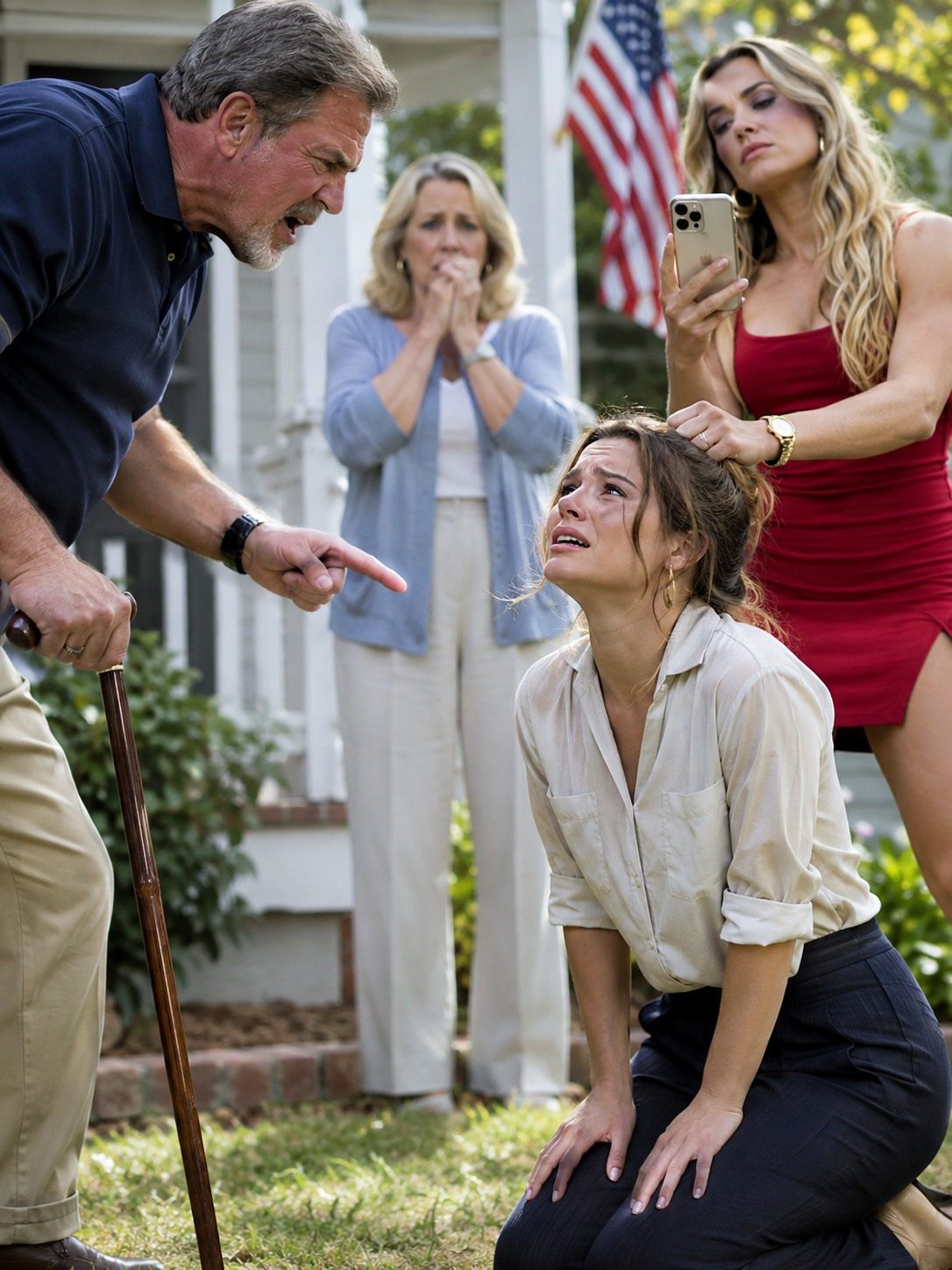
"Nobody opens that box!"
My father stood in the doorway of the bank's private viewing room.
Thomas Collins.
Twenty-one years had passed since I'd last seen him without the protection of a telephone screen or an old photograph.
His hair was almost entirely gray. His shoulders had rounded. The gold ring with the dark rectangular stone still occupied his right hand.
But I recognized his eyes.
Those cold, impatient eyes had watched me struggle for air on our living room floor.
Now they were fixed on the videotape in Melissa Grant's hands.
"Put that down," he ordered.
Nobody moved.
Margaret Shaw stood beside the open safe-deposit box.
Nora held her phone.
Melissa stepped backward.
And I looked at my father.
"Hello, Dad."
He turned toward me.
For a moment, his expression softened.
"Avery."
I waited.
He glanced around the room.
"Your mother said you were trying to take money from the family."
I stared at him.
Then I laughed.
It wasn't a happy sound.
"That's what she told you?"
His jaw tightened.
"Don't start."
I felt something old and familiar rise inside me.
The instinct to apologize.
To lower my voice.
To make myself smaller before he became angry.
But I wasn't seventeen anymore.
And this wasn't his living room.
I looked directly at him.
"The money was mine."
He shook his head.
"You don't understand how complicated those arrangements were."
"Then explain them."
He looked toward Margaret.
"You're supposed to be an attorney. You know family finances aren't that simple."
Margaret's expression remained calm.
"I know that Eleanor established an education trust for Avery. I also know that documents purporting to change its administration are now under serious scrutiny."
My father's face reddened.
"Those documents were legal."
"That remains to be determined."
He stepped toward the table.
"Give me the folder."
I moved between him and the box.
"No."
His eyes narrowed.
"Avery, move."
I didn't.
He stared at me.
Then said the words I'd heard throughout childhood.
"Don't make me tell you twice."
My heart hammered.
But my feet stayed planted.
"You don't get to order me around anymore."
For several seconds, we faced each other.
Then a bank security officer appeared behind him.
"Sir, you need to step away from the room."
My father turned.
"This is a family matter."
The officer didn't move.
"You're not authorized to enter this viewing room."
My father looked furious.
Then he noticed the document in his hand.
He lifted it.
"I have a court order."
Margaret extended her hand.
"May I see it?"
He hesitated.
Then handed it over.
She read the first page.
Her expression hardened.
"Thomas, this is a copy of a petition your wife filed seeking to restrict access to estate materials."
He folded his arms.
"Exactly."
Margaret turned the page.
"It isn't an order."
My father went still.
"The petition hasn't been granted."
He stared at her.
Margaret handed it back.
"You cannot use an unapproved request to prevent Avery from accessing property under a separate authorization."
For the first time that morning, my father had nothing to say.
The security officer asked him to leave.
He looked at me one last time.
"You have no idea what you're destroying."
I swallowed.
"Then maybe you should have thought about that before you destroyed my childhood."
His face changed.
He opened his mouth.
Then closed it.
And walked away.
The bank officer apologized for the interruption.
Melissa was shaking.
I looked at her.
"Are you okay?"
She nodded.
"Yes."
But she didn't look okay.
She looked like someone who'd spent twenty-one years waiting for a door to open.
And now that it had, she wasn't sure she could survive what stood on the other side.
Margaret closed the safe-deposit box.
"We shouldn't continue reviewing sensitive material here."
I nodded.
"What about the tape?"
Melissa looked down at the black case.
"I've kept it hidden for years."
I stared at her.
"Why?"
Her eyes filled.
"Because your grandmother asked me to."
I swallowed.
"Grandma knew you had it?"
Melissa nodded.
"She asked me to preserve the original recording if anything happened to her."
I looked at Margaret.
"Then why did Melissa say someone my parents told me was dead made the recording?"
Melissa took a breath.
"Because that's what Eleanor wanted you to understand."
I frowned.
"What does that mean?"
Melissa looked directly at me.
"The woman who recorded it was Karen Bell."
My stomach tightened.
Karen.
The hospital social worker.
The woman my brother had threatened.
The woman who'd kept evidence of my childhood abuse.
Melissa continued.
"Your parents spread a story that Karen had died years ago. They wanted people to stop looking for her."
I stared at the tape.
"But Karen was at Grandma's house?"
"Yes."
"When?"
"Before Eleanor died. Karen had been helping her document the trust concerns."
I swallowed.
"And the recording?"
Melissa's expression became serious.
"It contains Eleanor's final instructions. And something else."
"What?"
Melissa hesitated.
"A confession."
My heart pounded.
"Whose?"
She looked toward the door my father had just left through.
"Thomas Collins."
We reviewed the tape later that afternoon in Margaret's Madison office.
Dana joined us by video call from Seattle.
Karen Bell was there in person.
So was Judith Hale.
I sat between Nora and Melissa.
The original tape had been transferred to a digital file under documented conditions.
The specialist explained that the footage appeared continuous over the portions we were about to watch, though the source and integrity would still require formal authentication.
I barely heard him.
All I could see was Grandma's name on the screen.
ELEANOR COLLINS — FINAL STATEMENT.
Karen sat beside the monitor.
"I recorded this at Eleanor's request," she said.
I looked at her.
"Why didn't you tell me?"
Her eyes filled.
"Because I wanted you to hear it when the evidence was secure."
I swallowed.
Then nodded.
The recording began.
Grandma Eleanor appeared on the screen.
She was sitting in her bedroom.
The blue cardigan.
The silver hair.
The tired eyes.
I felt tears rise immediately.
"Hello, Avery," she said.
I covered my mouth.
"If you're watching this, I hope you're somewhere safe."
Her voice was weak.
But steady.
"I hope you've gone to college. I hope you've found people who treat you kindly. And I hope you understand that what happened in our family was never your fault."
I began crying.
Nora squeezed my hand.
Grandma continued.
"I established an education trust because I wanted you to have choices."
She smiled faintly.
"You always loved books. Even when you were little, you asked questions nobody else thought to ask."
I laughed through my tears.
"I remember," I whispered.
On the screen, Grandma looked down at a paper.
"Your father and mother have made decisions concerning that trust without my approval."
My stomach tightened.
"I have asked for an accounting. I have also instructed Margaret Shaw to preserve my original documents."
She took a breath.
"If anyone tells you I changed my mind about your inheritance, ask to see the original records."
I leaned forward.
Grandma continued.
"I did not authorize your father to use your education funds for Benjamin's business ventures."
My eyes filled.
"I did not authorize your mother to describe you as incapable of managing your affairs."
Her voice sharpened.
"And I did not approve any plan to use your asthma as evidence that you were unfit to receive what belongs to you."
I stared at the screen.
Twenty-one years.
Twenty-one years of wondering whether Grandma had believed the things my parents said about me.
And now I was hearing her answer.
She hadn't.
Not for one second.
Grandma paused.
Then looked toward someone outside the frame.
"Karen, is the recording still working?"
Karen's younger voice answered.
"Yes, Eleanor."
Grandma nodded.
"Good."
Then she said, "Thomas, come here."
My heart stopped.
The camera shifted.
My father entered the frame.
He looked younger.
Stronger.
His dark hair was neatly combed.
He wore the same gold ring.
He glanced toward the camera.
"Mom, what is this?"
Grandma looked at him.
"A record."
He frowned.
"Of what?"
"The truth."
My father laughed nervously.
"You're being dramatic."
Grandma's expression hardened.
"Sit down, Thomas."
He hesitated.
Then sat.
I leaned forward.
Grandma asked, "Did you authorize Richard Caldwell to transfer money from Avery's education trust?"
My father looked away.
"Mom—"
"Answer me."
He swallowed.
"Yes."
My stomach tightened.
Grandma continued.
"Did you know the money was intended for Avery?"
"Yes."
"Did you use part of it to support Benjamin?"
My father rubbed his forehead.
"Yes."
I closed my eyes.
The answer was so simple.
So ordinary.
Yes.
He'd taken money intended for my future.
Yes.
He'd given it to my brother.
Yes.
He'd known exactly what he was doing.
Grandma asked another question.
"Did you tell Avery?"
My father shook his head.
"No."
"Why not?"
He looked irritated.
"Because she didn't need to know."
Grandma stared at him.
"She was the beneficiary."
"She was a child."
"She was seventeen."
He shrugged.
"Exactly."
I felt my hands shaking.
Grandma leaned forward.
"Thomas, did you intend to repay the money?"
My father hesitated.
Then whispered, "Eventually."
"How?"
He said nothing.
Grandma looked at him.
"With what money?"
My father stared at the floor.
And for the first time, I understood something I'd never considered.
He hadn't simply borrowed from my trust.
He'd taken money he had no realistic plan to replace.
Grandma took a breath.
Then asked, "What happened the night Avery was hospitalized?"
My father's face changed.
He looked toward Karen.
"Why is she here?"
Grandma didn't move.
"Answer the question."
He swallowed.
"Benjamin was being stupid."
I felt cold.
Grandma continued.
"Did Benjamin take Avery's inhaler?"
"Yes."
"Did Avery ask for it back?"
"Yes."
"Did you know she was struggling to breathe?"
My father looked away.
"Yes."
Grandma's voice became sharper.
"Did you call an ambulance?"
"No."
"Why?"
My father rubbed his forehead.
"Margaret said we needed to wait."
I stared at the screen.
Grandma leaned forward.
"Wait for what?"
He hesitated.
Then said, "For the medical incident to be documented."
The room around me seemed to disappear.
I could hear my own heartbeat.
Grandma's voice trembled.
"Thomas, your daughter could have died."
My father stared at the floor.
"I know."
I covered my mouth.
Grandma continued.
"Did you understand that at the time?"
He nodded.
"Yes."
A sob escaped me.
For twenty-one years, I'd wondered whether my father understood how close I'd come to dying.
Now I knew.
He had understood.
And he had chosen not to help.
Grandma asked, "Who suggested waiting?"
My father looked toward the camera.
Then whispered, "Richard."
My stomach tightened.
"Why?"
My father rubbed his hands together.
"He said if Avery had another serious medical episode, it would support the argument that she couldn't manage the trust."
Grandma stared at him.
"And Margaret?"
My father swallowed.
"She agreed."
I felt sick.
Grandma's voice broke.
"You used your daughter's illness to steal her future."
My father shook his head.
"That's not what we intended."
Grandma leaned forward.
"Then what did you intend?"
He said nothing.
She waited.
Finally, he whispered, "We needed the money."
Grandma closed her eyes.
For several seconds, nobody spoke.
Then she said something I would remember forever.
"Thomas, you didn't need the money more than Avery needed to breathe."
I began crying harder.
Nora put her arm around me.
On the screen, my father looked down.
He didn't apologize.
He didn't deny it.
He simply sat there.
And Grandma continued.
"Did you know Margaret planned to use Avery's hospital records to support the trust amendment?"
He nodded.
"Yes."
"Did you agree?"
He hesitated.
Then whispered, "Yes."
The recording continued for several more minutes.
Grandma asked about the financial transfers.
The altered documents.
Richard Caldwell.
The trust.
My father admitted enough to confirm the central scheme.
He also claimed that my mother had directed most of the paperwork.
I didn't know how much of that was true.
But I knew what he had admitted.
He had watched me struggle to breathe.
He had known why they were waiting.
And he had chosen money over his daughter's safety.
When the recording ended, nobody spoke.
I sat motionless.
My face was wet.
My hands were shaking.
Then I looked at Melissa.
"Why didn't Grandma give this to the police?"
Melissa swallowed.
"She intended to."
I stared at her.
"What happened?"
"She became seriously ill before the meeting could take place."
I nodded slowly.
Karen spoke.
"She asked me to keep a copy outside the family."
I looked at her.
"And you did."
Karen nodded.
"Yes."
I wiped my face.
"Thank you."
Her eyes filled.
"I'm sorry it took so long."
I shook my head.
"You kept it."
That mattered.
The evidence had survived.
Even when Grandma hadn't.
The following weeks moved faster than I expected.
Margaret and an independent attorney began formal proceedings concerning the trust and estate documents.
Investigators reviewed the recordings, financial records, and witness statements.
The original trust documents were submitted for authentication.
The disputed amendment was examined.
And the financial transfers were traced.
The evidence did not establish that anyone had deliberately caused Grandma's fatal medical event.
Her final hospital records described a serious cardiac emergency, and the medical reviewers cautioned against conclusions the records couldn't support.
But the evidence did raise questions about delayed emergency assistance, false financial documents, and the handling of my trust.
Those questions were now being investigated by people my parents couldn't intimidate with a raised voice.
Meanwhile, Ben's position in Marisol's lawsuit continued to deteriorate.
His employer placed him on administrative leave while reviewing the allegations and his sworn statements.
Marisol's attorney pursued the retaliation claims.
And Ben's admissions about my childhood abuse became part of the court record.
For the first time, my family's version of events was no longer the only version anyone heard.
One afternoon, Margaret called me from Wisconsin.
"Avery, we have the preliminary accounting."
I sat at Nora's kitchen table.
"How bad is it?"
She took a breath.
"The trust originally held approximately seven hundred and forty thousand dollars."
My stomach tightened.
"And now?"
"Very little remains in the original accounts."
I closed my eyes.
"How much did they take?"
Margaret hesitated.
"Based on the records we have, substantial sums were transferred to accounts connected to your father, Richard Caldwell, and Benjamin's business interests."
I swallowed.
"Can we recover any of it?"
"Some assets appear traceable. There may also be claims against the individuals involved and potentially other sources of recovery."
I nodded.
"How long will it take?"
"Months, possibly longer."
I stared at the wall.
For years, I'd worked extra shifts to pay off student loans.
I'd skipped vacations.
I'd worried about bills.
I'd built a life without knowing Grandma had left me enough money to make those years easier.
But the money wasn't the part that hurt most.
It was the choice.
My parents had looked at my future and decided it mattered less than my brother's.
I took a breath.
"Do whatever we need to do."
Margaret's voice softened.
"We will."
Two weeks later, my mother called.
I almost didn't answer.
Then I did.
"Avery."
Her voice sounded tired.
"Hello, Mom."
A long silence followed.
Then she said, "You've made a terrible mistake."
I stared out the window.
"Have I?"
"You're destroying this family."
I closed my eyes.
There it was again.
The family.
Always the family.
Never me.
I took a breath.
"Mom, did you forge Grandma's signature?"
Silence.
"Did you?"
She swallowed.
"You don't understand the pressure we were under."
I stared at the wall.
"That's not an answer."
She sighed.
"Richard said it was necessary."
My heart pounded.
"Necessary for what?"
"To protect the assets."
"From me?"
She didn't answer.
I swallowed.
"Did you tell Ben not to give me my inhaler?"
Silence.
"Mom."
Her voice became sharp.
"You were always sick, Avery. You have no idea how difficult that was for everyone."
I felt my chest tighten.
Then I took a slow breath.
"I know exactly how difficult it was for me."
She went quiet.
I continued.
"You could have called an ambulance."
"We took you to the hospital."
"After I lost consciousness."
She said nothing.
"You knew what you were doing."
Her voice trembled.
"Your father agreed."
I closed my eyes.
Of course.
Even now, she was trying to divide the blame.
I looked at the photograph of Grandma on Nora's bookshelf.
Then I said, "I'm not going to argue with you anymore."
My mother inhaled sharply.
"Avery—"
"You can speak to my attorney."
I ended the call.
My hands shook afterward.
But I didn't call her back.
The next major hearing concerning the trust took place in Madison.
I flew there with Nora.
Ruth Green attended with Caroline.
Judith Hale came.
Karen Bell came.
Melissa Grant came.
Margaret Shaw sat beside my independent counsel.
My parents sat across the courtroom.
My mother wore a navy suit.
My father wore a gray one.
They looked respectable.
Ordinary.
Like the kind of people who would attend church on Sunday and complain about their children's ingratitude over lunch.
But the documents on the table told another story.
The judge reviewed the original trust.
The disputed amendment.
The signature comparisons.
The bank records.
The witness testimony.
And the recordings.
My mother stared straight ahead.
My father kept looking down.
At one point, the court heard a portion of Grandma's statement.
Her voice filled the room.
"Thomas, did you know Avery was struggling to breathe?"
My father's recorded answer came through the speakers.
"Yes."
"Did you call an ambulance?"
"No."
"Why?"
"Margaret said we needed to wait."
I looked toward my parents.
My mother had gone pale.
My father closed his eyes.
For twenty-one years, they had insisted I was lying.
Now their own words were being heard in a courtroom.
During a recess, my father approached me.
He stopped several feet away.
"Avery."
I looked at him.
He seemed older than he had at the bank.
Smaller.
"Can we talk?"
I glanced toward my attorney.
She remained nearby.
I nodded.
"Briefly."
My father swallowed.
"I never wanted you to get hurt."
I stared at him.
"You watched me collapse."
He looked down.
"I know."
"You heard me begging for help."
His eyes filled.
"I know."
I took a breath.
"Then what did you want?"
He stared at the floor.
Finally, he whispered, "I wanted the problem to go away."
I felt something inside me break.
Not because the words surprised me.
Because they were the clearest explanation he'd ever given.
I had been the problem.
My illness.
My needs.
My inheritance.
My existence.
He'd wanted all of it to disappear.
I looked at him.
"I was your daughter."
His face crumpled.
"I know."
I shook my head.
"No. You knew I was your daughter. You just didn't act like it."
He began crying.
I watched him.
For years, I'd imagined what it would feel like to see my father cry.
I'd imagined satisfaction.
Relief.
Maybe even forgiveness.
Instead, I felt tired.
He reached toward me.
I stepped back.
"Don't."
His hand fell.
I looked at him one last time.
"Whatever happens in court, you need to tell the truth."
He nodded.
"I will."
I didn't know whether to believe him.
Then I walked away.
When the hearing resumed, my mother was called to testify.
She took the stand.
She swore to tell the truth.
I watched her raise her right hand.
The same hand that had taken Grandma's telephone.
The same hand that had withheld help when I couldn't breathe.
The same hand that had practiced forging Eleanor Collins's signature.
My attorney began carefully.
"Mrs. Collins, did you sign Eleanor's name on the disputed trust amendment?"
My mother stared straight ahead.
"I don't recall."
The attorney showed her the handwriting practice notebook.
"Do you recognize this?"
My mother's face changed.
"No."
"Are these examples of your handwriting?"
She hesitated.
"I don't know."
The attorney presented a comparison prepared by a qualified examiner.
My mother shifted.
Then the attorney asked, "Did you instruct Helen Mercer to witness Avery's signature on a document Avery had not signed?"
My mother swallowed.
"No."
The attorney referred to Helen's sworn statement.
My mother looked toward the judge.
Then back at the attorney.
Her expression hardened.
"Helen misunderstood."
I almost laughed.
Of course.
Everyone misunderstood.
Everyone exaggerated.
Everyone lied.
Except my mother.
Then the attorney asked one final question.
"Mrs. Collins, did you know that Avery was experiencing a life-threatening asthma attack when you instructed Benjamin not to return her inhaler?"
My mother's face went pale.
She looked toward my father.
He stared at the floor.
She looked toward Ben.
He sat behind the attorneys, motionless.
Then she looked at me.
For a moment, I saw something I'd never seen before.
Not guilt.
Not remorse.
Fear.
She whispered, "I want to speak to my attorney."
The judge allowed a pause.
My mother leaned toward her lawyer.
They spoke quietly.
Then the attorney stood.
"Your Honor, my client wishes to correct portions of her earlier testimony."
The courtroom went silent.
I stopped breathing.
My mother looked at the judge.
Then at me.
Her lips trembled.
And for the first time in twenty-one years, she said, "Avery was telling the truth."
I stared at her.
The words seemed impossible.
My mother continued.
"Benjamin took her inhaler."
Her voice broke.
"Thomas knew."
My father closed his eyes.
"And I told them not to call for help immediately."
The courtroom was completely silent.
I felt tears running down my face.
My mother looked down.
"Richard said the medical documentation would help us gain control of the trust."
She swallowed.
"I believed him."
My attorney asked, "Did you understand that Avery could die?"
My mother hesitated.
Then whispered, "Yes."
A sob escaped me.
Nora put her arm around my shoulders.
My mother looked toward me.
For one brief second, our eyes met.
Then she whispered, "I'm sorry."
I didn't answer.
I couldn't.
Because twenty-one years of pain couldn't be erased by two words.
But the truth had finally been spoken.
Out loud.
Under oath.
In a room where everyone could hear it.
The judge recessed the hearing after the admissions.
My attorney explained that the court would continue reviewing the trust documents and that the testimony could have consequences beyond the estate dispute.
I nodded.
I understood.
The process wasn't finished.
The money hadn't been recovered.
The legal questions hadn't all been resolved.
And my parents hadn't yet faced the full consequences of what they'd done.
But something fundamental had changed.
They could no longer say I invented the story.
They could no longer say Grandma misunderstood.
They could no longer claim there was no evidence.
Their own words had destroyed the lie.
That evening, I returned to the hotel with Nora.
I was exhausted.
I wanted to sleep for a week.
But just after nine, my phone rang.
Margaret Shaw.
I answered.
"Margaret?"
Her voice was urgent.
"Avery, are you alone?"
I sat up.
"No. Nora's here."
"Good."
My stomach tightened.
"What's wrong?"
"Richard Caldwell has provided another document."
I closed my eyes.
"Another one?"
"Yes."
"What is it?"
Margaret hesitated.
"A transfer authorization."
My heart pounded.
"From the trust?"
"Yes."
I swallowed.
"What does it show?"
"That a large portion of the money wasn't transferred to your father."
I frowned.
"Then where did it go?"
Margaret took a breath.
"To an account opened in your name."
I froze.
"My name?"
"Yes."
I stared at the wall.
"But I never opened an account."
"I know."
My heart pounded.
"Who controlled it?"
Margaret hesitated.
"That's what we're trying to determine."
I swallowed.
"How much money?"
She told me.
More than four hundred thousand dollars.
My hands began shaking.
"Where is it now?"
Margaret's voice tightened.
"Avery, the account was closed in 2006."
I stared at her name on the phone screen.
"Closed?"
"Yes."
"By whom?"
A long silence followed.
Then Margaret said, "The closing documents bear your signature."
I stopped breathing.
"That's impossible."
"I know."
I looked at Nora.
She was watching me.
Margaret continued.
"And there's something else."
My stomach tightened.
"What?"
"The bank has surveillance photographs from the day the account was closed."
I swallowed.
"Who was there?"
Margaret's voice trembled.
"A woman who looked exactly like you."
I froze.
"What?"
"Same hair. Same age. Same physical description."
My heart pounded.
"That's impossible."
Margaret hesitated.
Then said, "Avery, I need you to come to my office tomorrow morning."
I stared at the wall.
"Why?"
"Because the woman in those photographs has just contacted us."
My stomach dropped.
"What does she want?"
Margaret took a breath.
"She says she's ready to tell you why she pretended to be you."
I couldn't speak.
Then Margaret added, "And she says your mother paid her to do it."
The line went quiet.
I stared at Nora.
She looked frightened.
"What happened?" she whispered.
I opened my mouth.
But before I could answer, another call appeared on my phone.
Unknown number.
I stared at it.
Then a text message arrived.
My name is Rachel. I was the girl your mother hired to become you.
My hands began shaking.
Another message appeared.
I have the money records.
Then a third.
And I know what happened to your grandmother after the ambulance left.
I stood.
Nora reached for my arm.
"Avery?"
I stared at the screen.
Then the final message arrived.
I'm outside your hotel room.
A knock sounded at the door.
Three slow taps.
Then a woman's voice whispered from the hallway.
"Avery Collins? Please open up. Your grandmother left something with me that your mother has been trying to destroy for twenty-one years."






Comments 0