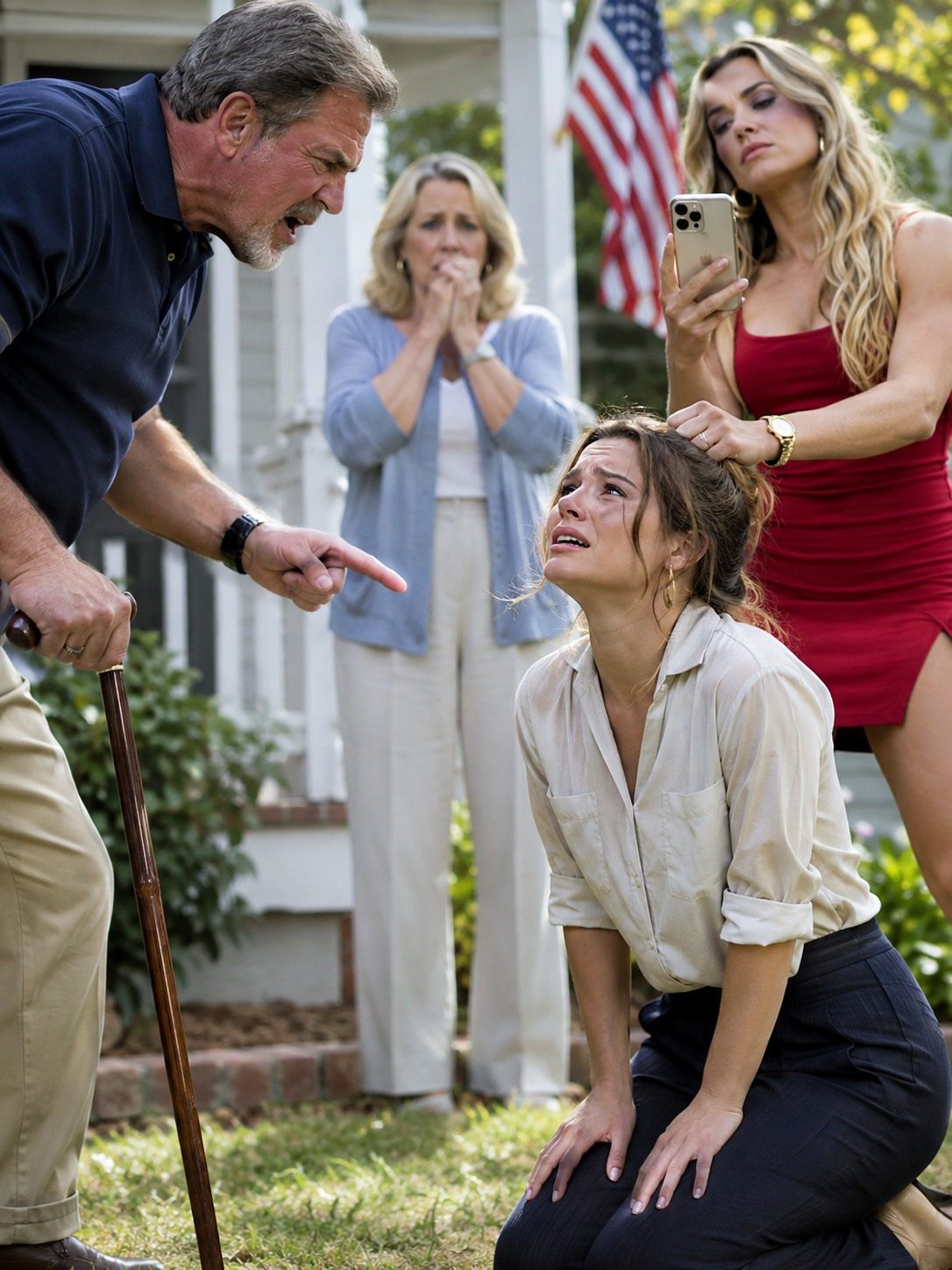
"Give me my inhaler, Ben!" I screamed, dropping to my knees.
My father sat in his leather recliner with the television remote in his hand.
On the coffee table beside him lay a blue medical inhaler with my name printed on a pharmacy label.
Someone had scratched two words into its plastic casing.
Drama Queen.
My brother was holding my real rescue inhaler above his head.
And for the first time in my life, I understood that he might actually let me die.
I was seventeen years old.
It was November 2005, and I was lying on the living room floor of our family home outside Madison, Wisconsin, struggling to pull enough oxygen into my lungs to stay conscious.
My name is Avery Collins.
And until that night, I had believed there was a difference between having a family that didn't love you and having a family that wanted you gone.
I was about to discover how thin that difference could be.
"Come on, Avery," Ben said, waving the inhaler above his head. "You want it? Get up and take it."
I tried.
My right hand pressed against the carpet. My knees shook beneath me.
The room seemed to tilt.
Every breath felt like trying to suck air through a drinking straw someone had pinched shut.
"Please."
Ben grinned.
"That's better."
He was twenty-one, four years older than me, and already an expert at making cruelty look like entertainment.
He had broad shoulders, a confident smile, and the kind of easy charm that made adults forgive him before he even apologized.
Teachers loved him.
Neighbors called him a good kid.
My parents treated his every accomplishment like evidence that our family was extraordinary.
I was the other child.
The difficult one.
The expensive one.
The daughter who needed medication, doctor appointments, and occasional emergency treatment.
My father liked to remind me that ordinary children didn't require so much maintenance.
Ben had learned to repeat that language.
"You're seriously going to crawl around like that?" he asked.
I reached for his jeans.
He stepped backward.
My fingertips brushed his ankle.
Then he deliberately brought his shoe down on my hand.
Pain exploded through my fingers.
I cried out, but the sound came out as a weak, broken gasp.
"God, you're pathetic."
Behind him, my mother stood in the kitchen doorway.
She was holding a dish towel.
I remember that detail with terrible clarity.
The towel was white with little blue flowers embroidered along one edge.
She kept folding it, unfolding it, and folding it again.
"Mom," I managed.
She sighed.
"Benjamin, stop aggravating your sister."
Ben laughed.
"She started it."
I looked at her.
"He... took..."
My chest seized.
I couldn't finish.
My mother rolled her eyes.
"Avery, I'm not doing this tonight."
Those words frightened me more than Ben's laughter.
Because I knew what they meant.
She had already decided I was pretending.
Or worse, she knew I wasn't pretending and had decided it didn't matter.
I turned toward my father.
"Dad."
He didn't look away from the television.
A pickup-truck commercial filled the screen.
A deep voice described horsepower and towing capacity while a shiny truck drove through a mountain stream.
"Dad, please."
He lifted his beer bottle.
"You're seventeen. Figure it out yourselves."
I remember thinking that if I could just reach him, if he could see how bad it was, something inside him would change.
He was my father.
Surely that meant something.
I dragged myself forward.
The carpet burned against my knees.
My right hand throbbed.
I tried taking another breath.
Nothing.
Not enough.
The room began narrowing around the edges.
Ben crouched in front of me.
"You're really committed to this performance, huh?"
He made a wheezing sound.
Then he laughed at his own imitation.
I stared at the inhaler in his hand.
A small blue plastic device.
Something that cost less than a family dinner.
Something that could help save my life.
He held it as casually as another person might hold a television remote.
And he wouldn't give it back.
"Ben," I whispered.
For one brief second, his smile disappeared.
He looked directly into my eyes.
I saw recognition there.
He knew.
He understood exactly how frightened I was.
Then his smile returned.
"If you weren't such a burden, maybe people would actually care."
I couldn't answer.
I couldn't even cry properly.
My body had become entirely occupied with one task.
Breathing.
I rolled onto my side and pulled my knees toward my chest.
My mother took one step forward.
Hope flashed through me.
Then she stopped.
"You're making everyone uncomfortable," she said.
I looked at her.
She looked back.
Neither of us moved.
My father picked up the remote.
Click.
The television grew louder.
Click.
Louder again.
The pickup-truck commercial drowned out the small, desperate noises coming from my throat.
I remember the smell of carpet cleaner.
The cold hardwood floor near the kitchen.
The pressure building behind my eyes.
And the strange realization that my parents were not confused about what was happening.
They were making choices.
My brother was choosing to keep my medication.
My mother was choosing to remain in the doorway.
My father was choosing to watch television.
And I was running out of air.
Then everything went black.
The next thing I remember was a voice.
"Avery? Can you hear me?"
Something soft covered my nose and mouth.
Air moved against my face.
There was a steady electronic beeping somewhere nearby.
I opened my eyes.
Bright fluorescent lights.
White ceiling tiles.
A curtain hanging from a metal track.
I was in a hospital.
A woman in blue scrubs leaned over me.
"That's it," she said gently. "Don't try to talk yet."
She adjusted the oxygen mask.
Her name badge read Melissa Grant, RRT.
Respiratory therapist.
I didn't know it then, but twenty-one years later, I would wear the same professional initials on my own hospital badge.
"You're safe," Melissa said.
I stared at her.
Safe.
The word sounded unfamiliar.
A doctor entered the room.
He introduced himself as Dr. Howard.
He asked my name.
"Avery," I whispered.
"Good. Do you know where you are?"
"Hospital."
"That's right."
He examined my eyes and listened to my breathing.
Then he looked toward the nurse.
"Let's continue monitoring her closely."
I tried lifting my right hand.
Pain shot through my fingers.
A bandage covered two of them.
"What happened?" I asked.
Melissa pulled a chair beside my bed.
"You had a very serious asthma attack."
I swallowed.
"How long?"
"You've been here for several hours. You were unconscious when you arrived."
My stomach tightened.
"Where's my mom?"
Melissa didn't answer immediately.
That hesitation told me something was wrong.
"Do you remember who brought you here?"
I shook my head.
She glanced toward the doctor.
"Someone left you at the emergency entrance," he explained. "They didn't come inside to register you."
I stared at him.
"What?"
"We've been trying to contact your family."
"My dad?"
"We haven't been able to reach him."
"Ben?"
The doctor shook his head.
I looked toward the doorway.
No familiar faces.
No winter coats hanging over chairs.
No worried mother.
No father demanding to know whether I was all right.
Just strangers who had helped me breathe.
"Nobody stayed?" I asked.
Melissa's expression softened.
"I'm sorry, sweetheart."
I turned my face toward the wall.
I didn't want them to see me cry.
Not because I was embarrassed.
Because I was afraid that if I started, I wouldn't be able to stop.
By morning, my mother finally arrived.
She wore her expensive camel-colored wool coat and carried a Starbucks coffee.
Her lipstick was perfect.
Her expression was not.
"Do you have any idea how embarrassing this is?" she demanded.
I stared at her.
"I couldn't breathe."
"You're breathing now."
"Ben took my inhaler."
She closed the door behind her.
"Don't start."
"He wouldn't give it back."
"Avery."
"He stepped on my hand."
She placed her coffee on the bedside table.
"Your brother was trying to get you to calm down."
I looked at her in disbelief.
"By taking my medicine?"
"You know how dramatic you get."
I lifted my injured hand.
"Look at this."
She barely glanced at it.
"Accidents happen."
Something inside me shifted.
It wasn't anger.
Not yet.
It was the first small crack in the belief that my mother would eventually become the person I needed her to be.
A knock interrupted us.
A woman entered carrying a folder.
"Good morning. I'm Karen Bell, the hospital social worker."
My mother's entire face changed.
Her shoulders relaxed.
Her voice became warm.
"Oh, thank goodness. We've been so worried."
I stared at her.
Karen pulled up a chair.
"Avery, I'd like to ask you a few questions about what happened."
My mother immediately stepped closer.
"Of course. Whatever you need."
Karen looked at her.
"I'd actually like to speak with Avery alone for a few minutes."
My mother's smile tightened.
"She's still very emotional."
"That's understandable."
"She sometimes misremembers things when she's upset."
Karen held her gaze.
"I'd still like to hear from her."
For a moment, I thought my mother might refuse.
Instead, she picked up her coffee.
"Fine."
Before leaving, she looked directly at me.
It was a small look.
A warning.
Then the door closed.
Karen waited.
"Avery, can you tell me what happened last night?"
I looked at my hands.
I wanted to tell her everything.
About Ben hiding my medication.
About my father's insults.
About my mother's habit of turning every medical emergency into an accusation.
But I also knew I had to go home eventually.
And home was where all three of them would be waiting.
"Ben took my inhaler," I whispered.
Karen wrote something down.
"Did he know you needed it?"
"Yes."
"Did you ask him to return it?"
I nodded.
"Did he?"
"No."
She paused.
"Where were your parents?"
I swallowed.
"Watching."
Karen stopped writing.
Both of us sat silently.
Then she asked, "Did either of them try to help you?"
I shook my head.
Her expression changed.
Not dramatically.
But enough.
She closed the folder.
"Avery, I need you to understand something. What you're describing is serious."
I stared at her.
"Am I in trouble?"
"No."
"Is Ben?"
"Right now, my priority is making sure you're safe."
I wanted to believe her.
I really did.
But seventeen years of living in that house had taught me that adults could say comforting things without changing anything.
Karen asked more questions.
I answered some.
Others I avoided.
When she finally left, I lay awake watching the hospital doorway.
An hour later, my mother returned.
She closed the door carefully.
Then she leaned over my bed.
"Listen to me," she whispered.
I felt my stomach tighten.
"Your grandmother is very sick."
I blinked.
Grandma Eleanor.
My father's mother.
The only person in our family who ever asked what I wanted to do with my life.
"What?"
"She's been having a difficult time. She doesn't need more stress."
"Is she okay?"
"That's not the point."
My mother moved closer.
"If you keep making accusations, people are going to start asking questions."
I stared at her.
"About Ben?"
"About all of us."
Her voice grew colder.
"Think about what happens to families when people start asking questions, Avery."
I didn't understand exactly what she meant.
But I understood the threat.
She straightened.
"And don't mention this hospital visit to your grandmother."
"Why?"
"Because I said so."
"Mom—"
"Promise me."
I looked at the window.
The sky outside was pale gray.
I wanted Grandma Eleanor.
I wanted her to come into the room and take my hand.
I wanted someone who knew my name to tell me that what happened wasn't normal.
Instead, I whispered, "Okay."
My mother smiled.
"There. Was that so difficult?"
I returned home two days later.
Ben was standing in the hallway.
"Look who's back from the dead."
He laughed.
I walked past him.
My father looked up from the newspaper.
"Hope you enjoyed your little vacation."
I stopped.
"Vacation?"
"Hospital stays aren't free."
I stared at him.
He folded the newspaper.
"You've cost this family enough money already."
I went upstairs without answering.
My bedroom door still had the same small crack near the handle.
My books were stacked on the desk.
A photograph of Grandma Eleanor stood beside my lamp.
In it, she was smiling at me during my sixteenth birthday.
Her arm was around my shoulders.
I picked up the frame.
She had once told me something I never forgot.
"Don't let anyone convince you that needing help makes you weak, Avery."
I sat on the bed.
For the first time since leaving the hospital, I cried.
Not loudly.
Not dramatically.
Just quietly, with my grandmother's photograph in my hands.
I didn't know then that she was already trying to protect me.
I didn't know she'd created an education trust.
I didn't know my parents had been discussing ways to keep me from accessing it.
And I certainly didn't know that my asthma attack had occurred at a moment when they were desperate to control what my grandmother might learn.
All I knew was that my family had watched me nearly die.
And nobody had apologized.
Three weeks later, Grandma Eleanor died.
My mother told me she'd been confused during her final days.
She said Grandma hadn't wanted visitors.
She said there was no reason for me to feel guilty.
But at the funeral, something happened that I would remember for the rest of my life.
An older woman approached me near the church entrance.
She wore a navy coat and held a small black handbag.
"You must be Avery," she said.
I nodded.
"My name is Ruth Green. I was a friend of your grandmother's."
I recognized the name.
Grandma had mentioned Ruth before.
"She loved you very much," Ruth said.
My throat tightened.
"Thank you."
Ruth glanced toward my parents.
Then she lowered her voice.
"Did Eleanor ever give you the blue envelope?"
I frowned.
"What envelope?"
Ruth's expression changed.
"She said she'd arranged everything."
"Arranged what?"
Before Ruth could answer, my mother appeared beside me.
"Ruth."
Her voice was sharp.
Ruth looked up.
"Margaret."
My mother placed a hand on my shoulder.
"Avery's had a very difficult few weeks. I don't think this is the time."
Ruth studied her.
Then she looked back at me.
For one second, I thought she might say something anyway.
Instead, she squeezed my hand.
"Your grandmother was proud of you, sweetheart."
She walked away.
My mother watched her leave.
Then she turned toward me.
"What did she say?"
"Nothing."
"Avery."
"She asked about an envelope."
My mother's face went still.
"What envelope?"
"A blue one."
She gripped my shoulder.
"Listen carefully. Your grandmother was confused near the end. People are going to tell you all sorts of things."
"Ruth didn't seem confused."
"That's enough."
She released me.
"Don't embarrass this family today."
I looked toward the church doors.
Ruth was gone.
And so was my chance to ask what she meant.
Twenty-one years later, I would finally understand why my mother had been so frightened of that question.
But the first clue arrived much sooner.
Two nights after Grandma's funeral, I woke to the sound of voices downstairs.
It was nearly midnight.
I stepped into the hallway.
My parents were arguing in the dining room.
Ben was there, too.
I heard my father's voice first.
"She doesn't know anything."
My mother answered.
"Ruth talked to her."
"So what?"
"She mentioned the envelope."
Silence.
Then Ben laughed.
"You're worried about Avery? Seriously?"
My father said something too quietly for me to hear.
I moved closer to the stairs.
My mother spoke again.
"After what happened in November, we cannot afford another investigation."
My heart began pounding.
Ben stopped laughing.
"What investigation?"
My father answered.
"The kind that gets people looking at medical records."
I gripped the banister.
My mother lowered her voice.
"Eleanor changed the instructions before she died."
My father swore.
Ben asked, "What instructions?"
A chair scraped against the floor.
Then my mother said something that made my blood turn cold.
"If Avery ever finds out what Eleanor put in that trust, she'll realize why we couldn't let anyone call an ambulance that night."
I stood frozen on the staircase.
Below me, a drawer opened.
Paper rustled.
My father said, "Then we make sure she never sees the original."
A moment later, footsteps approached the stairs.
I turned to run.
But the hallway light suddenly came on.
And my mother was standing at the bottom of the staircase, holding a blue envelope with my grandmother's handwriting across the front.
She looked up at me.
"Avery," she said quietly. "How much did you hear?"






Comments 0