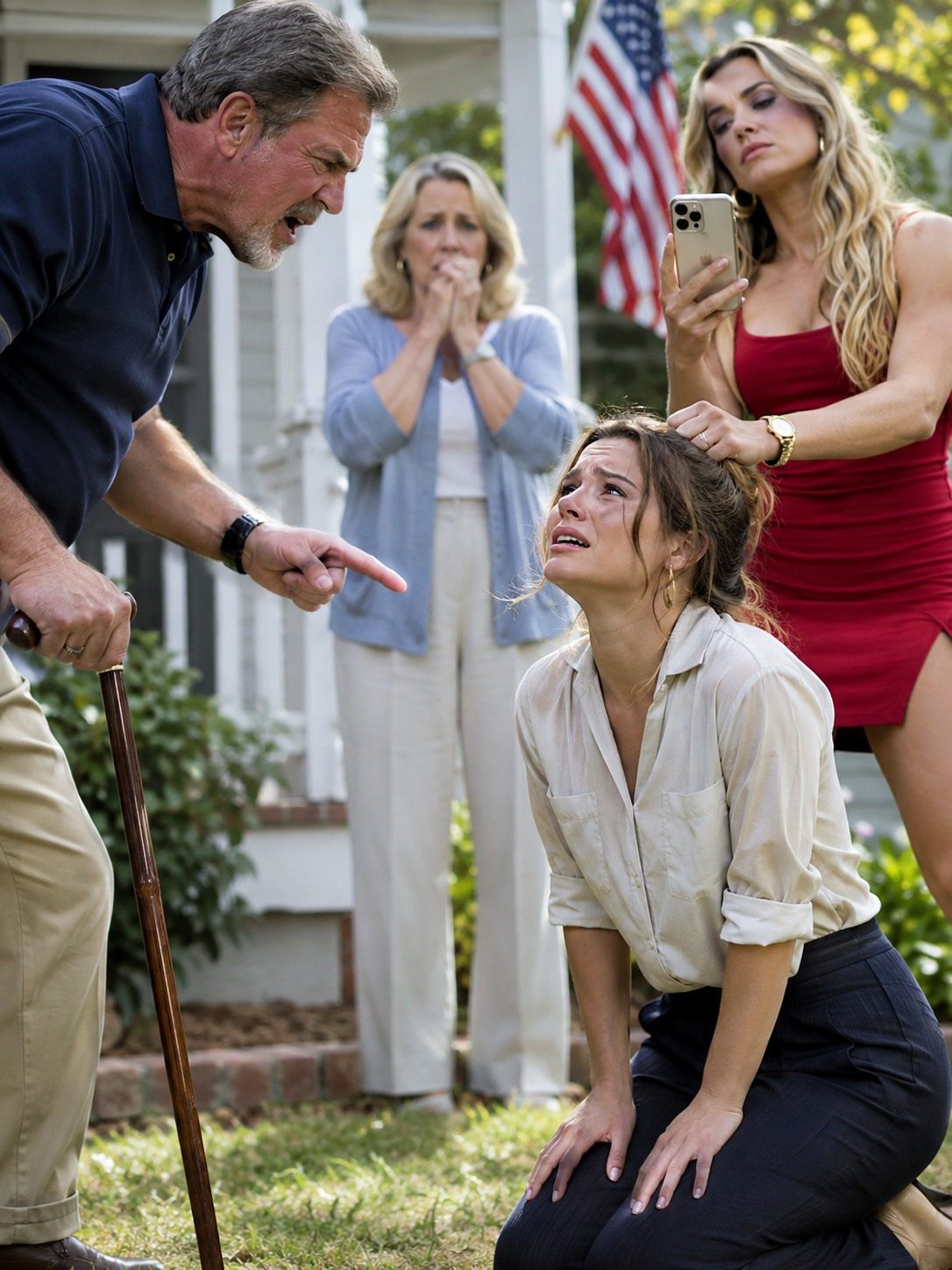
"How much did you hear, Avery?"
My mother's voice was quiet.
That frightened me more than shouting ever could.
She stood at the bottom of the staircase, holding a blue envelope with my grandmother's handwriting across the front.
Behind her, my father appeared in the dining room doorway.
Ben was standing beside him.
Three people.
Three pairs of eyes.
And suddenly, I was seventeen years old again, trapped in the same house where they had watched me struggle for air.
"Nothing," I whispered.
My mother didn't move.
"Don't lie to me."
"I just came downstairs for water."
She glanced toward my father.
He folded his arms.
"Then why are you standing there listening to conversations that don't concern you?"
I looked at the envelope.
My grandmother's name was written in the upper-left corner.
Eleanor Collins.
Below it, in handwriting I would have recognized anywhere, were three words.
For Avery Only.
My heart began pounding.
"Is that from Grandma?"
My mother immediately turned the envelope over.
"Go back to bed."
"She wrote my name on it."
"Avery."
"Why would Grandma leave something for me if she didn't want me to have it?"
My father stepped forward.
"Watch your tone."
I looked at him.
He was wearing the same dark trousers he'd worn to the funeral. His shirt sleeves were rolled up, and there was a half-empty glass of whiskey on the dining room table.
He looked tired.
But not sad.
I had seen him angry, impatient, and disappointed.
I couldn't remember the last time I'd seen him grieve.
"Grandma left me something," I said.
My mother sighed.
"Your grandmother was confused."
"That's what you keep saying."
"Because it's true."
"Then why are you hiding her letter?"
Ben laughed.
"Oh, here we go."
I turned toward him.
He was leaning against the doorway with his hands in his pockets, looking entertained.
The same expression he'd worn when he held my inhaler above his head.
"Maybe Grandma left you a list of all the ways you've embarrassed this family," he said.
"Shut up, Ben."
The words escaped before I could stop them.
My father's face hardened.
"What did you just say?"
I swallowed.
Ben straightened.
"Wow. Little Avery finally found a backbone."
My mother raised one hand.
"Enough."
Then she looked at me.
"You are exhausted. You're emotional. You've had a difficult month."
She spoke as if she were explaining something to a small child.
"Tomorrow, you'll understand why this conversation was unnecessary."
I looked at the envelope again.
"Can I just read it?"
"No."
One word.
No hesitation.
My mother had answered too quickly.
I took one step down.
She immediately moved the envelope behind her back.
And that was when I understood something important.
She wasn't protecting me from upsetting information.
She was protecting the information from me.
I went back upstairs because I had no other choice.
At seventeen, I had no car, no savings, and nowhere I could go without someone eventually calling my parents.
My bedroom was the only place in the house where I could close a door and pretend I had control over something.
I locked it.
Then I sat on the floor beside my bed.
My hands were shaking.
I could still hear my mother's words.
After what happened in November, we cannot afford another investigation.
And then the sentence that made everything worse.
If Avery ever finds out what Eleanor put in that trust, she'll realize why we couldn't let anyone call an ambulance that night.
I repeated it silently.
Again.
And again.
I knew what a trust was, at least in the broadest sense.
Grandma Eleanor had once explained that some people placed money aside for their grandchildren's education.
She'd told me that college was an investment in independence.
But my parents had always said there wasn't enough money for me to attend the schools I wanted.
My father insisted that community college was the only sensible option.
My mother said I wasn't emotionally prepared to live away from home.
Ben, meanwhile, had attended a private university for two years before dropping out.
My parents had paid for everything.
His tuition.
His apartment.
His car.
Even the expensive stereo system he'd purchased after failing his second semester.
Whenever I asked why he deserved so much more, my mother had the same answer.
"Your brother has potential."
Apparently, I had medical bills.
I reached beneath my mattress and pulled out a small spiral notebook.
It was where I kept things I couldn't say aloud.
I wrote down everything I'd overheard.
The trust.
The envelope.
The hospital.
The ambulance.
I wrote the date.
December 2005.
Then I underlined one sentence.
They knew I could die.
I stared at those words.
Until that night, I'd believed my parents had simply failed to understand the severity of my asthma attack.
It was easier to believe that.
Ignorance was terrible.
But deliberate indifference was something else.
And now I had heard them connect the medical emergency to money.
I didn't know how.
I didn't know why.
But I knew I needed help.
I reached for my phone.
Then I stopped.
My parents checked our phone records.
They had taken away my cell phone twice for calling friends without permission.
If I contacted someone about what I'd heard, they might find out.
So I opened my notebook again.
And wrote one name.
Nora Lang.
Nora was my best friend.
She was seventeen, stubborn, funny, and completely unimpressed by my family's reputation.
We'd met during freshman orientation when she sat beside me in chemistry and whispered that our teacher looked like a man who alphabetized his breakfast cereal.
I'd laughed so hard I nearly got sent into the hallway.
After that, we became inseparable.
Nora knew things about my family that nobody else knew.
She knew Ben stole my medication.
She knew my mother read my private messages.
She knew my father had once grounded me for crying after an asthma attack because he said the neighbors might hear.
And she knew I carried a second inhaler whenever possible.
That precaution had started after Ben hid my medication inside the freezer.
When I found it, the plastic casing was so cold it hurt my fingers.
He thought it was hilarious.
Nora didn't.
She'd bought me a small zippered pouch and told me to keep emergency medication somewhere Ben couldn't easily find it.
For months, that worked.
But on the night of my worst attack, I'd left my spare inhaler in my school backpack upstairs.
I had been watching television.
I thought I was safe.
That mistake nearly killed me.
The next morning, I found Nora waiting near my locker.
She took one look at my face.
"What happened?"
I shook my head.
"Avery."
"Not here."
She glanced toward the crowded hallway.
"Okay. Library. Lunch."
I nodded.
She didn't ask again.
That was one of the reasons I trusted her.
Nora understood that sometimes the most helpful thing a person could do was wait until you were ready to speak.
At lunch, we sat in the back corner of the school library.
I told her about the envelope.
About Grandma Eleanor.
About the conversation I'd overheard.
When I repeated what my mother had said about the ambulance, Nora went completely still.
"Say that again."
I did.
She leaned forward.
"Avery, that's not normal."
"I know."
"No. I mean this is really serious."
I looked down.
"Maybe I misunderstood."
"Did you?"
I didn't answer.
Nora reached across the table.
"Look at me."
I did.
"Your brother stole your inhaler while you were having an asthma attack. Your parents watched. You lost consciousness. Somebody dumped you at a hospital and left."
My eyes filled.
She lowered her voice.
"And now you're telling me they were talking about keeping people from investigating what happened?"
I nodded.
Nora sat back.
"We need to tell someone."
"No."
"Avery—"
"If my parents find out, it'll get worse."
"It already got worse."
"You don't understand."
"Then help me understand."
I stared at the table.
The truth was difficult to explain to someone who had never lived in a house like mine.
My parents didn't need to lock me in my bedroom.
They didn't need to threaten me every day.
They had spent years teaching me that every attempt to defend myself would lead to punishment.
If I complained about Ben, I was jealous.
If I cried, I was manipulative.
If I got sick, I was seeking attention.
If I disagreed with my father, I was disrespectful.
Eventually, I learned to question my own memories before anyone else had the chance.
"I just need to graduate," I whispered.
Nora looked at me for a long moment.
Then she said, "Okay."
I blinked.
"Okay?"
"We get you through graduation."
I exhaled.
"But we're not pretending this didn't happen."
She pulled a pen from her backpack.
"Write down everything you remember. Dates. Names. Exact words. Keep copies somewhere your parents can't reach."
I almost smiled.
"You sound like a detective."
"My aunt says documentation is how ordinary people protect themselves from powerful people."
"Your aunt Linda?"
"Yeah."
Nora shrugged.
"She's annoyingly practical."
Then she leaned closer.
"And Avery?"
"What?"
"Whatever Grandma left you, I don't think your mother wants you to find it."
Two weeks later, I tried contacting Ruth Green.
I found her telephone number in an old address book Grandma had given me.
It was tucked inside a cookbook with handwritten recipes.
I waited until my parents were out grocery shopping and Ben had gone to a friend's apartment.
Then I used the kitchen telephone.
Ruth answered after four rings.
"Hello?"
"Mrs. Green?"
"Speaking."
"It's Avery Collins."
Silence.
Then her voice softened.
"Oh, sweetheart."
My throat tightened.
"Hi."
"I've been hoping you'd call."
I looked toward the hallway.
"At Grandma's funeral, you asked me about an envelope."
"Yes."
"What was in it?"
Ruth hesitated.
"Did your parents give it to you?"
"No."
Another silence.
Then she asked, "Are you alone?"
I felt cold.
"Yes."
"Listen carefully, Avery. Your grandmother wanted you to have certain documents before she died."
"What documents?"
"Information about your education."
I gripped the telephone.
"College?"
"Among other things."
"What other things?"
Ruth took a breath.
"Your grandmother became concerned about how your parents were handling some financial arrangements."
I stared at the kitchen wall.
"What arrangements?"
"I don't want to explain something important over the telephone without the papers in front of me."
"Can I come see you?"
"Of course."
I nearly cried with relief.
"Tomorrow?"
"Yes. But Avery, there's something you need to know."
I held my breath.
"Your grandmother tried to speak with you in November."
I closed my eyes.
November.
The month of my asthma attack.
"She called the house several times," Ruth continued. "She said she couldn't reach you."
"My mom said Grandma was too sick to talk."
Ruth was quiet.
Then she said, "Eleanor wasn't confused when I last saw her."
I opened my eyes.
"She wasn't?"
"No."
My pulse quickened.
"Then why did Mom say—"
A car door slammed outside.
I froze.
My parents were home.
"Mrs. Green, I have to go."
"Avery, wait."
I heard footsteps on the front porch.
"Please don't tell my parents I called."
Ruth's voice changed.
"Sweetheart, what is happening in that house?"
The front door opened.
I hung up.
My mother entered carrying two grocery bags.
She looked at the telephone in my hand.
"Who were you talking to?"
I forced myself to breathe normally.
"Nora."
My mother studied me.
"Really?"
"Yes."
She set the groceries on the counter.
"Then why do you look frightened?"
I swallowed.
"Because you scared me."
She smiled.
But there was nothing warm about it.
"Well, don't be so jumpy."
The following afternoon, Ruth Green didn't answer her telephone.
I called three times.
No answer.
I left a message.
She never returned it.
Two days later, my mother announced that Ruth had gone to stay with relatives.
"She's getting older," she said casually over dinner. "People her age shouldn't live alone."
I stared at her.
"Who told you that?"
My mother looked up.
"What?"
"That Ruth went away."
"People talk, Avery."
I pushed my food around my plate.
"Where did she go?"
"Why do you care?"
I looked down.
"No reason."
Ben snorted.
"Probably thinks Grandma left her a million dollars."
My father laughed.
"That would be the day."
I said nothing.
But beneath the table, my hands were clenched.
Something was wrong.
I could feel it.
And I was beginning to understand that my parents' greatest weapon wasn't anger.
It was their ability to make every suspicious event seem ordinary.
A missing letter became confusion.
A dangerous asthma attack became a performance.
A woman who wanted to help me suddenly became unavailable.
And whenever I asked questions, the answer was always the same.
Stop being dramatic.
By January 2006, I had made a decision.
I was leaving Wisconsin.
Not immediately.
Not recklessly.
But permanently.
I applied to colleges outside the state.
I filled out scholarship applications at the public library.
I asked my guidance counselor about financial aid.
Her name was Mrs. Bennett.
She was a practical woman who wore bright scarves and kept a jar of peppermints on her desk.
One afternoon, she looked over my application materials.
"Avery, these are excellent."
I blinked.
"Really?"
"Your grades are strong. Your recommendations are good. And your personal statement is thoughtful."
I stared at the folder.
Nobody at home had ever described my work that way.
Mrs. Bennett smiled.
"Have you considered healthcare?"
I hesitated.
"Maybe nursing."
"Why nursing?"
I thought about Melissa Grant.
The respiratory therapist who had adjusted my oxygen mask.
The woman who had spoken to me like I mattered.
"Because I know what it's like to need help," I said.
Mrs. Bennett nodded.
"That's a good reason."
She turned another page.
"Have you discussed these applications with your parents?"
I shook my head.
"Not yet."
Her expression became thoughtful.
"Avery, there may be some financial aid paperwork requiring family information."
My stomach tightened.
"I know."
"We'll work through what we can."
I looked at her.
"You'd help me?"
"Of course."
I almost laughed.
It was such a simple answer.
And yet it felt extraordinary.
The first acceptance letter arrived in March.
A university in Washington State had offered me admission with a substantial scholarship.
I held the letter for almost ten minutes before opening it.
Then I read it three times.
I had done it.
I had found a way out.
That evening, I made the mistake of telling my parents.
My mother read the letter.
Her smile disappeared.
"Washington?"
I nodded.
"That's across the country."
"I know."
My father held out his hand.
"Let me see that."
He scanned the page.
"Scholarship doesn't cover everything."
"I can work."
"You're not moving across the country."
The words were immediate.
Final.
I stared at him.
"I'm eighteen in a few months."
He set the letter down.
"As long as you're living under my roof, you follow my rules."
Ben leaned back in his chair.
"Besides, who wants to hire someone who's always sick?"
I looked at him.
He grinned.
My mother folded the letter.
"You're not ready to live independently."
"I can learn."
"You're too emotional."
"I've been taking care of myself for years."
The room went silent.
My father's expression hardened.
"What is that supposed to mean?"
I knew I should stop.
I knew exactly what would happen if I continued.
But something inside me had changed.
Maybe it was Grandma's death.
Maybe it was the hospital.
Maybe it was the realization that no amount of obedience would ever make them treat me fairly.
I looked at my father.
"It means I know how to manage my medication. I know how to work. I know how to study. And I know when I need help."
Ben laughed.
"Except when you're crawling around begging for your inhaler."
I turned toward him.
He was smiling.
Proud of himself.
My mother said nothing.
My father reached for his beer.
And suddenly, I understood that I could spend the rest of my life trying to convince these people I deserved respect.
Or I could leave.
"I've accepted the offer," I said.
My mother stared at me.
"You did what?"
"I accepted."
My father stood.
"Then you can figure out how to pay for everything yourself."
I nodded.
"Okay."
He looked surprised.
"What?"
"Okay."
My mother's face tightened.
"Don't be ridiculous."
I picked up my letter.
"I'm going to college."
Then I walked upstairs.
For the first time in my life, I didn't wait for permission.
Graduation came in June.
Grandma Eleanor wasn't there.
Ruth Green wasn't there.
My parents attended because they wanted photographs.
Ben complained about the heat.
Nora hugged me so tightly I could barely breathe.
"You did it," she whispered.
I laughed.
"We did it."
She shook her head.
"No. You did."
Her aunt Linda took our picture.
Then she handed me a small wrapped package.
"Something for your next chapter," she said.
Inside was a leather-bound journal.
On the first page, she'd written:
Your memories belong to you. Don't let anyone rewrite them.
I stared at the words.
Then I hugged her.
I didn't know how much I would need that advice.
I left Wisconsin in August.
My parents didn't drive me to the airport.
My father said he had work.
My mother said traveling would make her anxious.
Ben didn't bother saying goodbye.
Nora drove me in her battered Honda Civic.
We listened to terrible music and laughed too loudly.
At the airport, she helped me carry my bags to the check-in counter.
Then she handed me a small zippered pouch.
Inside was a spare inhaler.
I looked at her.
"Nora."
"Just in case."
My eyes filled.
She shrugged.
"You're not getting rid of me that easily."
I hugged her.
For a moment, I couldn't speak.
Then I whispered, "Thank you."
She stepped back.
"Go build a life, Avery."
And I did.
Not all at once.
Not easily.
But steadily.
I studied.
I worked.
I learned to live in apartments where nobody searched my belongings.
I learned that disagreements didn't always end in punishment.
I learned that people could be angry without becoming cruel.
I eventually became a respiratory therapist.
I moved to Seattle.
I bought a modest condo overlooking Lake Union.
I adopted an orange cat named Maple.
And I stopped answering my family's calls.
Years passed.
Fifteen of them without seeing Ben or my parents.
I told myself the past was finished.
I told myself Grandma's blue envelope was gone.
I told myself that whatever had happened in Wisconsin no longer had power over my life.
But some memories don't disappear.
They simply wait.
One rainy Tuesday evening, when I was thirty-eight, I came home from a twelve-hour hospital shift.
Maple greeted me at the door.
I dropped my keys into the ceramic bowl beside the entryway.
My feet hurt.
My shoulders ached.
All I wanted was a shower and a quiet dinner.
Then I noticed the envelope on my kitchen counter.
Thick cream paper.
Formal lettering.
King County Superior Court.
I opened it.
Inside was a subpoena.
My eyes moved down the page.
Marisol Green v. Benjamin Collins and Northwest Pacific Logistics.
I stopped breathing for one terrible second.
Benjamin Collins.
My brother.
The man who had stolen my inhaler.
The man I hadn't seen in fifteen years.
I read the document again.
And again.
It required me to appear as a witness in a civil lawsuit involving workplace harassment, retaliation, and intentional emotional harm.
I had never heard of Marisol Green.
I had never worked for Northwest Pacific Logistics.
I didn't even know Ben lived in Washington.
Then I reached the final page.
A short paragraph identified the reason my testimony had been requested.
It concerned Benjamin Collins's previous conduct.
His credibility.
And statements he had made about his sister.
My hands began shaking.
Maple jumped onto the counter.
I barely noticed.
At the bottom of the document was a telephone number for the plaintiff's attorney.
Dana Willis.
I stared at it.
Then I noticed something tucked behind the subpoena.
A photocopied page.
Old.
Yellowed.
Covered in handwriting.
At the top was a date.
November 2005.
The month of my asthma attack.
Below it was a single sentence.
If anything happens to Avery, ask Margaret why she refused to call for help.
My grandmother's handwriting.
I knew it immediately.
I sat down.
The room seemed to tilt.
For twenty-one years, I had believed Grandma Eleanor died without knowing what happened to me.
But she had known.
Somehow, she had known.
I turned the page over.
There was another message.
This one was written in blue ink.
The hospital records were never the real secret.
Below it was a name.
A name I hadn't heard since the night I nearly died.
I leaned closer.
Then my phone rang.
An unfamiliar Seattle number appeared on the screen.
I answered.
"Hello?"
A woman's voice spoke quietly.
"Ms. Collins? My name is Dana Willis. I'm the attorney representing Marisol Green."
I gripped the phone.
"I was just reading your subpoena."
"I know this must be upsetting."
"How did you get my grandmother's handwriting?"
There was a pause.
Then Dana said, "Avery, before I answer that, I need to ask you something."
My heart pounded.
"What?"
"Do you remember the doctor who treated you after your asthma attack in 2005?"
I frowned.
"Dr. Howard."
"Yes."
I sat straighter.
"Why?"
Dana lowered her voice.
"Because he contacted our office this morning."
I stared at the photocopied page.
"What did he want?"
Another pause.
Then she said, "He told us the person who brought you to the hospital that night was not your brother."
My stomach dropped.
"What?"
"He said there was something unusual about your admission records."
I stood so quickly my chair scraped against the floor.
"Dana, who brought me there?"
She took a breath.
"That's what we're trying to establish. But Dr. Howard says someone left a sealed statement with the hospital."
I gripped the edge of the counter.
"A statement?"
"Yes."
"From who?"
Dana's voice became very quiet.
"Avery, the statement was addressed to your grandmother."
I couldn't move.
Then Dana continued.
"And according to the hospital's archived records, the person who delivered it signed a name your family insisted belonged to someone who was already dead."
I stared at the phone.
Before I could speak, another call appeared on my screen.
The caller ID showed a Wisconsin number.
I recognized it.
My mother's old home telephone.
I hadn't seen that number in fifteen years.
Dana was still speaking.
"Avery? Are you there?"
I looked at the incoming call.
Then a voicemail notification appeared.
The message was only seven seconds long.
I pressed play.
My mother's voice filled the kitchen.
"Avery, don't talk to that lawyer. And whatever you do, don't ask Dr. Howard about the woman who brought you to the hospital."
The message ended.
A second notification appeared immediately.
This one contained a photograph.
An old hospital security image.
A woman stood beside a wheelchair at the emergency entrance.
Her face was partly hidden.
But the coat she wore was unmistakable.
It was the same navy coat Ruth Green had worn to my grandmother's funeral.
And beneath the photograph was a message from an unknown number.
Ruth didn't disappear, Avery. Your mother made sure you believed she did. Now look at who's standing behind her.






Comments 0