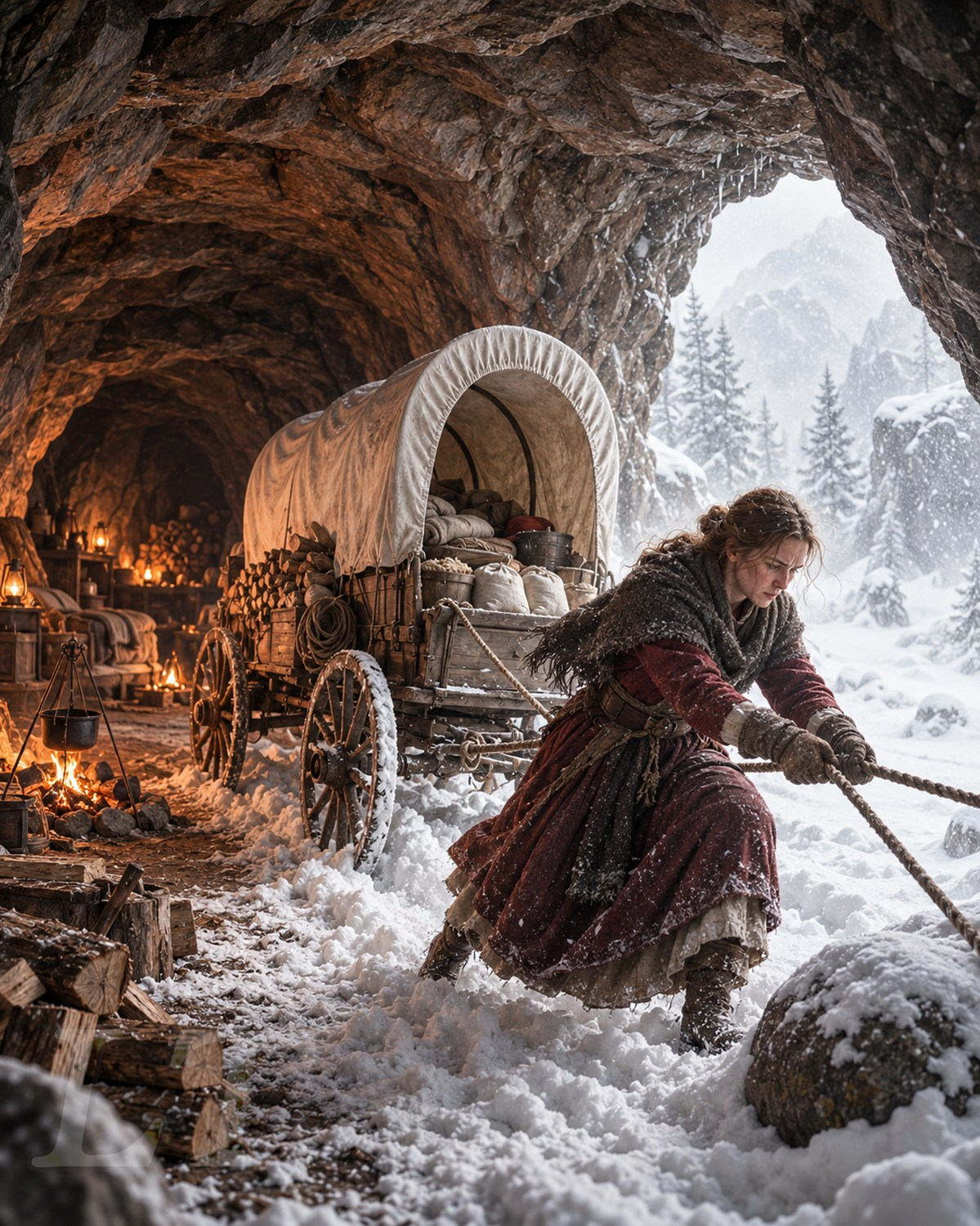
An eighteen-year-old girl stood outside a locked farmhouse door, clutching a small wooden chest.
"Please, Uncle Roderick. My parents built this home!"
When Roderick Vance appeared in the doorway, he held the property papers bearing his own name.
But one small detail on the bottom of the document was missing.
Adeline suddenly realized her uncle had made a terrible mistake.
The door slammed before she could say another word.
For several seconds, Adeline Vance remained on the front steps, staring at the dark wooden door.
Her fingers were numb around the handle of the small wooden chest she had managed to save. Behind that door were the rooms where she had grown up, the kitchen where her mother used to bake bread, and the fireplace where her father had taught her to repair broken tools.
Everything familiar to her was on the other side.
And now, according to her uncle, none of it belonged to her.
She heard Roderick moving around inside. A chair scraped across the floor. Something heavy was placed on a table.
Then his voice came through the door.
"Don't make this difficult, Adeline. You have one hour. After that, I won't be responsible for what happens to you."
She lowered her eyes.
Not because she agreed.
Because she did not want him to see her crying.
The November wind swept across the farmhouse yard, carrying the first tiny flakes of snow. The sky above Cutbank Hollow had turned an ugly shade of gray. Dark clouds were gathering over the distant mountains.
Everyone in town knew what that meant.
The first major winter storm was coming.
And it was coming early.
Adeline had heard the warnings at the general store that morning. The mountain roads would soon become impassable. The river crossings would freeze. Anyone caught outside without proper shelter could die before morning.
Roderick knew it, too.
That was why he had chosen this particular day.
He had waited until the last possible moment to throw her out.
Adeline stepped away from the porch.
Her mother's apple trees stood in a neat row along the eastern side of the property. They were bare now, their branches moving in the wind.
She remembered being six years old and helping Margaret Vance plant the youngest tree.
Her mother had knelt beside her, guiding her little hands through the dark soil.
"Something beautiful can grow from a place that looks empty," Margaret had told her.
Adeline had never forgotten those words.
She looked at the trees one last time.
Then she walked toward the barn.
There was no point arguing with Roderick.
Not anymore.
Two years earlier, her father, Thomas Vance, had died in a terrible accident at a silver prospecting site. A timber support had collapsed while he was working underground.
The mining company sent a payment to the family.
It was supposed to help Margaret and Adeline survive after Thomas's death.
But Margaret never spoke openly about the money.
She had placed the documents somewhere safe and told her daughter that the money would belong to her when she was old enough to understand what her father had left behind.
Less than a year later, Margaret died.
Her lungs had been weakened by years of illness, and the grief following Thomas's death had made everything worse.
Adeline was seventeen when she buried her mother.
She had barely learned how to manage the farmhouse alone when Roderick arrived.
He was Thomas's older brother.
At first, he seemed like a blessing.
He repaired the fence, spoke to the neighbors, and offered to help with the accounts. He told Adeline she should not worry about adult responsibilities.
"You've lost enough already," he said.
For a while, she believed him.
Then he began making decisions without asking her.
He took possession of the property records.
He spoke to the bank.
He visited the county office.
He told people in Cutbank Hollow that Thomas had left debts behind and that he was managing the estate on behalf of his niece.
Adeline did not understand what he was doing until it was too late.
One afternoon, she discovered that the farmhouse's ownership records had changed.
When she questioned him, Roderick became furious.
"You don't understand legal matters," he told her. "Leave these things to me."
But Adeline had seen enough.
Her uncle had not come to help her.
He had come to take everything.
And now he wanted the money Margaret had hidden.
That morning, he had demanded it directly.
"Your mother told you where she put the compensation, didn't she?"
Adeline had looked at him without answering.
"Don't pretend you don't know," he continued. "That money belongs to this family."
"It belongs to my parents."
His expression changed.
For the first time, he stopped pretending to be kind.
"Your parents are dead. You are a girl with no understanding of property or business. You have no idea what you are talking about."
Adeline had said nothing.
Roderick had leaned closer.
"Tell me where the money is."
She had looked straight into his eyes.
"No."
That single word had ended whatever remained of their relationship.
Now, as she entered the barn, Adeline felt the cold settling deeper into her clothes.
Barley stood near the far wall.
The old bay horse lifted his head when he heard her footsteps.
His coat was thick for winter, but his muzzle had begun turning gray. He had pulled Thomas's freight wagon for years and knew every familiar sound of the farm.
Adeline approached him.
"Hello, old boy."
Barley moved toward her.
She rested her forehead against his neck.
For a moment, she could almost imagine her father standing beside them.
Thomas had loved that horse. He had purchased him when Adeline was a little girl and had always insisted that Barley was more intelligent than half the men in town.
"Treat him kindly," Thomas used to say. "An old horse remembers who stood beside him when the road got hard."
Adeline stroked his mane.
"I wish Papa were here."
Barley breathed warmly against her cheek.
She swallowed the ache in her throat.
There was work to do.
The freight wagon stood near the barn entrance.
It was old, weathered, and in need of repair. One of its rear wheels had developed a dangerous wobble, and the canvas covering had several small tears.
But it was still usable.
Adeline had no other choice.
She began loading everything she could carry.
A sack of flour.
Dried beans.
Salted meat.
A small supply of oats.
Two blankets.
A kettle.
An iron cooking pot.
An axe.
A saw.
Several candles.
A lantern.
Her father's woodworking tools.
She wrapped the tools in a piece of old cloth and placed them carefully inside a wooden chest.
That chest had belonged to Thomas.
Its surface was scratched, and one corner had been repaired with a different piece of wood. Adeline remembered watching her father build it when she was nine.
He had refused to let her help with the final compartment.
"Some things need to be kept safe," he had told her.
At the time, she thought he meant his chisels.
She lifted the chest into the wagon.
Then she checked the supplies again.
There was not much.
But it would have to be enough.
A curtain moved in the upstairs window of the farmhouse.
Adeline noticed it.
Her uncle was watching.
She could imagine him standing behind the glass with his arms folded, satisfied with what he had accomplished.
For one brief moment, she wanted to turn around.
She wanted to run back to the house and demand that he give her the property papers.
She wanted to shout that he had no right to take her father's home.
But she knew what would happen.
Roderick would call her foolish.
He would threaten to have her removed.
And if she refused to leave, he might take Barley and the wagon, too.
So she climbed onto the driver's seat.
The leather harness creaked as Barley moved forward.
Adeline gathered the reins.
"Come on, Barley."
The horse began walking.
The wagon rolled out of the barn.
Its damaged rear wheel groaned as it crossed the uneven ground.
Adeline did not look back.
She passed the apple trees.
She passed the old well.
She passed the wooden gate Thomas had repaired every spring.
At the end of the driveway, she stopped for a moment.
The farmhouse stood behind her.
Its windows reflected the dull winter sky.
Somewhere inside, Roderick was probably already celebrating his victory.
Adeline tightened her grip on the reins.
He could have the house for now.
He could keep the furniture, the land, and the documents he had stolen.
But he would never get the money her mother had hidden.
That promise was the only thing she had left.
And she intended to keep it.
The road toward the mountains was already disappearing beneath a thin layer of snow.
Adeline guided Barley along the familiar trail.
She knew the first few miles well. Thomas had taken her hunting there when she was younger. They had crossed the Clear Water Fork many times and gathered fallen branches beneath the evergreen trees.
Years ago, her father had shown her a natural limestone shelter above the river.
It was not a proper cabin.
It was a deep recess in the mountainside, partially protected by a rocky overhang.
Hunters had used it decades earlier.
Thomas had once told her that the stone formation offered protection from the worst mountain winds.
"If you ever get caught in a bad storm," he had said, "remember that place. It won't give you comfort, but it might give you a chance."
At the time, Adeline had laughed.
She never imagined she would need it.
Now it was the only place she could think of.
The snow began falling harder.
Barley moved slowly, carefully placing each hoof along the narrow trail.
Adeline wrapped her scarf more tightly around her neck.
The wind pushed against the canvas covering.
The wagon swayed.
She glanced toward the sky.
The clouds were darker than before.
She needed to reach the cave before nightfall.
The trail climbed gradually toward the mountains. Trees crowded both sides, their branches already collecting snow.
After another mile, the wagon began struggling.
The damaged wheel caught against a buried stone.
The entire vehicle jerked sideways.
Adeline grabbed the wooden rail.
"Whoa!"
Barley stopped.
She climbed down and examined the wheel.
The axle was still intact, but the wheel had shifted slightly.
She knelt in the snow and tried to push it back into position.
Her fingers were already stiff.
The cold seemed to enter her bones.
She found a small piece of wood in the wagon and used it to secure the loose section temporarily.
It was not a proper repair.
But it might hold long enough.
She stood and looked toward Barley.
"We're not giving up now."
The horse flicked one ear.
Adeline climbed back onto the seat.
They continued.
By late afternoon, the snow had become a blizzard.
The trail was nearly invisible.
Trees disappeared behind a moving wall of white.
Adeline could no longer see the river clearly.
She had to stop twice to climb down and guide Barley through deep drifts.
The horse was breathing heavily.
His legs were tired.
Adeline knew she could not push him too hard.
But she also knew that stopping in the open wilderness would be dangerous.
She looked ahead.
Nothing.
Only trees, snow, and the pale outlines of the mountain slopes.
Then the wagon struck another buried rock.
This time, the damaged wheel made a sharp cracking sound.
Adeline froze.
She climbed down immediately.
A wooden spoke had split.
She examined the damage.
The wheel was still attached, but it could not withstand much more strain.
Her stomach tightened.
If the wheel broke completely, she would have to unload the entire wagon.
There was no time.
The storm was getting worse.
She looked at the surrounding trees, searching for anything she could use to reinforce the wheel.
Then she noticed a familiar shape through the snow.
A dark opening beneath a towering limestone wall.
At first, she thought it was a shadow.
Then she recognized the jagged outline of the rock formation.
The cave.
Relief washed through her so suddenly that she nearly lost her balance.
"There you are."
She turned toward Barley.
"Come on, old boy. We're almost home."
The horse stepped forward.
Adeline pulled the reins gently.
The wagon creaked.
The broken wheel dragged through the snow.
Every movement sounded like it might be the last.
But the cave entrance grew larger.
And then, finally, they reached the rocky threshold.
Adeline climbed down and led Barley beneath the overhang.
The wind became slightly weaker.
The limestone walls blocked some of the storm.
For the first time in hours, she could breathe without snow blowing directly into her face.
She stood still for several seconds.
Her legs trembled.
Her hands hurt.
Her clothes were damp.
But they were alive.
She looked at the wagon.
Then at Barley.
Then into the darkness of the shelter.
"Thank you, Papa," she whispered.
She had reached the place her father had shown her.
She had food.
She had tools.
She had firewood.
And she had Barley.
Perhaps they could survive after all.
But when Adeline stepped farther inside and raised her lantern, the small flame illuminated something she had not expected.
The old hunters' shelter had collapsed.
Broken beams lay across the rocky floor.
Snow had drifted deep into the recess.
A section of the back wall was covered in loose stone.
The cave was much colder than she remembered.
There was no proper chimney.
No finished walls.
No dry bedding.
And almost no protection from the wind.
Adeline slowly lowered the lantern.
The hope that had carried her through the storm began slipping away.
She turned toward Barley.
The horse was standing near the entrance, his head lowered.
He needed warmth.
He needed food.
He needed a safe place to rest.
And she had brought him here without knowing whether the cave could protect either of them.
Adeline closed her eyes for a moment.
Then she remembered her father's voice.
"When a thing breaks, don't waste daylight wishing it hadn't. Find out how to mend it."
She opened her eyes.
She put down the lantern.
And reached for the axe.
Outside, the snowstorm grew stronger.
Inside, an eighteen-year-old girl began rebuilding the only home she had left.






Comments 0