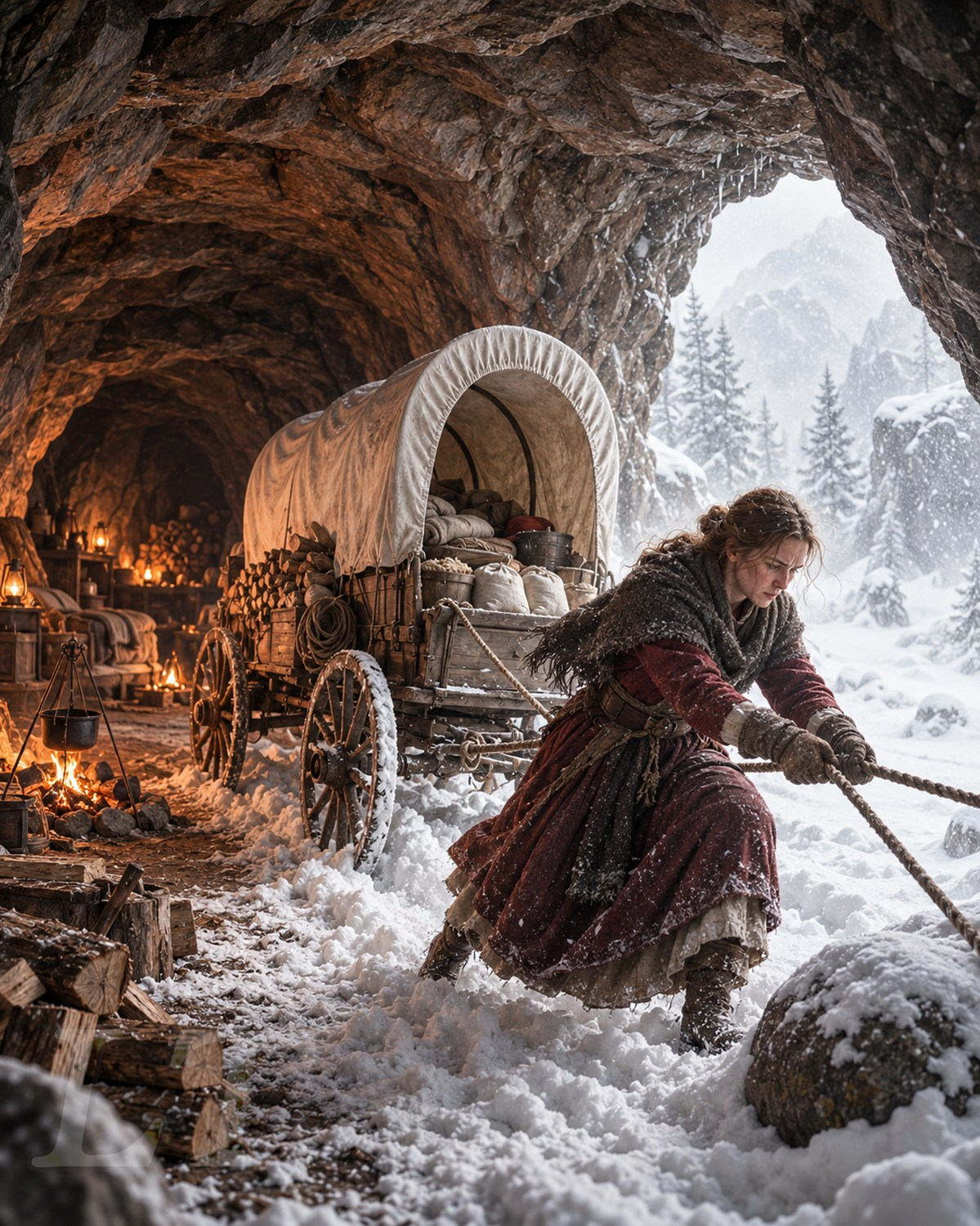
The iron handle turned again.
Adeline stood frozen beside her blankets, staring toward the darkness.
"Thomas Vance..."
The voice had been weak.
Almost a whisper.
But she had heard it.
Someone—or something—had spoken her father's name from behind the wooden door.
She reached for the lantern.
Her fingers trembled so badly that she nearly dropped it.
Barley shifted beside the wagon.
The old horse snorted and stamped his front hoof against the rocky floor.
Adeline turned toward him.
"Easy, boy."
She struck a match.
The lantern flickered to life.
Its pale yellow glow spread across the cave, revealing the fallen limestone, the narrow passage, and the small wooden door.
The iron handle was no longer moving.
Adeline approached cautiously.
She stopped several feet away.
"Who's there?"
Silence.
She raised the lantern.
The wooden door looked exactly as it had before.
The rusted hinges remained fixed.
The warning carved into its surface was still visible.
DO NOT OPEN ALONE.
Adeline swallowed.
Her father had written those words.
She had no idea why.
She moved closer and placed the lantern beside the frame.
A cold current of air brushed her cheek.
Then she noticed something.
The small stream of water that had been running beneath the door had stopped.
The floor was almost completely dry.
She crouched and examined the lower edge.
A small piece of metal was lying beside the frame.
It looked like part of an old hinge.
She picked it up.
The metal was unusually cold.
Adeline looked toward the handle.
Perhaps the door had shifted because of the pressure changes inside the mountain.
Perhaps the water had moved something behind it.
But that did not explain the voice.
She placed the metal fragment in her pocket.
Then she stepped backward.
She would not open the door.
Not tonight.
Not without understanding what lay behind it.
She returned to Barley and checked his harness.
The horse was still unsettled.
Adeline stroked his neck until his breathing slowed.
"It's all right. We're safe."
She said the words because she needed to believe them.
The fire was burning steadily near the entrance.
She examined the smoke.
It was rising through the ventilation passage as Thomas had apparently intended.
That was one thing she had managed to repair.
But the cave was becoming colder.
Much colder.
The wind outside had changed direction, and the temperature seemed to be dropping every hour.
Adeline added two small pieces of wood to the fire.
Then she returned to her blankets.
She kept the lantern within reach.
For the rest of the night, she barely slept.
Every sound made her open her eyes.
Every movement of the wind made her look toward the hidden door.
But nothing happened again.
By dawn, she had convinced herself that exhaustion had played tricks on her mind.
She was alone in a mountain cave.
She had barely eaten.
She had been working for hours in freezing conditions.
Perhaps she had mistaken the sound of air moving through the limestone for a human voice.
It was possible.
She needed to focus on what she could control.
And there was plenty to do.
The first task was strengthening the shelter.
The storm had left a thick layer of snow across the entrance.
Several broken branches had been buried.
Adeline put on her gloves and began clearing the area.
She used the axe to cut fallen branches into manageable lengths.
Then she dragged them beneath the overhang.
The wood was not entirely dry, but some pieces were usable.
She separated the better branches from the wet ones.
The dry material would be saved for starting fires.
The damp pieces could be placed farther from the flames and allowed to dry gradually.
She had learned that wasting fuel was dangerous.
Every piece of wood represented another hour of warmth.
Barley watched her from beside the wagon.
The old horse had begun eating less.
Adeline noticed that his movements were slower than usual.
She checked his water.
The small container was nearly empty.
She collected fresh water from the stream and boiled it before allowing it to cool.
Then she filled his drinking bucket.
Barley lowered his muzzle.
"That's better."
She rubbed his forehead.
The horse was more than transportation.
He was the last living connection she had to her father.
Losing him would mean losing another part of the family she had once known.
Adeline returned to the wagon and examined the food.
The flour sack worried her.
The bottom had become damp during the previous night's water leak.
She opened it carefully.
Some of the flour had begun sticking together.
She separated the dry portion and placed it in a smaller cloth bag.
The remaining flour would have to be used quickly.
She also discovered that the beans had absorbed moisture.
They were still edible, but she would need to dry them before storing them again.
She spread them on a piece of cloth near the fire.
Then she inspected the oats.
The bag was still dry.
That was important.
Barley needed them.
Adeline counted the remaining portions.
She calculated how long the supplies might last if she fed him carefully.
The numbers were unpleasant.
She had enough food for several weeks, perhaps longer if she rationed everything.
But winter could last months.
She needed another source of supplies.
The forest was covered in snow.
The river was dangerous.
And she could not travel far without risking becoming lost.
She looked toward the cave entrance.
A pale winter sun was visible through the clouds.
Perhaps she could collect fallen branches near the overhang.
Perhaps there were sheltered patches where she could find dry vegetation.
But she would not attempt anything until she understood the surrounding terrain.
She needed to mark the route.
Adeline took a length of rope and tied one end to a strong wooden support near the cave entrance.
Then she carried the other end several feet outside.
She secured it to a low branch.
The rope created a simple guide.
If the weather suddenly changed, she could follow it back to the shelter.
It was not a perfect solution.
But it was better than relying on memory.
After finishing, she returned to the cave.
The fire had begun burning unevenly.
She adjusted the wood and examined the smoke.
A small amount was escaping through the upper opening.
The rest moved toward the entrance.
She shifted one piece of timber in the windbreak.
The airflow improved.
Adeline watched until she was satisfied.
Then she sat beside the fire and warmed her hands.
For the first time that morning, she allowed herself to think about the farmhouse.
She wondered what Roderick was doing.
Perhaps he had already moved into her father's room.
Perhaps he had sold some of the furniture.
Perhaps he was searching through Margaret's belongings for the hidden compensation.
The thought made her jaw tighten.
Her uncle had not simply thrown her out.
He had tried to take the only thing her mother had specifically protected.
The money.
Adeline knew it existed.
She knew Margaret had hidden it somewhere.
But she had never been told exactly where.
Her mother had once said that the money would be safe as long as the wrong person did not know what to look for.
Adeline had assumed she meant a locked box.
Now she wondered whether the answer was connected to the papers in her father's possession.
She looked toward the wooden tool chest.
It was sitting beside the wagon.
The chest had belonged to Thomas for years.
Perhaps it contained more than tools.
But she had already examined it several times.
She knew every hammer, chisel, and saw.
Still, the thought remained.
She would investigate it properly when she had more time.
For now, survival came first.
The next several days passed in a relentless cycle.
Adeline woke before sunrise.
She checked the fire.
She fed Barley.
She collected snow or water.
She repaired the windbreak.
She gathered whatever dry wood she could find near the cave.
Then she returned to her supplies and measured the food.
Every task consumed energy.
Every mistake cost something.
The mountain did not care whether she was tired.
It did not care that she was eighteen.
It did not care that she had been thrown out of her home.
The weather continued changing without warning.
One morning, the sky was clear.
By afternoon, the wind was strong enough to shake the branches above the cave.
On another day, snow fell so heavily that the entrance disappeared behind a white curtain.
Adeline learned to watch the clouds.
She learned which direction the wind came from before a storm.
She learned that the temperature could fall sharply after sunset.
She learned to keep her boots dry and her blankets away from the damp wall.
Most importantly, she learned that the cave could not be trusted.
It offered protection.
But it also contained dangers she did not understand.
The hidden passage remained closed.
The wooden door never moved again.
Still, Adeline noticed that the air near it changed from time to time.
Sometimes the lantern flame leaned toward the passage.
Sometimes it remained perfectly straight.
She did not investigate.
Not yet.
By the second week, her supplies had begun shrinking faster than expected.
The damp flour was deteriorating.
The beans required longer cooking.
The dried meat was almost gone.
Barley had finished most of his original oats.
Adeline reduced his portions.
She hated doing it.
Every time she filled his feeding bag, she measured the amount twice.
The old horse had served her family for years.
She could not allow him to suffer because she had failed to plan properly.
One afternoon, she discovered another problem.
A small leak had formed near the wagon.
Water was dripping from a crack in the ceiling and landing directly on the sack containing the remaining oats.
Adeline rushed toward it.
She grabbed the sack and pulled it away.
But the bottom had already become wet.
She opened it.
The oats were damp.
Not ruined completely.
But enough to become dangerous if stored without drying.
She carried the sack toward the fire.
Then she spread the oats across a clean piece of cloth.
She turned them carefully.
Some had begun sticking together.
A bitter smell came from the wettest section.
Adeline separated the usable grain from the damaged portion.
Nearly a third was lost.
She stared at the small remaining pile.
For several seconds, she could not move.
Then she heard Barley shifting behind her.
She looked toward him.
The horse was waiting.
Adeline swallowed.
"Don't worry. I'll find a way."
She placed the usable oats in a dry container.
Then she returned to the fire.
That night, she ate less than usual.
She told herself she was not very hungry.
But the truth was that she was afraid.
She was afraid of running out of food.
Afraid of another storm.
Afraid of losing Barley.
And afraid of the unknown secret behind the wooden door.
The next morning, she decided to inspect the area above the cave.
She needed more dry wood.
She also wanted to understand where the ventilation passage emerged.
If she could find the upper opening, she might be able to prevent future smoke problems.
She tied the rope securely near the entrance.
Then she wrapped her scarf around her neck and took the axe.
Barley remained inside the sheltered area.
Adeline gave him a small portion of oats.
"I won't be long."
She stepped outside.
The snow reached halfway up her boots.
The trees stood heavy beneath white branches.
She followed the limestone wall toward a narrow slope.
The ground was uneven, but the weather was relatively calm.
She found several fallen branches beneath a large pine tree.
Most were wet.
But a few had been protected beneath the trunk.
She gathered what she could carry.
Then she noticed a narrow opening between two rocks.
Cold air was rising from it.
Adeline crouched.
She held her hand above the opening.
The air moved steadily upward.
It might be connected to the cave's ventilation passage.
She looked toward the mountain.
A thin line of rock extended upward, disappearing behind a snow-covered ridge.
Perhaps the passage continued much farther than she had imagined.
She marked the location with a small branch.
Then she turned back.
The sky had changed.
Dark clouds were moving across the mountain.
She hurried toward the cave.
The first snowflakes began falling.
Then the wind strengthened.
Adeline reached the rope.
She grabbed it and began following it toward the entrance.
But the storm was moving faster than she expected.
Snow struck her face.
The trees disappeared behind a shifting wall of white.
She could barely see the ground.
She continued holding the rope.
Then her foot slipped.
She fell hard against the snow.
The wood scattered from her arms.
Her axe slid several feet away.
She reached for it.
A sudden gust struck her.
The rope jerked violently.
Adeline grabbed it with both hands.
For several seconds, she remained on the ground.
She tried to stand.
Her legs felt weak.
She could no longer see the cave entrance.
She could barely see the nearest trees.
She began moving forward.
One step.
Then another.
The rope remained in her hands.
But something was wrong.
The line was pulling in a different direction.
She stopped.
She looked down.
The rope had caught around a low branch.
She pulled.
It did not move.
Adeline tried again.
Nothing.
The storm was growing stronger.
She knew she could not remain there.
She released the rope and took a few steps toward the direction she believed the cave was located.
Then she stopped.
The forest looked unfamiliar.
Every tree seemed identical.
Every slope disappeared beneath snow.
Her breathing became faster.
She turned around.
She could no longer see the branch where she had dropped the firewood.
She was lost.
Adeline called out.
"Barley!"
The wind swallowed her voice.
She tried again.
"Barley!"
Nothing answered.
She looked toward the sky.
There was no sun.
No visible landmark.
Only white.
Her hands began shaking.
She had heard stories of travelers who wandered in circles during whiteouts.
Some were found only after the snow melted.
Others were never found.
Adeline took another step.
Then another.
The snow was now above her ankles.
She tried to remember the direction of the river.
But the sound of the water had disappeared beneath the storm.
She turned toward the mountain wall.
It was nowhere to be seen.
Her heart began pounding.
She was cold.
She was alone.
And she had no idea where she was.
Then, through the violent wind, she heard something.
A faint sound.
At first, she thought it was a branch breaking.
Then it came again.
A horse.
Adeline stopped.
She turned her head.
There it was.
A distant, desperate neigh.
"Barley?"
The sound came from somewhere ahead.
She began moving toward it.
The horse called again.
This time, the sound was clearer.
Adeline stumbled through the snow.
Her boots sank.
Her lungs burned.
She pushed through a cluster of branches.
Then she saw a dark shape.
The cave entrance.
And beside it, Barley was standing in the snow, his head raised, calling for her.
Adeline almost collapsed with relief.
She reached the horse and wrapped both arms around his neck.
"I thought I'd lost you."
Barley breathed warmly against her face.
She buried her forehead in his mane.
For several moments, she could not speak.
Then she looked toward the cave.
She was safe.
At least for now.
But when she entered the shelter, she discovered that the storm had not been the only thing waiting for her.
The windbreak had partially collapsed.
Snow had blown across the floor.
And the fire was almost dead.
Adeline rushed toward the embers.
She dropped to her knees and began clearing away the ash.
There was barely any heat left.
She added dry bark.
Then thin branches.
She struck a match.
It went out.
She tried again.
Another match broke.
Her fingers were barely responding.
She looked toward Barley.
The old horse was shivering.
Adeline grabbed the last dry pieces of wood.
She arranged them carefully.
Then she struck the final match.
A tiny flame appeared.
She shielded it with both hands.
The bark caught.
The fire began to grow.
She stayed beside it, feeding it slowly until the orange glow returned.
Only then did she allow herself to sit.
Her body was shaking.
Her clothes were wet.
Her hands hurt.
She looked at Barley.
The horse had saved her.
If he had not called out, she might have continued walking until she collapsed in the snow.
Adeline stood and wrapped both arms around his neck.
"I won't leave you," she whispered. "Not while I'm breathing."
Barley lowered his head.
She remained beside him until his breathing settled.
Then she looked toward the back wall.
The hidden wooden door was still closed.
But the floor beneath it had changed.
A fresh line of water was flowing from the narrow passage.
And beside the door, partially uncovered by the moving water, lay a small object wrapped in dark oilcloth.
Adeline approached slowly.
She crouched and picked it up.
It was a leather strap.
Old.
Weathered.
And attached to it was a small brass key.
She turned it over.
There were two initials engraved on its surface.
M.V.
Margaret Vance.
Her mother's initials.
Adeline looked toward the wooden door.
Then she looked at the key.
Her mother's initials.
Her father's warning.
And a hidden passage neither of them had ever explained.
She moved closer to the door.
The brass key fit into the rusted lock.
Adeline placed her hand around it.
Then, from somewhere beyond the wooden door, she heard a second metallic click.
Something on the other side had just unlocked.






Comments 0