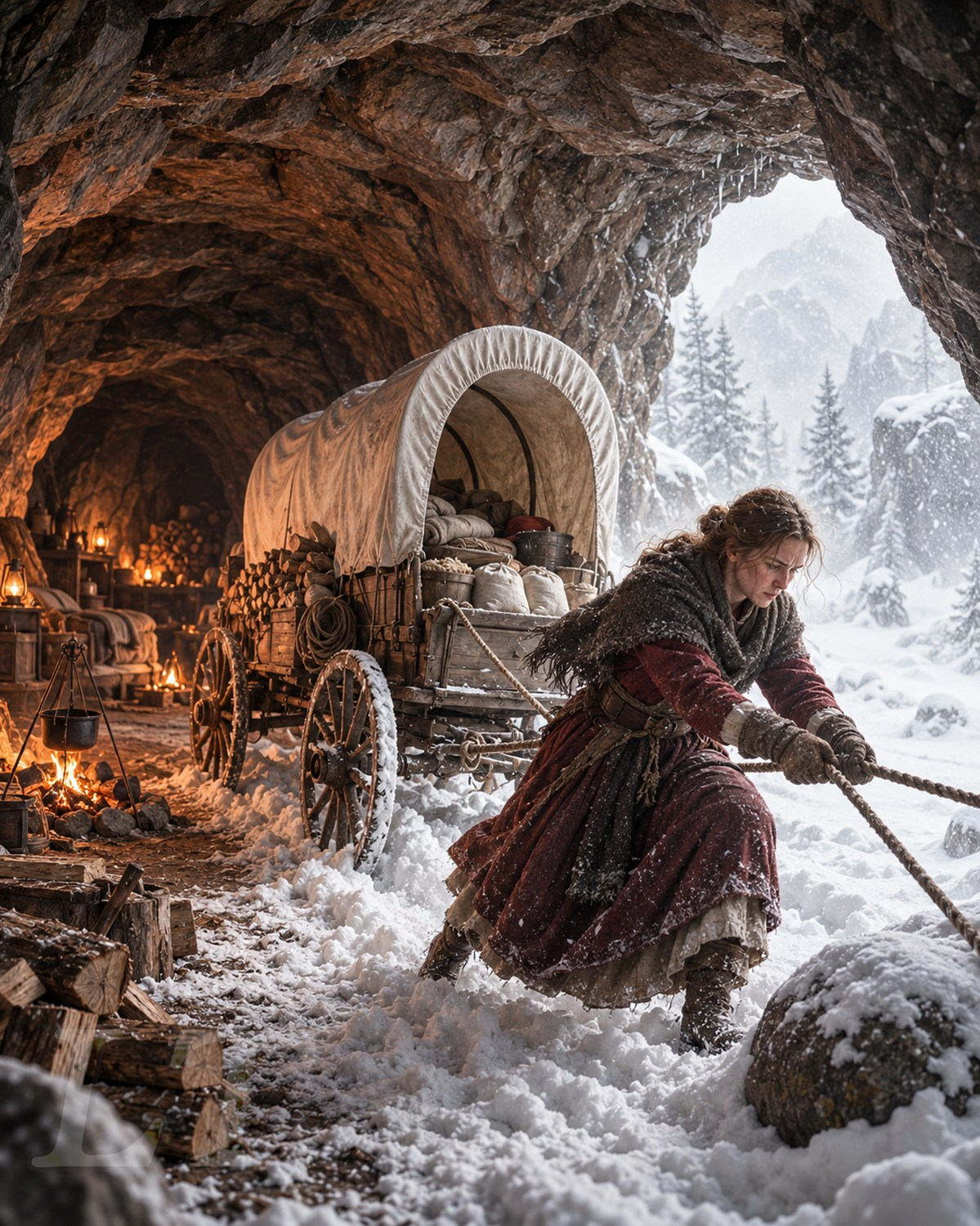
The first thing Adeline heard was the wind.
It moved through the cave entrance with a low, hollow whistle, pushing loose snow across the stone floor.
She stood beside the wagon, holding her father's axe.
For several seconds, she studied the collapsed hunters' shelter.
There was more damage than she had expected.
Two heavy wooden beams had fallen across the entrance. One was partially buried beneath snow, while the other rested against a large limestone boulder. Several smaller branches had broken apart and scattered across the ground.
The shelter had once been useful.
Now it was barely more than a place where a desperate traveler might stop before freezing to death.
Adeline looked toward Barley.
The old horse was standing near the wagon, shifting his weight from one leg to another. His ears moved nervously whenever the wind rushed through the cave.
She approached him and rubbed his neck.
"We need to make this work."
Barley lowered his head.
Adeline untied the leather harness and allowed him to rest.
Then she began unloading the wagon.
The sacks of flour and beans went onto a relatively dry patch of stone. She placed the dried meat inside a wooden crate and covered it with a blanket.
The oats were especially important.
Barley could survive for a short time on hay and whatever vegetation he might find beneath the snow, but the winter would make grazing nearly impossible.
She measured a small portion into his feeding bag.
"Not too much," she whispered. "We have to be careful."
While Barley ate, Adeline inspected the cave.
Her father had shown her the shelter years earlier, but she had been a child then. She remembered the wide opening, the rough stone walls, and the feeling of being protected from the wind.
She did not remember the broken timber.
Nor had she understood how difficult it would be to keep a fire burning inside a natural rock formation.
She walked toward the back wall.
The limestone was uneven and damp.
Water had collected in several shallow depressions.
A thin stream ran down one side of the rock and disappeared beneath a pile of stones.
Adeline crouched and touched it.
Cold.
Almost painfully cold.
She moved her lantern closer.
There was a narrow ledge above the damp section where she could store food and tools. It was not ideal, but it was better than leaving everything on the wet ground.
She began carrying supplies there.
By the time she finished, her shoulders ached.
She removed her gloves and rubbed her fingers together.
They were already becoming red.
The temperature inside the cave was only slightly warmer than outside.
She needed a fire.
Adeline gathered the driest pieces of wood from the wagon and arranged them near the entrance.
She remembered watching Thomas build fires during their hunting trips.
He always began with the smallest pieces.
Thin branches.
Dry bark.
Shavings from fallen wood.
Then he gradually added larger pieces.
"Fire needs patience," he used to say. "Give it too much too soon, and you'll smother it."
Adeline collected some dry bark and scraped thin curls from a piece of wood.
She arranged them carefully.
Then she struck a match.
The first one broke.
The second burned out before reaching the bark.
The third finally caught.
A small flame appeared.
Adeline leaned closer, protecting it with her hands.
The fire grew slowly.
Orange light moved across the limestone walls.
For a few precious minutes, the cave looked almost welcoming.
She placed a small piece of wood onto the flames.
Then another.
The warmth began reaching her face.
Adeline closed her eyes.
She had not realized how badly she needed that feeling.
She imagined her mother's kitchen.
The smell of fresh bread.
The old kettle singing over the stove.
Thomas sitting at the table, cleaning his tools after a long day.
For a moment, she was home again.
Then she coughed.
Once.
Then again.
She opened her eyes.
A thin layer of smoke was collecting beneath the cave ceiling.
Adeline looked upward.
The smoke had nowhere to go.
She stood quickly and examined the rock above the fire.
There was no chimney.
No obvious opening.
The natural entrance was partially blocked by the collapsed shelter, and the wind outside was blowing directly toward the cave.
She grabbed a branch and tried moving the burning wood closer to the entrance.
The wind immediately pushed smoke back toward her.
She coughed harder.
Her eyes began watering.
"Come on."
She moved another piece of wood.
A gust of wind swept through the cave.
Several sparks jumped from the fire.
One landed near the hay.
Adeline reacted immediately.
She stamped it out with her boot.
Another spark landed against a piece of dry cloth.
She grabbed it and threw it onto the rocky floor.
Her heart was racing.
A fire could warm them.
But it could also burn the entire shelter.
She looked toward Barley.
The horse had moved farther back, away from the smoke.
His nostrils flared.
Adeline understood.
She could not keep the fire burning in its current position.
She grabbed the iron shovel and pushed the burning wood toward the entrance.
Then she smothered the flames with a layer of damp earth and snow.
The orange light disappeared.
Darkness returned.
For several moments, she simply stood there.
The cave was cold again.
The smoke slowly began thinning.
Adeline wiped her eyes.
She had failed.
Not because she lacked determination.
Because she had not understood the mountain.
She sat on a flat stone and looked at her father's axe.
Its wooden handle was worn smooth from years of use.
She remembered him teaching her how to split logs.
She remembered the small workshop behind the farmhouse.
And she remembered something else.
A conversation from years earlier.
Thomas had been repairing a wooden stove when Adeline asked why some chimneys pulled smoke upward while others filled the room.
He had laughed.
"Air has to move somewhere, little bird. Fire needs a way to breathe. A room without proper ventilation can turn dangerous faster than you think."
He had shown her how a draft worked.
Warm air rose.
Cool air entered to replace it.
A properly designed opening allowed smoke to escape while fresh air continued feeding the fire.
Adeline looked toward the ceiling.
Perhaps the cave had a natural passage.
Perhaps her father had noticed it when he first brought her here.
She stood and lifted the lantern.
The flame flickered.
Then it leaned.
Not toward the entrance.
Toward the back wall.
Adeline froze.
She moved the lantern closer to the stone.
The flame bent farther toward a narrow crack between two limestone formations.
She pulled it away.
The flame straightened.
She moved it closer again.
It bent in the same direction.
Adeline stared at the crack.
Air was moving through it.
She raised the lantern higher.
The opening continued upward, disappearing into darkness.
Her father's voice seemed to return to her.
Air has to move somewhere.
She looked at the floor.
Then at the ceiling.
A small possibility began forming in her mind.
If the narrow opening continued through the mountain, perhaps she could widen it enough to create a natural chimney.
But she could not know how deep it went.
She could not even know whether the rock would allow it.
Still, it was the first useful discovery she had made since arriving.
She returned to the wagon and opened the tool chest.
Inside were Thomas's hammer, chisel, hand saw, several metal wedges, and a small collection of other tools.
She carefully selected the hammer and chisel.
Then she examined the crack again.
The opening was too narrow for her hand.
But she could reach the lower section.
She placed the chisel against a loose edge of limestone and tapped it gently.
A small fragment fell.
She repeated the movement.
Another fragment broke away.
The work was slow.
Each strike sent a dull echo through the cave.
After several minutes, she stopped.
Her arms were trembling.
She needed to save her strength.
She also needed to keep Barley fed.
Adeline returned to the horse.
He had finished his oats and was resting near the wagon.
She checked his legs, inspected the harness, and brushed snow from his mane.
There was a small scrape near one shoulder where the leather had rubbed against his skin.
She cleaned it with a little water and wrapped a strip of cloth around the damaged area.
"Sorry, Barley."
The horse turned his head toward her.
She rested her hand against his cheek.
"I should have brought more grain."
Her voice broke slightly.
She looked away before the tears could fall.
She could not afford to waste food.
She could not afford to waste daylight.
And she could not afford to lose him.
Adeline spent the next hour repairing the wagon.
She removed the damaged rear wheel and examined the broken spoke.
The wood had split along the grain.
A proper replacement would require a workshop, but she could make a temporary brace using a straight piece of timber.
She selected a branch from the firewood pile, cut it to the appropriate length, and shaped one end with her father's knife.
The repair was rough.
But it held.
She pushed the wagon forward.
The wheel turned.
Adeline allowed herself a small breath of relief.
At least one thing had gone right.
By the time she finished, the light outside had begun fading.
She returned to the narrow crack.
The lantern flame still leaned toward it.
She placed a small strip of cloth near the opening.
It moved gently.
There was definitely a current of air.
Adeline examined the limestone around the crack.
Some sections were solid.
Others appeared fractured.
She remembered her father warning her never to strike a mountain wall carelessly.
A stone that appeared loose might be supporting a much larger section.
She studied the formation before choosing where to work.
Then she began carefully removing the smaller fragments.
One.
Two.
Three.
The opening widened slightly.
A cold stream of air brushed her face.
She looked upward.
For the first time, she could see a faint trace of pale daylight far above the narrow passage.
It was not enough.
But it was something.
She continued until her arms could no longer manage the hammer.
Then she stopped.
She needed rest.
She needed food.
And tomorrow, she would need to find a way to make the ventilation opening large enough for smoke to escape.
Adeline prepared a small meal of beans and dried meat.
She warmed it over a tiny fire near the entrance, keeping the flames low and watching the smoke carefully.
This time, she did not allow the fire to grow.
She ate slowly.
Barley rested nearby.
The wind continued howling outside.
As darkness settled, Adeline arranged the blankets against the driest section of the cave.
She placed the tool chest beside her.
The lantern remained close enough to reach.
She was exhausted.
But before lying down, she looked toward the narrow opening above the back wall.
The flame moved gently toward it.
She smiled faintly, not with happiness, but with the relief of someone who had finally found a direction.
"Tomorrow," she whispered.
She covered Barley with the spare blanket and settled beside him.
For the first time since leaving the farmhouse, she allowed herself to sleep.
But the mountain was not finished testing her.
Sometime after midnight, a deep cracking sound echoed through the cave.
Adeline woke immediately.
She sat up.
Barley was already standing.
Another sound followed.
A heavy piece of limestone shifted somewhere above the back wall.
Adeline reached for the lantern.
The flame flickered wildly.
Then she heard something that made her blood run cold.
Water.
A sudden stream of water was beginning to run through the narrow opening she had spent the afternoon widening.
And the stone beneath it was starting to move.






Comments 0