Merritt Ainsworth stared at the unfinished sentence until the letters blurred.
"Merritt, if you are reading this, then the men who killed me have..."
Her hands trembled.
Four years.
For four years, she had believed her husband died beneath a collapsed mine roof.
Four years of accepting condolences from men who had carried his coffin.
Four years of thanking people who told her Jonas had simply been unlucky.
Now she was standing inside a hidden chamber beneath the Colorado mountains, holding a letter written in his unmistakable handwriting.
And the first sentence was telling her that his death had been no accident.
She lifted the lantern closer.
The paper had been folded so many times that the creases threatened to split.
A dark stain covered the lower corner.
Merritt swallowed and carefully opened the remaining folds.
The sentence continued.
"...already discovered what I found beneath the eastern ridge."
She stopped.
The silence inside the mountain seemed to deepen.
Outside, the wind moved through the narrow entrance with a low, hollow whistle.
Merritt read on.
My dearest Merritt,
If this letter has reached your hands, I must assume I have failed to return home safely.
I pray that I am wrong.
I pray that someday we will sit together beside our fireplace and laugh about how frightened I was when I wrote these words.
But if that day never comes, there are things you must know.
Barnaby Thorne is not the man he pretends to be.
Merritt's fingers tightened around the paper.
She remembered Thorne standing outside Cordelia's store.
His polished boots.
His careful smile.
His offer of fifteen hundred dollars.
The way he had spoken about the law as though it belonged to him.
She forced herself to continue.
Three weeks ago, I was assigned to inspect an abandoned survey passage connected to the Aspen Fork workings.
The passage lies beneath the eastern ridge, not far from our homestead.
What I discovered there was not copper.
It was evidence.
Evidence that Thorne has been concealing the true value of several mineral deposits while purchasing surrounding claims through dishonest means.
I also found records suggesting that men who refused to sell their land were deliberately driven away.
Some were threatened.
Some were ruined.
And at least one never came home.
Merritt lowered the letter.
Her breathing had become shallow.
Jonas had never told her any of this.
Not once.
He had come home tired from the mine, washed the dust from his hands, and spoken about planting potatoes.
He had kissed her forehead while she stirred supper.
He had complained about the price of nails.
He had made plans for a porch.
All the while, he had been carrying a secret dangerous enough to get him killed.
She looked toward the carved warning on the granite wall.
DO NOT TRUST THORNE.
The letters were rough but unmistakable.
Jonas had carved them himself.
She remembered his handwriting.
The way he formed his capital J.
The slight downward slant of his letters.
Even his grocery lists had looked like instructions written by a schoolteacher.
There could be no mistake.
She raised the letter again.
I have hidden copies of what I found.
The originals may already be gone.
If anything happens to me, do not surrender our land.
Whatever Thorne offers, refuse him.
The mountain contains something he cannot afford to let the authorities discover.
And the entrance is closer to our home than anyone realizes.
The final paragraph was shorter.
Forgive me for keeping this from you.
I thought silence would protect you.
If I was wrong, I hope you will someday understand.
I love you more than this mountain, more than the land, and more than any dream we ever made together.
Your Jonas.
Merritt read the final words three times.
Then she pressed the paper against her chest.
For a moment, she was no longer standing inside a cave.
She was twenty-nine again.
Jonas was alive.
His boots were muddy.
His hands smelled of pine resin and iron.
He was laughing because the roof beam had fallen on his foot, and he insisted the beam had suffered more than he had.
She could almost hear him.
Almost.
Then the memory disappeared.
Merritt sank onto a flat stone.
She had spent four years learning how to live without her husband.
Now, in a single evening, she had discovered that she might never have understood how he died.
Her eyes filled.
She allowed herself one quiet sob.
Only one.
Then she wiped her face.
"All right, Jonas," she whispered. "Tell me what you were trying to protect."
The wooden box rested beside the wall.
Merritt set the letter carefully inside her cloak and examined it.
The iron bands were rusted.
One corner had split.
The lid was partially crushed beneath a fallen stone.
She touched the wood.
It crumbled beneath her fingers.
Whatever had been stored inside had remained untouched for years.
She removed the broken lid.
Inside lay a small leather pouch, a folded sheet of thick paper, and a brass object wrapped in cloth.
Merritt lifted the pouch first.
It contained six silver dollars.
She recognized two of them.
Jonas had kept them in a drawer beside their bed.
He called them his emergency money.
He had once told her that a man should always keep enough silver hidden away to get his wife home safely.
Merritt closed her fingers around the coins.
"Still looking after me," she murmured.
She returned them to the pouch.
Next came the folded paper.
It was a map.
Not a government survey.
A hand-drawn diagram of the mountain ridge.
Jonas had sketched the cabin, the creek, the old mining road, and several rocky outcroppings.
A narrow line ran from the cave chamber toward the eastern side of the mountain.
At its end, he had drawn a square.
Beside it were the words:
OLD SURVEY ROOM.
Beneath those words, another note appeared.
Second record hidden beyond the iron door.
Merritt frowned.
An iron door?
She looked around the chamber.
The lantern illuminated rough granite, scattered stones, and the narrow passage through which she had entered.
There was no iron door.
Not here.
She studied the map again.
The passage seemed to continue deeper into the mountain.
Perhaps beyond the smaller opening behind the granite column.
She looked toward it.
Darkness filled the narrow gap.
Something about that darkness unsettled her.
She had already discovered more than she could understand.
Exploring farther without preparation would be foolish.
And Merritt had survived four years alone by learning when courage became recklessness.
She folded the map.
Then she unwrapped the brass object.
It was a key.
Heavy.
Old-fashioned.
Its bow was shaped like a small circle, and its shaft ended in three uneven teeth.
A number had been stamped into one side.
17.
Merritt turned it over.
On the other side, Jonas had scratched a single letter.
M.
Her initial.
She stared at it.
He had left the key for her.
Not for the mine owners.
Not for the sheriff.
For her.
She slipped it into the pocket of her dress.
Then she gathered the remaining objects and placed them inside her canvas bag.
She was about to stand when she noticed something beneath the empty box.
A small piece of cloth protruded from the gravel.
She pulled it free.
It was a strip of blue cotton.
Faded.
Torn.
Stained with old dust.
Merritt recognized the fabric immediately.
Jonas had worn a blue work shirt on the morning he died.
She had sewn the left sleeve herself after it caught on a nail.
The repair had been crooked.
He had teased her about it for weeks.
Now she held a torn piece of that same shirt.
Her throat tightened.
If Jonas had hidden this box before his death, why had part of his shirt been left beneath it?
Had he been injured?
Had someone followed him?
Had he returned here after discovering that his life was in danger?
She looked toward the deeper passage.
A terrible possibility entered her mind.
What if the mine collapse had not happened where everyone claimed?
What if Jonas had discovered something inside this mountain and tried to escape?
Merritt stood.
The lantern flame moved sharply.
A gust of air passed through the chamber.
She turned toward the entrance.
The last daylight had nearly disappeared.
She had to leave.
Deacon was waiting when she emerged.
The mule lifted his head and gave a low, impatient sound.
Merritt touched his neck.
"You found it, didn't you?"
Deacon blinked.
"You knew there was something here."
The animal lowered his head toward her pocket.
She laughed softly despite herself.
"No, you cannot eat the evidence."
She untied the rope and wound it around her arm.
Then she looked back at the cave entrance.
From outside, the opening seemed almost impossible to notice.
The overhanging granite concealed it.
A person walking along the trail would see only shadow.
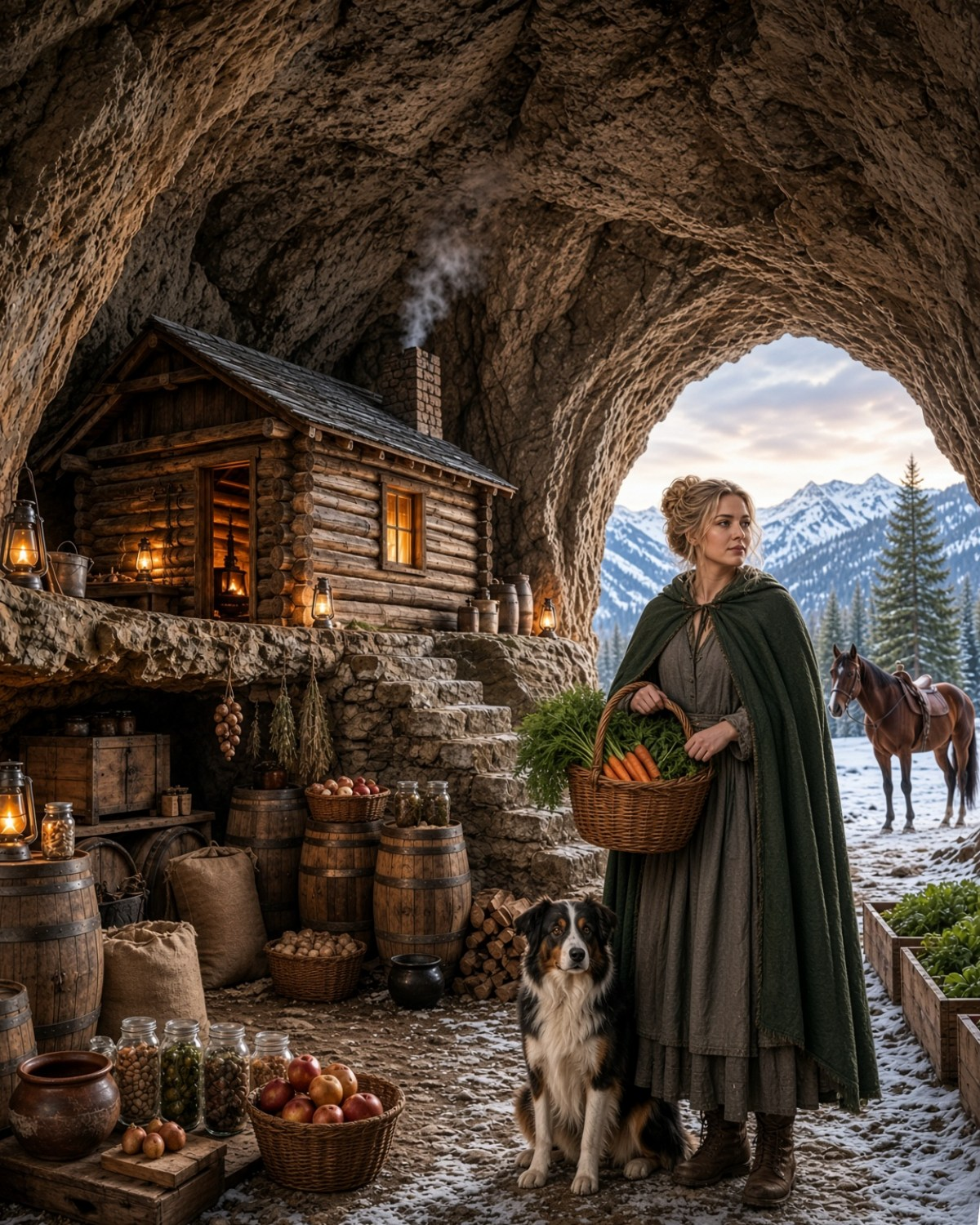
Yet beyond that shadow lay a chamber large enough to shelter her cabin, her supplies, and perhaps even Deacon.
She imagined the structure she might build.
A sturdy log room against the eastern wall.
A stone hearth.
A properly vented chimney.
A sheltered storage area.
She could use timber from her land.
The mountain would provide the roof.
And the walls would never twist as green pine logs did.
She felt a small, unfamiliar surge of excitement.
For the first time since autumn began, she had discovered a solution that did not require money she lacked.
But the discovery came with a danger she could not ignore.
Barnaby Thorne wanted her land.
Jonas had known why.
And now she possessed a letter accusing the richest man in the valley of crimes serious enough to destroy him.
Merritt looked down at the canvas bag.
She needed to protect it.
She also needed someone she could trust.
Only one name came immediately to mind.
Cordelia Vance.
But even Cordelia had customers, employees, and neighbors who listened too carefully.
Merritt could not simply ride into town waving a letter.
Not yet.
She would have to be patient.
She would have to be clever.
And she would have to survive the winter long enough to expose the truth.
She led Deacon down the trail.
By the time Merritt reached the cabin, darkness had settled over the mountains.
She fed the mule and secured him in the small lean-to beside the eastern wall.
Then she entered the house.
The interior was colder than the outside air had been an hour earlier.
She knelt beside the fireplace.
The ashes were damp.
A thin draft moved across the floor.
Merritt stared at the hearth.
She could light a fire.
But if the wind shifted, smoke might fill the room again.
She looked toward the window.
Beyond the glass, the mountain stood dark against the night sky.
Somewhere inside it was a chamber protected from the wind.
A chamber Jonas had discovered before his death.
She wondered whether he had intended to build there.
Perhaps the map contained more than a route to hidden records.
Perhaps he had imagined the same shelter she now imagined.
She placed the canvas bag beneath her bed.
Then she took out the letter.
She read it again.
Slowly.
This time, she paid attention to every word.
One sentence troubled her more than the others.
The mountain contains something he cannot afford to let the authorities discover.
Not something valuable.
Something dangerous.
Evidence.
She considered the distinction.
If Thorne wanted silver or copper, he might simply purchase mineral rights.
But if he wanted to conceal evidence of wrongdoing, he would need control of the entire property.
That explained his offer.
It also explained his threats.
He could not risk Merritt discovering what Jonas had hidden.
And yet he had waited four years.
Why?
Perhaps he did not know where the records were.
Perhaps he believed Jonas had destroyed them.
Or perhaps he had been waiting for Merritt to abandon the homestead so he could search without witnesses.
She folded the letter.
A knock sounded at the door.
Merritt froze.
It was nearly eight o'clock.
No one visited her cabin after dark.
Not without warning.
She remained still.
The knock came again.
Three firm strikes.
"Merritt?"
She recognized the voice.
Caleb Mercer.
Her nearest neighbor.
He owned a small cattle holding two miles down the slope.
Caleb was forty-six, broad-shouldered, and usually smelled of tobacco and horses.
His wife, Ruth, had died of fever the previous winter.
Since then, he had become quieter.
Merritt opened the door a few inches.
"Caleb?"
He stood outside holding a lantern.
His hat was pulled low.
"Evening, Mrs. Ainsworth."
"Is something wrong?"
He glanced behind him.
"Mind if I come in?"
Merritt hesitated.
Caleb had always treated her kindly.
He had helped repair her fence after a spring storm.
He had brought potatoes when her garden failed.
But tonight, his expression was different.
Nervous.
She opened the door.
He stepped inside.
The cold followed him.
"You're out late," she said.
"I know."
He removed his hat.
"I came because I heard something in town."
Merritt felt her stomach tighten.
"About what?"
Caleb looked toward the window.
"Your land."
She kept her face neutral.
"What about it?"
"Thorne's been talking to the county clerk."
"I know."
"No, Merritt. You don't."
He stepped closer.
"He's preparing papers."
"What kind of papers?"
"A challenge to your homestead claim."
Merritt said nothing.
Caleb continued.
"He says you haven't made sufficient improvements. Says the cabin isn't fit for habitation."
"I've lived here for four years."
"That may not matter if he convinces the land office you've abandoned the place."
"I haven't abandoned anything."
"I know."
Caleb lowered his voice.
"But he doesn't need the truth. He needs someone willing to swear to a lie."
Merritt remembered Edwin Pike standing beside the carriage.
The surveyor's uncomfortable expression.
The red mark on the map.
"Who?"
Caleb hesitated.
"That's the trouble."
"Tell me."
"He's offering money."
"To whom?"
"Anyone willing to testify that you've spent too much time away from the property."
Merritt stared.
She had traveled to town only when necessary.
She had slept in her cabin nearly every night since Jonas died.
Yet a few dishonest statements might be enough to create trouble.
"Why are you telling me this?" she asked.
Caleb looked offended.
"Because Jonas was my friend."
Merritt studied him.
"Was he?"
The question came out more sharply than she intended.
Caleb's face changed.
"Of course he was."
"Then tell me something."
He waited.
"Did Jonas ever mention trouble at the Aspen Fork mine?"
Caleb became very still.
For a moment, the only sound was the wind moving through the cracks in the wall.
"What kind of trouble?" he asked.
Merritt watched him carefully.
"Anything unusual."
Caleb looked toward the fireplace.
"Mining's dangerous work."
"That isn't what I asked."
He rubbed his jaw.
"Merritt, I don't know what you've heard."
"Then tell me what you know."
Caleb remained silent.
She took one step closer.
"Did Jonas ever tell you he was afraid of Barnaby Thorne?"
Caleb's head snapped toward her.
The reaction was immediate.
Too immediate.
Merritt felt her pulse quicken.
"You knew," she whispered.
Caleb closed his eyes.
"Lord help me."
"What did you know?"
He sat heavily in the wooden chair beside the table.
For several seconds, he said nothing.
Then he looked up.
"About a week before Jonas died, he came to my place."
Merritt gripped the edge of the table.
"He was upset," Caleb continued. "More upset than I'd ever seen him."
"Why?"
"He said he'd found something in the old survey workings."
Merritt barely breathed.
"What?"
"He wouldn't tell me."
"Why not?"
"He said the fewer people who knew, the safer we'd be."
Merritt felt anger rising.
"Then why didn't you tell me after he died?"
Caleb looked ashamed.
"Because I was frightened."
The answer was so simple that it stunned her.
Caleb stared at his hands.
"Two days after the collapse, a man came to my ranch."
"Who?"
"I never got his name."
"What did he want?"
"He asked whether Jonas had left anything with me."
Merritt's mouth went dry.
"What did you say?"
"I told him no."
"And?"
"He said that was fortunate."
Caleb swallowed.
"Then he told me I had two children depending on me, and it would be a terrible thing if another accident happened."
Merritt stepped back.
Caleb's voice broke.
"My youngest was only six."
She looked at him.
For years, she had wondered why some of Jonas's friends stopped visiting after the funeral.
She had assumed they were uncomfortable around grief.
Now she understood that fear might have been involved.
"I'm sorry," Caleb said.
Merritt wanted to be angry.
Part of her was.
But she also knew what it meant to be alone and afraid.
"Did you recognize the man?" she asked.
Caleb shook his head.
"He wore a dark coat. Had a scar near his left ear."
"Was he from town?"
"I don't think so."
Merritt considered the description.
"Did you see him again?"
"Once."
"When?"
"Last week."
Her blood chilled.
"Where?"
"Outside Thorne's office."
Silence settled between them.
Caleb stood.
"Whatever Jonas found, Merritt, leave it alone."
She looked at him.
"I can't."
"Then sell the land and get out."
"No."
He shook his head.
"You're making a mistake."
"Maybe."
"Merritt—"
"But it's mine to make."
Caleb studied her for a long moment.
Then he put on his hat.
"Lock your door tonight."
She followed him to the threshold.
"Caleb?"
He turned.
"Did Jonas say anything else?"
The rancher hesitated.
"Just one thing."
"What?"
"He said if anything happened to him, you were smarter than all of us put together."
Merritt felt tears rise.
Caleb looked away.
"Good night."
He disappeared into the darkness.
Merritt locked the door.
Then she dragged the wooden table against it.
She knew the furniture would not stop a determined intruder.
But it might buy her a few seconds.
She took Jonas's rifle from the wall.
Checked the chamber.
Loaded it.
Then she placed it beside her bed.
For the first time since her husband's death, she felt that someone might be watching the cabin.
She extinguished the lantern.
Darkness filled the room.
She sat beside the window.
The mountains were silent.
A thin moon hung above the ridge.
The wind had eased.
She could hear Deacon shifting in the lean-to.
Merritt waited.
An hour passed.
Then another.
Nothing happened.
Eventually, exhaustion overcame her fear.
She lay down without removing her boots.
The rifle rested within reach.
But sleep did not come easily.
Every creak of the cabin sounded like footsteps.
Every gust against the wall seemed deliberate.
She thought of Jonas.
Of the letter.
Of the key marked seventeen.
And of the hidden passage leading toward an iron door.
Somewhere inside that mountain was evidence powerful enough to frighten Barnaby Thorne.
She needed to find it.
But first, she needed a home that would survive the winter.
At dawn, Merritt began measuring the cave.
She carried a length of rope, a notebook, a carpenter's square, and the lantern.
Deacon followed her up the trail.
The air was bitterly cold.
Frost covered the grass.
The creek had formed a thin crust of ice.
Inside the cave, however, the temperature felt noticeably steadier.
Merritt noticed it immediately.
Her breath remained visible, but the biting wind disappeared.
She measured the broad stone shelf.
Twenty-eight feet across.
Nearly twenty feet deep.
More than enough room for a small cabin.
The ceiling rose high above it.
A natural stone column separated the shelf from the deeper passage.
She inspected the floor.
Solid granite.
Dry.
She examined the overhead rock for loose fractures and found none obvious, though she knew a proper inspection would require care.
The cave was not automatically safe simply because it looked impressive.
She would have to test it.
Watch how water moved during storms.
Check for falling stone.
Determine whether a chimney could be vented without filling the chamber with smoke.
And make sure Deacon could enter without injuring himself.
But the possibilities were extraordinary.
She could dismantle part of the old cabin.
Reuse the strongest logs.
Carry them to the cave.
Build beneath the natural overhang.
A smaller house would require less firewood.
The stone would shield it from the wind.
She could store vegetables along the cooler wall.
And the cave entrance was wide enough to build a small enclosed shelter for the mule.
Merritt opened her notebook.
She began drawing.
A wall here.
A door there.
A hearth near the natural ventilation shaft.
A storage area behind the cabin.
She worked for nearly two hours.
When she finally stepped back, she had sketched the outline of a home.
Not the home Jonas had imagined.
But one that might save the dream they had shared.
She looked at the drawing.
Then at the stone shelf.
"I can do this," she whispered.
For the first time, she believed it.
She would need timber.
Nails.
Mortar.
A properly constructed flue.
And help moving the heaviest logs.
She thought of Cordelia.
Perhaps the older woman knew someone willing to work for food and a few dollars.
Perhaps Caleb would help despite his fear.
But she could not risk telling anyone about Jonas's letter.
Not yet.
She folded the notebook.
Then a sound echoed from the deeper passage.
A metallic sound.
Sharp.
Distinct.
Merritt froze.
She turned toward the granite column.
The noise came again.
Clink.
Then silence.
She raised the lantern.
"Hello?"
No answer.
She waited.
A faint scraping sound followed.
It seemed to come from somewhere beyond the narrow passage.
Merritt's heart began pounding.
She had assumed the cave was empty.
But the map showed an old survey room.
An iron door.
And possibly another entrance somewhere on the eastern ridge.
What if someone else knew about it?
What if someone had already entered?
She slowly approached the narrow opening.
The lantern flame flickered.
She could see only a few feet into the darkness.
"Who's there?"
Silence.
Then another sound.
A dull impact.
As though something heavy had shifted against stone.
Merritt took one step backward.
She remembered Caleb's warning.
Lock your door tonight.
She looked toward the entrance.
Daylight remained visible beyond the chamber.
Deacon stood outside.
She could retreat.
Return with a rifle.
Wait for help.
That would be sensible.
But another thought stopped her.
What if the sound came from an old piece of machinery?
What if the iron door was shifting in the draft?
What if the mountain was settling?
She had no way to know.
Merritt lowered the lantern and listened.
The scraping came again.
Closer this time.
Her skin prickled.
She took another step backward.
Then the lantern illuminated something she had not noticed before.
A narrow iron rail embedded in the stone floor.
It disappeared beneath the gravel.
She crouched.
Brushed away the loose dirt.
The rail continued into the passage.
An old mine-cart track.
She followed it with her eyes.
It ran directly toward the darkness.
And resting beside it was a fresh boot print.
Merritt stared.
The impression was sharp.
The edges had not crumbled.
Someone had walked through the passage recently.
Very recently.
She slowly stood.
Then she noticed a second print.
And a third.
They led toward the chamber where she was standing.
Her breath caught.
The footprints were not pointing deeper into the mountain.
They were pointing toward her.
She raised the lantern.
A shadow moved beyond the granite column.
Merritt stepped backward.
The metallic scraping stopped.
For one terrible second, the entire cave became silent.
Then a man's voice came from the darkness.
"Mrs. Ainsworth?"
Merritt's blood turned cold.
The voice was unfamiliar.
But the next words were not.
"Your husband told me you'd come looking."
She gripped the lantern.
"Who are you?"
No answer.
A heavy iron latch clicked somewhere beyond the passage.
Then another.
Merritt watched the darkness.
A narrow door began to open.
And from the other side, a man whispered:
"Don't move. There's someone standing behind you."






Comments 0