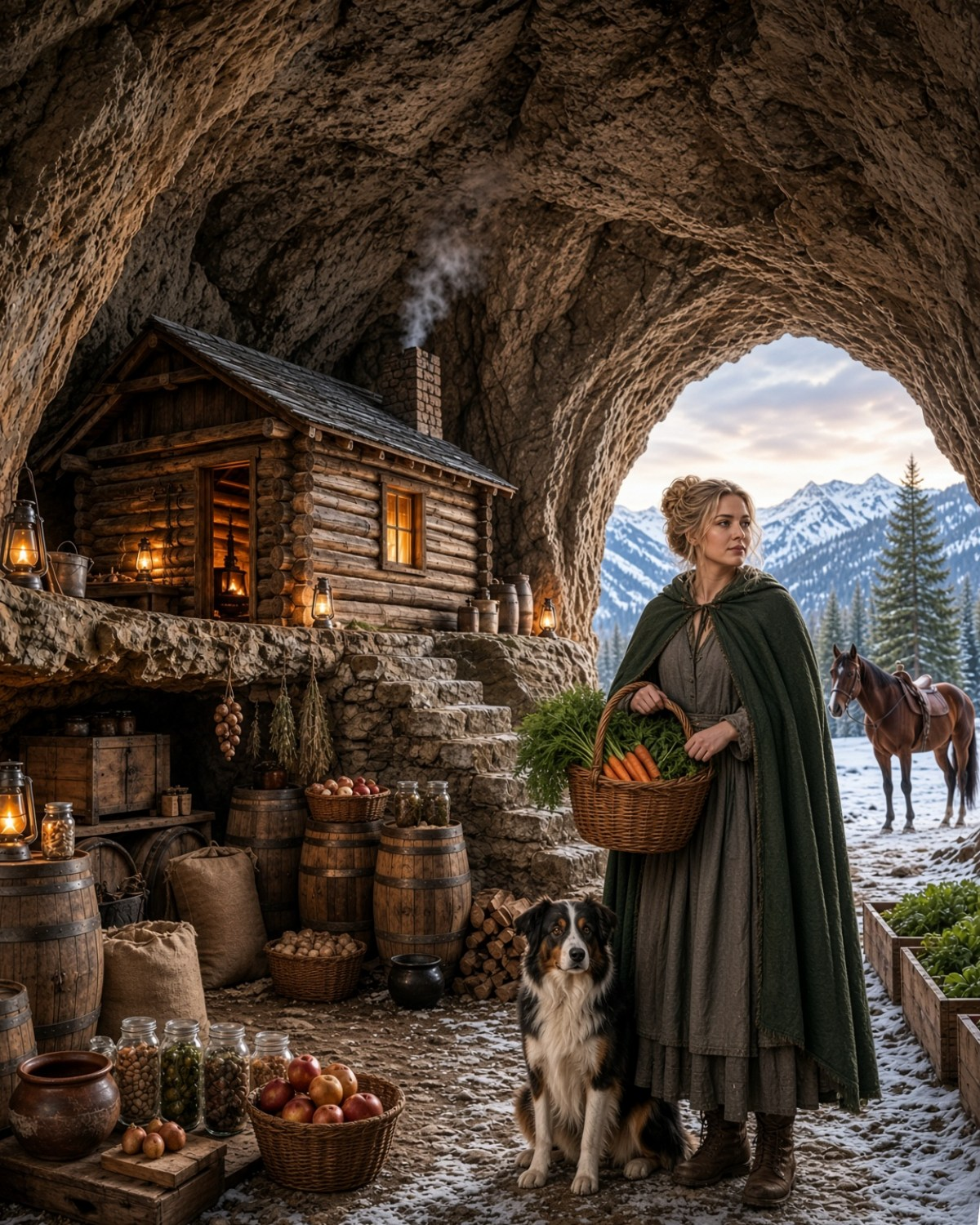
"Get your hands off my husband's land!"
Merritt Ainsworth stepped between Barnaby Thorne and the surveyor holding a folded homestead map.
The richest man in Copperline Hollow pointed at a small red mark beside her property line.
Three words were written beneath it.
CLAIM SUBJECT TO CONTEST.
Thorne wasn't offering to buy her land anymore.
He was preparing to take it.
Merritt looked from the map to the man holding it.
"Where did you get that?"
Barnaby Thorne smiled without showing his teeth.
"From someone who understands how the law works, Mrs. Ainsworth."
The surveyor, a thin fellow named Edwin Pike, shifted his weight uncomfortably. He had been standing beside Thorne's carriage when Merritt rode into town, and now he seemed determined to look anywhere except at her.
"That's my husband's claim," she said.
"Your late husband's claim," Thorne corrected.
The distinction was deliberate.
Merritt felt it like a small knife pressed against an old wound.
Four years had passed since Jonas Ainsworth died beneath six tons of broken rock in the Aspen Fork copper mine.
Four years since two miners carried a pine coffin up the trail to her cabin.
Four years since the preacher stood beside a grave and explained that the Lord sometimes called good men home before their work was finished.
Merritt had never found much comfort in that explanation.
Jonas had been twenty-nine years old.
He had wanted a farm, three children, and a porch facing the morning sun.
Instead, he had received a grave beneath a crooked pine tree.
And Merritt had inherited a hundred and sixty acres of stubborn Colorado wilderness.
Now Barnaby Thorne wanted those acres.
"You have no authority to contest my claim," she said.
Thorne slowly removed his gloves.
"Authority is an interesting word. The government has authority. The land office has authority. And the law has requirements."
"I know the requirements."
"Then you know that a homestead claimant must establish residence and make improvements."
"I live there."
"In a structure that may not survive November."
Merritt's fingers tightened around Deacon's reins.
The mule stood beside her, patiently chewing the corner of a dry weed.
"That's none of your business."
"Actually, it may become everyone's business."
Thorne stepped closer.
His coat was dark wool, tailored in Denver. His boots had been polished so thoroughly that they reflected the pale afternoon light.
He looked like a man who had never carried his own firewood.
"I made you a generous offer," he continued. "Fifteen hundred dollars. Three times what that miserable piece of mountain is worth."
"Then why do you want it?"
For the first time, his expression changed.
Only slightly.
But Merritt noticed.
"I have investments in the valley."
"Then invest somewhere else."
Pike coughed.
Thorne glanced at him.
The surveyor immediately became interested in the mud beneath his boots.
"Mrs. Ainsworth," Thorne said, lowering his voice, "I admire determination. But there is a difference between determination and foolishness."
Merritt said nothing.
"You are a woman alone. Winter is approaching. Your cabin is failing. You have no livestock worth mentioning, no hired hands, and no family within five hundred miles."
"I have a mule."
Thorne looked at Deacon.
The animal blinked.
"Yes," Thorne said dryly. "A magnificent empire."
A man standing outside the neighboring blacksmith shop laughed.
Another joined him.
Merritt kept her eyes on Thorne.
She had learned something during four years of widowhood.
People expected a woman alone to explain herself.
They expected apologies.
Gratitude.
Tears.
And when none appeared, they became offended.
"You can keep your money," she said.
Thorne's smile disappeared.
"Be careful."
"Of what?"
"Of confusing pride with survival."
Merritt stepped around him.
He caught her attention with one final sentence.
"When the snow comes, Mrs. Ainsworth, remember that I offered you a way out."
She stopped.
Then she turned.
"And when spring comes, Mr. Thorne, remember that I refused."
She climbed onto Deacon and rode away.
Behind her, someone laughed again.
This time, she did not look back.
Cordelia Vance caught up with her outside the general store.
"Merritt!"
The older woman hurried down the wooden steps, holding a small brown parcel against her chest.
Cordelia was fifty-eight, broad-shouldered, and permanently unimpressed by most of the men in Copperline Hollow.
She had buried two husbands.
The first died of pneumonia.
The second fell from a wagon after insisting he could drive six miles home while drunk.
Cordelia had once remarked that she missed the first and regretted the second.
"Take this," she said.
Merritt looked at the parcel.
"What is it?"
"Coffee. A little sugar. Some dried beans."
"I didn't order those."
"I know."
"Cordelia—"
"Don't start."
Merritt sighed.
"I can pay you next month."
"You can pay me when you're rich."
"Then you'll be waiting a while."
Cordelia gave her a hard look.
"Not necessarily."
Something in her voice made Merritt pause.
"What does that mean?"
Cordelia glanced toward the street.
Thorne was speaking with Pike beside his carriage.
"That man doesn't offer fifteen hundred dollars for worthless land."
"I know."
"Then there's something up there he wants."
Merritt followed her gaze.
"Timber, perhaps."
"He's surrounded by timber."
"Water rights?"
"Maybe."
Cordelia lowered her voice.
"Or something he hasn't told anyone."
A wagon rattled past.
Neither woman spoke until it was gone.
"Did Jonas ever mention finding anything unusual?" Cordelia asked.
Merritt thought about it.
Jonas had loved that mountain bench.
He had spoken about its soil, its southern exposure, and the little creek that ran through the lower meadow.
He had believed they could grow potatoes, raise chickens, and eventually build a proper house.
But he had never mentioned silver.
Or copper.
Or anything worth fifteen hundred dollars to Barnaby Thorne.
"No," she said.
Cordelia studied her.
"Then be careful."
Merritt gave a tired smile.
"Everyone keeps telling me that."
"Because you're too stubborn to listen."
"That's what Jonas said."
Cordelia's expression softened.
"Jonas was a good man."
"Yes."
For a moment, Merritt could not say anything else.
Then Cordelia pressed the parcel into her hands.
"Get home before dark."
The ride up the mountain took nearly two hours.
The trail climbed through stands of lodgepole pine and aspen whose yellow leaves had already begun to fall.
Ice clung to the shaded edges of the creek.
Above the valley, the Elk Range rose in jagged white ridges.
It was October 1883.
The first hard frost had arrived three weeks early.
Old-timers in Copperline Hollow said that meant a bad winter.
But old-timers said that every autumn.
Merritt had stopped listening to predictions.
She preferred evidence.
And the evidence was troubling.
The creek had begun freezing before noon.
The wind had changed direction.
Even the ravens flew lower than usual.
She pulled her burgundy wool cloak tighter around her shoulders.
Her dark auburn braid rested against the back of her coat.
She had worn her hair that way since Jonas died.
It was practical.
Easy to keep out of the fire.
Easy to manage while chopping wood.
She had once worn it loose because Jonas liked the way the sunlight caught its reddish strands.
She tried not to remember that too often.
Deacon stumbled over a loose stone.
"Easy, old boy."
The mule recovered and continued climbing.
Merritt leaned forward to rub his neck.
"You and me," she murmured. "That's all we've got."
Deacon flicked one ear backward.
"Don't look so offended. You're good company."
The animal snorted.
Merritt almost smiled.
Almost.
Then the trail turned, and her cabin came into view.
The sight erased whatever amusement she had felt.
It stood at the edge of the clearing, beneath a granite ridge.
From a distance, the building looked respectable.
Jonas had raised its walls during the summer before he died.
He had chosen thick pine logs and laid a stone foundation.
He had even built a chimney from rock gathered along the creek.
But the logs had been cut green.
Over the years, they twisted as they dried.
New cracks appeared between them.
The roof sagged near the western corner.
And the chimney—
Merritt stared at the thin black stain above the doorway.
The chimney was becoming a serious problem.
Three nights earlier, she had lit a full fire to test the draft.
For ten minutes, everything seemed perfect.
Then the wind shifted.
Smoke poured backward into the room.
It rolled across the floor and filled the cabin until Merritt could barely see the door.
She had stumbled outside coughing.
Deacon had watched from the fence.
The next morning, she climbed onto the roof and inspected the chimney.
Nothing appeared blocked.
But the mountain wind had a way of finding weaknesses.
And her house had too many.
She dismounted.
The silence around the clearing felt heavier than usual.
She carried the supplies inside.
The room smelled of pine smoke, damp wool, and old ashes.
A narrow bed stood against the eastern wall.
A rough table occupied the center.
Above the fireplace hung Jonas's hunting rifle.
Beside the door rested his work boots.
She had never moved them.
Four years.
And she still had not moved them.
Merritt placed Cordelia's parcel on the table.
Then she noticed the floor.
A thin line of frost had formed beneath the western wall.
She knelt.
Cold air flowed through a crack wide enough to admit two fingers.
She pushed a handful of moss into the opening.
The wind immediately stirred it.
Merritt sat back on her heels.
"Not again."
She had repaired that wall twice in September.
Now it needed a third repair.
She looked toward the roof.
A small drop of water fell from the ceiling into an empty tin cup.
Another followed.
Then another.
The snow on the roof had begun melting in the afternoon sun.
And the water was finding its way inside.
She closed her eyes.
For a few seconds, she allowed herself to feel exhausted.
Not defeated.
Just tired.
There was a difference.
By late afternoon, Merritt had carried in firewood, fed Deacon, and patched the worst of the western wall.
She stood outside the cabin, examining the roof.
She needed new shingles.
More chinking.
A stronger chimney.
And at least one man to help lift the western support beam.
She had money for none of it.
Her savings amounted to twenty-seven dollars and forty cents.
She counted it every Sunday.
The amount never seemed to grow.
She had sold two quilts, six jars of preserves, and a small collection of Jonas's old tools.
That money had purchased flour, salt, lamp oil, and nails.
Winter would demand more.
Much more.
She glanced toward the small cemetery plot beneath the pine tree.
Jonas's grave was marked by a wooden cross.
She had carved his name herself.
JONAS AINSWORTH
1850–1879
BELOVED HUSBAND
Merritt walked toward it.
She brushed fallen needles from the base of the marker.
"I went to town today," she said.
The wind moved through the branches.
"Thorne made another offer."
She waited.
It was foolish, speaking to a grave.
She knew that.
But some habits were harder to abandon than others.
"Fifteen hundred dollars."
She looked down at the cross.
"You would have laughed."
Jonas had been the kind of man who could laugh while standing knee-deep in mud.
He had believed every problem had a solution.
A broken wagon wheel could be repaired.
A failed crop could be replanted.
A leaking roof could be patched.
He had never encountered a difficulty he considered permanent.
Except death.
Death had arrived without asking his opinion.
Merritt swallowed.
"I don't know how to fix the house."
The confession surprised her.
She had not spoken it aloud before.
"I've tried everything I know."
Her voice became quieter.
"And I'm afraid, Jonas."
She looked toward the distant mountains.
"Not of Thorne. Not of being alone."
A long pause.
"I'm afraid I'll lose what we started."
The wind rose.
A few dry needles fell onto the grave.
Merritt wiped her eyes with the back of her glove.
Then she stood.
"Well," she said, "crying won't mend a roof."
She turned toward the cabin.
And that was when Deacon began behaving strangely.
The mule stood near the upper trail.
His head was raised.
His ears pointed toward the granite cliff above the clearing.
Merritt frowned.
"Deacon?"
The animal did not move.
She approached.
"Come on. Supper's waiting."
Deacon took one step backward.
Then another.
His attention remained fixed on the cliff.
Merritt followed his gaze.
At first, she saw nothing unusual.
The granite wall rose nearly a hundred feet above the trail.
Its surface was broken by shelves, cracks, and narrow seams.
She had passed beneath it hundreds of times.
Jonas had called it the Old Giant.
He said the mountain looked like a sleeping man with his face turned toward the sky.
Merritt had always thought that was a generous interpretation of an ugly rock.
Now she studied it more carefully.
"What is it, boy?"
Deacon stamped.
A small stone rolled down the slope.
Merritt looked upward.
The late afternoon sunlight had shifted.
A narrow beam struck a projecting ledge.
Below it, the granite remained dark.
She narrowed her eyes.
Something about the shadow seemed wrong.
Most shadows followed the contours of the rock.
This one did not.
It formed a vertical black line.
Straight enough to resemble a doorway.
Merritt stepped closer.
The line disappeared behind a jutting stone.
She moved left.
It reappeared.
Her heart began beating faster.
"Well, I'll be."
She climbed the narrow slope.
Loose gravel shifted beneath her boots.
Deacon remained on the trail.
Merritt reached the stone ledge and placed one hand against the cliff.
The granite was cold.
She leaned forward.
The black line was not a stain.
It was an opening.
A genuine opening in the mountain.
Narrow at the bottom.
Wider near the top.
Almost completely hidden by an overlapping slab of rock.
She had walked past it for four years.
Jonas had walked past it too.
Neither had noticed.
Merritt stared.
"How in heaven's name..."
She stopped speaking.
A faint current of air brushed her cheek.
It came from the opening.
Not toward it.
From it.
She raised her hand.
The breeze was steady.
Cool.
But not as cold as the wind outside.
That interested her.
A crack that narrow should not have carried such a consistent draft.
Unless there was open space beyond it.
A great deal of open space.
She stepped back and examined the surrounding cliff.
The stone above the opening projected outward, forming a natural roof.
Below it, the ground sloped gently toward the clearing.
Water had carved a shallow channel along the outside edge.
The entrance itself appeared dry.
Merritt crouched.
She picked up a small stone and tossed it through the gap.
It struck something.
Then bounced.
Then struck again.
The final sound came from farther away than she expected.
She held her breath.
Silence.
She tried another stone.
This one rolled.
And rolled.
And rolled.
Merritt slowly stood.
The opening was deeper than it appeared.
Much deeper.
She returned to the cabin for a lantern.
The sun was already descending behind the western ridge.
She had perhaps forty minutes before darkness.
Ordinarily, she would never have explored an unknown cave alone.
Jonas had taught her that much.
Loose stone could fall.
Hidden shafts could open beneath your feet.
Bad air could gather in underground pockets.
But this was not an ordinary evening.
For weeks, she had searched for a way to keep her homestead.
She had looked at the cabin.
At the forest.
At the creek.
At every piece of land she could afford to improve.
And all the while, she had ignored the mountain itself.
She lit the lantern.
The flame glowed amber.
She took a length of rope from the wall and tied one end around a sturdy pine near the trail.
The other end she secured around her waist.
Then she retrieved Jonas's old iron walking stick.
It had a heavy pointed end.
Useful for testing uncertain ground.
She returned to the opening.
Deacon watched her.
"Stay here."
The mule flicked his ears.
"I'm serious."
He lowered his head.
Merritt turned toward the granite.
The entrance looked even darker now.
She lifted the lantern.
Warm light touched the first few feet of stone.
Beyond that lay darkness.
She stepped inside.
Her shoulder brushed the left wall.
The passage was narrow.
She turned sideways.
The lantern scraped gently against the rock.
For several feet, the opening remained barely wide enough for her body.
Then the walls began to separate.
She stopped.
Raised the lantern higher.
And stared.
The passage opened into a natural chamber.
Not a small hollow.
Not a shallow recess.
A chamber large enough to hold a house.
The ceiling arched high above her.
Massive stone ribs curved across it.
The floor sloped gently downward.
And along the eastern wall, a broad shelf of granite formed a level platform.
Merritt's mouth opened.
No words came.
She took another step.
Then another.
Her lantern light traveled across the rock.
The chamber extended farther than she could see.
A second opening high in the wall admitted a faint wash of evening light.
That explained the steady draft.
The air was moving through the mountain.
She looked upward.
The ceiling appeared solid.
No dangling stones.
No obvious fractures.
She examined the floor.
Dry.
Remarkably dry.
Outside, the ground had been wet with melting frost.
Inside, she could find no standing water.
She touched the stone wall.
It was cool.
But it did not feel frozen.
She remembered something Jonas had once told her.
Deep ground held its temperature more steadily than open air.
He had learned that in the mines.
The mountain could be brutally cold on its surface while remaining comparatively stable beneath.
Merritt slowly turned.
The chamber was sheltered from the prevailing western wind.
Its high entrance could provide ventilation.
The broad stone shelf might support a small cabin.
And the overhanging granite would protect a roof from the heaviest snowfall.
Her heart pounded.
She tried to imagine it.
A log cabin beneath the stone.
A fireplace with a properly directed chimney.
A dry place for supplies.
A sheltered area for Deacon.
She imagined the winter wind howling outside while she sat beside a warm fire.
She imagined snow piling against the cliff without reaching her door.
She imagined spring.
For the first time in weeks, spring seemed possible.
Then she remembered Barnaby Thorne.
Fifteen hundred dollars.
Three times the value of the land.
Why?
Merritt turned toward the back of the chamber.
The lantern flame flickered.
There was another passage.
Smaller.
Almost invisible behind a thick column of granite.
She approached carefully.
The ground changed beneath her boots.
The natural stone floor gave way to a narrow stretch of loose gravel.
She knelt.
Something had disturbed it.
Not recently.
But deliberately.
A line of small stones had been pushed against the wall.
She examined them.
They were arranged too neatly to be accidental.
Merritt felt the first real chill of fear.
Someone had been here before.
She raised the lantern.
A dark shape rested against the far wall.
At first, she thought it was a fallen branch.
Then the light caught a straight edge.
Wood.
Old wood.
She stepped closer.
It was a box.
A small wooden box, half buried beneath loose stones.
Its lid had collapsed inward.
Iron bands held the remaining sides together.
Merritt crouched beside it.
She brushed away dust.
A faded mark appeared on the wood.
Three letters.
A.F.M.
Aspen Fork Mine.
Her husband's mine.
Merritt stared at the initials.
A strange pressure gathered beneath her ribs.
She knew the Aspen Fork operation had worked several shafts along the valley.
But no one had ever mentioned a mine entrance on her property.
She reached toward the box.
Then stopped.
A thin line ran across the stone behind it.
Not a crack.
A scratch.
Several scratches.
She lifted the lantern.
Someone had carved words into the granite.
The letters were shallow.
Old.
Partially hidden beneath mineral stains.
Merritt leaned closer.
She could make out a name.
JONAS.
Her breath caught.
She brought the lantern nearer.
Beneath the name were four more words.
The first two were clear.
The last two disappeared beneath a thick layer of dirt.
Merritt rubbed the stone with her sleeve.
Dust fell away.
She read the message.
And the blood drained from her face.
JONAS AINSWORTH
DO NOT TRUST THORNE
She stared at the warning.
Her husband's name.
Her husband's handwriting.
And the name of the man who wanted her land.
For four years, Merritt had believed Jonas died in an ordinary mining accident.
Now she stood inside a hidden mountain chamber, looking at a warning he had left behind.
Her hand began to tremble.
She lowered the lantern.
Then she noticed something else.
The wooden box was not completely closed.
A folded piece of paper protruded from beneath its broken lid.
Merritt reached for it.
The paper was yellow with age.
She carefully pulled it free.
One corner bore a dark reddish stain.
Across the front, in handwriting she recognized immediately, were three words.
FOR MY WIFE.
Merritt stopped breathing.
She unfolded the first corner.
Inside was a letter.
And the first line began:
"Merritt, if you are reading this, then the men who killed me have..."






Comments 0