"Don't let him touch that lever. It's connected to the charges beneath the shelter."
The warning came from behind the second iron door.
Merritt Ainsworth recognized the voice immediately.
Silas Bell.
The old surveyor stood in the narrow maintenance passage, his injured arm hanging uselessly at his side. His white beard was covered in dust, and blood ran from a fresh cut above his eyebrow.
Walter Briggs turned toward him.
For the first time that night, the former mine foreman looked genuinely frightened.
"You should have stayed dead, old man."
Silas stepped into the lantern light.
"And you should have learned when to stop digging."
Above them, the granite ceiling groaned.
Another crack spread across the eastern wall.
Merritt could hear people coughing inside the main chamber. Nearly one hundred men, women, and children were trapped beneath the mountain, their lives depending on a ventilation system that Briggs had deliberately sabotaged.
The iron lever trembled in his hand.
Jonas stood beside Merritt, holding his rifle.
"Put it down, Briggs."
The foreman laughed.
"You think that gun frightens me?"
"It should."
Briggs looked toward Merritt.
"Give me the deeds."
"No."
"Then I'll bury every last one of you."
He moved his hand toward the lever.
Silas shouted, "The chain, Jonas! Above his head!"
Merritt looked up.
A heavy iron chain hung from a rusted wheel fixed into the stone. It ran across the ceiling and disappeared into a narrow shaft.
Jonas understood before she did.
He fired.
The bullet struck the iron bracket.
Sparks flew.
The bracket shattered.
The chain dropped.
It struck Briggs across the shoulder.
He screamed.
The lever fell from his hand.
Merritt lunged forward.
She caught the lever before it struck the stone.
For one terrible instant, she felt the weight of the mechanism pulling against her fingers.
A cable beneath the floor tightened.
Somewhere deep in the mountain, metal scraped against metal.
Silas shouted, "Don't let it fall!"
Merritt gripped the lever with both hands.
Jonas dropped the rifle and caught it beside her.
Together, they held it steady.
Briggs staggered backward.
His face twisted with rage.
"You fools! You don't understand what you've done!"
Amos appeared behind Merritt.
He took one look at the mechanism.
Then he seized a length of timber from the passage wall.
"Hold it!"
Merritt's arms trembled.
Jonas braced his shoulder against the stone.
Amos forced the timber beneath the lever.
The wood bent.
Then wedged firmly against the iron housing.
The cable stopped moving.
Silas fell to his knees beside the mechanism.
With his remaining good fingers, he reached beneath the wheel and pulled out a small locking pin.
He drove it through the gear.
The machinery froze.
For several seconds, nobody moved.
Then Silas exhaled.
"The charges won't fire now."
Merritt looked toward the main chamber.
Smoke still drifted beneath the ceiling.
"The ventilation."
Silas nodded.
"That's next."
Walter Briggs tried to run.
He made it three steps.
Jonas caught him by the collar and slammed him against the stone wall.
The foreman struggled.
Jonas held him there.
Four years of stolen freedom stood between them.
Four years of imprisonment.
Four years of lies.
Four years during which Merritt had believed her husband was dead.
Briggs looked into Jonas's face.
"Go ahead," he whispered. "Kill me."
Jonas's grip tightened.
Merritt stepped closer.
"Jonas."
He did not look at her.
Briggs smiled through his bleeding lip.
"That's what you want, isn't it?"
Jonas's breathing grew heavy.
Merritt touched his arm.
"Look at me."
Slowly, he turned.
She saw the pain in his eyes.
The anger.
The years he could never recover.
But she also saw the man who had risked his life to save Briggs from the burning warehouse because a little boy had been watching.
"Come home with me," Merritt whispered.
Jonas stared at her.
"He's taken everything."
"No."
She shook her head.
"Not everything."
His eyes filled.
Merritt held his gaze.
"He didn't take us."
For a long moment, Jonas said nothing.
Then his grip loosened.
He shoved Briggs toward Amos.
"Tie him."
The carpenter took a length of rope from his belt.
Briggs resisted.
Amos struck him sharply across the back of the knees with his iron rod.
The foreman collapsed.
"You're finished giving orders," Amos said.
He bound Briggs's wrists and ankles.
Then secured him to an iron ring in the wall.
Merritt turned toward Silas.
"How do we open the ventilation?"
The old surveyor pointed toward the second iron door.
"Through there."
She looked into the darkness.
"Is it safe?"
Silas hesitated.
"The passage is damaged, but it still stands."
Amos examined the crack in the eastern wall.
"Not for long."
Merritt took the lantern.
"Then we hurry."
The ventilation chamber lay beyond a narrow stairway cut into the granite.
The air grew colder as they descended.
Old machinery lined the walls.
Iron wheels.
Heavy chains.
Wooden braces.
A complicated system of dampers had once carried fresh air through the abandoned mine.
Briggs had used that same system to threaten the people sheltering above.
Silas approached a large iron wheel.
"The main shaft is closed here."
Amos examined the mechanism.
A chain had been wrapped around the wheel and secured with a padlock.
"Can we break it?"
Silas nodded.
"If the gears aren't damaged."
Amos raised his hammer.
Three blows shattered the lock.
The chain fell.
Jonas and Merritt seized the wheel.
They turned.
Nothing.
Amos joined them.
The wheel shifted slightly.
Then stopped.
Silas knelt beside the lower gears.
"There's a stone wedged in the housing."
He reached for it.
Merritt caught his wrist.
"Your arm."
"I've worked with worse."
He pushed his fingers into the narrow gap.
Blood stained the stone.
Then he pulled the obstruction free.
"Now!"
They turned the wheel again.
Slowly, the machinery moved.
A deep metallic groan echoed through the passage.
Then cold air rushed down from above.
Merritt felt it against her face.
Fresh air.
She nearly cried.
"The shaft's open!"
Silas nodded.
"But we need the secondary damper too."
Amos looked toward the next wheel.
It was smaller.
The chain had been cut.
He examined the mechanism.
Then smiled grimly.
"That one's easy."
He fitted his iron rod through the spokes.
Pulled.
The wheel turned.
Somewhere above them, a wooden shutter slammed open.
Air rushed through the passage.
The stale smoke began moving toward the upper shaft.
Merritt looked at Jonas.
"We did it."
He smiled.
Then the mountain trembled.
A deep crack rolled through the stone.
Dust fell.
Silas looked toward the ceiling.
"Move!"
They ran.
Behind them, a section of the old ventilation passage collapsed.
Stone crashed against iron.
The floor shook.
Merritt stumbled.
Jonas caught her.
Amos pulled Silas toward the stairs.
They climbed as the mountain groaned around them.
At the top, they reached the main passage.
The eastern wall was cracked.
But the reinforced section still held.
Amos examined it.
Then looked toward Merritt.
"We need to close this passage permanently."
She nodded.
"After everyone is safe."
They hurried toward the main chamber.
The difference was immediate.
The smoke was thinning.
Fresh air moved through the cave.
The children had stopped coughing.
Cordelia stood beside the hearth, directing people away from the eastern wall.
Caleb was helping two miners carry water.
Clara Briggs sat with Samuel in her arms.
When Merritt appeared, a murmur spread through the refugees.
Then someone began clapping.
Another joined.
Soon the sound filled the granite chamber.
Merritt stopped.
She had never heard anything like it.
The people who had once mocked her mountain home were standing.
Applauding.
Some were crying.
Others simply looked at her with exhausted gratitude.
Merritt felt her throat tighten.
She raised one hand.
"Please."
The clapping slowly stopped.
"We're not finished."
The room became quiet.
She looked toward the eastern wall.
"The ventilation is working again. But part of the old mine is unstable."
Amos stepped beside her.
"We need everyone to stay in the main chamber. Nobody enters the eastern passages."
A miner nodded.
"We'll help secure them."
Merritt looked around.
"Good. We'll need timber, stone, and every able pair of hands."
People began moving.
No one argued.
No one laughed.
No one questioned whether a woman who lived inside a mountain knew how to protect them.
They simply followed her instructions.
By dawn, the dangerous passage had been sealed.
Amos directed the work.
The miners carried stone.
Caleb helped reinforce the timber barricade.
Jonas secured the iron gate.
Silas supervised from a chair, his injured arm newly bandaged.
The explosives had been disconnected from their firing cable and left untouched until qualified men could remove them safely.
Briggs remained bound under guard.
The main cave was stable.
The ventilation worked.
And the refugees were alive.
But Merritt knew their greatest danger had not passed.
Food.
She stood beside the table, staring at the remaining supplies.
Cordelia joined her.
"One day," the older woman said quietly.
Merritt nodded.
"Perhaps two if we stretch everything."
Cordelia looked toward the children.
"They're already hungry."
Merritt closed her eyes.
She thought of the hidden warehouse.
The fire.
The crates that Amos said had survived.
Then she looked toward Jonas.
"We have to recover the food."
He nodded.
"I know."
Amos approached.
"I've been thinking about that."
Merritt turned.
"What?"
"The warehouse fire burned along the western wall. The eastern storage racks were protected by stone."
She felt hope rise.
"How much survived?"
"Enough to matter."
"Can we reach it?"
"Not through the collapsed freight tunnel."
Merritt's heart sank.
Then Amos smiled faintly.
"But there's an old loading shaft."
Jonas looked up.
"The upper ore chute?"
Amos nodded.
"It connects to the eastern storage level."
Silas leaned forward.
"I remember that shaft."
Merritt looked between them.
"Can we use it?"
Amos scratched his beard.
"With ropes and a little luck."
Merritt reached for her coat.
"Then let's go."
Jonas caught her hand.
"Not this time."
She frowned.
"What?"
He smiled.
"You've saved a hundred people. Let someone else carry a few sacks of flour."
Merritt stared.
Then, despite everything, she laughed.
It was the first real laugh she had managed in days.
She squeezed his hand.
"All right."
Amos looked relieved.
"Finally, a sensible decision."
The recovery took most of the day.
Amos, Jonas, Caleb, and six miners descended through the upper ore chute.
They found the eastern storage chamber scorched but largely intact.
Several barrels of beans had survived.
So had sacks of flour protected beneath heavy canvas.
Crates of dried apples.
Salt pork.
Potatoes.
Blankets.
Medical supplies.
The fire had destroyed much of the western section, but the stone walls had prevented it from reaching the entire warehouse.
The men worked in shifts.
They hauled supplies upward with ropes.
Merritt organized the receiving teams.
Cordelia counted every sack.
Clara helped prepare meals.
Even Barnaby Thorne carried crates.
At first, the sight seemed so strange that Merritt could scarcely believe it.
The richest man in Copperline Hollow, whose hands had never known honest labor, stood beside a miner and hauled sacks of beans across the stone floor.
His expensive coat was gone.
His sleeves were rolled up.
His face was streaked with dust.
Nobody thanked him.
Nobody praised him.
And he did not ask them to.
By evening, the shelves were full enough to last several weeks under careful rationing.
Merritt stood before them.
For the first time since the blizzard began, she felt certain that the people inside the mountain would not starve.
Cordelia touched her shoulder.
"You did it."
Merritt shook her head.
"We did."
The older woman smiled.
"That's what makes it remarkable."
The storm finally began to weaken on the fourth morning.
Snow still fell.
But the wind had lost its fury.
The sky brightened.
The upper ridge became visible.
From the cave entrance, Merritt could see the buried valley stretching beneath a pale winter sun.
Copperline Hollow had suffered terribly.
Several buildings were destroyed.
The bridge was gone.
The main road lay beneath snow and fallen timber.
But smoke rose from the surviving chimneys.
And the church bell rang again.
Slowly.
Steadily.
A signal that the town had survived.
Merritt stood beneath the granite overhang with Jonas beside her.
He slipped his hand into hers.
For a long time, neither spoke.
Then he said, "I used to dream about this."
She looked at him.
"About what?"
"Standing beside you in the morning."
Merritt felt tears rise.
He smiled faintly.
"Nothing grand. Just sunlight. Coffee. The sound of you telling me I was late for breakfast."
She laughed softly.
"You usually were."
"I know."
He looked toward the valley.
"Those dreams kept me alive."
Merritt leaned against him.
"I wish I'd known."
"So do I."
She turned toward him.
"No more secrets."
Jonas nodded.
"No more secrets."
Then he reached into his pocket.
He removed his gold wedding ring.
For a moment, Merritt feared he was taking it off.
Instead, he held it toward her.
"It doesn't fit properly anymore."
She looked at his thin fingers.
"We can have it resized."
He smiled.
"That's what I was hoping you'd say."
She took the ring.
Then kissed his hand.
"We have time."
Jonas looked at her.
"Yes."
His voice broke.
"At last, we do."
Three days later, the first rescue party reached the mountain.
The storm had eased enough for men from the southern settlements to clear a narrow route through the lower valley.
They brought food.
Medicine.
Blankets.
And news.
The territorial authorities had been alerted to the disaster.
A federal land investigator was traveling from Denver.
A district marshal was coming with him.
Merritt listened as the rescue leader explained.
"Word reached the railroad station before the roads closed. They knew people were trapped up here."
She looked toward Cordelia.
The older woman smiled.
"Good news travels when enough people carry it."
Merritt nodded.
Then she turned toward the locked storage alcove.
Walter Briggs was still inside.
So was the evidence against him.
And Barnaby Thorne's confession lay safely wrapped in oilcloth beneath Merritt's bed.
She had guarded it more carefully than anything she owned.
Except the people.
The investigators arrived nine days after the storm began.
They came with a district marshal, two deputies from outside the county, and a federal land examiner named Nathaniel Price.
Price was a quiet man with sharp eyes and a habit of reading every page twice.
He sat at Merritt's table beneath the granite ceiling.
The leather ledger lay before him.
Beside it were the original deeds.
The black book.
The medical records.
The transport order signed by Sheriff Daniel Rourke.
The letter describing the removal of mine supports.
And Barnaby Thorne's confession.
Price studied the documents for hours.
Then he looked up.
"Mrs. Ainsworth."
Merritt straightened.
"Yes?"
"Where did you find these?"
She pointed toward the sealed eastern passage.
"In the old survey workings beneath my property."
Price looked toward Jonas.
"And you can confirm the circumstances of your imprisonment?"
Jonas nodded.
"Every day of it."
The examiner turned to Silas.
"And you?"
The old surveyor lowered his head.
"I helped survey those workings."
He swallowed.
"And I failed to speak when I should have."
Price studied him.
"Then you will speak now."
Silas nodded.
"Everything."
One by one, the witnesses gave their statements.
Jonas described the staged mine collapse.
The holding chamber.
The threats against Merritt.
The transfer to the eastern station.
His repeated attempts to send letters.
Clara Briggs confirmed the prisoners had been held under false names.
Thomas Keene explained how the company had used false burial records to hide men who were transferred or killed.
Silas described the survey room and the original deeds.
Amos testified about the sabotaged chimney, the hidden passages, and the attempts to collapse the mine.
Caleb explained the threats against his children and the false newspaper statement attributed to him.
Then Merritt asked about the entry in Thorne's ledger.
Two hundred dollars beside Caleb's name.
Caleb looked ashamed.
"I wondered when you'd ask."
Merritt waited.
He lowered his eyes.
"Thorne offered me that money to testify against you."
She felt a sharp pain.
"Did you take it?"
"No."
He looked directly at her.
"I refused. But his bookkeeper entered it as paid anyway."
Price examined the ledger.
Then a separate receipt.
The signature beneath Caleb's name was plainly forged.
Caleb swallowed.
"I should have told you sooner."
Merritt looked at him.
"Yes."
He nodded.
"I know."
She glanced toward his children, sitting safely beside Cordelia.
Then back at him.
"But you helped save people when it mattered."
Caleb's eyes filled.
"I'll spend the rest of my life trying to make up for the silence."
Merritt nodded.
"Then start by telling the truth."
"I will."
Sheriff Rourke's testimony came next.
He sat opposite the federal examiner, his hat in his hands.
Price placed the transport order before him.
"Is this your signature?"
Rourke stared.
"Yes."
"Did you authorize the transfer of Jonas Ainsworth?"
"Yes."
"Did you know he was being held against his will?"
The sheriff closed his eyes.
"Yes."
Merritt felt Jonas's hand tighten around hers.
Price continued.
"Did you knowingly assist in concealing his survival from his wife?"
Rourke lowered his head.
"Yes."
The room became silent.
The sheriff looked toward Merritt.
"I told myself I was protecting the town."
She stared.
"From what?"
"Thorne. Briggs. The men they paid."
Merritt shook her head.
"You protected them."
Rourke's eyes filled.
"Yes."
He swallowed.
"And I let innocent people suffer because I was afraid."
Price closed the file.
The district marshal stepped forward.
Daniel Rourke surrendered his badge without resistance.
Merritt watched it disappear into the marshal's hand.
For years, the sheriff had represented the law in Copperline Hollow.
Now the law had finally come for him.
Walter Briggs was questioned separately.
At first, he denied everything.
Then the investigators placed the black book before him.
The false identities.
The transfers.
The deaths.
The records of men who had vanished.
Briggs laughed.
"Those papers don't prove anything."
Price opened another folder.
"Then perhaps your own signatures will."
The foreman's smile faded.
The examiner placed several transport orders on the table.
Then the original letter authorizing removal of the mine supports.
Briggs stared.
For the first time, he seemed to understand the evidence could not be frightened into silence.
He looked toward Thorne.
"You'll pay for this."
Thorne stood beside the marshal.
His face was pale.
"I already am."
Briggs lunged toward him.
The deputies seized his arms.
He struggled.
Cursed.
Then stopped when the marshal drew his revolver.
Walter Briggs was taken away in irons.
Harlan and the surviving hired men were arrested as well, their involvement established by witness statements and company records.
The investigators ordered the abandoned mine workings secured and the remaining explosives removed by experienced mining crews.
No one would be allowed to use those tunnels again until they were declared safe.
Merritt watched the prisoners leave.
She felt no triumph.
Only relief.
For four years, fear had ruled her life.
Now the men responsible were finally being held accountable.
Barnaby Thorne did not ask for mercy.
He gave a full statement.
He admitted the fraudulent land transfers.
The bribed officials.
The false survey reports.
The intimidation of homesteaders.
He acknowledged knowing Jonas had survived the collapse and allowing Briggs to keep him imprisoned.
He also surrendered the company records that remained in his possession.
The federal examiner studied the confession.
Then looked toward Merritt.
"Mrs. Ainsworth, this evidence will support proceedings against the men involved and a review of the affected land claims."
She nodded.
"And the families?"
Price looked toward the refugees.
"The rightful owners will have the opportunity to recover their property. Some cases will require court proceedings."
Merritt swallowed.
"But the records are enough?"
"They are substantial evidence."
He paused.
"And your own homestead claim appears properly established."
Merritt stared.
"What?"
Price opened a separate file.
"The challenge to your residency was based on false statements and an unsupported interpretation of the improvement requirements."
He looked toward the cave house.
"You have occupied and improved your claim."
Merritt felt her heart begin to pound.
Price continued.
"The land office will withdraw the pending contest. Your claim will proceed through the ordinary process."
For a moment, she could not speak.
The land.
Her home.
The mountain.
The place she had fought so hard to keep.
She looked toward Jonas.
His eyes were shining.
Merritt pressed a hand against her mouth.
Price smiled faintly.
"You've built something extraordinary here, Mrs. Ainsworth."
She looked around.
At the timber walls.
The hearth.
The shelves.
The granite ceiling.
The shelter that had saved so many lives.
Then she whispered, "Thank you."
Spring came slowly to Copperline Hollow.
The snow melted from the lower valley.
The creek returned to its banks.
The bridge was rebuilt.
The road reopened.
Families returned to their homes.
Some repaired damaged roofs.
Others rebuilt barns.
The church received new windows.
Cordelia reopened her general store in a repaired building, with a larger storeroom and a stronger chimney.
Caleb rebuilt the fences around his ranch.
His children visited Merritt often, usually bringing apples for Deacon.
Clara Briggs moved into a small house near Cordelia's store.
She found work helping with the general store's accounts and deliveries.
Samuel's arm healed.
He remained quiet for a while, but the nightmares gradually faded.
He spent afternoons helping Amos in the workshop, learning how to measure timber and drive nails.
Merritt never asked him to answer for his father's crimes.
He was a child.
He deserved a childhood.
Thomas Keene gave his testimony and was formally identified as a survivor of the old mining operation.
He helped investigators locate additional records and identify men whose families had been told they were dead.
Some families received answers they had waited years to hear.
Others received the painful truth.
Merritt understood both kinds of grief.
She knew what it meant to bury someone.
And what it meant to discover the burial had been a lie.
The grave beneath the pine tree was eventually opened under official supervision.
The remains were identified through surviving records and testimony as those of another miner whose death had been concealed.
His family was located.
They gave him a proper burial beneath his own name.
Merritt stood beside Jonas as the new headstone was placed.
She looked at the grave she had visited for four years.
Then at her husband.
"I used to talk to him."
Jonas squeezed her hand.
"I know."
"I told him everything."
He looked toward the stone.
"Then perhaps he kept you company when I couldn't."
Merritt wiped her eyes.
She placed a small bunch of wildflowers beside the grave.
"Rest now," she whispered.
Then she turned toward Jonas.
And walked home.
By early summer, the first decisions on the stolen properties began to be issued.
Several families recovered land that had been taken through forged transfers.
Others received settlements or had their claims reopened for review.
Thorne's holdings were placed under legal supervision while the courts examined the fraudulent transactions.
His mining company was dismantled.
The officials who had accepted bribes were removed or charged.
The county appointed a new sheriff.
The federal examiner returned to Denver with copies of the evidence.
Merritt kept the originals in a secure cabinet until the court ordered their transfer.
She had learned that truth was worth protecting.
And that a document could sometimes accomplish what a rifle could not.
Barnaby Thorne pleaded guilty to several charges and received a prison sentence.
Walter Briggs was convicted of multiple serious crimes, including unlawful imprisonment, conspiracy, and attempted murder.
Sheriff Rourke also faced punishment for his role in the conspiracy.
The legal proceedings took time.
But the truth did not disappear again.
Too many people knew it.
Too many had survived to tell it.
One warm afternoon, Amos stood beside Merritt's cave house, studying a new wooden frame.
Jonas approached carrying a box of nails.
"Think it'll hold?"
Amos gave him an offended look.
"Of course it'll hold."
Jonas smiled.
"Just asking."
The carpenter pointed toward the frame.
"That'll be the new pantry."
Merritt stepped outside.
"And the room beside it?"
Amos grinned.
"Guest room."
She laughed.
"We already have one."
"Not enough."
Jonas looked toward the broad granite chamber.
During the blizzard, nearly one hundred people had sheltered there.
Now the space was quiet.
But Merritt had plans.
A larger kitchen.
Additional sleeping rooms.
A proper storeroom.
A place where travelers could find warmth during winter storms.
And an emergency shelter for families who lived too far from town.
The community had offered to help build it.
Timber.
Stone.
Tools.
Labor.
No one had asked for payment.
They simply arrived.
The same neighbors who once called Merritt foolish now came with wagons full of supplies.
Amos looked toward the new walls.
"Never thought I'd spend my old age building a hotel inside a mountain."
Merritt smiled.
"It's not a hotel."
"What is it, then?"
She looked toward the entrance.
The broad overhang.
The sheltered stable.
The warm house beneath the granite.
"A place where nobody has to freeze alone."
Amos nodded slowly.
Then he picked up his hammer.
"Well, we'd better get back to work."
That evening, Merritt and Jonas sat outside beneath the mountain overhang.
The valley stretched before them.
Green.
Quiet.
Alive.
The creek glittered in the distance.
Smoke rose from the chimneys of Copperline Hollow.
Children played near the lower trail.
Deacon grazed beside the stable.
Jonas held two cups of coffee.
He handed one to Merritt.
She took it.
"Thank you."
He sat beside her.
For a while, they watched the sunset.
Then Jonas reached into his pocket.
He removed his wedding ring.
It had been resized.
The gold shone softly in the evening light.
Merritt smiled.
"Fits?"
He slipped it onto his finger.
"Perfectly."
She looked at him.
He was stronger now.
The hollowness had begun to leave his cheeks.
His shoulders were straighter.
He still carried scars.
Some visible.
Others not.
But he laughed more often.
He slept through most nights.
And when he woke from bad dreams, Merritt was there.
They had learned to speak about the years they lost.
Not all at once.
Not easily.
But honestly.
Jonas looked toward the valley.
"I used to think coming home would make everything the way it was."
Merritt turned.
"And?"
He smiled faintly.
"It doesn't."
She nodded.
"No."
He took her hand.
"But perhaps that's all right."
Merritt studied him.
He continued.
"We're not the people we were four years ago."
She looked toward the house.
The mountain.
The new rooms.
The place that had become a refuge for an entire town.
"No," she whispered.
"We're not."
Jonas squeezed her hand.
"But I still love you."
Merritt smiled.
"Good."
He laughed.
"Good?"
She leaned closer.
"Because I intend to keep you."
He kissed her.
Slowly.
Gently.
Without fear of someone interrupting.
Without a gunshot.
Without a collapsing mine.
Without the terrible uncertainty that had haunted them for years.
When they pulled apart, Jonas rested his forehead against hers.
"Mrs. Ainsworth."
"Yes?"
"Would you marry me again?"
She laughed softly.
"We're already married."
"I know."
He smiled.
"But I'd like to give you a better wedding day than the one followed by four years of trouble."
Merritt pretended to consider.
"Will there be cake?"
"Yes."
"Music?"
"Of course."
"Will Amos complain about the decorations?"
"Certainly."
She laughed.
Then kissed him again.
"Then yes."
They held the celebration on the first Saturday in September.
The weather was clear.
The valley glowed beneath the late summer sun.
People came from Copperline Hollow and the surrounding farms.
Cordelia brought a wedding cake.
Caleb brought fresh apples.
Amos built a wooden arch beneath the granite overhang.
Silas arrived wearing a new coat, his injured arm finally healed enough for him to help with light work.
Clara brought flowers.
Samuel carried a small basket of ribbons.
The new sheriff attended.
So did the federal examiner, who had returned to finalize several land matters.
There was music.
Food.
Laughter.
And more people than Merritt had ever imagined gathering at her home.
Jonas stood beneath the arch.
Merritt approached wearing a simple cream-colored dress.
It was not expensive.
It did not need to be.
Jonas looked at her as though she were the most beautiful woman in the world.
When she reached him, he took her hands.
The preacher smiled.
"Four years ago, these two made promises to one another."
He looked toward the gathered neighbors.
"Today, they have asked to make those promises again."
Merritt felt tears rise.
Jonas looked into her eyes.
"I promised to love you in good times and bad."
His voice trembled.
"I didn't know how bad the times could become."
A quiet murmur moved through the crowd.
He continued.
"But even when I was far from you, even when I thought I'd never see you again, I never stopped loving you."
Merritt squeezed his hands.
Jonas smiled through his tears.
"I promise that whatever years we have left, I will spend them beside you."
Merritt swallowed.
Then she spoke.
"I thought love meant holding on to someone."
She looked at him.
"But I learned that love can also mean holding on to hope when everything tells you to let go."
Her voice grew steadier.
"I built a house inside a mountain because I needed somewhere safe to live."
She glanced toward the people gathered beneath the granite.
"But that house became something bigger than I ever imagined."
She looked back at Jonas.
"And now that you're home, I want to spend the rest of my life filling it with laughter."
Jonas's eyes shone.
Merritt smiled.
"And perhaps a few children, if we're lucky."
The crowd laughed warmly.
Jonas grinned.
"I'd like that."
The preacher pronounced them husband and wife.
Jonas kissed her.
The crowd cheered.
Cordelia cried.
Amos pretended he had something in his eye.
And somewhere near the stable, Deacon brayed so loudly that everyone burst into laughter.
That night, after the guests had gone, Merritt stood inside the mountain house.
The fire burned softly.
The new pantry was full.
The guest rooms were ready.
Fresh blankets lay folded on the shelves.
A brass lantern hung beside the door.
Above it, Amos had carved a wooden sign.
AINSWORTH MOUNTAIN SHELTER
A WARM FIRE FOR EVERY TRAVELER
Merritt touched the letters.
Jonas approached from behind.
He slipped his arms around her waist.
"What do you think?"
She smiled.
"It's perfect."
He kissed her cheek.
"You're happy?"
Merritt looked around.
At the house she had built when everyone told her to leave.
At the walls that had sheltered frightened children.
At the hearth that had warmed strangers.
At the man she had mourned and somehow found again.
She turned in his arms.
"Yes."
The answer surprised her with its simplicity.
After everything, happiness no longer seemed like a distant dream.
It was here.
In the smell of fresh bread.
In the warmth of the fire.
In the sound of Jonas breathing beside her.
In the knowledge that tomorrow belonged to them.
Outside, the stars shone above the Colorado mountains.
The valley rested beneath a peaceful sky.
And the granite ridge stood exactly where it always had.
Strong.
Quiet.
Unmoved.
Merritt looked toward the open doorway.
"Do you remember what Mr. Thorne said when he first offered to buy this land?"
Jonas smiled.
"That you were a fool to stay?"
She nodded.
"And what did you tell him?"
Merritt laughed softly.
"I told him it wasn't for sale."
Jonas kissed her forehead.
"Best decision you ever made."
She considered.
Then shook her head.
"No."
He raised an eyebrow.
"What was?"
She slipped her hand into his.
"Marrying you."
Jonas smiled.
"Twice?"
"Twice."
He laughed.
Then drew her close.
The fire crackled.
The lantern glowed.
And beyond the doorway, the mountain sheltered the home they had fought so hard to keep.
Years later, the people of Copperline Hollow would still tell the story of the winter of 1883.
They would remember the blizzard that buried the valley.
The road that disappeared.
The families who came begging for shelter.
And the widow everyone had mocked for building her home inside a mountain.
But Merritt never thought of herself as a hero.
She had been frightened.
Stubborn.
Sometimes uncertain.
Often exhausted.
She had made mistakes.
She had needed help.
And when the storm came, her neighbors had helped one another survive.
That was what mattered to her.
The mountain had given them shelter.
But the people had made it a home.
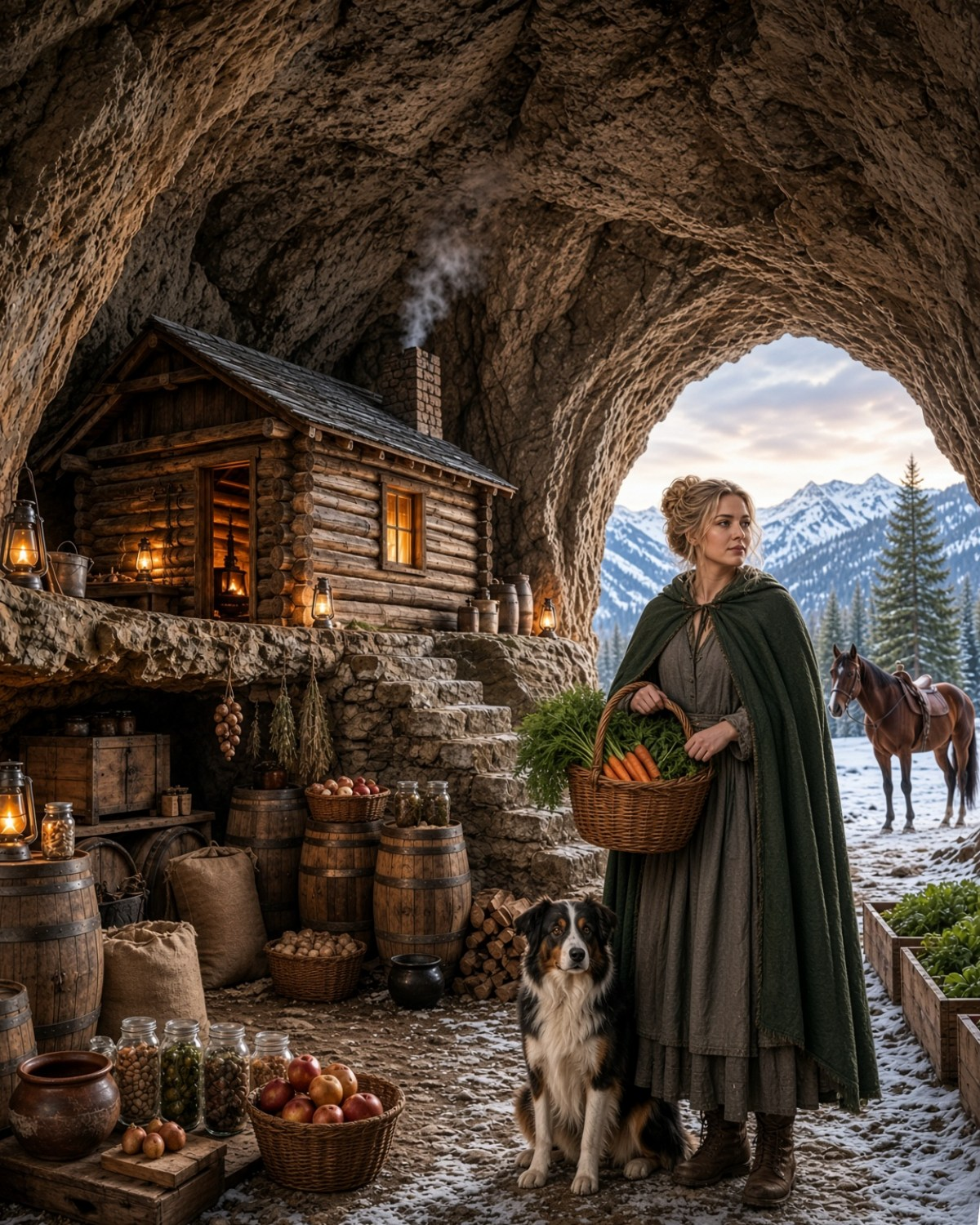
And when the next winter arrived, the doors of Ainsworth Mountain Shelter stood ready.
There was firewood beside the hearth.
Food in the pantry.
Blankets on the shelves.
And a warm welcome waiting for anyone who needed it.
Merritt stood beside Jonas beneath the granite ceiling, watching the first gentle snowflakes drift past the entrance.
He took her hand.
"Ready for winter?"
She smiled.
"With you?"
He nodded.
"With me."
Merritt leaned against him.
"Always."






Comments 0