"Mom, don't open that envelope yet."
I stared at the six words glowing on my phone.
My son was thousands of miles away, celebrating his honeymoon in Hawaii with the woman he'd married without inviting me.
Yet somehow, he knew exactly what I was holding.
I looked at the cream-colored envelope on my kitchen table.
The clear tape across its flap caught the overhead light.
Someone had opened it.
Someone had tried to seal it again.
And now Cullen was telling me not to look inside.
My phone vibrated.
Another message.
"I'm serious, Mom. We need to talk before you do anything."
I didn't answer.
Instead, I turned the envelope over.
My attorney's return address was printed neatly in the upper-left corner.
Beneath it was my name.
The handwriting on the front was mine.
I remembered writing it.
I remembered the afternoon my attorney had handed me the envelope and told me to keep it somewhere safe until I was ready.
I remembered driving home with it on the passenger seat, imagining the day I would finally give it to Cullen.
That had been three months earlier.
Before the secret wedding.
Before the suitcases.
Before my son decided my home belonged to him.
I picked up my phone.
I typed one question.
"How do you know which envelope I'm holding?"
Three dots appeared immediately.
Then disappeared.
Then appeared again.
Finally, his reply came.
"Because I know you, Mom."
I almost laughed.
He knew me?
The son who believed I was too unsophisticated to attend his wedding?
The son who moved his wife's belongings into my bedroom without asking?
The son who apparently told forty-six wedding guests that I was too sick to attend?
He knew me?
I placed the phone face down.
Then I reached for the letter opener.
There are moments when a person realizes that the life they thought they understood was only part of the story.
For me, that moment began with a strip of transparent tape.
I carefully lifted the corner.
The tape came away more easily than I expected.
Underneath, the original adhesive had been torn.
Someone had used a thin blade to separate the flap.
I recognized the method.
Nile used to open old envelopes that way when he wanted to preserve stamps for his collection.
Cullen had watched him do it dozens of times.
I felt a strange chill.
I slid the letter opener beneath the flap.
Then I stopped.
Not because Cullen had told me to.
Because I suddenly remembered something my attorney, Daniel Mercer, had said when we prepared the document.
"Keep the original sealed until we meet again. If anything changes before then, call me."
At the time, I hadn't thought much about it.
Now everything had changed.
I put the letter opener down.
It was Sunday evening.
Daniel's office would be closed.
But he had given me his personal number years earlier, after Nile died.
I had never used it for anything that wasn't important.
This qualified.
I called.
He answered on the fourth ring.
"Margaret?"
Hearing my name in his familiar voice nearly undid me.
"Daniel, I'm sorry to bother you on a Sunday."
"Don't apologize. Is everything all right?"
I looked at the envelope.
"No. I don't think it is."
His tone changed immediately.
"Tell me what's happened."
I began with the wedding.
I told him Cullen had married Blythe without inviting me.
I told him about the phone call from the airport.
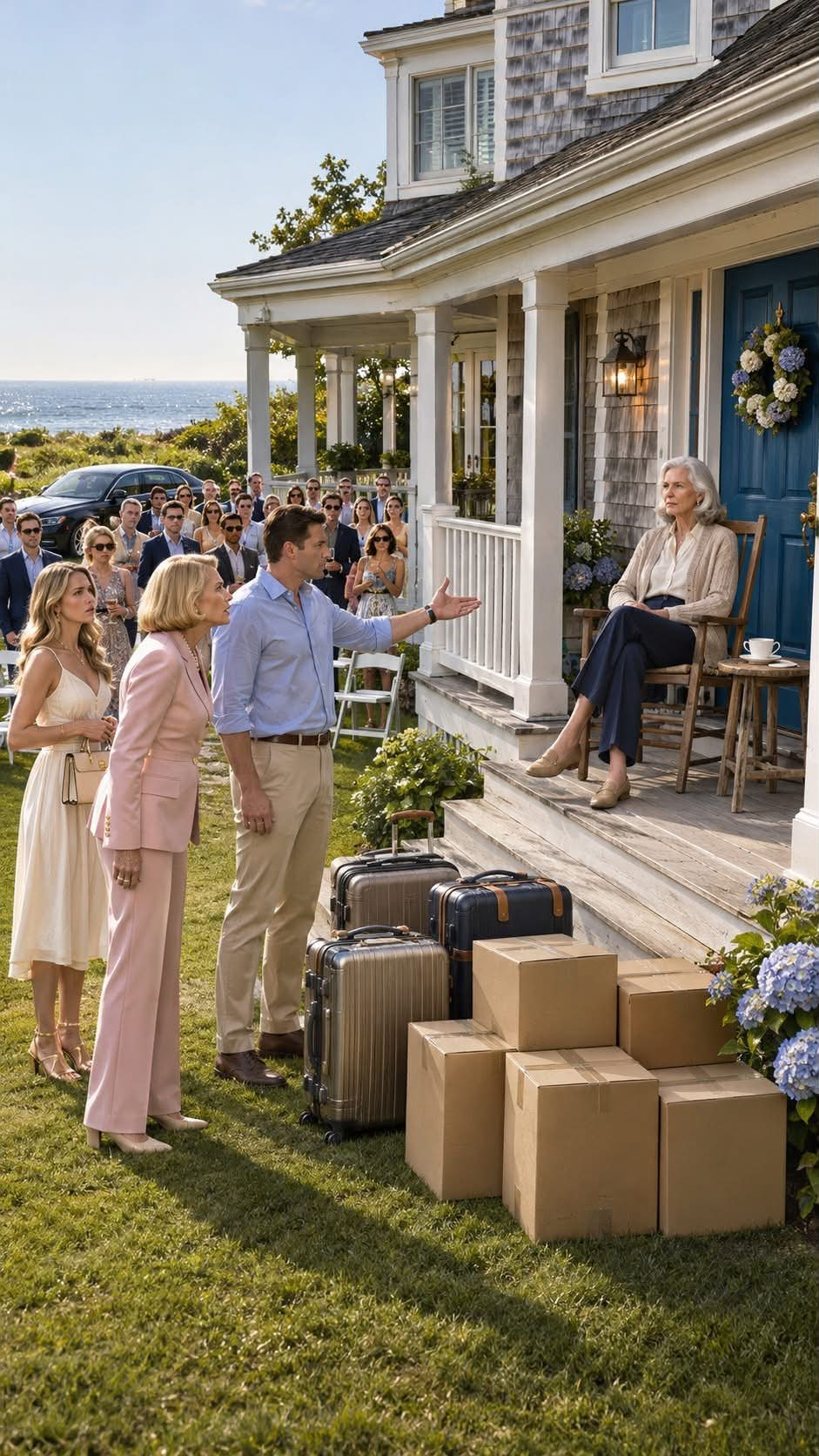
The plans to move into the beach house.
The suitcases.
The moving boxes.
The white bathrobe hanging in my bedroom.
I told him about Nile's photograph.
That was the first time my voice trembled.
Daniel didn't interrupt.
When I finished, he was quiet for several seconds.
Then he asked, "And the envelope?"
I looked down.
"Someone opened it."
"Are you certain?"
"There's tape across the seal. I didn't put it there."
"Have you removed the documents?"
"No."
"Good."
I heard a chair move on his end of the line.
"Margaret, I want you to leave everything exactly as it is. Put the envelope somewhere secure. Bring it to my office tomorrow morning."
"Daniel, Cullen claims the house is already his."
Another silence.
"Did he say that specifically?"
"Yes."
"Did he mention a deed?"
I hesitated.
"His mother-in-law did. She said she believed the paperwork had been completed."
Daniel exhaled slowly.
"Margaret, listen carefully. You haven't signed any new transfer documents, correct?"
"No."
"Nothing giving Cullen ownership of the property?"
"Absolutely not."
"Then don't let anyone convince you that a conversation, a promise, or an expectation is the same as a completed legal transfer."
I closed my eyes.
For the first time that evening, I felt something resembling relief.
Then Daniel asked a question that made me sit up.
"Has Cullen been inside the house recently?"
"Apparently."
"Before today?"
"He has a key. Or he did."
"Did he have access to your personal documents?"
I looked toward the hallway cabinet.
"Yes."
Daniel was quiet again.
Then he said, "I want you here at nine tomorrow morning. Bring the envelope, and don't discuss its contents with anyone until we've examined it."
"Daniel?"
"Yes?"
"Do you think my son has done something illegal?"
He didn't answer immediately.
And somehow, that was worse than an answer.
"I think," he said carefully, "we need to establish exactly what he saw and what he believes he saw."
I barely slept that night.
Every time I closed my eyes, I saw the wedding cake.
Not Cullen's face.
Not Blythe's dress.
The cake.
A perfect little replica of my beach house.
The gray shingles.
The white porch railings.
The blue front door.
Nile had spent an entire weekend choosing that blue.
He'd brought home six paint samples and held them against the front entrance.
I'd teased him for treating a door like a presidential decision.
He'd told me a front door mattered because it was the first thing people saw when they came home.
Now that same door had appeared on a wedding cake at a celebration I hadn't been invited to attend.
I wondered how long Cullen had been planning this.
Had he and Blythe discussed moving into the house before they became engaged?
Had they already told her parents?
Had they presented the property as an inheritance?
Or something more?
At 2:13 a.m., my phone lit up.
Another message from Cullen.
"Mom, please stop making this difficult."
I read it.
Then I turned the phone over.
At 2:27, another arrived.
"Blythe is crying. This isn't fair to her."
I sat up in bed.
I thought about the woman who had hung her bathrobe in my closet.
I thought about my own robe shoved into the hallway.
And I wondered whether Blythe had any idea what Cullen had actually promised her.
At 3:04, the phone vibrated again.
This time, it was a photograph.
Cullen and Blythe standing on a beach in Hawaii.
Both smiling.
Both holding drinks.
Beneath it, Cullen had written:
"We should be enjoying our honeymoon instead of dealing with this."
I stared at the photograph.
Then I typed:
"You are enjoying your honeymoon, Cullen. I'm dealing with what you did to my home."
I sent it.
He didn't reply.
At eight the next morning, I drove to Daniel's office.
The cream-colored envelope sat inside a folder on the passenger seat.
I had placed it between two sheets of cardboard so the tape wouldn't peel away any further.
I don't know why I was being so careful.
Perhaps because I had spent my entire life believing that important things deserved to be handled properly.
Marriage.
Family.
Promises.
Property.
Trust.
Apparently, my son had developed a different philosophy.
Daniel's office occupied the second floor of an old brick building downtown.
He had represented Nile and me for more than twenty years.
He helped us purchase the beach house.
He reviewed our insurance after the hurricane repairs.
He handled Nile's estate.
And when I finally decided to prepare something for Cullen, Daniel was the first person I called.
His receptionist, Evelyn, greeted me with concern.
"Good morning, Margaret."
"Good morning, dear."
"Daniel's expecting you."
She glanced at the folder in my hands.
Then she looked away.
That small gesture told me Daniel had warned her the meeting was serious.
I entered his office.
He stood immediately.
At sixty-four, Daniel had the careful manner of a man who spent his career listening to people describe the worst days of their lives.
He wore reading glasses on a cord around his neck and always kept a yellow legal pad beside his desk.
"Margaret."
He came around the desk and shook my hand.
"Sit down."
I placed the folder between us.
He didn't touch it immediately.
"First," he said, "how are you?"
I almost gave him the answer I always gave.
Fine.
But I was tired of that word.
"I'm hurt," I said.
He nodded.
"Understandably."
"And I'm angry."
"Also understandably."
I looked at the envelope.
"But mostly, Daniel, I'm confused."
He leaned forward.
"Then we'll start with what we know."
I told him about the online wedding photographs.
About the comment claiming I had been too sick to attend.
About the reply suggesting I'd signed everything before the ceremony.
Daniel wrote each detail on his legal pad.
Then I told him about Laurelai's call.
When I repeated her statement about the paperwork, his pen stopped moving.
"Did she use the word completed?"
"Yes."
"Not promised?"
"She said Cullen assured them the property had already been promised. Then she mentioned paperwork."
Daniel made another note.
"Interesting."
"Interesting isn't the word I'd use."
He gave me a brief, sympathetic look.
"No. I suppose not."
Then he put on his reading glasses.
"May I see the envelope?"
I slid it across the desk.
He examined the front.
Turned it over.
Studied the tape.
Then reached for a small magnifying glass.
I watched his expression change.
"Margaret."
"Yes?"
"This seal has definitely been disturbed."
My stomach tightened.
"I knew it."
He carefully lifted one corner of the tape.
"Whoever opened it tried to preserve the original flap."
"Can you tell when?"
"No. Not from this alone."
He looked up.
"May I open it?"
I nodded.
"Please."
He removed the tape and lifted the flap.
Inside were several folded pages.
He took them out carefully.
I watched him arrange them on his desk.
The first page was exactly what I remembered.
The second was familiar.
So was the third.
But when Daniel reached the final page, he stopped.
His eyebrows drew together.
He looked at the paper.
Then at the envelope.
Then back at the paper.
"Margaret," he said quietly, "did you remove anything from this packet?"
"No."
"Are you absolutely certain?"
"Daniel, I haven't opened it since you gave it to me."
He leaned back.
For several seconds, he said nothing.
Then he opened a drawer and removed a thick file.
My name was written on the tab.
He placed it beside the envelope.
"I kept a complete copy of the original packet," he said.
He turned several pages.
Then laid one sheet beside the document from my envelope.
I couldn't see the difference immediately.
Both pages had the same heading.
The same margins.
The same formal language.
But Daniel pointed to the lower section.
"Look here."
I leaned closer.
There was a blank space.
A signature line.
And beneath it, a printed name.
My name.
Margaret.
I frowned.
"That's where I was supposed to sign when the time came."
"Correct."
He pointed to the copy from his file.
"Now look at this one."
I stared.
The wording above the signature line was different.
Only one paragraph.
But the difference was unmistakable.
"Someone replaced a page?" I whispered.
Daniel nodded slowly.
"It appears so."
I felt cold.
"Why?"
"That's what we need to determine."
I looked at the altered page.
"Does it give Cullen the house?"
"Not by itself."
"Then what does it do?"
Daniel removed his glasses.
"It changes the description of what you would be acknowledging if you signed."
I stared at him.
"Explain that in plain English."
He folded his hands.
"The original packet was prepared to document your intentions regarding the property. This substituted page could be used to make it appear that you were confirming a different arrangement."
I looked at the signature line.
My name.
Waiting.
"Could someone use this to take my house?"
"Not simply by placing a page in an envelope. There are legal requirements for transferring real property. But a misleading document can still create confusion, pressure, or a dispute."
I swallowed.
"Who would do that?"
Daniel didn't answer.
He didn't have to.
There were only a few possibilities.
And one of them was my son.
I sat in Daniel's office for almost two hours.
We reviewed everything.
The original document.
The altered page.
The envelope.
The timing.
The people who had access to my house.
Daniel photographed the seal and preserved the packet.
He made copies for me.
He advised me not to sign anything presented by Cullen or his new in-laws without having it reviewed independently.
Then he asked whether I wanted to change my estate plans immediately.
I looked at the framed photograph on his desk.
His wife.
His children.
His grandchildren.
A family smiling together.
"I don't know," I admitted.
"That's all right."
"I still love him."
"I know."
"He's my only child."
Daniel nodded.
"That doesn't mean you have to reward behavior that harms you."
I looked down at my wedding ring.
Nile had placed it on my finger forty-eight years earlier.
I had never taken it off.
"When Cullen was little," I said, "he used to follow his father everywhere."
Daniel listened.
"He wanted to help with everything. Painting. Fixing the porch. Carrying lumber. He was so proud when Nile let him hold the flashlight."
I smiled despite myself.
"He used to tell everyone that one day he was going to fix houses just like his dad."
"What changed?" Daniel asked.
I thought about that.
Cullen had always been ambitious.
Even as a boy, he wanted the newest bicycle.
The best sneakers.
The biggest birthday party.
Nile and I tried to teach him the difference between wanting something and deserving it.
Sometimes we succeeded.
Sometimes we didn't.
After Nile died, Cullen became more focused on appearances.
He started talking about connections.
Investments.
Social circles.
He bought expensive watches he couldn't comfortably afford.
He leased cars that cost more than my first annual salary.
And when he met Blythe, everything seemed to accelerate.
Her parents belonged to a world Cullen had spent years trying to enter.
Private clubs.
Exclusive events.
Luxury vacations.
People who introduced themselves by mentioning the companies they owned.
I never disliked Blythe.
But I often felt as though she and Cullen were performing for an audience I couldn't see.
Now I understood who that audience was.
And apparently, I hadn't made the guest list.
Daniel interrupted my thoughts.
"Margaret, there's something else we should discuss."
I looked up.
"The handwritten note Nile left."
My throat tightened.
"Yes."
"Do you still have the original?"
"Of course."
"Where?"
"In my personal safe."
"At your primary residence?"
"Yes."
He nodded.
"Good. Keep it there."
I studied his face.
"Daniel, do you think Cullen knows about the note?"
He hesitated.
"He may know it exists."
"But not what it says?"
"I can't answer that."
I looked at the altered document.
Then I remembered Cullen's message.
Don't open that envelope yet.
He hadn't asked whether I had found the envelope.
He hadn't asked whether it was safe.
He had simply told me not to open it.
As though he already knew what was inside.
Or what should have been inside.
When I left Daniel's office, the morning sun was bright enough to make me squint.
I sat in my car for several minutes.
I should have felt relieved.
The house was still mine.
Daniel had confirmed that nothing in the altered packet automatically transferred ownership.
But relief wasn't what I felt.
I felt grief.
Not the familiar grief of losing Nile.
This was different.
This was the grief of realizing someone you loved might have deliberately deceived you.
I drove to a small diner near the courthouse.
Nile and I used to eat breakfast there after appointments.
I ordered coffee and scrambled eggs.
The waitress asked whether I wanted toast.
I said yes.
Then I sat looking at the empty chair across from me.
For years, I had imagined that growing older would make family relationships simpler.
You raised your children.
They built their lives.
You celebrated their happiness.
You helped when you could.
You learned when to step back.
Nobody warned me that stepping back could be mistaken for surrender.
My phone rang.
Blythe.
I let it ring twice before answering.
"Hello, Blythe."
"Margaret."
Her voice sounded strained.
"Can we please talk like adults?"
I looked at my untouched breakfast.
"Of course."
"Cullen says you changed the locks."
"Yes."
"And put our belongings outside."
"Yes."
She exhaled sharply.
"Do you understand how humiliating that is?"
I considered the question.
"Do you understand how it felt to find your bathrobe hanging in my bedroom?"
Silence.
Then she said, "Cullen told me that room was going to be ours."
"Did he tell you I had agreed?"
Another silence.
"He said everything was arranged."
"That wasn't my question."
I heard movement in the background.
Perhaps she had stepped away from Cullen.
Finally, she said, "He told me the house was part of our future."
I closed my eyes.
"Blythe, did you ever ask me?"
"Why would I? He's your son."
"Exactly."
She seemed confused.
"What does that mean?"
"It means he should have known better."
For a moment, neither of us spoke.
Then Blythe said something unexpected.
"Margaret, I didn't know you weren't invited until after the invitations went out."
I sat straighter.
"What?"
"Cullen said you didn't want to attend."
My hand tightened around the phone.
"He said that?"
"Yes."
I stared at the diner window.
"And when people asked why you weren't there, he said you were sick."
The room seemed to grow quieter.
"Blythe, I wasn't sick."
"I know that now."
"Did you believe him?"
She hesitated.
"At first."
I looked down at my wedding ring.
"Why didn't you call me?"
No answer.
I waited.
Then she whispered, "Because he told me you'd make everything about yourself."
I closed my eyes.
There it was again.
My son had turned my absence into a character flaw.
He hadn't simply excluded me.
He had created a story in which excluding me was reasonable.
Perhaps even necessary.
"Blythe," I said quietly, "I hope you understand that I never wanted to embarrass you."
Her voice softened.
"Then why are you doing this?"
"Because the house belongs to me."
"But Cullen said—"
"I know what Cullen said."
I paused.
"Now I need you to think about what he never asked."
She didn't respond.
Then I heard Cullen's voice in the background.
"Blythe? Who are you talking to?"
The line went silent.
A second later, the call ended.
I drove home slowly.
At a red light, I noticed my hands were shaking.
Not from fear.
From the effort of holding myself together.
I had spent seventy-one years trying to be reasonable.
Trying to avoid unnecessary conflict.
Trying to understand other people's feelings before expressing my own.
But I was beginning to recognize something important.
Reasonableness only works when the other person is willing to be reasonable, too.
By the time I reached my driveway, I had made three decisions.
I would not sign anything.
I would not surrender my keys.
And I would not discuss the beach house with Cullen again until he returned from Hawaii.
I went inside.
Made tea.
And placed Daniel's copies in my personal safe beside Nile's handwritten note.
Then I checked my phone.
There were seventeen new notifications.
Most were from social media.
Apparently, the wedding photographs had attracted considerable attention.
I opened the post.
People were congratulating Cullen and Blythe.
Commenting on the flowers.
Admiring the venue.
Complimenting the cake.
Then I noticed something beneath the photograph of the miniature beach house.
A woman had written:
"What a beautiful wedding gift from the groom's mother!"
Someone else replied:
"Imagine being given a nearly two-million-dollar oceanfront home!"
I stared at the screen.
A wedding gift?
My house?
I scrolled farther.
Another comment appeared.
"Blythe told us they're hosting everyone at the house when they get back!"
I felt my stomach tighten.
Hosting everyone?
At my house?
I clicked on Blythe's profile.
There was a photograph of her standing beside Cullen, both holding champagne glasses.
The caption read:
"Married my best friend. Honeymoon first, then home to our forever beach house."
Our forever beach house.
I read those words several times.
Then I closed the app.
I didn't comment.
I didn't correct anyone.
I didn't write a public explanation.
Instead, I opened my contacts and called my neighbor, Eleanor.
She lived two houses down from the beach property.
We had known each other for nearly twenty years.
She answered immediately.
"Margaret, honey, I've been meaning to call you."
Something in her voice made me uneasy.
"Is everything all right?"
"Well, that depends."
I sat down.
"On what?"
"On whether you know about the party."
I went still.
"What party?"
There was a pause.
"Oh, Margaret."
I could hear the concern in her voice.
"Please tell me somebody told you."
"Told me what?"
Eleanor sighed.
"There's a welcome-home celebration being planned for Cullen and Blythe."
I looked toward the window.
"Where?"
Another pause.
"At your beach house."
I closed my eyes.
"Who planned it?"
"Blythe's parents, from what I understand."
I felt a strange calm settle over me.
"How many people?"
"I'm not sure. Several dozen, I think."
"Did they send invitations?"
"Yes."
I opened my eyes.
"Eleanor, do you have one?"
"Actually, that's why I called."
I heard paper rustling.
Then she said, "Margaret, there's something printed at the bottom that I think you need to see."
"What does it say?"
She hesitated.
"I'd rather show you."
I glanced at the clock.
"Can you come over?"
"I'm already in my car."
Eleanor arrived twenty minutes later.
She was seventy-four, with short silver hair and the kind of practical intelligence that made her impossible to intimidate.
She had been one of the first people to bring food after Nile died.
She had also been the person who helped me plant the hydrangeas along the porch.
When I opened the door, she hugged me.
Not the polite kind of hug people give at church.
A real one.
The kind that tells you someone knows you're hurting.
Then she stepped inside and reached into her handbag.
"I brought this."
She handed me a thick cream-colored invitation.
My name was nowhere on the envelope.
I opened it.
Inside was an elegant card with raised lettering.
The first line read:
WELCOME HOME, CULLEN & BLYTHE.
Beneath it was the date.
September 26.
Then the location.
The Point.
My beach house.
I kept reading.
The invitation described an intimate gathering to celebrate the newlyweds' return from Hawaii and the beginning of their new life in their coastal home.
Their coastal home.
I looked at Eleanor.
"Did you know about this?"
"Not until yesterday."
"Who sent it?"
"Laurelai and Miles."
I turned the card over.
There was a smaller line printed near the bottom.
I brought it closer to the light.
Eleanor watched me.
"What does that mean?" she asked.
I read the words silently.
Then again.
The invitation didn't merely announce a celebration.
It described a ceremonial presentation.
A public handover.
A moment when I was apparently expected to stand in front of the guests and give my son the keys.
I felt my face grow warm.
"They've planned a ceremony," I whispered.
Eleanor nodded.
"That's what it sounds like."
I looked at the date.
September 26.
Twelve days after the wedding.
The day Cullen and Blythe returned from Hawaii.
"They haven't even asked me," I said.
Eleanor reached across the table and touched my hand.
"Margaret, you don't have to let them do this."
I looked at the invitation.
At the expensive paper.
At the carefully chosen words.
At the assumption that my consent was unnecessary.
Then I thought about the altered page in Daniel's office.
The taped envelope.
The wedding cake.
The lie about my illness.
And Cullen's desperate message.
Don't open that envelope yet.
I folded the invitation carefully.
"No," I said.
"I don't."
Eleanor studied my face.
"Are you going to cancel the party?"
I looked toward the hallway where Nile's old photograph hung beside the staircase.
For a moment, I imagined him standing there.
His sleeves rolled up.
A paintbrush in his hand.
That familiar half-smile on his face.
Then I looked back at Eleanor.
"No."
She blinked.
"No?"
I shook my head.
"Let them come."
Eleanor stared at me.
"Margaret, are you sure?"
I placed the invitation on the table.
"They want an audience."
I paused.
"Then they'll have one."
Eleanor was silent for several seconds.
Then she reached into her handbag again.
"There's one more thing."
I watched her remove her phone.
"A man came by the beach house yesterday evening."
My stomach tightened.
"What man?"
"I didn't recognize him. He was taking photographs of the front door and the driveway."
"Did you speak to him?"
"Yes."
"What did he say?"
Eleanor looked uncomfortable.
"He said he was checking the property for the new owners."
I felt the blood drain from my face.
"New owners?"
She nodded.
"I told him you owned the house."
"What did he say?"
"He looked surprised."
Eleanor unlocked her phone.
"I took a picture of his car before he left."
She turned the screen toward me.
A dark sedan was parked near my driveway.
The license plate was visible.
And standing beside the car was a man holding a folder.
I leaned closer.
Something about him seemed familiar.
Then I recognized his face.
I had seen him before.
Not at the beach house.
Not at Cullen's apartment.
At Daniel Mercer's office.
Several months earlier.
I looked at Eleanor.
"Did he give you his name?"
She nodded slowly.
"Yes."
"What was it?"
Before she could answer, my phone rang.
Daniel Mercer.
I picked it up immediately.
"Daniel?"
His voice was unusually tense.
"Margaret, are you alone?"
I looked at Eleanor.
"No. My neighbor is here."
"Good. Keep her there."
My heart began pounding.
"What's happened?"
"After you left, I reviewed the property records and made several calls."
I gripped the phone.
"And?"
"Someone has been asking questions about your house."
"Who?"
Daniel hesitated.
Then he said, "Margaret, I need you to listen very carefully."
I stopped breathing.
"An application was submitted requesting certified copies of documents connected to your property."
"By Cullen?"
"No."
I looked at Eleanor.
"Then who?"
Daniel took a breath.
"The person who submitted it claimed to be acting with your authorization."
I stared at the invitation on the table.
"Daniel, I haven't authorized anyone."
"I know."
"Then whose name was on the request?"
There was a rustling sound on his end of the line.
He was looking through papers.
"Margaret, I have the form in front of me."
I tightened my grip on the phone.
"Tell me."
He began to read.
Then stopped.
"That's strange."
"What?"
"The signature isn't yours."
My heart hammered.
"Daniel—"
"And the person listed as the authorized representative..."
He fell silent.
I could hear him turning another page.
Then his voice dropped.
"Margaret, there's something attached to this request that you need to see."
"What is it?"
He didn't answer immediately.
When he finally spoke, his words came slowly.
"It's a copy of a document bearing your name."
I stared at the cream-colored invitation.
"Daniel, what document?"
He drew a sharp breath.
Then said, "Margaret, someone has submitted a signed statement claiming you voluntarily agreed to give Cullen the beach house."
I stood so quickly my chair scraped across the floor.
"I never signed anything!"
"I know."
"Then whose signature is it?"
Daniel was silent.
For several seconds, I heard nothing but the faint hum of the refrigerator.
Then he said, "That's why I'm calling."
I pressed the phone harder against my ear.
"Daniel?"
"The signature looks almost exactly like yours."
I couldn't move.
Eleanor rose from her chair.
She must have seen something in my expression.
"Margaret?" she whispered.
But I was still listening.
Because Daniel hadn't finished.
"There's one more problem," he said.
I swallowed.
"What problem?"
"The statement is dated three days before Cullen's wedding."
My eyes moved toward the invitation.
The party.
The keys.
The crowd.
The certainty.
It suddenly made a terrible kind of sense.
"Daniel," I whispered, "who witnessed the signature?"
I heard him turn the final page.
Then everything went quiet.
"Margaret," he said, "I need you to come back to my office."
"Why?"
"Because the witness's name is someone you know."
I gripped the edge of the table.
"Who is it?"
Daniel hesitated.
Then he said, "I'm sending you a photograph of the signature page right now."
My phone vibrated against my ear.
A new image appeared on the screen.
I lowered the phone.
Opened the photograph.
And looked at the name written beneath the words WITNESS TO SIGNATURE.
My hands went cold.
Because the name belonged to someone who had been standing beside me at Nile's funeral.
Someone I had trusted for fourteen years.
Someone who still had a key to my house.
And just as I recognized the handwriting, the doorbell rang.
Eleanor looked toward the front door.
I looked at the photograph again.
Then I heard a familiar voice from the other side.
"Margaret? It's me. We need to talk."






Comments 0