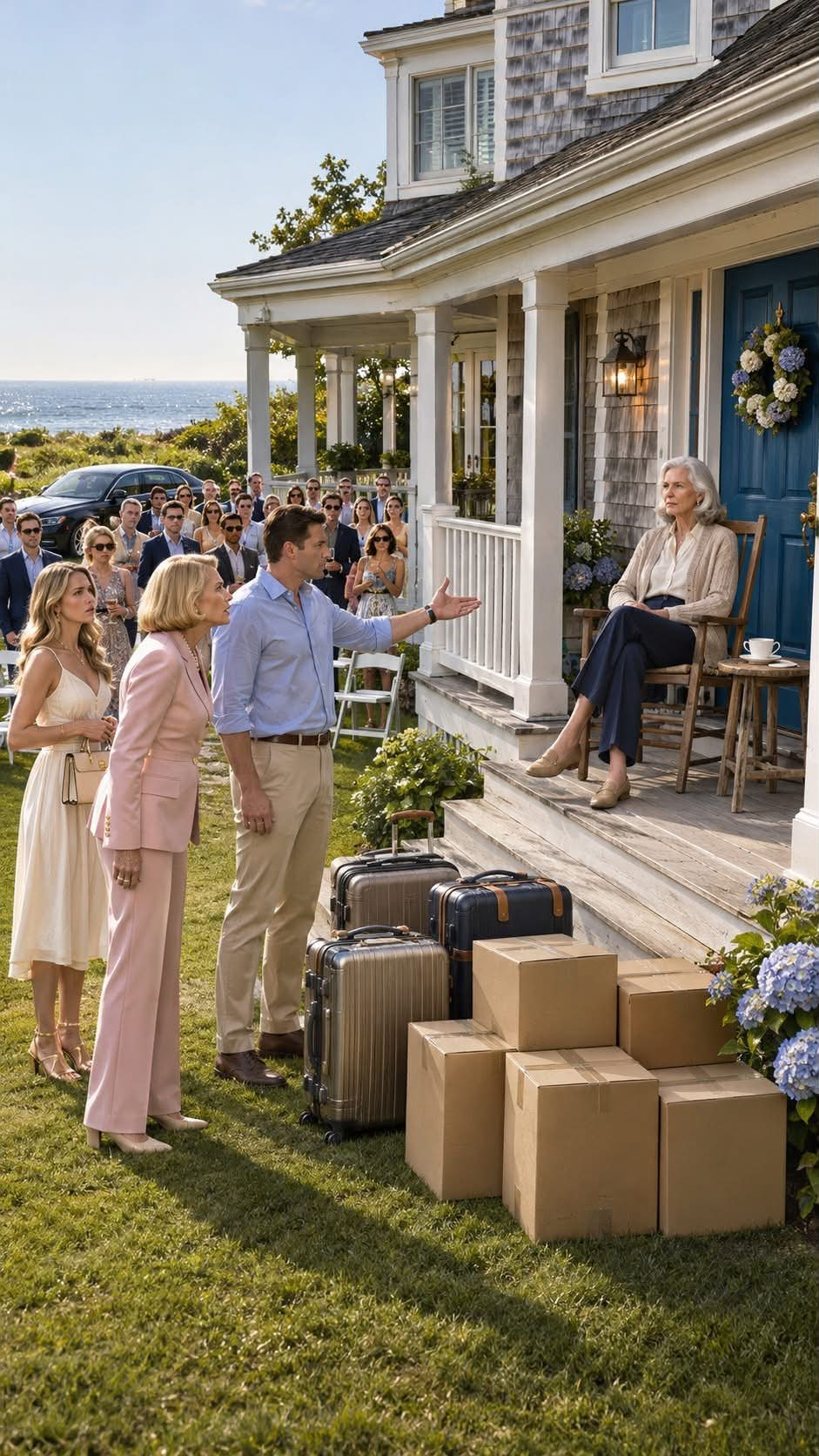
"Mom, open the door. Now!"
My son Cullen was shouting from the bottom of my porch steps when I reached into my handbag for a cream-colored envelope.
There was a narrow strip of clear tape across the flap.
Someone had opened it.
Someone had tried to hide that fact.
And when Cullen saw the envelope in my hand, the anger disappeared from his face.
For the first time in his thirty-nine years, my son looked at me as though he had no idea who I was.
But to understand why twenty-nine people were standing on my lawn that September afternoon, waiting for me to surrender a house worth $1.94 million, I have to take you back twelve days.
Back to a Sunday morning.
Back to the phone call that changed everything.
I was seventy-one years old, a widow, and the mother of one son.
Until that morning, I believed those three facts told most of the story of my life.
I was wrong.
My phone rang at 9:17 a.m.
I remember the exact time because I was standing in my kitchen, waiting for the coffee maker to finish brewing, when Cullen's name appeared on the screen.
He rarely called on Sunday mornings.
For a brief, foolish moment, I thought he might be calling to invite me to lunch.
"Good morning, sweetheart," I answered.
"Mom! Big news!"
His voice was bright and excited.
I smiled.
"What happened?"
"Blythe and I got married yesterday!"
I stood perfectly still.
The coffee maker clicked behind me.
For several seconds, I couldn't find the words to respond.
"Married?" I finally asked.
"Yeah! We finally did it. We're at the airport now. Heading to Hawaii."
I looked at the little calendar hanging beside my refrigerator.
Saturday.
Yesterday had been Saturday.
My only son had gotten married on Saturday.
And I hadn't known there was going to be a wedding.
"Oh," I said.
It was the smallest word I could manage.
Cullen laughed.
"Surprise!"
I leaned against the kitchen counter.
"Well," I said carefully, "congratulations, sweetheart."
"Thanks, Mom. We wanted to keep everything simple."
Simple.
That was the word he used.
Later, I would discover there had been forty-six guests.
A professional photographer.
An elaborate floral installation.
A three-tier wedding cake.
A reception at a private waterfront venue.
And a miniature replica of my beach house sitting on top of the cake.
But that Sunday morning, I knew none of those things.
I only knew my son had gotten married without me.
"Was it just the two of you?" I asked.
There was a pause.
"Not exactly."
"Who was there?"
"Oh, you know. Some friends. Blythe's family. A few people from work."
"How many people, Cullen?"
He sighed.
"Mom, don't make this weird."
I closed my eyes.
"I'm not making anything weird. I'm asking about my son's wedding."
"It was forty-six people, okay?"
Forty-six.
I repeated the number silently.
Forty-six people had watched my son exchange wedding vows.
Forty-six people had celebrated with him.
Forty-six people had been important enough to receive an invitation.
His mother had not.
"Why didn't you tell me?" I asked.
Another sigh.
This one was louder.
"Because we knew you'd get emotional."
I stared at the wall.
"Emotional?"
"Mom, come on. You know what I mean."
"No, Cullen. I don't."
He lowered his voice, as though explaining something obvious to a child.
"It was a certain kind of wedding. Blythe's parents know a lot of influential people. Business owners. Investors. People with status."
I said nothing.
"And honestly, you would have hated it."
There it was.
Not an apology.
Not an explanation.
A judgment.
My son had decided that the woman who raised him did not belong among the people he wanted to impress.
I looked down at my hands.
The same hands that had packed his school lunches.
The same hands that had held his forehead when he was sick.
The same hands that had helped my late husband rebuild a hurricane-damaged beach house, board by board, summer after summer.
Apparently, those hands weren't suitable for a wedding attended by people with status.
"Mom?"
"I'm here."
"You're not upset, are you?"
I considered the question.
Then I answered honestly.
"I'm surprised."
"Well, don't be. We didn't want a big family production."
I almost laughed.
Forty-six guests.
But no room for one mother.
"All right," I said.
"Great. Listen, there's something else."
His tone changed.
It became casual.
Almost cheerful.
"When we land on the twenty-sixth, we're going straight to the point."
I frowned.
"The point?"
"Yeah. The house."
My fingers tightened around my coffee mug.
"Which house?"
"Mom."
He laughed again.
"Your beach house. Obviously."
I waited.
He continued.
"Blythe and I have been talking, and it just makes sense for us to settle in there after the honeymoon."
"Settle in?"
"Yeah. It's perfect for us. We can entertain there, and it's close enough to everything we need."
I slowly placed my mug on the counter.
"Cullen, are you asking to stay for a few days?"
"No. I mean live there."
I stared at the kitchen window.
Outside, a bird landed on the fence and flew away.
"Live there," I repeated.
"Exactly. You barely use the place anymore."
That wasn't true.
I visited every week.
Sometimes I stayed for several days.
Sometimes I sat on the porch until sunset, remembering the summers my husband and I had spent there.
But Cullen wasn't interested in how often I visited.
He was interested in how much the house was worth.
"Have you and Blythe found another apartment?" I asked.
"We gave ours up."
My stomach tightened.
"You gave up your apartment?"
"Yeah. Why would we keep paying rent when we have the house?"
We.
Have.
The house.
Three small words.
Three enormous assumptions.
"Cullen," I said quietly, "we need to discuss this."
"There's nothing to discuss, Mom. It's family property."
Family property.
I almost told him then.
I almost explained what his father had written years earlier, when he was still alive.
I almost mentioned the attorney.
The document.
The envelope.
But something stopped me.
Perhaps it was the way Cullen had spoken about the wedding.
Perhaps it was the certainty in his voice.
Or perhaps, after seventy-one years, I had finally learned that people reveal more when you stop interrupting them.
Instead, I said, "Congratulations again, sweetheart. Have a safe flight."
"Thanks, Mom. Love you."
The call ended.
I stood in my kitchen for a long time.
Then I picked up my car keys.
The drive to the beach house took forty-three minutes.
I knew every turn.
Every intersection.
Every stretch of road where the trees opened and the ocean first became visible.
My husband, Nile, used to say he could tell when we were getting close because I stopped talking.
He was right.
The closer we came to the water, the quieter I became.
It wasn't sadness.
It was peace.
Nile and I bought the house after a hurricane had torn through the coastline.
Back then, it was barely standing.
The roof leaked.
The porch leaned.
The kitchen floor had rotted near the back door.
The real estate agent called it a challenging opportunity.
Nile called it ours.
We weren't wealthy.
He worked as a marine electrician.
I spent most of my career managing accounts for a small medical supply company.
We saved carefully.
We drove old cars.
We repaired things instead of replacing them.
And when we finally bought that damaged house, we had just enough money left to purchase a secondhand ladder and a few boxes of nails.
For six summers, we rebuilt it ourselves.
Nile replaced the damaged porch boards.
I stripped old paint from the window frames.
He repaired the railings.
I planted hydrangeas.
He painted the front door blue.
I complained that the color was too dark.
He kissed my forehead and told me I would love it by August.
He was right about that, too.
The house became our greatest shared accomplishment.
Not because of its value.
Because every room held evidence that we had built a life together.
Fourteen years before that September, Nile died.
The house became quieter afterward.
But it never stopped feeling like home.
I kept his photograph on the mantel.
In it, he was standing on the porch, smiling with a paintbrush in his hand.
There was a streak of blue paint on his cheek.
I loved that photograph more than anything else in the house.
I had no idea that afternoon how important it was about to become.
When I pulled into the driveway, I immediately noticed something wrong.
The curtains in the front bedroom were open.
I always left them closed.
Then I noticed tire marks in the gravel.
Fresh ones.
I parked beside the hydrangeas and walked toward the porch.
The front door was locked.
At least that was something.
I used my key and stepped inside.
The first thing I saw was a suitcase.
Large.
Expensive.
Black leather.
It stood beside the staircase.
A second suitcase sat near the living room doorway.
Then a third.
Then a fourth.
I stared at them.
Cullen had said they were going straight to the house when they returned from Hawaii.
He had not mentioned moving their belongings in before leaving.
I walked farther inside.
Six cardboard moving boxes were stacked along the hallway.
One was labeled KITCHEN.
Another said MASTER BEDROOM.
I stopped.
Master bedroom?
My bedroom?
I walked upstairs.
The door was open.
Inside my bedroom closet hung a white bathrobe.
It was embroidered with the name Blythe.
My own robe was gone.
I found it in the hallway closet, folded carelessly on a shelf beneath a pile of spare towels.
For a moment, I simply stood there.
I wasn't angry yet.
I was trying to understand the audacity of it.
My son and his wife had entered my house.
Moved in their possessions.
Claimed my bedroom.
And relocated my belongings.
Without asking.
Without telling me.
Without even waiting until they were home from their honeymoon.
I returned downstairs.
That's when I noticed the mantel.
At first, I couldn't identify what was wrong.
There was the little brass clock Nile had repaired.
There was the ceramic lighthouse Cullen had made in elementary school.
There was the bowl of sea glass we'd collected over the years.
But something was missing.
The photograph.
Nile's photograph.
I walked toward the mantel.
The rectangular patch where the frame had stood was slightly lighter than the surrounding wood.
I checked the side table.
The bookshelves.
The cabinet beneath the television.
Nothing.
Then I opened the drawer beneath the mantel.
There it was.
Face down.
Under several takeout menus.
I lifted the frame carefully.
The glass was dusty.
Nile's smile looked exactly as I remembered it.
For a long moment, I couldn't move.
I had endured fourteen years without my husband.
I had learned to eat dinner alone.
To sleep without hearing his breathing beside me.
To make decisions without asking what he thought.
I had survived the hardest thing life had ever given me.
And now my son had allowed someone to bury his father's photograph beneath restaurant menus.
I sat on the sofa.
I held the frame against my chest.
Then I cried.
Not loudly.
Not dramatically.
Just a few quiet tears that slipped down my cheeks before I could stop them.
When I finished, I wiped my face.
I looked at Nile's photograph.
And I remembered something he used to tell Cullen when he was young.
"Respect isn't what people owe you because of your name. It's what you earn by the way you treat them."
I wondered when my son had forgotten that.
Then I stood up.
And I called a locksmith.
The locksmith arrived at 2:40 that afternoon.
His name was Martin.
He was a broad-shouldered man in his late fifties with a patient expression and a toolbox that looked older than my son.
"All exterior locks?" he asked.
"Every one."
"Front door, back door, side entrance?"
"Yes."
He glanced toward the suitcases.
"Moving out?"
"Someone is."
He didn't ask another question.
While he worked, I carried the first suitcase outside.
It was heavier than I expected.
I had to stop halfway down the porch steps.
Martin offered to help.
I thanked him, but declined.
I wanted to do this myself.
Not because I was trying to prove anything.
Because I needed to feel that I could still make decisions about my own home.
One suitcase became two.
Then three.
Then four.
I carried the boxes outside as well.
I arranged everything neatly on the lawn, away from the flowerbeds and beneath the shade of the porch roof.
I didn't throw anything.
I didn't damage anything.
I didn't open their luggage.
Their possessions remained exactly as I had found them.
By 4:15, Martin had replaced every exterior lock.
He handed me three new keys.
I paid him.
Then I walked through the house one more time.
I returned my robe to the bedroom closet.
I placed Nile's photograph back on the mantel.
I straightened the ceramic lighthouse.
I closed the curtains.
And I stood in the living room, listening to the familiar sound of the ocean beyond the windows.
For the first time that day, I felt steady.
I stepped outside.
Locked the front door.
And took a photograph of the suitcases and boxes.
Then I sent Cullen a message.
"Congratulations again. I've changed the locks at the point. Your things are safe on the lawn."
I placed my phone in my handbag.
It began ringing before I reached my car.
I let it ring.
Then it rang again.
And again.
By the time I arrived home, Cullen had called eleven times.
There were six messages from him.
Three from Blythe.
And one from a number I didn't recognize.
I sat at my kitchen table and opened the first message.
"Mom, what the hell are you doing?"
The second came less than a minute later.
"We already told everyone we're living there."
The third was even more revealing.
"Everyone, Mom. EVERYONE."
I read that message twice.
Not once had he asked whether I was all right.
Not once had he apologized for entering the house without permission.
Not once had he mentioned his father's photograph.
He was worried about what people would think.
I opened Blythe's message.
"Please tell me this is some kind of misunderstanding. We gave up our apartment because Cullen said everything was settled. I don't understand why you're doing this to us."
I considered calling her.
I considered explaining.
But the truth was simple.
I hadn't done anything to them.
I had merely refused to give them something that wasn't theirs.
I typed one reply.
"I hope you both enjoy Hawaii. We'll discuss the house when you return."
Then I turned off my phone.
That evening, I made myself a small dinner.
Tomato soup.
Toast.
A sliced apple.
I ate at the kitchen table where Nile and I had once planned the renovations.
For years after his death, I had continued setting two placemats out of habit.
Eventually, I stopped.
That night, I almost reached for the second one again.
Instead, I opened the drawer beside the table.
Inside was a small notebook.
Nile's handwriting filled the first several pages.
Measurements.
Supply lists.
Little reminders.
"Replace east porch railing."
"Check attic vent."
"Buy blue paint."
On the final page, he had written something that wasn't about repairs.
I had read it many times.
But that evening, it felt different.
He had written:
"Make sure the house stays a home, not a prize."
I traced the words with one finger.
Then I closed the notebook.
A few months earlier, I had asked my attorney to prepare an important legal document.
It concerned the beach house.
It concerned Cullen.
And it concerned a handwritten note Nile had left behind.
At the time, I had imagined presenting the document to my son on his wedding day.
I had imagined seeing gratitude on his face.
Perhaps even tears.
I had imagined telling him how proud his father would have been.
Now I wasn't sure what I had imagined was ever going to happen.
I went to the hallway cabinet where I kept important papers.
Insurance policies.
Property records.
Tax documents.
Nile's death certificate.
And one long cream-colored envelope.
I opened the cabinet.
Pulled out the document box.
And lifted the envelope.
Something felt wrong.
The flap wasn't sitting flat.
I turned it over.
A narrow strip of clear tape ran across the seal.
I stared at it.
I had never taped that envelope.
My attorney had sealed it himself.
And I had placed it in the cabinet unopened.
I ran my thumb along the tape.
Then I noticed something else.
A faint crease near the bottom corner.
As though someone had bent the envelope while removing its contents.
My pulse quickened.
Only a few people had ever been inside my house unsupervised.
Cullen was one of them.
I thought about the moving boxes.
The bathrobe.
The missing photograph.
Then I thought about something my son had said during our phone call.
"There's nothing to discuss, Mom. It's family property."
I looked down at the envelope.
For the first time, I wondered whether Cullen had been making assumptions.
Or whether he believed he knew something I didn't.
I carried the envelope to the kitchen table.
Under the overhead light, I examined the seal more carefully.
The tape had been pressed down unevenly.
One corner was lifting.
I slipped a fingernail beneath it.
Then I stopped.
Because my phone, which I had turned back on only moments earlier, began vibrating.
The screen showed an unfamiliar number.
I answered.
"Hello?"
A woman's voice spoke immediately.
"Is this Cullen's mother?"
"Yes."
"My name is Laurelai. I'm Blythe's mother."
Her tone was smooth.
Controlled.
The kind of voice that expected people to listen.
"I think we need to clear up a very unfortunate misunderstanding."
I glanced at the envelope.
"What misunderstanding?"
"The beach house, of course."
I waited.
She continued.
"Cullen assured us that the property had already been promised to the children."
I felt my shoulders straighten.
"Promised?"
"Yes. And frankly, I don't appreciate you embarrassing my daughter while she's on her honeymoon."
I looked toward the dark kitchen window.
"Mrs. Laurelai, my son never asked my permission to move into that house."
A brief silence followed.
Then she said something that made me grip the edge of the table.
"Permission? My dear, I was under the impression that the paperwork had already been completed."
I looked down at the taped envelope.
"What paperwork?"
Laurelai hesitated.
For the first time, her confidence seemed to falter.
Then she said, "Perhaps you'd better ask Cullen what he showed us."
Before I could respond, the call ended.
I sat motionless.
The envelope lay beneath my hand.
The tape caught the kitchen light.
I thought about calling my attorney.
I thought about calling Cullen.
Instead, I opened my laptop.
I typed my son's name into the search bar.
His wedding photographs had just been posted online.
And the first picture I saw wasn't of the bride.
It wasn't of the groom.
It was of a three-tier wedding cake.
Sitting on top was a perfect miniature replica of my beach house.
The gray shingles.
The wraparound porch.
The blue front door Nile had painted himself.
I leaned closer to the screen.
Then I noticed a comment beneath the photograph.
It had been posted by a woman I recognized from Cullen's childhood.
"So sorry your mom couldn't make it, Cullen. Hope she's feeling better."
I read it once.
Then again.
Feeling better?
I hadn't been sick.
I clicked on the replies.
And there, beneath the wedding photograph, someone had written a sentence that made my blood run cold.
"Cullen told us his mother was too ill to attend, but at least she signed everything before the ceremony."
I stopped breathing for a moment.
Signed everything?
I looked at the envelope.
Then back at the screen.
And just as I reached for my phone to call my attorney, a new message appeared.
It was from Cullen.
Only six words.
"Mom, don't open that envelope yet."






Comments 0