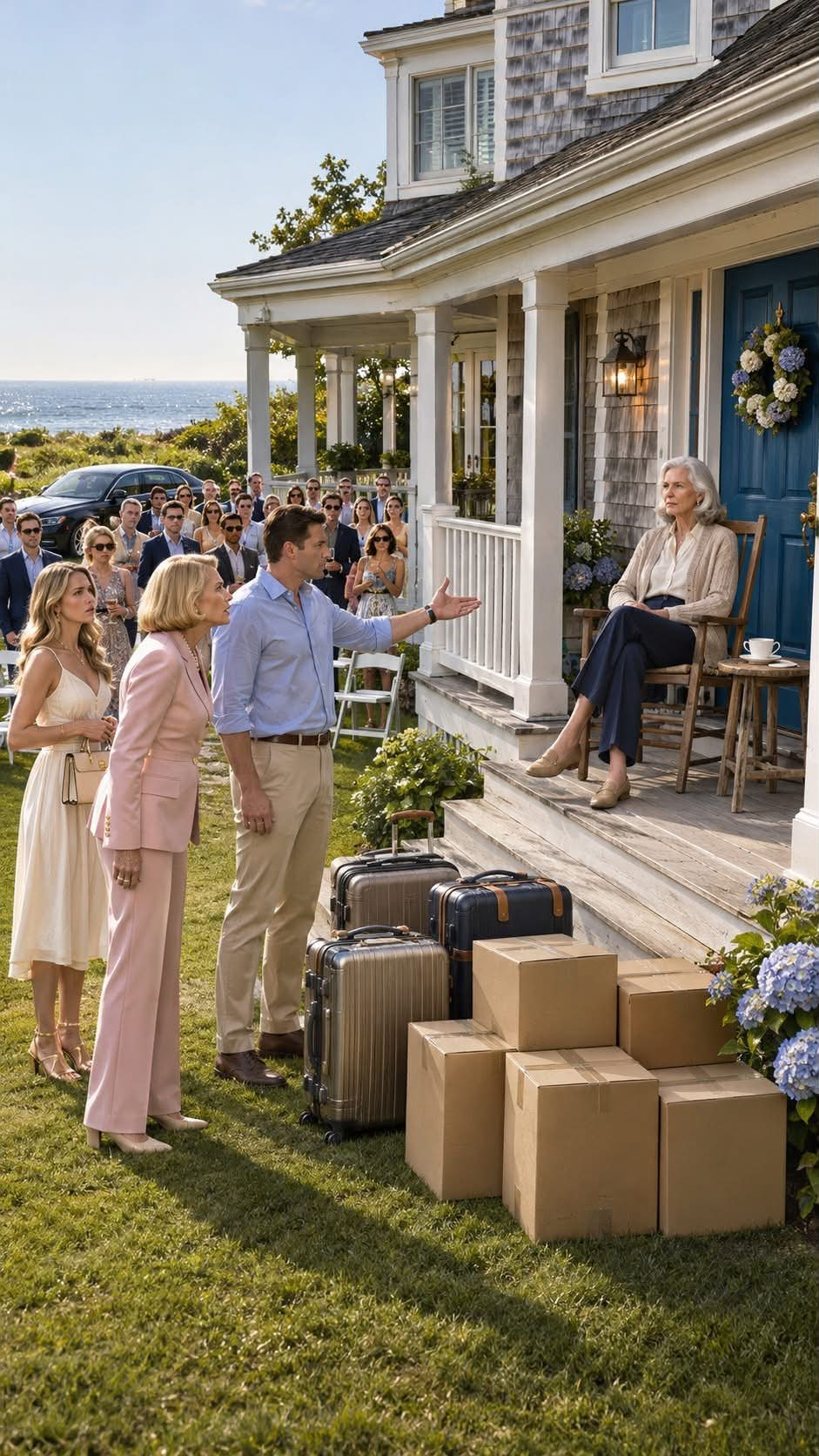
The key turned halfway.
Then stopped.
I stood in the hallway of my primary residence, staring at the front door.
Daniel Mercer was beside me, holding Nile's old photograph inside its protective sleeve.
Outside, someone tried the lock again.
A small metallic click.
Then another.
My heart pounded.
"Margaret," Daniel whispered, "step away from the door."
I backed toward the kitchen.
The porch light had gone out only moments earlier. Someone had deliberately switched off the power to the exterior fixture.
Now a stranger was trying to enter my home.
Except he wasn't entirely a stranger.
According to the message on my phone, I had met him before.
Trusted him.
And he was coming for the photograph my husband had hidden fourteen years ago.
Daniel took out his phone.
"I'm calling the police."
The person outside stopped moving.
For several seconds, everything was silent.
Then a man's voice came through the door.
"Margaret? It's Martin."
I froze.
Martin.
The locksmith.
The man who had changed every exterior lock at my beach house after Cullen moved his belongings inside.
The man who had stood on my porch with his toolbox and promised that nobody could enter without my permission.
"Martin?" I whispered.
Daniel held up his hand.
"Don't open it."
The voice came again.
"Margaret, I need to speak with you."
I stared at the door.
"Why are you trying to unlock my house?"
A pause.
Then he said, "Because I need something that belongs to me."
I felt cold.
"What?"
"The photograph."
Daniel's expression changed.
He moved closer to the door.
"Martin, this is Daniel Mercer. Police have been called. Step away from the entrance."
Silence.
Then Martin laughed.
It was a quiet, unpleasant sound.
"You should have left the old papers alone."
I closed my eyes.
And suddenly, I understood why his face had seemed familiar in the photograph.
Not because he resembled someone I knew.
Because I had known him under another name.
Fourteen years earlier, he had come to our beach house wearing an expensive jacket.
He had introduced himself as Andrew Vale.
And Nile had told him to leave.
The police arrived before Martin could get inside.
We heard a car door slam.
A command.
Footsteps.
Then an officer calling for someone to keep their hands visible.
Daniel opened the door only after an officer identified herself and confirmed it was safe.
Martin stood beside his van.
His hands were raised.
An officer was speaking to him.
I stepped onto the porch.
The night air was cool.
Martin looked toward me.
For the first time since I'd hired him to change my locks, he seemed uncertain.
I stared at him.
"Andrew Vale."
His face changed.
Only slightly.
But enough.
"You remember," he said.
"Not at first."
He looked down.
Then I asked the question that had been troubling me.
"Why did you come back?"
He didn't answer.
The officer asked me whether I had given him permission to enter.
"No."
"Did you provide him with a key?"
"No."
Martin began protesting.
He claimed he'd been asked to inspect a lock.
He claimed there had been a misunderstanding.
But the officers found an old key in his possession, along with several tools.
The key had apparently been cut for my former front-door lock.
It no longer worked properly because I'd changed part of the locking mechanism after Nile died.
Martin had been trying to force it.
The officers took statements.
They photographed the door.
And they asked Martin to explain why he had come to my property after dark.
He stopped talking.
Eventually, they took him away for further questioning.
I watched the police car disappear down the street.
Then I turned toward Daniel.
"That man changed my beach house locks."
Daniel nodded.
"Yes."
I pressed a hand against the porch railing.
"He could have kept copies."
"That's something the investigators will need to establish."
I looked toward the driveway.
"And if he did?"
"We'll replace the locks again, using someone independent."
I nodded.
Then I looked down at Nile's photograph.
For years, my husband had kept a record of the man who threatened him.
And when I finally needed a locksmith, that same man had appeared at my door.
It was almost impossible to believe.
But the evidence was beginning to explain how.
The following morning, Daniel received a call from the investigator assigned to the case.
Martin's real name was Martin Andrew Vail.
Years earlier, he had used Andrew Vale while working as a consultant on coastal property acquisitions.
He had later operated a locksmith and security business under his legal name.
He had never told me about his earlier involvement with Nile.
Nor had he mentioned his long association with Miles.
Daniel listened carefully.
Then made several notes.
When he ended the call, he looked at me.
"Martin was referred to you by someone connected to Miles."
I stared at him.
"Who?"
"Patricia."
I closed my eyes.
Of course.
When I had needed the beach house locks changed, Patricia had mentioned that she knew a reliable locksmith.
I hadn't thought much about it.
Martin had arrived promptly.
He'd been polite.
He'd completed the work.
I'd paid him.
And I'd thanked him.
"Did Patricia know who he really was?"
"She says she didn't recognize him as Andrew Vale until recently."
I looked at Daniel.
"Do you believe her?"
"I don't know yet."
I nodded.
I was learning to accept that answer.
Not every question could be settled immediately.
But every question deserved an honest investigation.
Daniel continued.
"Investigators are also reviewing the property-management representative's involvement."
I leaned forward.
"The woman with the white folder?"
"Yes."
"What's her name?"
"Vivian Cross."
I repeated it slowly.
Vivian Cross.
The woman who had stood on my lawn and claimed she could take possession of my home.
Daniel explained that Vivian had worked with a predecessor of Miles's property business years earlier.
Her name appeared on historical filings connected to Andrew Vale.
She had later become involved in private property management.
When Miles approached her about my beach house, she already knew the property.
That explained the old signature.
The company reference.
And the reason she had appeared so confidently on my porch.
"Did she know the documents were false?" I asked.
"Investigators will determine what she knew and when. Her firm has suspended its involvement, and she's been instructed not to contact you."
I sat back.
For the first time, the people surrounding the house were beginning to have names.
Real names.
Real histories.
And responsibilities they could no longer hide behind.
The photograph was examined by a document specialist that afternoon.
Daniel arranged for the protective backing to be separated carefully.
I waited in his office while the work was done.
Eleanor sat beside me.
She had brought a thermos of coffee and a small bag of lemon biscuits.
"You haven't eaten enough," she said.
I smiled faintly.
"You're becoming worse than Nile."
"Good. Somebody should."
I laughed.
It felt strange.
After so many days of fear, laughter almost seemed unfamiliar.
Then Daniel entered.
He was carrying a clear evidence sleeve.
Inside was a thin folded sheet of paper.
Yellowed.
Creased.
Covered in Nile's handwriting.
I stood.
"Is that it?"
Daniel nodded.
"The missing page."
My throat tightened.
"May I read it?"
"Of course."
He placed a copy in front of me while the original remained protected.
I sat down.
And began.
"My darling Margaret."
I stopped.
Those three words were enough to bring tears to my eyes.
Nile had called me that when we were young.
He'd called me that when our bills were overdue.
When Cullen was born.
When we argued.
When we made up.
And when he was too ill to walk down the porch steps without help.
I wiped my eyes.
Then continued reading.
"If you have found this page, it means the troubles I hoped would disappear have followed us longer than I expected."
My hands trembled.
Nile explained that several men had attempted to persuade him to cooperate with a coastal redevelopment scheme.
They wanted access to property records and revised boundary information.
They claimed the arrangement would benefit everyone.
But Nile had discovered discrepancies.
Documents described agreements that had never been made.
Certain owners were being pressured to accept terms they didn't understand.
And Andrew Vale had threatened him when he refused to cooperate.
Nile had preserved correspondence, photographs, and notes.
He had also given copies of certain records to Samuel Whitcomb.
I looked up.
"Samuel knew."
Daniel nodded.
"Apparently he kept the records Nile entrusted to him."
I continued.
Then I reached the paragraph that made me stop breathing.
"Margaret, I have never believed that the house was worth more than the people who lived in it. But I know there are men who see a family home and think only of what they can take from it."
I pressed the paper against the table.
Nile had understood.
Years before Cullen's wedding.
Years before Harbor Crest Holdings.
Years before anyone called me confused.
My husband had understood exactly what kind of people were interested in our land.
Then came the final paragraph.
"If Cullen ever wants the house, I hope he asks you with love and accepts your answer with grace. If he cannot do that, the house should remain yours. You owe him your love, Margaret. You do not owe him your home."
I began crying.
Not quietly.
Not politely.
I cried the way I had cried the night Nile died.
Eleanor put her arms around me.
Daniel looked away.
And for several minutes, I let myself grieve.
Not only for my husband.
But for the years I had spent wondering whether I was selfish for wanting to keep something he and I had built together.
Nile had never wanted me to surrender the house.
He had wanted me to choose freely.
The remaining mysteries were resolved over the following weeks.
Not all at once.
Not dramatically.
But through records, interviews, and people finally telling the truth.
Richard Voss provided his complete files.
He admitted that he'd been hired by Miles to review the proposed property transfer and financing arrangements.
He had become concerned when documents appeared that didn't match the owner's instructions.
The white envelope he'd left beneath my doormat contained copies of early correspondence and a note identifying discrepancies in the transfer packet.
He had approached me badly.
Frightened me unnecessarily.
But his records helped establish the sequence of events.
Rebecca Hale supplied her father's correspondence and explained her own involvement.
She admitted that she had helped prepare paperwork for Miles without fully examining the claims made about my consent.
When she discovered the forged signature, she hesitated.
Then she tried to warn me.
The anonymous messages had come from Rebecca.
She had used an unregistered messaging service because she feared Miles would discover she was helping me.
It wasn't an excuse for entering my home.
She acknowledged that.
But it explained why the warnings had arrived when they did.
Patricia's involvement was harder to accept.
She had signed the witness statement without seeing me sign.
She had agreed to the false statement about my capacity.
She had accepted the promise of twenty thousand dollars.
And she had given Rebecca a key to my primary residence without my permission.
Patricia told investigators everything.
She surrendered her messages.
She provided the original paperwork Miles had shown her.
She admitted that she had allowed her financial worries to become more important than her loyalty to me.
I didn't excuse what she'd done.
But I stopped wondering whether there was some secret reason that made it acceptable.
There wasn't.
She had made terrible choices.
And now she had to live with them.
The financial investigation revealed why Miles had been so desperate.
Harbor Crest Holdings had been formed to pursue an investment that depended on access to valuable coastal property.
My beach house was supposed to provide credibility and potential collateral.
But I had never authorized its use.
No valid transfer had occurred.
No enforceable mortgage against my property had been established through the documents they produced.
Cullen's personal guarantee created problems for him.
Serious ones.
But those problems were his.
Not mine.
Laurelai's proposed management authority had never become a lawful right to control my house.
The ceremonial handover was meant to make the arrangement appear settled.
Twenty-nine witnesses.
Photographs.
A public declaration.
The appearance of family agreement.
Miles had hoped that once everyone believed the house belonged to Cullen, I would be too embarrassed to contradict them.
He had underestimated how much embarrassment I could survive.
He had also underestimated Daniel.
The altered documents, misleading statements, and disputed financial arrangements were referred to the appropriate authorities.
The civil proceedings continued separately.
Miles and Laurelai faced legal consequences that took time to resolve.
Vivian Cross's role was examined.
Martin's unauthorized entry and his connections to the earlier property scheme were investigated.
I followed the developments through Daniel.
I didn't attend every meeting.
I didn't read every filing.
I had spent enough of my life thinking about people who wanted my house.
I wanted to start living in it again.
Cullen's capacity petition was eventually withdrawn.
The court records reflected that the emergency request had been denied.
The independent evaluation supported my ability to manage my affairs.
The false statements had been challenged.
And the people who had tried to make me appear incapable no longer had a credible basis for continuing that effort.
I remember the day Daniel called with the news.
I was sitting on the beach house porch.
The ocean was calm.
The familiar board creaked beneath my chair.
"Margaret," he said, "the petition is over."
I closed my eyes.
"Really?"
"Yes."
I took a breath.
Then another.
For the first time in weeks, I didn't feel as though I needed to defend myself.
"Thank you, Daniel."
"You did the difficult part."
I smiled.
"I had help."
"Yes, you did."
After we ended the call, I sat quietly for a long time.
Then I went inside.
Took Nile's photograph from the mantel.
And carried it onto the porch.
"We kept it," I whispered.
The wind moved through the hydrangeas.
I smiled through my tears.
"We kept our house."
Cullen came to see me three weeks later.
He called first.
Asked permission.
And waited until I said yes.
That alone told me something had changed.
When he arrived, he stood at the bottom of the porch steps.
"Hi, Mom."
I looked at him.
"Hello, Cullen."
He wore a plain blue shirt and dark trousers.
He looked tired.
But different.
Less certain of himself.
Perhaps more honest.
"May I come up?"
I nodded.
"Yes."
He climbed the steps.
The board creaked.
He looked down.
Then smiled faintly.
"Dad never fixed that."
I smiled.
"He liked it."
Cullen nodded.
"I remember."
We sat beside each other.
For a while, neither of us spoke.
Then he took an envelope from his pocket.
"I wrote you something."
I looked at it.
"What?"
"An apology."
I hesitated.
Then accepted it.
He watched as I opened the envelope.
Inside was a handwritten letter.
Not a legal document.
Not a statement prepared by someone else.
His own words.
He apologized for excluding me from the wedding.
For lying about my health.
For treating my house as though it belonged to him.
For signing documents without understanding them.
For allowing Miles to manipulate him.
And for helping create the court proceeding that had frightened me so badly.
Near the end, he had written:
"I wanted to look successful in front of people who didn't know me. I forgot that the person who knew me best was the one I was hurting."
I lowered the paper.
Cullen was crying.
"I'm sorry, Mom."
I looked at him.
"I know."
He swallowed.
"I don't expect you to give me the house."
I nodded.
"Good."
"I don't expect you to forgive me today."
I studied his face.
"Good."
He looked down.
Then whispered, "I just want to be your son again."
My throat tightened.
"You never stopped being my son."
He began crying harder.
I reached for his hand.
"But being my son doesn't mean you get to hurt me without consequences."
He nodded.
"I understand."
I squeezed his hand.
"Then we can start there."
Blythe came the following Sunday.
She arrived carrying flowers.
Not expensive ones.
Just a small bunch of daisies wrapped in brown paper.
She looked nervous.
"Margaret, I wasn't sure whether you'd want to see me."
I took the flowers.
"Thank you."
She looked toward the porch.
"I owe you an apology."
I nodded.
"Yes, you do."
Her eyes filled with tears.
She admitted that she'd believed what Cullen and her parents had told her.
That she'd accepted the story about my illness.
That she'd allowed herself to imagine the beach house was a wedding gift.
And that she'd ignored things that should have made her ask questions.
"I was so worried about having a perfect wedding," she whispered, "that I didn't think about the person who was missing."
I looked at her.
"Perfection is a dangerous thing to chase."
She nodded.
"I know."
Then she said something I hadn't expected.
"Cullen and I are going to counseling."
I studied her.
"Together?"
"Yes. And separately."
I nodded.
"That sounds sensible."
She took a breath.
"We're also dealing with the debt. We're selling things. We've spoken to an attorney and a financial adviser."
I looked toward the ocean.
"Good."
She hesitated.
"Margaret, we aren't asking you for money."
I turned toward her.
"I appreciate that."
She swallowed.
"And we aren't asking for the house."
I nodded.
"Then perhaps we can begin getting to know each other properly."
Her face softened.
"I'd like that."
So would I.
Not because everything had been forgiven.
But because the truth had finally become more important than appearances.
By the following spring, the beach house looked like itself again.
I had the locks replaced by a reputable company Daniel recommended.
Every key was accounted for.
The security system was updated.
The old documents were preserved.
And the hidden compartment beneath the east porch was repaired.
Not sealed forever.
Just restored.
I wanted to remember what Nile had left there.
But I no longer needed secrets to protect my home.
I had also made a new estate plan.
Daniel helped me prepare it.
The house would remain mine for as long as I lived.
Afterward, its future would be decided according to instructions I had chosen freely, with safeguards against pressure and unauthorized transactions.
Cullen knew about the plan.
He didn't argue.
He didn't ask for details.
He simply said, "It's your house, Mom."
And for once, I believed he understood what those words meant.
One Saturday in May, Eleanor came over with a basket of strawberries.
Cullen and Blythe were already there.
They had asked whether they could help with the porch.
I had agreed.
Not because the porch needed much work.
Because I wanted to see whether we could spend an ordinary afternoon together.
Cullen was kneeling beside the railing with a paintbrush.
Blythe was washing the windows.
Eleanor was giving everyone instructions they hadn't requested.
And I was sitting in my favorite chair, watching the ocean.
At one point, Cullen looked up.
"Mom?"
"Yes?"
"Do you want me to fix this board?"
He tapped the loose plank beneath his knee.
The one that had creaked for years.
I looked at it.
Then smiled.
"No."
He frowned.
"Why not?"
"Your father liked that board."
Cullen laughed softly.
"I know."
He set down the paintbrush.
Then came to sit beside me.
For a while, we watched the waves.
Finally, he said, "I miss him."
I looked at my son.
"So do I."
He swallowed.
"I think about what he'd say if he knew everything."
I took a slow breath.
"He'd be disappointed."
Cullen lowered his eyes.
"I know."
"But he wouldn't stop loving you."
My son's eyes filled with tears.
I continued.
"He'd expect you to do better."
Cullen nodded.
"I'm trying."
I looked at him.
"I can see that."
He smiled faintly.
Then he reached for my hand.
And for the first time in a very long while, holding my son's hand didn't feel like surrendering something.
It felt like being his mother.
That evening, we ate dinner on the porch.
Nothing fancy.
Grilled fish.
Potatoes.
A bowl of salad.
Strawberries with cream.
Eleanor told a story about Nile trying to repair the kitchen sink and accidentally flooding the pantry.
Cullen laughed so hard he nearly dropped his fork.
Blythe asked questions about the house.
Not about its value.
Not about ownership.
About the summers we had spent there.
About the photographs.
About the marks on the kitchen doorway where Nile had measured Cullen's height.
I told her everything.
I told her about the summer Cullen learned to swim.
About the time a storm blew the porch furniture into the yard.
About the little blue boat Nile had built and never quite finished.
And about the first night Nile and I slept in the house after buying it.
There had been no curtains.
No proper bed.
Only a mattress on the floor and the sound of the ocean.
We had eaten sandwiches from a paper bag.
And Nile had looked at me and said, "Margaret, I think we're going to be happy here."
He had been right.
We had been happy.
Not every day.
Not every year.
But often enough to make the house feel full of love even after he was gone.
When dinner was finished, Cullen helped carry the dishes inside.
Blythe washed them.
Eleanor dried them.
And I stood in the doorway, watching.
For once, nobody was asking me for anything.
Nobody was presenting a document.
Nobody was telling me what I ought to do.
They were simply helping.
I smiled.
Later, after everyone had gone, I returned to the porch.
The sky was turning pink.
The ocean was quiet.
The hydrangeas moved gently in the breeze.
I sat in Nile's old chair.
Beside me was the final page of his letter, safely copied and framed.
I read the last sentence again.
"You owe him your love, Margaret. You do not owe him your home."
I smiled.
For fourteen years, I had wondered whether Nile would have approved of the choices I made without him.
Now I knew.
He had trusted me to make them.
I looked toward the blue front door.
The same door Cullen had once pounded on.
The same door strangers had tried to claim.
The same door I had locked when I needed to protect myself.
Tonight, it stood open.
Not because anyone had forced it.
Because I had chosen to open it.
Inside, Nile's photograph rested on the mantel.
The furniture was back where it belonged.
The rooms were peaceful.
And tomorrow, Cullen and Blythe were coming for breakfast.
They had asked.
I had said yes.
That was how it should have been from the beginning.
I stood and walked toward the doorway.
The familiar porch board creaked beneath my feet.
I laughed softly.
"Still here, Nile."
Then I stepped inside, turned on the warm kitchen light, and left the blue door open to the evening breeze.
The house was mine.
My life was mine.
And at seventy-one, I had discovered that there was still plenty of happiness waiting for me.






Comments 0