My father's car was parked outside my apartment when Marcus turned onto our street.
I recognized it immediately.
The dark sedan sat beneath the entrance lights, its headlights switched off. Gerald was standing beside the driver's door, holding his phone and staring toward the building.
Victoria's warning echoed in my mind.
Dad knows Grandma left you the original.
Marcus slowed the car.
"Do you want me to call the police?"
I looked at my father's silhouette.
"No. Not yet."
We parked several spaces away.
Gerald approached before I had even removed my seat belt.
"Tory, we need to talk."
I stepped out.
"About what?"
"Your grandmother's documents."
I looked directly at him.
"You mean the documents you spent thirty years trying to keep from me?"
His jaw tightened.
"Don't be dramatic."
"I'm not."
He glanced at Marcus.
"Can we speak privately?"
"No."
He exhaled sharply.
"You're making a mistake."
I almost smiled.
"You've been telling me that every time I ask a question."
He lowered his voice.
"Your mother is falling apart. Victoria is upset. This entire situation is tearing the family apart."
I looked at him.
"No, Dad. The truth is exposing what was already broken."
For several seconds, he said nothing.
Then he asked:
"Do you still have the original letter?"
I understood immediately.
He wasn't there because he missed me.
He wasn't there to apologize.
He wanted the document.
I shook my head.
"It's with my attorney."
His expression changed.
"You gave it to Patricia Lim?"
"Yes."
He looked genuinely frightened.
"That was a private family document."
"Grandma addressed it to me."
He stared at the ground.
Then he said something I had never expected to hear.
"Your grandmother made me promise I would protect you."
I felt my chest tighten.
"Then why did you spend my childhood keeping people who loved me away?"
He opened his mouth.
But no answer came.
Marcus stepped beside me.
"Mr. Callahan, you should leave."
My father looked at me one last time.
"I hope you understand what you're doing."
I watched him return to his car.
This time, I didn't feel guilty.
I felt tired.
And strangely, free.
The following morning, Patricia Lim called.
She had finally received the complete archival record from the hospital.
The sealed statement my grandmother had left behind had been located, authenticated, and added to the documentation.
I went to her office with Marcus.
Patricia placed a thick folder on the desk.
"I believe we now have enough information to reconstruct what happened."
I sat down.
"Please tell me everything."
She opened the folder.
The first document was the original guardianship proposal.
The second was the amended version.
The third was a correspondence record from November 18.
And the fourth was my grandmother's statement.
Patricia began explaining.
When I was five, my hospitalization had created serious tension between my parents.
My medical condition required continued observation, and the doctors had recommended additional support during my recovery.
My father was worried about the financial consequences.
My mother was overwhelmed by the responsibilities of caring for two young children.
Rather than asking Diane to continue helping, my parents had begun considering a temporary placement arrangement.
Initially, my grandmother, Margaret, had volunteered to care for me.
She loved me deeply and believed I would recover more comfortably with someone familiar.
My mother had signed a preliminary authorization.
But my father wanted a different arrangement.
He had approached Eleanor and Richard through the hospital assistance program.
He believed they could provide better financial and practical support.
At first, Eleanor and Richard thought they were being asked to help a family with temporary medical expenses.
They didn't understand that my father was considering a much more extensive guardianship arrangement.
When they learned the full details, they refused to proceed without independent legal advice.
Then my grandmother intervened.
She discovered the arrangement and confronted my father.
She argued that I should remain with someone who already knew me and loved me.
My father refused.
The disagreement became so serious that he instructed the hospital to restrict Diane's involvement.
He also demanded that my grandmother stop challenging his decisions.
But Margaret refused.
She contacted the hospital social worker, documented her concerns, and submitted a written request to be considered as my temporary guardian.
The amended document had been created during this dispute.
My mother's name had originally appeared on the receiving guardian line.
It was later replaced with Eleanor's name following discussions with my father.
However, Eleanor and Richard never completed the arrangement.
They declined after discovering that the proposal involved more than temporary assistance.
My grandmother's intervention prevented the placement from proceeding.
I sat quietly.
"So I was never actually transferred?"
Patricia shook her head.
"Correct. The records do not establish that any guardianship transfer took place."
I exhaled.
"And Grandma?"
Patricia opened the final statement.
"She left this specifically for you."
I took the pages.
My grandmother's handwriting filled the first sheet.
I began reading.
"My dearest Tory,
If you are reading this, then I hope you have grown into a woman who knows her own worth.
I wish I could have told you these things myself.
When you were little, I watched adults argue about what was best for you. Some were frightened. Some were overwhelmed. Some were trying to protect their pride.
But I never doubted what you needed most.
You needed to be loved without conditions.
You needed people who would show up.
You needed to know that you were never a burden.
I wanted to care for you when you were ill. Your father believed he knew what was best, and your mother was afraid of losing control of her family.
I disagreed with them.
I also made mistakes. I should have fought harder to remain part of your life.
But I never stopped loving you.
There is one thing I want you to remember.
You were never unwanted.
You were never difficult to love.
And you were never responsible for the arguments between the adults around you.
If life ever gives you the opportunity to choose the people who stand beside you, choose the ones who make you feel safe enough to be yourself.
Love,
Grandma Margaret."
I stopped reading.
My vision blurred.
Marcus placed his hand over mine.
I cried quietly.
Not because I was discovering that my childhood had been perfect.
It hadn't been.
I cried because someone had finally put into words what I had needed to hear for most of my life.
I had never been the problem.
There was one final document.
Patricia placed it on the desk.
It was a letter from Helen Parker, the former hospital social worker.
She had written a detailed account of the events surrounding my hospitalization.
She confirmed that the proposed guardianship arrangement had never become effective.
She also confirmed that my grandmother had repeatedly requested that I be allowed to maintain relationships with Diane and other relatives who had supported me.
The hospital had documented the disagreement.
But the matter had eventually been closed after my condition improved and I returned home.
There was no evidence that Eleanor or Richard had attempted to take me away.
There was also no evidence that Diane had ever tried to undermine my parents.
In fact, the records showed that she had been consistently concerned about my welfare.
Patricia closed the folder.
"Legally, this resolves the question surrounding the old arrangement. There was a proposal, but no completed transfer. Your adult adoption remains valid, and nothing in these documents changes your legal relationship with Eleanor and Richard."
I looked at her.
"Thank you."
She smiled gently.
"Your grandmother did a remarkable job preserving the truth."
I nodded.
For the first time, I felt that the past was no longer something I had to fear.
It was something I could finally understand.
My father called three days later.
I almost didn't answer.
But I decided to listen.
"Tory."
"Hello, Dad."
He sounded older.
Less certain.
"I read the documents Patricia sent."
I said nothing.
"I should have told you what happened."
"Yes."
He sighed.
"I thought I was making the right decision."
"You thought you were making the easiest decision."
He didn't respond.
I continued.
"You were worried about money. You were worried about work. You were worried about what people would think."
"Tory—"
"But did you ever think about what it would feel like for a five-year-old girl to be surrounded by adults arguing about where she should live?"
Silence.
"I didn't know everything," he finally said.
"You were my father. You were supposed to ask."
His breathing became uneven.
"I was wrong."
Those three words were difficult to hear.
Not because they were complicated.
Because I had waited thirty years for them.
He continued.
"I don't expect you to forgive me immediately."
"Good."
"I just wanted you to know that."
I looked out my apartment window.
"Then start by respecting my decisions. Don't show up without permission. Don't demand documents. And don't tell me who I'm allowed to consider family."
He agreed.
We ended the call.
I didn't feel suddenly healed.
But I felt that a boundary had finally been drawn.
And this time, I intended to keep it.
Victoria came to see me the following weekend.
She arrived carrying a bakery box and looking nervous.
I opened the door.
She stood there for a moment.
"Hi."
"Hi."
She held up the box.
"I brought cookies."
I stepped aside.
"Come in."
We sat at the kitchen table.
For a while, neither of us spoke.
Then she looked at me.
"I'm sorry."
I waited.
She continued.
"For Thanksgiving. For the way Mom treated you. For the years I ignored you."
I looked at her.
"Why did you send me those messages?"
Victoria lowered her eyes.
"Because I was tired of pretending."
She explained that she had heard arguments between our parents for years.
She remembered our grandmother confronting them.
She remembered Diane being blamed for everything.
And she remembered how our mother always changed the subject whenever someone mentioned my childhood hospitalization.
"I knew something wasn't right," she said. "But I was younger. I liked being the favorite. I didn't want things to change."
Her honesty surprised me.
I had expected excuses.
Instead, she admitted something uncomfortable.
"I knew you were being treated unfairly, and I benefited from it."
I looked at her for a long time.
"That hurt more than you probably realize."
"I know."
She wiped her eyes.
"I'm not asking you to pretend everything is fine."
I reached across the table.
"I'm not ready to go back to being sisters the way we were before."
She nodded.
"But I am willing to start again."
Victoria began crying.
She squeezed my hand.
For the first time in years, we sat together without competing for our parents' attention.
It wasn't a perfect reconciliation.
It was an honest beginning.
And that was enough.
Three months later, Eleanor and Richard invited everyone to dinner in Brooklyn.
Diane came.
Victoria came.
Marcus's brother David and his wife Janelle brought Cora, who was now old enough to insist that she was responsible for choosing dessert.
Richard prepared an enormous meal.
He also made three terrible Toronto jokes.
Eleanor threatened to divorce him.
Everyone laughed.
At one point, Diane stood beside me in the kitchen.
She was holding a photograph.
It was the old hospital picture of me wearing my yellow cardigan and hugging the stuffed rabbit.
"I found something else," she said.
She handed me a small envelope.
Inside was a photograph of the same rabbit.
It had been taken years later.
The floppy ear had been repaired.
I stared at it.
"Where did you find this?"
"Your grandmother kept it."
Diane smiled sadly.
"She told me you would want it someday."
I held the photograph against my chest.
"Thank you."
She hugged me.
For a moment, I remembered the little girl in the hospital bed.
I wished I could go back and tell her that she would eventually find people who would never make her question whether she belonged.
But perhaps the best thing I could do was live that promise now.
The wedding took place the following June.
We chose the same vineyard venue Marcus and I had originally planned.
White roses decorated the ceremony space.
A string quartet played beneath the afternoon sunlight.
Our invitations listed Richard and Eleanor Morrison as the bride's parents.
Beneath their names was the line I had chosen months earlier.
"The family who chose her."
This time, I didn't hesitate before reading it.
Eleanor walked me toward the ceremony.
Richard stood beside Marcus.
Diane sat in the front row.
Victoria held my bouquet before the ceremony began because I had nearly forgotten it in the dressing room.
And when the officiant asked who had supported me throughout my life, Eleanor and Richard stood together.
Richard looked toward the guests.
"All of us," he said.
Everyone laughed.
I looked at Marcus.
He was smiling.
Not the nervous smile of a man waiting for something to go wrong.
The peaceful smile of someone who knew exactly where he belonged.
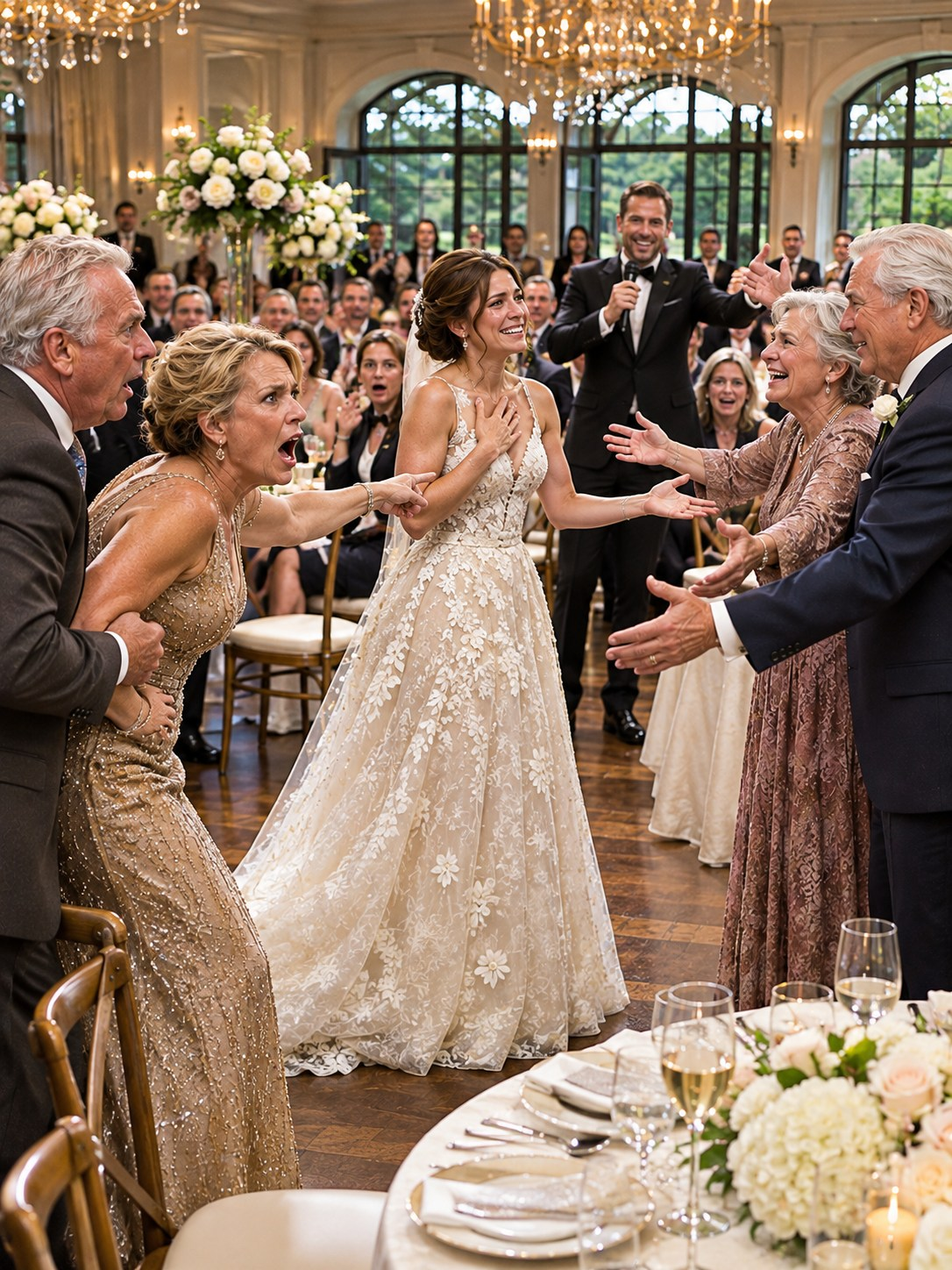
During the reception, the emcee tapped his microphone.
The ballroom grew quiet.
I stood near the far wall in my wedding dress.
My mother and father were seated several tables away.
They had received invitations, but they had not been given any special role in the ceremony.
That had been my decision.
The emcee smiled.
"Before we begin the next part of the evening, we'd like to recognize the two people who gave our bride a home, a family, and a place where she never had to earn her right to belong."
Eleanor covered her mouth.
Richard looked down.
The emcee continued.
"Please welcome the bride's parents, Richard and Eleanor Morrison."
The ballroom erupted in applause.
My biological mother straightened.
For a second, I saw the old expectation return to her face.
Then she understood.
The names being called were not hers.
I looked toward her.
She lowered her eyes.
I didn't feel victorious.
I didn't feel angry.
I simply felt at peace.
Because the people being celebrated were the people who had shown up.
When Eleanor reached me, she hugged me tightly.
Richard kissed my forehead.
Marcus took my hand.
And I realized that the moment I had once imagined as revenge had become something much better.
It was gratitude.
Later that evening, my father approached me.
He looked uncomfortable.
"Congratulations, Tory."
"Thank you."
He glanced toward Richard and Eleanor.
"They seem happy."
"They are."
He nodded.
Then he said quietly:
"I'm sorry I couldn't be the father you needed."
I looked at him.
"I hope you become a better one from now on."
He nodded.
There were no dramatic promises.
No demands for forgiveness.
Just an honest moment between two people who had finally stopped pretending.
He returned to his table.
I turned back toward the dance floor.
Marcus held out his hand.
"Mrs. Morrison?"
I laughed.
"That's me."
We danced beneath the lights while our family surrounded us.
Diane was laughing with Eleanor.
Victoria was dancing with David.
Cora was trying to convince Richard that the wedding cake needed another layer.
And I stood in the middle of it all.
Surrounded by people who had chosen to love me.
For thirty-one years, I had believed that belonging was something I needed to earn.
I had called home every Sunday.
Remembered every birthday.
Sent every card.
Made every effort.
And when my biological family turned away, I thought the failure belonged to me.
But it never had.
I had not been difficult to love.
I had simply spent too long asking the wrong people to prove it.
My grandmother's letter remained in my bedside drawer.
Her final words were the ones I carried with me:
You were never unwanted.
I finally believed her.
That night, when Marcus and I returned home, I placed the old photograph of the little girl with the stuffed rabbit beside our wedding picture.
One showed the child who had once been left waiting.
The other showed the woman who had finally found her place.
And for the first time in my life, I didn't feel like I was standing outside someone else's family.
I was home.






Comments 0