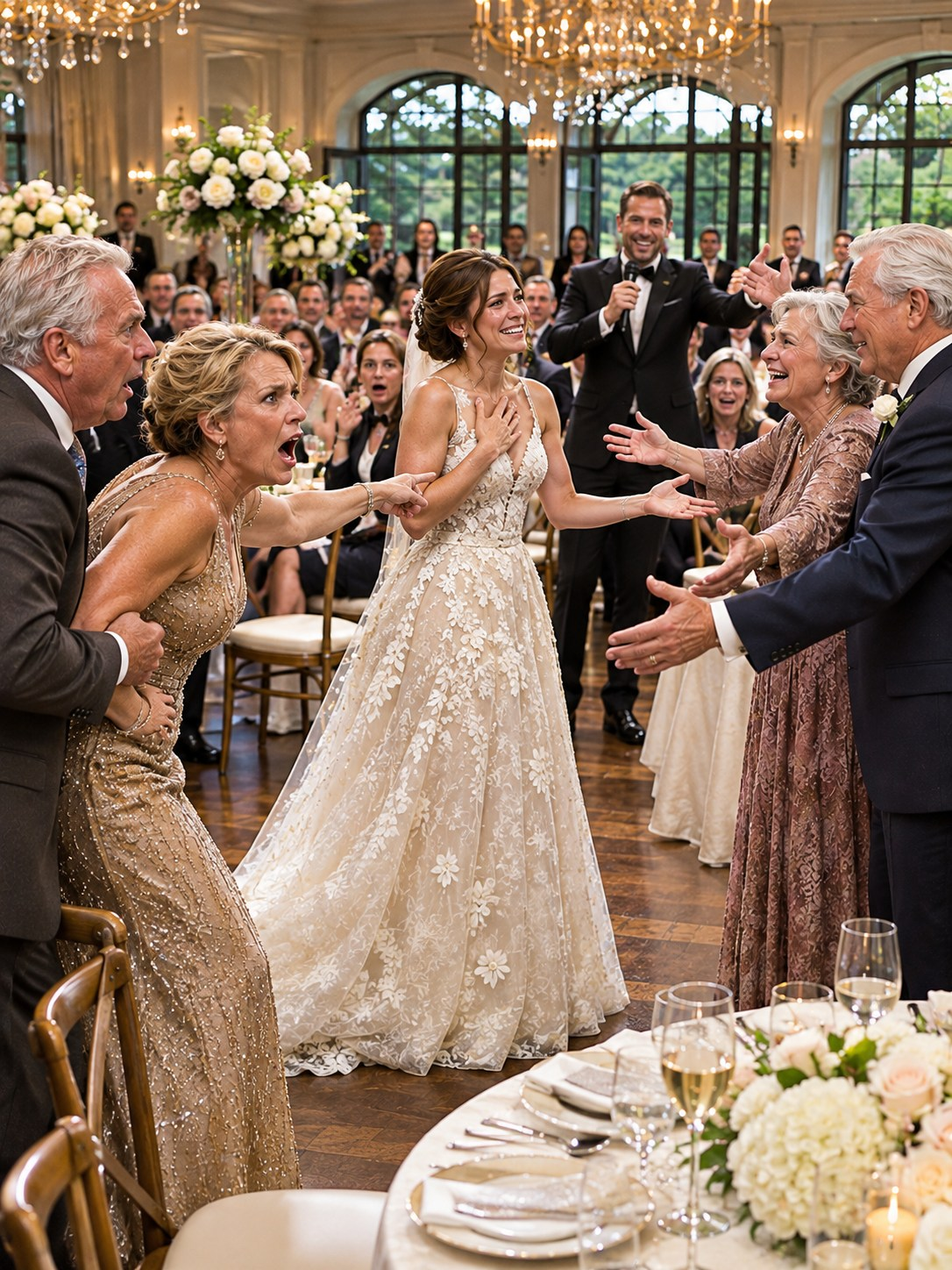
The door handle began turning.
Diane stood frozen beside the cabinet, one hand gripping the small wooden drawer she had just opened.
Marcus immediately stepped between me and the entrance.
"Stay behind me," he whispered.
I looked toward the front door.
A shadow moved across the frosted glass.
Then came another knock.
Harder this time.
"Diane! Open the door!"
My father's voice.
I had heard that voice my entire life. I knew its different tones, its warnings, its impatience, and the particular sharpness he used whenever someone refused to obey him.
But I had never heard it sound frightened.
Diane looked at me.
"Whatever happens, don't let him take that box."
She pulled out a small black case and pressed it against her chest.
I stared at it.
"What is inside?"
She shook her head.
"Something your parents should have told you a long time ago."
The door shook again.
"Diane! I know she's in there!"
Marcus walked toward the entrance.
"Maybe we should call the police."
Diane nodded.
"Please."
He took out his phone.
I remained beside the cabinet, staring at the black case.
Then the front door opened.
Gerald Callahan stepped inside.
He was wearing his usual dark navy jacket, a white shirt, and the expression I remembered from childhood whenever I had done something he considered unacceptable.
His eyes immediately found me.
"Tory."
I didn't move.
"Hello, Dad."
He glanced at Marcus.
"What is he doing here?"
Marcus remained calm.
"I'm here with Tory."
Gerald ignored him.
He turned toward Diane.
"Give me the box."
Diane tightened her grip.
"No."
His jaw clenched.
"I told you never to interfere again."
"You don't get to tell me what to do anymore, Gerald."
He took one step toward her.
I moved between them.
"Stop."
My father looked at me.
For a moment, he seemed genuinely surprised.
Then his expression hardened.
"Move, Tory."
"No."
"You don't understand what's happening."
"Then explain it."
He glanced at the black case.
"That belongs to our family."
Diane laughed bitterly.
"Your family? You threw away every letter I ever sent to that little girl."
Gerald's face turned red.
"Enough."
I looked between them.
"What is in the box?"
Neither answered.
My father took another step.
Marcus moved closer to me.
"Mr. Callahan, I think you should leave."
Gerald pointed at him.
"This is a family matter."
Marcus didn't move.
"Then you should have treated her like family."
The words landed harder than I expected.
My father stared at him.
Then he turned back toward me.
"Tory, come home. We'll discuss this privately."
I almost laughed.
"Privately? You've spent my entire life deciding what I was allowed to know."
"That's not true."
"Then why did you sign the hospital record telling them Diane couldn't contact me?"
His expression changed.
Only slightly.
But I saw it.
He knew exactly which document I meant.
"That was a long time ago."
"Why did you do it?"
He looked toward Diane.
"She was interfering."
"With what?"
"Your upbringing."
Diane stepped forward.
"I was taking care of a sick child."
"You were trying to turn her against her mother."
"I was trying to make sure she wasn't alone!"
The room fell silent.
I looked at my father.
He didn't appear remorseful.
He appeared angry that someone had finally said the words aloud.
Marcus called the police.
He explained that there was an unwanted confrontation at a private residence and that everyone involved needed assistance.
Gerald immediately objected.
"You're calling the police on me?"
Marcus looked at him.
"You're refusing to leave."
"This is ridiculous."
Diane moved toward the kitchen.
I followed her.
She placed the black case on the table.
Her fingers shook as she opened it.
Inside were several documents, an old photograph, and a small cassette recorder.
I looked at the papers.
The top sheet carried the name of the hospital where I had been treated as a child.
There was also a date.
And a handwritten note.
I recognized the handwriting immediately.
My father's.
I picked it up.
The note was short.
It contained instructions concerning my medical care and the people permitted to receive information about my condition.
I read it twice.
Then I looked at Diane.
"What is this?"
She sat down.
"It's the reason I never came back."
My father appeared in the doorway.
"Put that away."
I turned toward him.
"No."
"Tory, you don't know what you're reading."
"Then tell me."
He shook his head.
"That document is incomplete."
Diane looked up.
"No, Gerald. It isn't."
He stared at her.
She opened another compartment in the case and removed a folded letter.
"This is the original."
My father went completely still.
I looked at the letter.
The paper was yellowed.
The hospital's letterhead was visible at the top.
There were two signatures at the bottom.
One belonged to a physician.
The other belonged to my father.
I began reading.
The letter described a meeting that had taken place during my hospitalization.
It mentioned a treatment plan.
It mentioned a recommendation.
And it contained a sentence that made my hands go cold.
"Parental consent for the proposed intervention remains unresolved."
I looked up.
"What intervention?"
Diane's eyes filled.
"That's what your father doesn't want you to know."
Gerald moved toward the table.
"Give me that."
I stepped back.
"No."
He stopped.
For several seconds, nobody spoke.
Then he said quietly:
"You were five years old. You were sick. We were trying to do what was best for you."
I looked at him.
"Then why hide it?"
He didn't answer.
Diane took the letter from my hand.
"Because the doctors had recommended additional testing, and your father refused to authorize it."
My mouth went dry.
"Why?"
She looked toward Gerald.
"Ask him."
I turned.
My father rubbed his forehead.
"The doctors didn't agree among themselves. There were risks."
"That still doesn't explain why you kept me from knowing."
"You were a child!"
"I know I was a child!"
My voice broke.
I took a breath.
"That's exactly why someone should have been looking after me."
Diane covered her mouth.
My father looked away.
The police arrived approximately fifteen minutes later.
Two officers entered the house and asked everyone to explain what had happened.
Gerald immediately described the situation as a family disagreement.
Diane told them he had entered without permission and demanded property belonging to her.
Marcus explained that we had been discussing old family documents when Gerald arrived.
The officers separated everyone.
One spoke with Gerald.
The other spoke with Diane and me.
I explained that I didn't want my father to take the documents.
I also told them that I had received no threats of physical violence, but that the confrontation had become intimidating.
The officer advised everyone to remain calm.
Gerald was told to leave unless Diane invited him to stay.
He looked at me before walking out.
"You have no idea what you're doing."
I held his gaze.
"Then explain it."
He shook his head.
And left.
I watched his car disappear down the street.
For several minutes, I couldn't move.
Diane sat beside me.
"I'm sorry."
I looked at her.
"How many years have you been carrying this?"
She lowered her eyes.
"Thirty."
I felt something break inside me.
Thirty years.
Three decades of silence.
Three decades of believing that a woman who had once cared for me had simply disappeared.
And all that time, she had been keeping letters, photographs, and documents.
"I want to know everything," I said.
Diane nodded.
"I'll tell you."
Marcus returned from speaking with the officer.
He sat beside me and placed his hand over mine.
"Are you okay?"
I shook my head.
"No."
He didn't ask me to pretend otherwise.
Diane made tea.
We sat at the kitchen table with the black case between us.
The afternoon light fell across the old documents.
She began explaining what she remembered about my hospitalization.
When I was five, I had developed a serious infection.
My condition had worsened quickly, and I had been admitted for treatment.
My parents were overwhelmed.
Victoria was still very young, and Gerald was working long hours.
Diane had offered to help.
She had spent time at the hospital.
She had spoken with doctors.
She had helped organize practical arrangements for my recovery.
Then the medical team recommended additional testing.
There had been uncertainty about the cause of the infection and whether another underlying problem needed investigation.
Diane believed the tests were important.
My father disagreed.
He wanted to wait.
The doctors had documented their recommendations.
And the family had begun arguing.
I listened carefully.
"Did the doctors eventually perform the tests?"
Diane shook her head.
"Some of them. Not all."
"Why?"
"Your father withdrew his consent for the additional procedures at that time."
I looked at the letter.
"Was that allowed?"
"Your parents were your legal guardians. They had authority over medical decisions, subject to the applicable rules and emergency circumstances."
I nodded slowly.
"Did you think he was wrong?"
Diane looked at me.
"I thought he was frightened. I also thought he was making decisions without listening carefully enough."
"Did you argue with him?"
"Yes."
"About me?"
"Always."
She looked down.
"Your mother eventually accused me of wanting to become your mother. She said I was trying to take you away from her."
I swallowed.
"Did you?"
Diane looked almost offended.
"No, sweetheart. I wanted you to have your mother. I wanted you to be healthy. I wanted you to grow up knowing that you were loved."
Her voice trembled.
"That was all."
I looked at the photographs.
Then at the letters.
There was one question I still couldn't answer.
"Why did Dad say this would destroy the family?"
Diane took a breath.
"Because the hospital social worker became involved after the disagreement. There was a formal review of the decisions made during your treatment."
I sat straighter.
"What kind of review?"
"She wanted to understand why the recommended testing had been delayed and why you had been left without a consistent adult presence during parts of your hospitalization."
I looked at the handwritten notes.
"Did she investigate my parents?"
"She documented what happened."
"And Dad was afraid of that?"
Diane nodded.
"He believed the report could damage his reputation and create serious problems for your family."
I stared at her.
Then I noticed the cassette recorder.
"What is that?"
Diane looked at it.
"A recording."
"Of what?"
She touched the recorder gently.
"A conversation that took place after the hospital review."
I felt my heartbeat accelerate.
"Between whom?"
"Your father and the hospital social worker."
I stared at the little machine.
"How did you get it?"
"The social worker gave me a copy of a recorded statement after I asked for help understanding what had happened."
"Why didn't you give it to me before?"
"Because I was afraid your parents would use it to hurt you. I thought you deserved to grow up without being dragged into their conflict."
She paused.
"But I should have found another way to protect you."
I looked at the cassette.
My father had known this existed.
That explained why he had rushed here.
I reached for it.
Diane stopped me gently.
"Before you listen, I need you to understand something."
I looked at her.
"What?"
"There's a reason your father was so determined to keep you away from me."
She opened the black case again.
Beneath the documents was another envelope.
It was sealed.
My name was written across the front.
Not Tory Callahan.
Just Tory.
The handwriting belonged to my grandmother.
I stared at it.
"My grandmother?"
Diane nodded.
"She gave me that envelope shortly before she died."
I carefully picked it up.
There was a date written beneath my name.
It was from the same year I had been hospitalized.
I looked at Diane.
"What's inside?"
Her eyes filled.
"Something your grandmother wanted you to know about your parents."
I turned the envelope over.
The seal had never been broken.
Then Diane whispered:
"Your grandmother told me that if Gerald ever discovered I still had this letter, he would do everything possible to stop you from reading it."
I looked toward the front window.
A car had just pulled up outside.
Marcus noticed it too.
He stood.
"Who is that?"
Diane looked through the curtain.
Her face went pale.
"It's Patricia."
My mother.
She stepped out of the car.
And she wasn't alone.
Standing beside her was a woman I had never seen before, carrying a second black folder.
Diane gripped my arm.
"Oh, God."
I looked at her.
"Who is that?"
Diane whispered the answer.
"The hospital social worker."
Then the woman reached the front door, raised her hand, and said:
"Tory Callahan? Before you open that envelope, there's something you need to hear about your grandmother..."






Comments 0