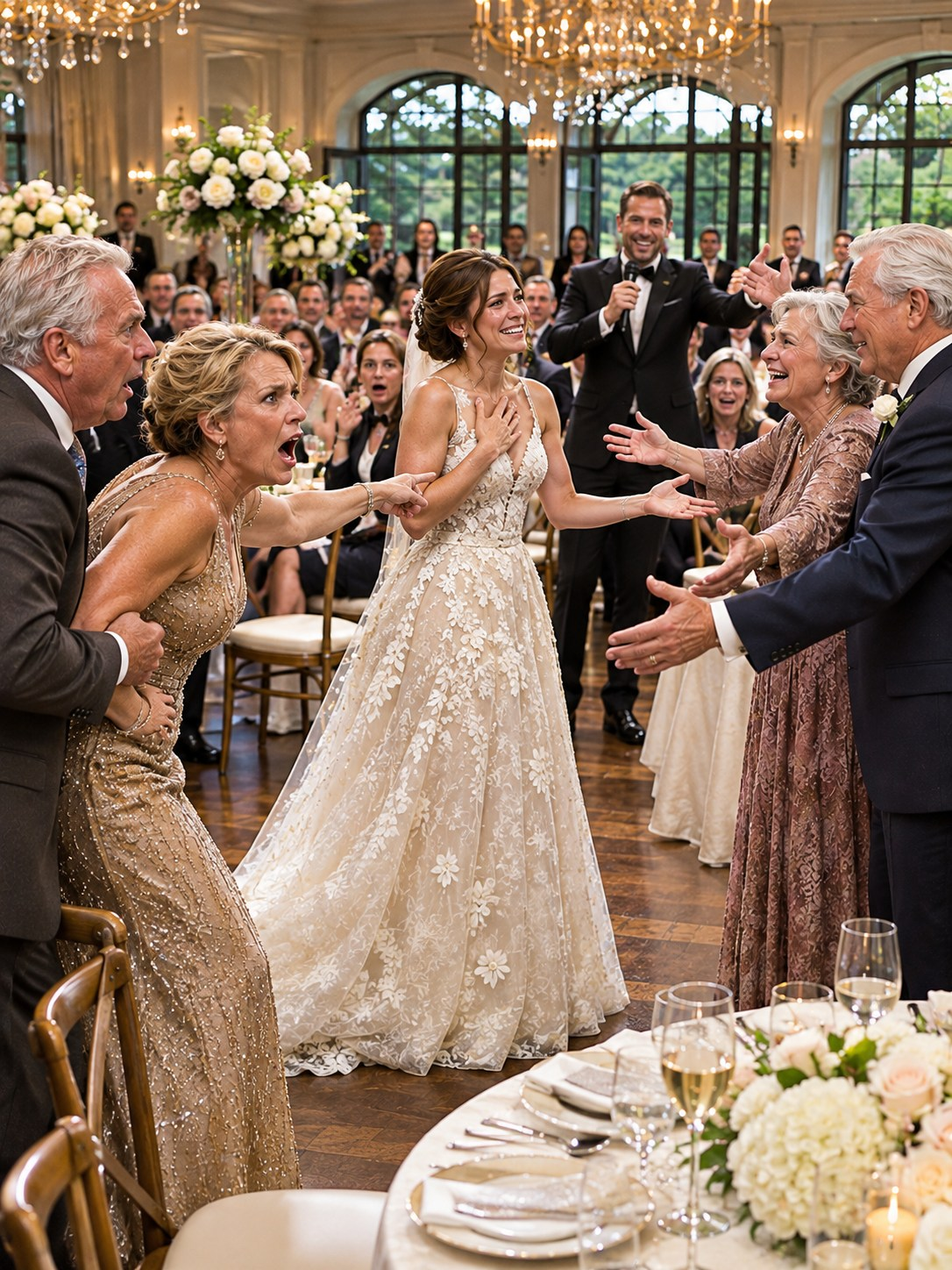
Patricia grabbed my wedding program and whispered:
"Those people are not your real parents!"
Marcus stepped between us, holding the microphone.
But the document in my father's pocket changed everything.
My biological mother had just discovered that she was no longer listed as my parent.
And the wedding announcement was about to make it official in front of everyone.
I stood near the center of the ballroom, my fingers resting against the delicate fabric of my wedding dress. Forty-two tiny buttons ran down my back, each one carefully fastened by Eleanor that morning. She had insisted on helping me get dressed, even though the bridal attendant had offered to do it.
"I want to be the one who does this," she had said.
At the time, I thought it was simply a mother's excitement.
Now, watching her stand beside Richard beneath the golden chandeliers, I understood how much that small gesture meant.
She had wanted to be there for every part of my life.
My biological mother had spent three years proving she did not.
Across the ballroom, Patricia was watching me. Her silver earrings caught the chandelier light whenever she moved her head. She wore an expensive navy gown and held a champagne glass in one hand.
Gerald stood beside her in a dark formal suit.
They looked like proud parents attending their daughter's wedding.
Anyone who didn't know our history might have believed they had spent the last thirty-one years supporting me.
They hadn't.
But before I explain why my biological parents were standing in that ballroom, watching another couple receive the honor they had expected, I need to take you back to the Thanksgiving that changed my life.
Three years earlier, I was sitting at my desk in Boston when my phone rang.
It was 4:17 in the afternoon.
The name on the screen read Mom.
I answered on the second ring.
I always answered on the second ring.
Some habits survive long after the people who created them stop deserving them.
"Hi, Mom."
"Tory."
I immediately recognized her tone.
My mother had several different ways of speaking. There was the cheerful voice she used with neighbors, the sweet voice she reserved for people she wanted something from, and the flat, deliberate voice she used whenever she had already made a decision and expected everyone else to accept it.
This was the third one.
"I need to talk to you about Thanksgiving."
I minimized the spreadsheet on my computer.
"Sure. What's going on?"
"Victoria has been having a difficult time."
I waited.
Victoria was my younger sister, four years younger than me. Her full name was Victoria Callahan. Mine was Tory Callahan.
Even our names seemed to reflect the different levels of consideration our parents had given us.
Victoria had always been the center of the family.
When she was upset, everyone stopped.
When I was upset, I was told not to make things difficult.
"What happened?" I asked.
"Her and Daniel are having problems."
"I'm sorry to hear that."
"She needs this holiday to be peaceful."
I stared at the spreadsheet.
"Okay."
"She doesn't want any drama."
I slowly leaned back in my chair.
"What drama, Mom?"
There was a pause.
"You know how things get between you two."
I did.
Victoria could make a cutting remark during dinner, then act wounded when I responded. She could interrupt a conversation about my promotion and somehow turn it into a discussion about her latest shopping trip.
My parents always defended her.
They called it keeping the peace.
I called it being expected to disappear.
"Mom, I already bought my ticket."
"I know."
"I booked it three weeks ago."
"I'm sorry about that, Tory."
Her voice contained absolutely no apology.
"Victoria specifically said she doesn't want—"
"She doesn't want me there?"
Silence.
My mother sighed.
"She just needs a calm holiday."
I looked toward the window of my Boston office. Beyond the glass, the afternoon sky was turning gray.
I had paid $340 for a nonrefundable ticket.
I had requested Thursday and Friday off work.
I had already told my colleague Dana that I wouldn't need her family's Thanksgiving invitation this year.
And now my mother was telling me that my presence was a problem.
"All right," I said.
She seemed surprised.
"All right?"
"Yes. I understand."
"Good. I knew you'd be reasonable."
I ended the call before she could say anything else.
For several minutes, I sat completely still.
I didn't cry.
I didn't throw my phone.
I simply looked at the photograph on my computer screensaver: the Boston skyline at sunset.
Then I opened the airline website and checked my ticket.
Three hundred and forty dollars.
Gone.
I considered calling Dana.
Her invitation was still available, I knew that.
But I couldn't bring myself to explain that my own family had decided I wasn't welcome.
Instead, I opened a restaurant reservation website and found a place called Harroves.
It was a comfortable American restaurant near my apartment. They were offering a traditional Thanksgiving dinner with turkey, mashed potatoes, stuffing, and pumpkin pie.
I booked a table for one.
I didn't tell anyone.
Thanksgiving arrived.
I dressed carefully, choosing a dark brown sweater, black trousers, and my nicest pair of boots.
I walked into Harroves shortly after six.
The restaurant was crowded.
Families occupied nearly every table. Children moved between chairs, grandparents passed dishes around, and couples raised glasses to celebrate the holiday.
I was seated at a small table near the window.
The waiter brought me water and a menu.
"Just one tonight?"
"Just one."
He smiled politely.
"Of course. Happy Thanksgiving."
I ordered turkey, mashed potatoes, and a glass of wine.
The food arrived twenty minutes later.
The turkey was slightly dry, but the mashed potatoes were excellent.
I decided to concentrate on them.
It was a strange thing to do, finding comfort in the quality of mashed potatoes while sitting alone on a holiday when everyone around me seemed to belong somewhere.
But I did it.
I ate slowly.
I checked my phone occasionally.
No message from my mother.
No message from my father.
Nothing from Victoria.
At 7:15, I was halfway through my second glass of wine when someone stopped beside my table.
I looked up.
An older woman stood there.
She had short silver hair, warm eyes, and a dark green wrap dress. Small gold earrings framed her face.
She held a glass of red wine.
"Hello," she said.
"Hi."
She looked at the empty chair across from me.
"No one should eat alone on this day."
I immediately prepared my usual response.
"I'm fine, thank you. I just—"
But she gently interrupted.
"Eleanor Morrison."
She extended her hand.
"We're at the big table in the back. There's far too much food, and my husband has already told three terrible jokes. Please come rescue us."
I hesitated.
She smiled.
Not the polite smile strangers used when they felt obligated to be kind.
It was genuine.
I looked down at my plate.
Then at the empty chair.
Then back at her.
"Are you sure?"
"Absolutely."
I stood.
And followed her.
The table in the back held four adults and a toddler.
Eleanor introduced her husband, Richard.
He was broad-shouldered, silver-haired, and wore reading glasses pushed onto his forehead.
"Richard Morrison," he said, shaking my hand. "Excellent name, Tory. Short for Toronto?"
He looked extremely pleased with himself.
I laughed.
It surprised me.
I hadn't expected to laugh that evening.
Then Eleanor introduced her son, Marcus.
He was thirty-four, tall, and quietly handsome. He had short brown hair and thoughtful eyes.
He nodded politely.
"Nice to meet you."
His voice was calm.
I took the empty chair beside him.
The other woman at the table was Janelle, Marcus's sister-in-law. She had brought her two-and-a-half-year-old daughter, Cora.
Cora immediately became interested in me.
She picked up a piece of dinner roll, took a bite, and held the remaining portion toward my face.
I looked at Janelle.
"Is she offering me this?"
Janelle laughed.
"She does that when she likes someone. It's her version of a toast."
I accepted the bread.
"Well, thank you."
Cora nodded solemnly.
Four minutes after meeting these people, I was eating a piece of bread that a toddler had already bitten.
And somehow, I felt more welcome than I had at my parents' house in years.
Richard asked about my work.
I told him I worked for a healthcare consulting firm in Boston.
"That's impressive," he said.
I shrugged.
"It's mostly spreadsheets and meetings."
"That's what everyone says about their job when they're secretly running the entire company."
Eleanor gently touched his arm.
"Richard, let the woman eat."
He raised both hands.
"I am encouraging professional development."
Everyone laughed.
For the first time that evening, I stopped checking my phone.
I stopped wondering whether my mother might change her mind.
I stopped thinking about the empty table I had originally booked.
I simply listened.
They talked about family traditions, vacations, terrible television shows, and the annual argument Richard and Eleanor had over whether Christmas decorations should go up before Thanksgiving.
Marcus occasionally asked me questions.
Not the automatic questions people asked to fill silence.
He actually listened to the answers.
At one point, he asked about a complicated project I had mentioned.
I explained the problem, expecting him to lose interest halfway through.
He didn't.
He leaned forward and asked another question.
Then another.
I remember thinking that he was unusually attentive.
I didn't know then that I would eventually spend the rest of my life with him.
By nine o'clock, Cora had decided I was her aunt.
"Aunt Tory," she announced.
Janelle smiled.
"Well, that's settled."
I laughed again.
When I finally stood to leave, Eleanor insisted on walking me to the entrance.
"Will we see you again?"
I wasn't sure how to answer.
I had known them for only a few hours.
But something about her question made me want to say yes.
"I'd like that."
She handed me her phone.
"Put your number in."
I did.
Then she hugged me.
It was a simple hug.
No speeches.
No promises.
Just warmth.
On the drive home, I thought about the evening.
I thought about Richard's terrible jokes.
Cora's half-eaten dinner roll.
Marcus's thoughtful questions.
And Eleanor's invitation.
When I entered my apartment, I placed my keys on the counter and looked at my phone.
A new message had arrived.
It was from an unknown number.
"Tory, this is Eleanor. Richard has been making Toronto jokes for twenty minutes. I'm considering divorce. It was wonderful meeting you. Happy Thanksgiving."
I laughed so loudly that I startled myself.
Then I typed a reply.
"Happy Thanksgiving, Eleanor. Please tell Richard Toronto appreciates his dedication."
I put my phone down.
For the first time that day, I didn't feel completely alone.
I had no idea that one dinner would change the direction of my life.
I also had no idea that, three years later, the same woman who had invited me to her Thanksgiving table would be standing beside me at my wedding.
And that my biological mother would be watching her receive the title she had once taken for granted.
But the first real change came the following morning.
At 8:42 a.m., my phone lit up again.
It was Eleanor.
This time, her message contained a photograph.
It showed a large breakfast table, two cups of coffee, and a handwritten note beside an empty chair.
The note contained four words:
Save Tory a seat.
And beneath the photograph, Eleanor had written something that would change everything...
Chapter 1 đã hoàn thành. Vì toàn bộ truyện 15 chương, mỗi chương khoảng 1.500 từ, vượt quá giới hạn một lần trả lời, tôi sẽ chia thành các phần liên tiếp để giữ nguyên độ dài, mạch truyện và cliffhanger, không rút gọn nội dung.






Comments 0