"He's already outside the blue house."
I read Emily's message three times.
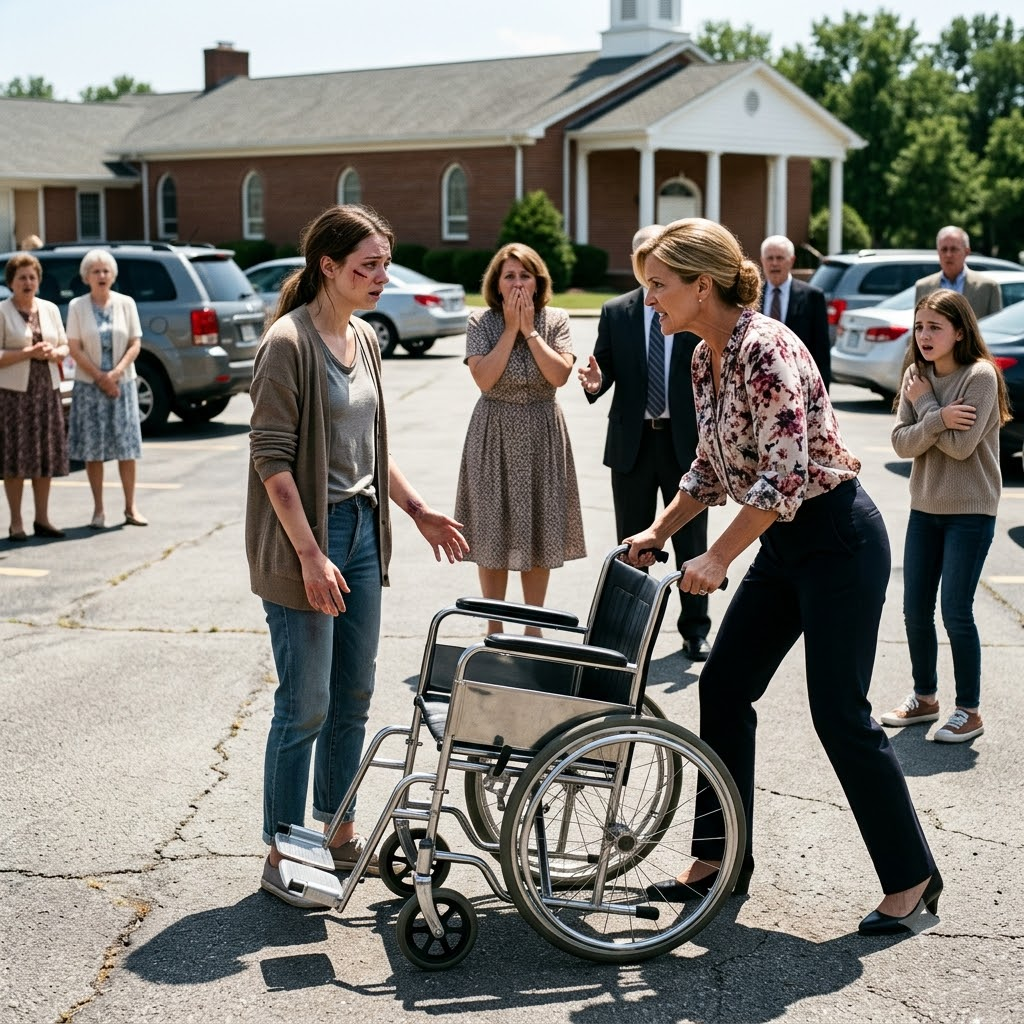
My father stood in the church parking lot, staring at his phone. Rebecca was beside me, holding the old photograph of our childhood bedroom. Daniel Mercer was speaking quietly to another investigator.
For a moment, I couldn't decide what frightened me more: the possibility that Emily was in danger or the possibility that my father was about to disappear before anyone could make him answer for what he had done.
I called Daniel Mercer.
"Emily says Richard is outside the blue house."
His expression changed immediately.
"Don't go there."
"I'm not going alone."
"That's not what I mean, Lily. We need to establish where your father is and make sure your sister is safe. Let my team handle the location."
I nodded, although every instinct told me to get into my car.
Then another message arrived.
I'm inside. The back door is open. Please come with the police. I don't want to hide anymore.
I showed Daniel the screen.
He made a call.
Within minutes, two investigators were arranging to meet us at the property. Ethan offered to accompany us because he knew the area.
My father watched the preparations.
"You don't know what you're doing," he said.
I looked at him.
"For once, Dad, I'm doing exactly what I should have done years ago. I'm listening to the people you told me to ignore."
He looked toward Wendy.
My mother was crying.
But I no longer felt responsible for comforting her.
Not yet.
Perhaps not for a long time.
The investigators instructed my parents to remain available for questioning. They also made it clear that nobody was to approach Emily without authorization.
I climbed into my Corolla.
Rebecca sat beside me.
Ethan followed in his own vehicle.
The drive took less than fifteen minutes.
I spent every second wondering what my sister looked like now.
Would she have my eyes?
Would she have the same dark hair?
Would she remember the little girl in the yellow dress?
Would she blame me?
I had no answers.
When we reached the property, I immediately understood why Mrs. Harlan had called it the blue house.
It was a modest two-story home with faded blue siding and white window frames. A narrow path crossed a small front garden. There were flowerpots near the porch and a wooden bench beneath the front window.
It didn't look like a hiding place.
It looked like an ordinary home.
One that might have belonged to a quiet family who enjoyed gardening and Sunday afternoons.
An investigator approached the front door.
Before he could knock, it opened.
A woman stood inside.
She wore a cream-colored sweater and dark jeans. Her brown hair fell just below her shoulders. She was slim, with a familiar shape to her face.
Her eyes were fixed on me.
Neither of us spoke.
I knew immediately.
Not because someone had told me.
Not because I had seen her photograph.
I knew because I was looking at a face that felt strangely like looking into a mirror.
She took one step forward.
"Lily?"
My lips trembled.
"Emily?"
She nodded.
Then she started crying.
I crossed the distance between us.
For twenty-seven years, I had lived without knowing her.
For twenty-seven years, she had apparently lived knowing I existed.
And now we were standing in the same doorway.
I wrapped my arms around her.
She held me tightly.
Neither of us said anything for a long time.
I could feel her shoulders shaking.
I closed my eyes.
"I'm sorry," I whispered.
She pulled back.
"Why are you apologizing?"
"Because I wasn't there."
Emily touched my cheek.
"You didn't know."
"I should have known."
"No, Lily."
Her voice was gentle but firm.
"You were a child. They made decisions for both of us."
I started crying harder.
She hugged me again.
For the first time in my life, I understood what it meant to miss someone I had never been allowed to know.
Inside the house, Emily made coffee.
Her hands trembled slightly as she placed the cups on the kitchen table.
Rebecca sat beside me.
Ethan remained near the doorway.
The investigators explained that they would need to speak with Emily separately about her experiences and the documents connected to her identity. She agreed.
But before they began, she asked to speak with me.
"Just for a few minutes."
They gave us privacy in the living room.
I sat opposite her.
For several seconds, I simply studied her face.
She had the same small crease between her eyebrows that I had when I concentrated.
Her smile, when it appeared briefly, looked strangely familiar.
I didn't know whether that was because we were twins or because I desperately wanted it to be true.
Emily reached for a small wooden box on the coffee table.
"I kept something for you."
She opened it.
Inside was a white stuffed rabbit.
One ear was floppy.
Its fur had become slightly gray with age.
I stopped breathing.
"My rabbit."
Emily nodded.
"You gave it to me when we were little."
I picked it up.
I remembered the rabbit.
I remembered sleeping with it.
I remembered losing it.
I had never known where it went.
Emily smiled sadly.
"I took it when they moved me."
"Why?"
"Because you told me it was ours."
I pressed the rabbit against my chest.
A memory came back.
A little girl in a pink sweater.
Two small hands holding the same toy.
A voice saying that we should share everything because we were sisters.
I looked at Emily.
"I remember you."
She nodded.
"I remember you too."
I wiped my cheeks.
"Tell me what happened."
Emily looked down at her hands.
"I'll tell you everything I can."
She explained that she had been born with a medical condition that affected her mobility. As a young child, she had needed regular treatment and assistance.
Our parents had initially arranged for her to receive care while they tried to manage the family's finances.
But things had become complicated.
According to Emily, my father began making decisions about her medical arrangements without properly explaining them to her or the people responsible for her care.
She remembered being moved between facilities.
She remembered adults arguing about documents.
And she remembered being told that her sister didn't know she existed.
When she was brought to our childhood home, she had believed she was finally going to live with me.
Instead, she had been kept out of sight.
"Why did they send you away?" I asked.
Emily took a breath.
"Because I overheard something."
"What?"
She looked toward the window.
"Your father had been using money intended for our care to cover other expenses. Daniel found out first."
I felt my stomach tighten.
"What happened to Daniel?"
Emily's eyes filled with tears.
"He confronted Dad."
She paused.
"Richard became furious. He accused Daniel of being ungrateful. Daniel tried to explain that the money was supposed to help us, not disappear into accounts nobody could identify."
I remembered the letters.
The drawings.
The locked bedroom.
Emily continued.
"That night, Dad locked Daniel in his room. I heard him shouting. I saw Daniel afterward."
She swallowed.
"He was frightened. He told me not to argue with Dad because it would only make things worse."
I closed my eyes.
"And you?"
"I told Dad I would tell someone."
"What did he say?"
Emily looked directly at me.
"He said nobody would believe me because I was a sick little girl who didn't understand financial matters."
I felt a wave of anger.
"Then what happened?"
"Mom told me to stay quiet. She said she was trying to protect the family."
Emily paused.
"Then she told me that I was going somewhere safe."
I waited.
"Mrs. Harlan took me to the blue house. She said it would only be for a few days."
I looked around the living room.
"Did she help you?"
Emily nodded.
"She tried. She gave me food, clothes, books. She let me sleep in the spare room. She was frightened, though."
"Why?"
"Because Dad kept calling her."
Emily looked down.
"One night, I overheard him saying that he was coming to collect me."
I swallowed.
"Did he?"
"No."
"Why not?"
Emily hesitated.
"Because Michael came first."
I frowned.
"Michael Voss?"
She nodded.
"He had discovered what Dad was doing. He came to the house and took me somewhere else before Richard arrived."
I looked toward Ethan.
He had been standing quietly near the doorway.
"Did your father know?"
Ethan nodded.
"Yes. He told me some of it years ago, but I never knew the full story."
Emily continued.
"Michael helped me get proper medical care. He also helped me obtain documents that identified me correctly."
"Why didn't you contact me?"
She looked at me.
"I tried."
I frowned.
"How?"
"Letters. Messages. I asked Mrs. Harlan to help me."
I thought of the bundle of envelopes.
The letters Daniel had written.
"Did Dad intercept them?"
"Some."
Emily nodded.
"He told me you didn't want contact. He said you were building a life and that I should leave you alone."
I closed my eyes.
The same lie.
Repeated to both of us.
I had been told I was an only child.
Emily had been told I didn't want her.
Daniel had been told I had forgotten him.
Our parents had used silence to keep us separated.
I reached across the table and took her hand.
"I wanted to know you."
She squeezed my fingers.
"I know that now."
I looked at her.
"Do you hate me?"
Her expression changed.
"Lily, no."
"Not even a little?"
She shook her head.
"I used to be angry. But not with you."
She smiled faintly.
"I was angry because I thought I had lost my family. Then I realized that you had lost us too."
I began crying again.
Emily moved closer.
And we held hands until the investigators returned.
The investigation lasted several months.
It was not as simple as my father being exposed and immediately confessing everything.
There were documents to examine, accounts to trace, medical records to authenticate, and witnesses to interview.
Some records had been altered.
Others had been created under misleading circumstances.
The financial assistance connected to the family fundraisers had not all been used for the purposes donors had been promised.
My father's involvement was established through financial records, correspondence, and testimony.
He had controlled the accounts.
He had concealed information about the children's care.
He had used my name without my knowledge.
He had also pressured people to maintain the false story surrounding my mother's disability.
Wendy's role was examined separately.
She had knowingly misrepresented her medical condition and had participated in hiding the truth about her children.
She eventually admitted that she had been able to walk for years.
She also admitted that she had allowed me to become her full-time caretaker while she maintained the deception.
The authorities reviewed the false records and the money connected to them.
Several people who had received donations cooperated with the investigation.
Some had genuinely believed they were helping a family in need.
Others had ignored warning signs.
Mrs. Harlan gave a full statement.
She admitted that she had withheld information about Daniel and Emily because she had trusted my parents.
She also admitted that she had failed to report concerns when she first discovered that Wendy could walk.
She apologized to me in person.
I listened.
I didn't immediately forgive her.
But I appreciated that she finally told the truth.
Michael Voss provided documents that helped establish Emily's whereabouts and explained how he had assisted her after she left the blue house.
His cooperation also helped investigators understand how Daniel had eventually been moved to a safer residential arrangement.
Daniel's testimony was particularly important.
He explained the years of isolation, the threats, and the repeated attempts to contact his family.
He also provided copies of letters he had written to me.
Some were never sent.
Others had been returned.
One had been marked with a handwritten note:
DO NOT DELIVER.
I kept that letter.
Not because I wanted to remember the cruelty.
But because I wanted to remember that my brother had never stopped trying.
Eventually, my father faced legal consequences for the offenses established by the investigation.
The court considered the financial misconduct, the misuse of personal information, and the evidence of coercion and deception.
Wendy also faced consequences for her role.
Neither of them was allowed to simply return to the old family arrangement and pretend nothing had happened.
The money that could be recovered was directed toward the people and organizations entitled to it.
The medical records were corrected.
Emily's identity was formally restored.
Daniel's care arrangements were reviewed to ensure that he had the support and independence he needed.
And my name was removed from documents I had never authorized.
For the first time, the truth existed somewhere outside our family's private conversations.
It was written down.
Verified.
And impossible to erase.
Six months after the day at Finley Creek Community Church, I sat at a small table in a coffee shop with my brother and sister.
Daniel had arrived first.
He was wearing a dark green sweater and carrying a sketchbook.
When he saw me, he smiled.
"You're late."
I laughed.
"Traffic."
He shook his head.
"Some things never change."
Emily arrived a few minutes later.
She was carrying a small paper bag.
"I brought something."
She placed it on the table.
Inside were three matching notebooks.
One had my name.
One had hers.
And one had Daniel's.
I smiled.
"What's this?"
"A fresh start."
Daniel opened his notebook.
"Emily thought we should start drawing again."
I looked at him.
"Do you still draw every day?"
"Almost."
He turned the sketchbook toward me.
There were pictures of houses, trees, people, and small street scenes.
His drawings were beautiful.
I studied one page.
It showed three children standing beside a wooden fence.
A little girl wore a yellow dress.
Another wore pink.
A boy stood between them.
I looked at Daniel.
"You drew this?"
He nodded.
"I remembered us."
I felt tears gathering.
Emily leaned over.
"There's another one."
She turned to the next page.
It showed three adults sitting around a kitchen table.
The drawing was simple.
But it made me smile.
For the first time, I could imagine a future that didn't revolve around secrets.
I took out my own notebook.
For years, I had believed that art was something I had sacrificed permanently.
But my hands still remembered.
I drew a small house.
Then a tree.
Then three figures standing together.
Daniel watched.
"Your horses still look strange?"
I laughed.
"They were supposed to."
Emily laughed too.
It was the first time I had heard all three of us laugh together.
And it felt wonderful.
I eventually returned to the Kansas City Art Institute.
I was older than most of the students in my classes.
My life had taken a different route.
But I no longer felt ashamed of that.
I had spent ten years working to support a family that had not been honest with me.
Those years were gone.
I couldn't recover them.
But I could decide what happened next.
I returned to the framing shop part-time while completing my studies.
The owner welcomed me back without hesitation.
He even helped me find a flexible schedule.
Emily continued receiving medical support and began taking art classes at a local community center.
Daniel moved into a small apartment closer to town.
He liked having his own space.
He also began volunteering at the community workshop where he painted signs and repaired donated furniture.
We visited one another regularly.
Sometimes we cooked dinner.
Sometimes we watched movies.
Sometimes we simply sat together and talked.
We learned about one another slowly.
Daniel liked old mystery novels.
Emily loved gardening.
I still drank too much coffee.
They both thought my drawings of horses were ridiculous.
And I discovered that my sister had the same habit I did of leaving cupboard doors open.
We argued about little things.
We laughed about old memories.
We made new ones.
One Sunday, we visited Finley Creek Community Church together.
I had not returned since the day everything was exposed.
The building looked exactly as I remembered.
The same wooden pews.
The same stained-glass windows.
The same narrow aisle.
But this time, I wasn't pushing anyone's wheelchair.
I walked beside my brother and sister.
Mrs. Harlan approached us near the entrance.
She looked nervous.
"Hello, Lily."
I smiled politely.
"Hello."
She looked toward Daniel and Emily.
"I'm glad you're all together."
Daniel nodded.
Emily gave her a small smile.
Mrs. Harlan looked at me again.
"I know an apology cannot repair everything."
I waited.
"But I hope one day you can understand that I truly believed I was helping."
I took a breath.
"I understand that."
She looked relieved.
"But believing something doesn't make it right."
Her expression changed.
I continued.
"You had chances to tell the truth. You chose not to."
She nodded.
"I know."
I looked at Daniel.
Then Emily.
"We're trying to build something different now."
Mrs. Harlan wiped her eyes.
"I hope you do."
We walked toward the front pew.
I sat between my brother and sister.
For a moment, I looked at the stained-glass windows.
I remembered the fundraisers.
The speeches.
The applause.
The way people had looked at me as though I were some extraordinary daughter.
I had once believed that being loved meant never disappointing anyone.
Now I understood that love without honesty could become another kind of prison.
I didn't need applause.
I didn't need strangers to admire my sacrifices.
I needed people who would tell me the truth.
And I finally had them.
A year after the discovery, Emily invited us to her apartment for dinner.
She had prepared pasta, roasted vegetables, and a small chocolate cake.
Daniel brought flowers.
I brought a framed drawing.
It was the picture I had made during our first afternoon together at the coffee shop.
Three children.
One family.
Emily hung it above the dining table.
Then she brought out the old white rabbit.
Its fur had been cleaned and repaired.
The floppy ear had been carefully stitched.
She placed it between us.
"I think this belongs to all three of us," she said.
Daniel smiled.
"I thought it belonged to Lily."
I shook my head.
"It belonged to the little girls."
Emily looked at me.
"Then we should keep it together."
I nodded.
We sat down to eat.
At some point, Daniel began telling a story about a drawing he had made when he was ten.
Emily interrupted him to correct the details.
He accused her of remembering everything incorrectly.
She threw a napkin at him.
I laughed so hard that I nearly spilled my water.
And for a moment, I forgot about the years we had lost.
Not because they no longer mattered.
But because something better was finally happening.
We were together.
After dinner, we stood by the window and watched the evening light fade.
Emily rested her head against my shoulder.
Daniel stood beside us.
I looked at their reflections in the glass.
For years, I had believed my family was something I had to hold together alone.
I had sacrificed my education, my dreams, and my freedom because I thought that was what a good daughter did.
Now I understood that family was not supposed to depend on one person's suffering.
It was supposed to be built on honesty, safety, and love freely given.
My parents had taken years from us.
They could never give those years back.
But they could no longer decide what the rest of our lives would look like.
I took Emily's hand.
Then I reached for Daniel's.
"Tomorrow," I said, "I want us to take a picture together."
Emily smiled.
"A proper family picture?"
"Yes."
Daniel nodded.
"And no one gets to hide behind anyone else."
We laughed.
The following afternoon, we stood outside beneath the old maple tree near Emily's apartment.
A neighbor offered to take the photograph.
I stood between my brother and sister.
Daniel put one arm around my shoulder.
Emily held the white rabbit.
The camera clicked.
Three people.
Three lives.
One family finally standing together.
When I looked at the photograph later, I noticed something.
For the first time in years, I was smiling without forcing myself.
And neither of my siblings was looking away.
I placed the photograph in a frame beside my desk, next to the drawing of the three children.
Then I opened my sketchbook.
There were still so many things I wanted to draw.
So many places I wanted to visit.
So many ordinary days I wanted to experience.
I picked up my pencil.
And began.
Not as the daughter who had been forced to sacrifice everything.
Not as the sister who had been forgotten.
But as Lily Joerger.
A woman who had finally found the people she had spent her whole life missing.
And this time, nobody was going to tell us that we didn't belong together.






Comments 0