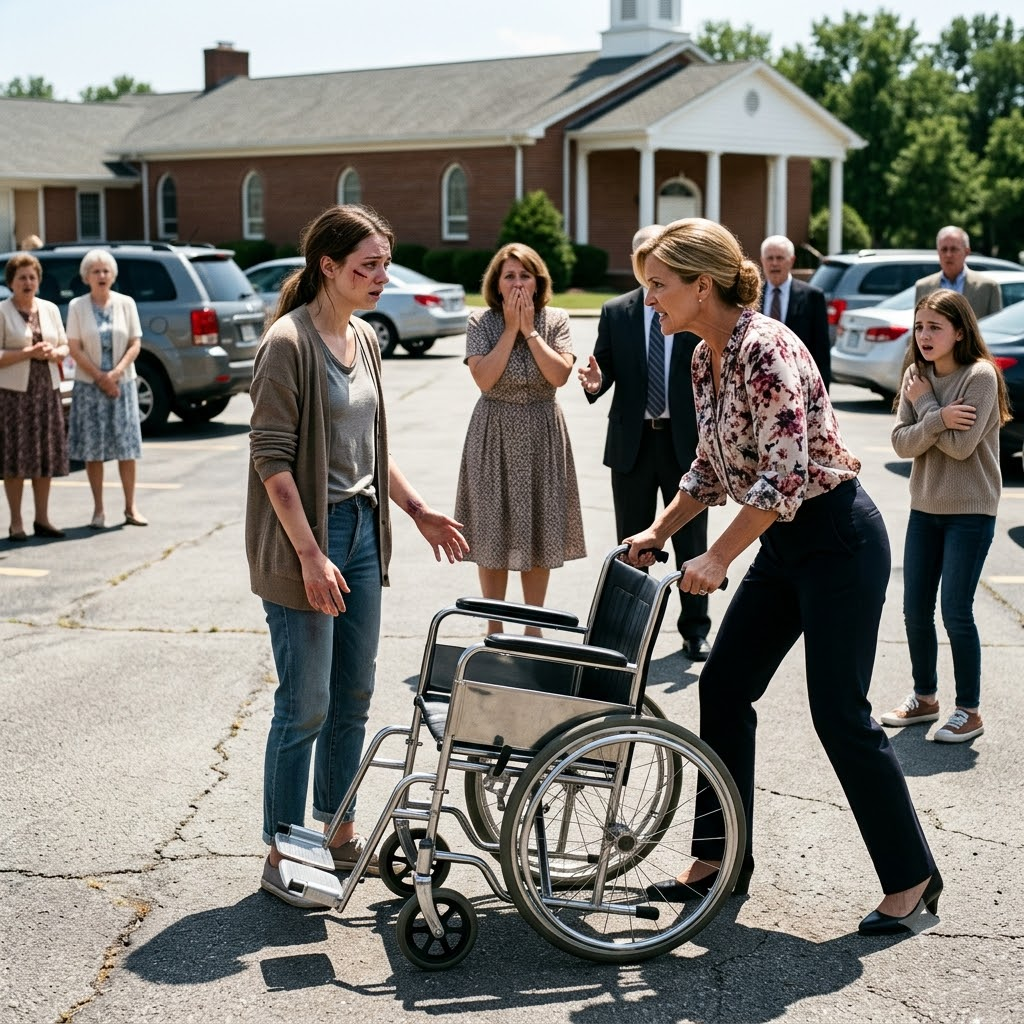
My mother was lifting a wheelchair when I screamed:
"Mom! What are you doing?"
My father came running toward me, carrying the keys to our old Toyota Corolla.
But the wheelchair was already inside the trunk.
And my mother was standing on two perfectly healthy legs.
Everything I believed was about to collapse.
My name is Lily Joerger. I was twenty-seven years old, and until that Sunday afternoon, I believed I knew exactly who my mother was.
I was wrong.
For ten years, my life had revolved around one person.
Wendy Joerger.
My mother.
The woman everyone in Nixa, Missouri, admired for her courage.
The woman our church described as an inspiration.
The woman who supposedly battled progressive Multiple Sclerosis with extraordinary grace.
And the woman I had spent nearly half my adult life caring for.
I had stopped attending college because she needed someone at home. I had given up my partial scholarship to the Kansas City Art Institute. I had worked exhausting forty-hour weeks at a small framing shop, sometimes taking extra shifts on weekends.
There were nights when I ate saltine crackers for dinner because I needed the money for her prescriptions.
There were mornings when I woke before sunrise to help her get dressed, prepare breakfast, organize her medication, and transfer her from bed to her wheelchair.
I had done everything a daughter could possibly do.
Or at least, I thought I had.
That Sunday began like every other Sunday.
I helped Mom into her pale blue cardigan, checked that her medication was packed in her handbag, and placed a small blanket over her legs.
She complained that the church parking lot was always too crowded.
I apologized and told her I would find a closer space next time.
She smiled.
"You're a good girl, Lily. I don't know what I'd do without you."
I remembered those words because they would haunt me later.
At Finley Creek Community Church, everyone knew us.
The pastor greeted Mom warmly. Elderly women stopped to kiss her cheek. Men who had known our family for years offered to carry her handbag.
Every year, the congregation organized the Walk for Wendy fundraiser.
They sold homemade pies, collected donations, and held small community events to help with her medical expenses.
People donated because they believed they were helping a woman whose body was slowly failing her.
They donated because they believed I was a daughter who had given up everything to keep her mother comfortable.
I never asked for recognition.
I never wanted it.
I only wanted Mom to have a good life.
That afternoon, the service ended shortly after noon.
The sunlight was already beating down on the parking lot.
I pushed Mom's wheelchair through the side entrance while Dad walked ahead of us.
He was sixty-one, broad-shouldered, and rarely spoke about emotions.
His name was Richard Joerger.
He had always insisted that our family keep private matters private.
Whenever I asked about Mom's illness, he reminded me that stress could make her symptoms worse.
Whenever I questioned an unfamiliar medical bill, he told me not to worry.
"Your mother has enough to deal with," he would say.
So I stopped asking.
After reaching the Corolla, I opened the passenger door and helped Mom settle into the seat.
I folded the blanket across her lap.
"Are you comfortable?"
She nodded.
"Just fine, sweetheart."
I placed her handbag beside her and closed the door.
Then I remembered my phone.
I had left it beneath the hymnal on the pew.
"Mom, I forgot my phone. I'll be right back."
She waved casually.
"Don't rush. Your father is coming."
I hurried toward the church.
The side entrance was still unlocked.
Inside, a few people were gathering their belongings, but the sanctuary was mostly empty.
I found my phone beneath the hymnal, checked the screen, and turned toward the exit.
I was thinking about the grocery list.
We needed milk, bread, and the special low-sodium soup Mom preferred.
I also needed to call the pharmacy because her latest prescription had become more expensive.
Ordinary problems.
Ordinary responsibilities.
I had no idea that in less than a minute, I would stop worrying about every single one of them.
I pushed through the side door.
The parking lot was unusually quiet.
Most of the congregation had already left.
The asphalt shimmered beneath the afternoon sun.
I could hear distant traffic from the road.
Then I saw movement near our Corolla.
At first, I thought someone was helping Mom adjust her position.
I took another step.
And stopped.
My mother was standing.
Not leaning.
Not holding onto the car.
Standing.
Her back was straight.
Her shoulders were relaxed.
Both feet were planted firmly on the asphalt.
I blinked.
For one impossible second, I thought I was looking at someone else.
But the mustard-yellow cardigan was unmistakable.
So was the short silver-blonde hair.
It was Wendy.
My mother.
The woman who had supposedly lost the ability to stand without assistance years ago.
She bent down and reached for the wheelchair.
I watched her hands wrap around the metal frame.
Then she lifted it.
Effortlessly.
The heavy steel wheelchair rose from the ground.
She turned toward the open trunk.
And threw it inside.
THUMP.
The sound echoed across the empty parking lot.
My phone nearly slipped from my hand.
I couldn't breathe.
I looked at her legs.
Then at the wheelchair.
Then at her legs again.
There was no trembling.
No weakness.
No visible struggle.
She had moved with the confidence of someone who had never needed that wheelchair in her life.
Ten years.
Ten years of helping her get out of bed.
Ten years of lifting her into the car.
Ten years of pushing her through grocery stores, hospital corridors, and church aisles.
Ten years of being told that her condition was progressive and that she might never walk again.
And now she was standing behind our car as naturally as anyone else.
My mother turned.
Her eyes found mine.
Forty feet separated us.
I saw the exact moment she recognized what I had witnessed.
Her expression changed.
The faint satisfaction disappeared from her face.
Her lips pressed together.
Her shoulders became rigid.
She looked at me with an expression I had never seen before.
Not embarrassment.
Not confusion.
Not fear of being caught doing something harmless.
Calculation.
She was calculating how much I had seen.
I couldn't move.
My mouth opened, but no words came out.
Mom glanced toward the church.
Then back at me.
She didn't attempt to sit down.
She didn't pretend to stumble.
She simply stood there.
Waiting.
I finally managed to whisper one word.
"Mom?"
She took a slow breath.
"Lily."
Her voice was different.
It lacked the softness she usually used when speaking to me.
I looked at the wheelchair inside the trunk.
"How..."
I couldn't finish the sentence.
She glanced down at her legs.
Then raised her eyes again.
For a brief moment, I thought she might laugh and explain that I had misunderstood something.
Perhaps there was some medical treatment I didn't know about.
Perhaps her doctors had discovered something miraculous.
Perhaps I had been worrying unnecessarily for years.
But then she said something that destroyed every hopeful explanation.
"Don't make a scene."
I stared at her.
"You're standing."
She didn't answer.
"Mom, you're actually standing."
Her eyes narrowed.
"Get in the car, Lily."
I felt something cold move through my chest.
"What happened to your legs?"
She looked toward the church again.
I followed her gaze.
Several people had begun exiting through the side entrance.
Mrs. Harlan, an elderly woman who had organized the last three Walk for Wendy fundraisers, was walking beside another church member.
They hadn't noticed us yet.
Mom lowered her voice.
"Not here."
I looked at her.
"Then where?"
Her expression hardened.
"At home."
I wanted to ask a hundred questions.
Instead, I stood there holding my phone.
A decade of memories seemed to rearrange themselves inside my head.
The hospital visits.
The specialist appointments.
The fundraising envelopes.
The nights I had slept beside her bedroom because she sometimes claimed she couldn't move her legs.
The mornings when I had helped her into her wheelchair before driving her to church.
I remembered one winter when she had developed what she described as severe muscle weakness.
I had taken unpaid leave from work.
I remembered another time when she said she could barely feel her feet.
I had canceled an important meeting with the owner of the framing shop because she needed someone to take her to a specialist.
And the scholarship.
I remembered the scholarship letter.
It had arrived in a white envelope with the Kansas City Art Institute printed across the top.
I had opened it at our kitchen table.
I had cried with happiness.
Mom had congratulated me.
Then, three weeks later, she had told me that her symptoms were getting worse.
I had withdrawn.
I had never gone.
Now I looked at her standing beside the Corolla.
And I wondered whether she had known all along what she was doing.
A car door slammed behind me.
My father appeared from between two parked vehicles.
He was carrying his keys and looking irritated.
"What is taking so long?"
Then he saw us.
His eyes moved from Mom to me.
He noticed the wheelchair inside the trunk.
He noticed my expression.
His face changed.
"What happened?"
I looked directly at him.
"Did you know?"
He stopped walking.
Mom said nothing.
Dad looked at her.
Then at me.
His jaw tightened.
"Get in the car."
I shook my head.
"Did you know she could walk?"
For several seconds, nobody spoke.
Behind us, the church members were getting closer.
Mrs. Harlan looked toward Mom and smiled.
Then her smile disappeared.
She had noticed something.
Mom was not sitting in her wheelchair.
She was standing beside the open trunk.
Mrs. Harlan stopped walking.
Her companion stopped too.
I saw their eyes move toward the wheelchair.
Then toward Mom's legs.
A quiet gasp escaped one of them.
Dad stepped between us.
"Lower your voice."
I stared at him.
"Ten years, Dad."
He reached for my arm.
I pulled away.
"Ten years of my life."
His face became red.
"Not here."
I almost laughed.
Not because anything was funny.
Because even then, after everything I had just witnessed, my father was still more concerned about where we were standing than about what had happened.
Mom slowly moved toward the passenger door.
Her movements were perfectly normal.
She opened it herself.
No assistance.
No hesitation.
No weakness.
I watched her lower herself into the seat.
Then she looked up at me.
Her eyes were cold.
"Get in, Lily."
I remained where I was.
My father stepped closer.
His voice dropped.
"Listen carefully. You have no idea what you're talking about."
I looked at his face.
Then I noticed something in his right hand.
A small folded piece of paper.
It was partly hidden beneath his car keys.
The paper had an official-looking blue seal.
I had seen that seal before.
It was printed on the envelopes that arrived whenever Mom's medical expenses were reviewed.
My father quickly closed his fingers around it.
But not before I noticed the words written across the top.
FEDERAL BENEFITS REVIEW.
I stared at the paper.
Dad noticed.
His expression changed again.
For the first time that afternoon, he looked genuinely frightened.
And then, from behind the church entrance, someone called my name.
"Lily Joerger?"
I turned.
A tall man in a light gray jacket stood near the side door.
He wasn't wearing church clothes.
He wasn't carrying a Bible.
He held a black folder against his chest.
He looked directly at my father.
Then at my mother.
Finally, his eyes settled on me.
"Could we speak with you for a moment?"
My father went completely still.
And my mother suddenly grabbed the edge of the passenger seat.
Because neither of them had expected that man to be there.






Comments 0