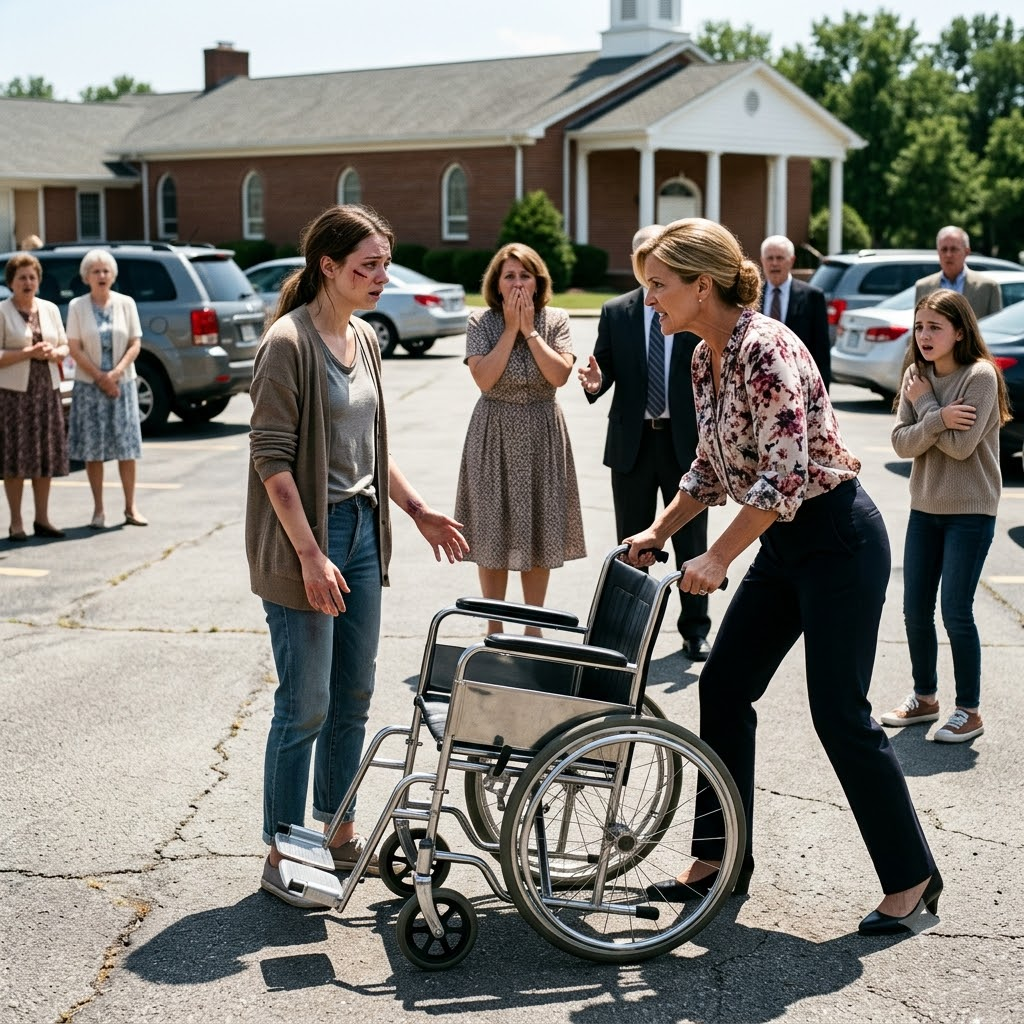
My mother had spent ten years convincing an entire town that she couldn't walk.
But when she saw the elderly man approaching us from the church entrance, she looked more frightened than I had ever seen her.
"Please," she whispered.
It was barely audible.
I turned toward her.
"What?"
She shook her head.
"Nothing."
But I had heard her.
And for the first time in my life, I realized my mother was afraid of someone other than her illness.
The elderly man continued walking across the parking lot.
He was probably in his late seventies, with neatly combed white hair, thin silver-framed glasses, and a navy jacket that looked several years old. He carried a small brown envelope in one hand.
I recognized him immediately.
His name was Harold Bennett.
He had been the church treasurer for almost twenty years before retiring. He was the kind of man who remembered everyone's birthday, knew which families were struggling financially, and quietly paid for groceries when someone couldn't afford them.
He had once helped me repair the brakes on my first bicycle.
When I was sixteen, he had given me twenty dollars after hearing that I had won an art competition.
I remembered him sitting in the church hall, carefully counting donation envelopes while my mother smiled beside him.
He had always been kind to our family.
So why did Wendy look as though she wanted to disappear?
"Hello, Lily," Harold said.
His voice was gentle.
I nodded.
"Hello, Mr. Bennett."
He looked at my mother.
For several seconds, he didn't speak.
Then his eyes moved toward the open trunk.
The wheelchair was still inside.
He took a slow breath.
"So it's true."
My father immediately stepped forward.
"Harold, this is none of your business."
The old man didn't look at him.
"Richard, I think it became my business a long time ago."
Dad's jaw tightened.
"Whatever you think you know, you don't."
Harold finally turned toward him.
"I hope you're right."
Those four words seemed to irritate my father more than any accusation could have.
I looked between them.
"Does someone want to explain what's happening?"
Harold glanced at Daniel Mercer, who had stopped beside his vehicle.
"Has she seen the records?"
Daniel answered carefully.
"Not yet."
"What records?" I asked.
Harold looked at me with an expression that made my stomach tighten.
"Your mother and father have been telling people one story for years, Lily. Unfortunately, some of the paperwork tells another."
Mom suddenly opened the passenger door.
"Richard, take me home."
Nobody moved.
She looked directly at Harold.
"You have no right to do this."
Harold held up the brown envelope.
"I wish I hadn't needed to."
Dad moved closer to him.
"Put that away."
Harold didn't.
Instead, he turned toward me.
"Do you remember the Walk for Wendy fundraiser last October?"
Of course I remembered.
It had been one of the largest fundraising events our church had organized.
More than a hundred people had attended. Local businesses had donated food and supplies. Volunteers had spent weeks collecting contributions.
There had been a silent auction, a bake sale, and a charity dinner.
I had worked at the framing shop until six the previous evening, then spent the entire night helping Mom prepare decorations.
The following morning, I had arrived at church before seven.
I remembered carrying boxes.
I remembered arranging photographs of Mom in her wheelchair.
I remembered smiling at strangers who told me how brave I was.
"Yes," I answered.
Harold nodded.
"Do you remember how much money was collected?"
I tried to remember.
"Somewhere around twenty thousand dollars."
"Twenty-three thousand, four hundred and eighty dollars," he corrected.
My stomach tightened.
He continued.
"That was the amount recorded on the final donation sheet."
I looked toward Daniel.
He was listening carefully.
Harold opened the envelope and removed several folded documents.
"At the time, I was responsible for reconciling the fundraiser's contributions with the church's financial records."
Dad interrupted.
"He retired. He doesn't have access to anything."
Harold looked at him.
"I kept copies."
The parking lot seemed to become quieter.
He held one sheet toward me.
I hesitated.
Then I took it.
At the top was the name of our church.
Below it was a list of donations.
Some were anonymous.
Others included names I recognized.
Mrs. Harlan.
The Miller family.
A local hardware store.
A retired schoolteacher.
A small construction company.
Each contribution had been recorded carefully.
At the bottom, a handwritten total read:
$23,480.
I looked at Harold.
"What am I supposed to see?"
He pointed to a column on the right.
"Look at the final deposit."
I followed his finger.
The amount was $23,480.
Then I noticed the next line.
A transfer.
$8,750.
The destination account number was partially obscured.
I recognized the final four digits.
4812.
My blood ran cold.
It was the same account Daniel had mentioned.
I looked up.
"What is this?"
Harold folded his hands.
"That was the account your father told the church was being used for your mother's medical expenses."
I looked toward Dad.
He was staring at the document.
His face had become completely expressionless.
"That's not possible," I whispered.
Harold didn't answer.
I looked back at the paper.
There were additional transfers.
Some were smaller.
One was listed as a reimbursement.
Another was marked as a medical transportation expense.
I recognized the dates.
They were dates when I had personally driven Mom to appointments.
I remembered buying gasoline with my own money.
I remembered paying for parking.
I remembered keeping receipts because I was trying to make every dollar stretch.
And now I was looking at financial records showing that money had supposedly been paid for those same expenses.
"Why was this account in my name?" I asked.
Harold's expression softened.
"That is one of the things I have been trying to understand."
I looked at my father.
"Tell me."
He didn't move.
"Tell me why my name is on this account."
Dad finally spoke.
"You signed some paperwork years ago. You were helping with family expenses."
"I was nineteen."
"You were an adult."
"I didn't know what I was signing."
His expression hardened.
"Then perhaps you should have read it."
The cruelty of that response hit me harder than I expected.
I stared at him.
For years, he had handled every complicated document in our home.
He had told me where to sign.
He had told me what each paper meant.
When I hesitated, he reminded me that I was making things harder for my mother.
I had trusted him.
I had believed that he knew better.
Now he was blaming me for trusting him.
Harold stepped closer.
"Lily, I don't want you to misunderstand something. I am not accusing you of taking money."
I looked at him.
"Then why does my name appear on the account?"
"Because someone authorized it."
"Who?"
He looked toward my father.
Dad immediately pointed a finger at him.
"Be careful."
Harold's voice remained calm.
"I have been careful for months."
That was when I noticed something unusual.
Daniel was watching my father rather than the documents.
He seemed particularly interested in his reactions.
I turned toward the investigator.
"Did you already know about this account?"
"Yes."
"Did you know my name was attached to it?"
He nodded.
I felt a wave of nausea.
"Then why didn't you tell me?"
"Because we needed to verify the account history before discussing it with you."
I looked down again.
The paper was shaking in my hands.
"How much money went through this account?"
Harold glanced at Daniel.
Daniel answered.
"We're still reviewing the full transaction history."
"Is it a lot?"
Neither man responded immediately.
That silence told me enough.
My mother suddenly spoke from the car.
"Harold, you have no idea what you're doing."
He turned toward her.
"I know exactly what I'm doing, Wendy."
She shook her head.
"You've always been jealous of our family."
I couldn't believe what I was hearing.
Harold looked genuinely hurt.
"Jealous?"
"You've spent years interfering in things that don't concern you."
He lowered his eyes for a moment.
Then he looked at her again.
"I helped organize the fundraiser because people wanted to help you. I counted their money. I recorded their donations. I thanked them personally."
He paused.
"I believed every dollar was going toward your treatment."
Mom looked away.
Harold continued.
"Do you remember Mrs. Carter?"
Mom said nothing.
"She sold her wedding ring to contribute to the fundraiser."
I remembered Mrs. Carter.
She was a quiet woman who attended the early Sunday service.
Her husband had passed away several years earlier.
She lived alone in a small house near the edge of town.
I remembered her giving Mom a hug after the fundraiser.
She had said that she hoped the money would make life a little easier.
Harold's voice became unsteady.
"She told me she couldn't afford another medical bill, but she wanted to help you anyway."
Mom's lips tightened.
"That was her decision."
"Yes," Harold replied. "It was."
He looked down at the documents.
"And that's why I couldn't ignore what I found."
I felt as though I was standing outside my own body.
The people who had donated money weren't strangers.
They were neighbors.
Church members.
Retired teachers.
Families who had given what little they could.
They had believed they were helping a woman who couldn't walk.
They had believed their donations would help pay for medical treatment.
And I had helped them believe it.
I had stood beside my mother during those fundraisers.
I had thanked people.
I had smiled.
I had told them how grateful we were.
My stomach twisted.
"I helped organize those events," I whispered.
Harold looked at me.
"You didn't know."
"But I was there."
"That doesn't make you responsible for what happened."
My father suddenly laughed.
"That's convenient."
I turned toward him.
He looked directly at me.
"Everyone wants to pretend they're innocent now. But you signed the documents. You helped with the account. You were part of this family."
My voice became stronger.
"I was your daughter."
He stepped closer.
"And we were trying to keep this family together."
I shook my head.
"No. You were keeping something hidden."
For a moment, nobody spoke.
Then Mom opened the passenger door again.
She stepped out.
Her black shoes touched the asphalt.
She stood upright.
Her movements were steady.
The congregation watched.
Mrs. Harlan had moved closer, her hand covering her mouth.
One of the church elders whispered something to another man.
Mom ignored them.
She looked directly at me.
"You're making a terrible mistake."
I stared at her.
"What mistake?"
"Believing these people."
I looked toward Harold.
Then Daniel.
Then back at her.
"Are you telling me that everything I've seen today is fake?"
Her eyes narrowed.
"You don't understand the situation."
"Then explain it."
She said nothing.
"Explain why you can walk."
Silence.
"Explain why you lifted that wheelchair."
Still nothing.
"Explain why Dad told me you were getting worse every year."
Her expression changed.
For a fraction of a second, something resembling panic appeared in her eyes.
Then it vanished.
She looked toward the congregation.
"Everyone is staring."
I couldn't believe it.
That was what she cared about.
Not my questions.
Not the ten years I had lost.
Not the money.
Not the people who had trusted her.
She was worried about being watched.
I took another step toward her.
"Mom, I need you to tell me the truth."
Her voice dropped.
"You don't want the truth."
I felt my heart pounding.
"Why?"
She leaned closer.
"Because once you know everything, you won't have a family anymore."
My father moved behind her.
For a moment, they stood together.
It was the first time I had seen them look united that afternoon.
And I realized something else.
They weren't simply trying to explain themselves.
They were trying to control what I learned.
Daniel stepped between us.
"Mrs. Joerger, I think this conversation should stop here."
Mom turned toward him.
"You can't dictate what happens in my family."
"I'm not attempting to."
"Then leave us alone."
Daniel looked at the wheelchair in the trunk.
"That may not be possible."
My father suddenly reached for the documents in my hands.
I pulled them against my chest.
"Don't touch me."
He froze.
For a moment, his expression was almost unrecognizable.
The father I knew had always been stern.
He could be impatient.
Sometimes he was difficult.
But I had never seen him look at me with such open hostility.
Harold gently touched my elbow.
"Lily, there's something else."
I looked at him.
"What?"
He glanced toward the church.
"I didn't file the complaint because of the fundraiser."
I frowned.
"Then why did you?"
He looked at Wendy.
"Because I saw her walking."
My breath caught.
"When?"
"Last November."
I stared at him.
"Where?"
"At the pharmacy near the highway."
He continued carefully.
"I had gone in to collect a prescription. I saw Wendy walking through the parking lot with a shopping bag. At first, I thought I was mistaken."
He paused.
"Then she opened the driver's door of a vehicle and got inside."
I felt dizzy.
My mother had driven?
I looked at her.
She remained silent.
Harold continued.
"I didn't want to believe what I had seen. So I waited. I thought perhaps she was recovering. Perhaps there was some treatment I hadn't heard about."
He looked down.
"But the next Sunday, she arrived at church in her wheelchair."
My throat tightened.
"And you didn't say anything?"
"I wanted to be certain."
He explained that he had reviewed the donation records again after noticing discrepancies in the medical expense reimbursements.
Some payments had been recorded twice.
Others had no supporting receipts.
A few had been transferred to accounts that were not listed as medical providers.
When he asked my father about the differences, Richard told him that the money had been used for private treatment.
Harold had accepted that explanation initially.
But then he saw Wendy walking again.
He contacted the appropriate authorities.
And several months later, federal investigators became involved.
I looked at Daniel.
"So the investigation started because of the money?"
"Financial irregularities were one part of it," he replied.
"And the medical claims?"
"We're examining those as well."
I looked at the ground.
I couldn't understand how something so enormous could have remained hidden for so long.
Then Harold reached into his envelope again.
This time, he removed a smaller photograph.
It showed my mother outside a building.
She was wearing a dark jacket and carrying a handbag.
Her legs were straight.
Her posture was relaxed.
But that wasn't what caught my attention.
Behind her stood a man.
He was younger than my father.
Perhaps in his forties.
He wore a dark blue suit and was holding a thick folder.
I looked closer.
I recognized the building.
It was the medical office where Mom had supposedly received her specialist evaluations.
I turned the photograph over.
There was a date.
And beneath it, Harold had written:
December 14. Independent medical assessment.
I frowned.
"Who is that man?"
Harold looked at the photograph.
"I don't know his name."
Daniel stepped closer.
"May I see that?"
Harold handed it to him.
Daniel studied the image.
His expression changed slightly.
"Where did you get this?"
"From the church security camera footage. The building manager gave me a copy after I asked about the parking lot."
Daniel looked at the photograph again.
Then he turned toward my father.
Richard's face had lost almost all its color.
I noticed immediately.
He recognized the man.
I was certain of it.
"Who is he?" I asked Dad.
He didn't answer.
I repeated the question.
"Who is that man?"
My father looked at Mom.
She looked back at him.
They exchanged a glance that lasted less than a second.
But I saw it.
It was the kind of silent communication people developed after years of sharing a secret.
Daniel noticed it too.
He slipped the photograph into his folder.
"Mr. Joerger, I need you to answer a question."
Dad stared at him.
"Which question?"
"Do you know the man standing behind your wife?"
"No."
The answer came too quickly.
Daniel waited.
"Are you certain?"
"I said no."
Harold shook his head.
"Richard, I think you should stop lying."
My father suddenly turned toward him.
"You've done enough."
Then he reached into his pocket.
His phone began ringing.
He looked at the screen.
For the first time since I had known him, I saw his hands shake.
He answered without speaking.
I watched his expression.
At first, he looked irritated.
Then confused.
Then frightened.
He turned slightly away from us.
I could only hear fragments.
"What do you mean?"
A pause.
"No. That's impossible."
Another pause.
Then he looked directly at me.
His face changed.
"Did you say her name?"
My stomach tightened.
He listened again.
Then whispered:
"She's standing right here."
He ended the call.
Nobody moved.
I looked at him.
"Who was that?"
He didn't answer.
Mom had stepped closer.
"What happened?"
Dad stared at the phone in his hand.
Then he slowly raised his eyes toward me.
"Lily..."
His voice sounded different.
Almost defeated.
I waited.
He swallowed.
"Someone has just requested access to the original medical records."
I frowned.
"Whose records?"
He looked at me.
"Yours."
My blood ran cold.
"Why would anyone want my medical records?"
Dad opened his mouth.
But before he could answer, Daniel's phone rang.
He glanced at the screen.
Then looked at me.
His expression became completely serious.
"Lily, don't leave this parking lot."
He answered.
Listened.
And then said three words that made my mother stagger backward.
"She has a sister."
I stared at him.
I had no sister.
I had never had a sister.
But Daniel slowly turned his phone toward me.
A photograph appeared on the screen.
A young woman stood outside a medical records office.
She had my eyes.
My face.
And beneath the photograph was a name I had never seen before.
LILY JOERGER — SECOND PATIENT FILE.






Comments 0