"I was the one who gave Ethan your old bank account number."
My father's confession hung between us.
I didn't speak.
I couldn't.
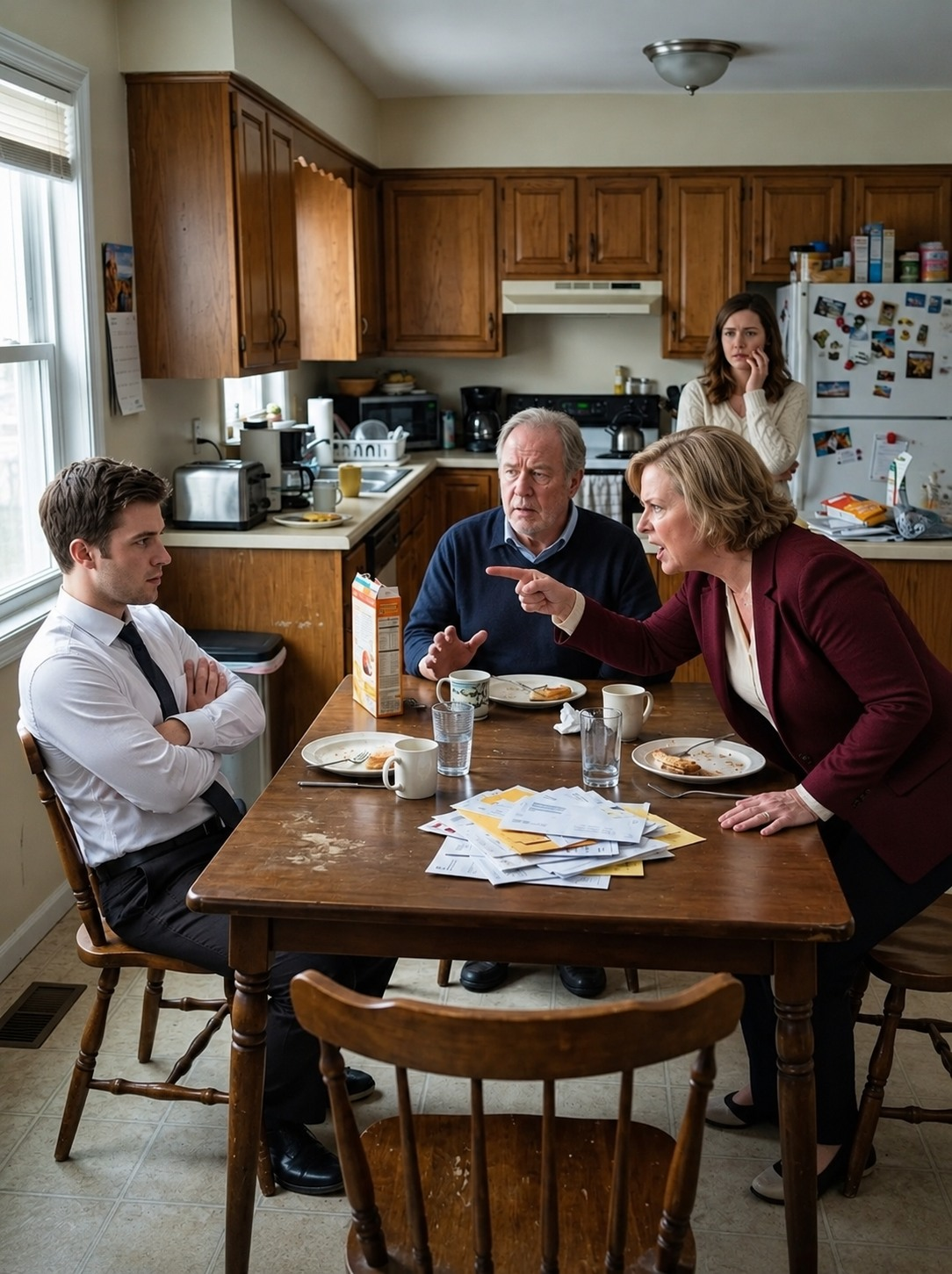
For several seconds, I stared at the photograph he had sent me. The old oak kitchen table was visible in the background. Beside the financial agreement sat a yellow envelope, a glass of water, and a stack of papers that looked as though someone had been searching through them for hours.
My father's handwriting appeared at the bottom of the second page.
His signature.
His date.
His authorization.
Eleven months earlier.
I had spent the last several weeks believing that Britney and Ethan had built a financial arrangement around my identity without my parents fully understanding what was happening.
Now I was learning that my father had provided information that helped them do it.
"Why?" I finally asked.
My father began crying.
"Daniel, I swear I didn't know what they were planning."
"That isn't an answer."
"I know."
"Why did you give him the account number?"
He took a shaky breath.
"Because he said the company needed a verified account to complete the initial business registration."
I closed my eyes.
"Why my account?"
"He said it was only for identification purposes."
I looked at the transaction record again.
The account number.
The $125,000 transfer.
The beneficiary information.
"Did he tell you money would be deposited into it?"
"No."
"Did he tell you my name would be used?"
"He said you were going to help with the logistics."
I laughed once.
Not because anything was funny.
Because I couldn't believe I was having this conversation.
"Dad, I never agreed to help with that business."
"I know that now."
"You knew I hadn't agreed eleven months ago."
He went silent.
I waited.
Then he whispered, "Britney said you had discussed it with her."
I closed my eyes.
There it was again.
Britney said.
Ethan said.
Someone else said.
Everyone had an explanation.
Nobody had bothered to ask me.
"Did you ever call me to confirm?"
"No."
"Did you ever send me the paperwork?"
"No."
"Did you ever ask whether I wanted my old bank account connected to a private business?"
He began crying harder.
"No."
I stared at the wall.
"Then what exactly did you verify?"
He didn't answer.
I looked at the photograph again.
My father's signature was unmistakable.
He had signed the document.
He had provided the account information.
He had apparently confirmed something he had never discussed with me.
And now someone was claiming that $125,000 had been deposited into an account under my name.
I took a slow breath.
"Dad, I need the entire story."
He sniffed.
"Okay."
"Not the version Britney told you. Not the version Ethan gave you. I need what actually happened."
He hesitated.
Then he began.
Eleven months earlier, Ethan had visited my parents' house with Britney.
According to my father, they had arrived on a Saturday afternoon.
Britney was excited.
She had been talking about starting an online distribution business for weeks.
Ethan presented himself as someone with experience in business development and private financing.
He brought a folder.
Inside were printed business projections, registration forms, and several pages describing the company's proposed operations.
My father remembered the photographs.
Warehouses.
Delivery trucks.
Pallets of merchandise.
A chart showing projected monthly revenue.
Everything looked professional.
Ethan explained that the company would purchase inventory in bulk, distribute it through online retailers, and eventually establish regional warehouse partnerships.
My father wasn't a businessman.
He had worked for years in maintenance management before retiring.
But he understood budgets.
He understood equipment.
He understood the importance of having reliable people involved.
And Ethan knew exactly how to speak to him.
He described Britney as ambitious.
He described the company as an opportunity.
He described me as someone whose logistics experience could help the business become more credible.
My father said he was proud when he heard that.
That part hurt.
He had apparently been proud of something I had never agreed to do.
"Did Ethan say I was going to invest money?" I asked.
"No."
"Did he say I was guaranteeing a loan?"
"No."
"Did he say I would become an owner?"
My father hesitated.
"He said you would be listed as an adviser."
I closed my eyes.
"An adviser doesn't automatically become a guarantor."
"I understand that now."
"What did he tell you about the bank account?"
"He said the business needed an account connected to someone with stable employment history."
I rubbed my forehead.
"And you gave him mine."
"Yes."
"Did he have access to my old banking information?"
"No. I gave him the account number from an old statement."
I sat upright.
"Where did you get that statement?"
"From the basement box."
I closed my eyes.
The box.
The same box Britney had been organizing.
The same documents that had apparently contained old employment records and personal information.
"Did you give him the statement?"
My father hesitated.
"I showed him the account details."
"Did he take a photograph?"
"I don't remember."
"Did he copy it?"
"I don't know."
I took a slow breath.
"Did Mom know?"
"She was there."
I looked at the clock.
9:14 p.m.
I had been on the phone with my father for nearly forty minutes.
Every answer seemed to create another question.
"Did you understand that the account was closed?"
He went silent.
Then whispered, "I thought it was."
I stared at the transaction record.
"Why?"
"Because you had changed banks years ago."
I closed my eyes.
I remembered closing the account.
Or at least I thought I had.
I had moved most of my finances to another institution after an administrative issue.
But I needed to verify whether the old account had actually been closed.
If it remained active, someone might have been able to receive funds through it.
"Did you tell Ethan it was closed?"
"No."
"Then why would he use it?"
"I don't know."
I rubbed my forehead.
"Did you tell him the account belonged to me?"
"Yes."
I closed my eyes.
My father sighed.
"Daniel, I thought I was helping you."
I didn't answer.
He continued.
"Your sister said the company could eventually provide income for the whole family. She said you might want to be involved after you came home."
I looked at the photograph of my burned cheek.
"Was that why Britney asked for my credit card?"
He hesitated.
"Yes."
I sat completely still.
"She was supposed to get the financing approved using your credit."
I closed my eyes.
"Was that the plan before I came home?"
"Yes."
"Did Mom know?"
He sighed.
"She knew Britney wanted to ask you."
"Did she know what the money was for?"
"She thought it was for the business."
I stared at the wall.
Then I asked the question I had been avoiding.
"Dad, did you know she was going to ask me for my credit card at breakfast?"
He was silent.
Then whispered, "Yes."
I felt something tighten in my chest.
"Did you know she was going to throw coffee at me?"
"No!"
His answer came immediately.
"Absolutely not. I didn't know she'd do that."
I believed that part.
But it didn't erase what came before.
"You knew she was going to ask me for my credit."
"Yes."
"You knew I hadn't agreed."
"Yes."
"And you sat at that table."
He began crying.
"I thought if you heard the business plan, you might change your mind."
I closed my eyes.
I remembered that breakfast.
Britney stirring sugar into her coffee.
My mother sighing.
My father staring at his eggs.
The credit card demand.
The familiar family script.
Family helps family.
Now I understood that the conversation hadn't been spontaneous.
It had been planned.
And my father had known.
The next morning, I requested information about the old bank account.
I contacted the institution through its official number.
After completing identity verification, I explained that I had received a transaction record suggesting a substantial payment had been deposited into an account associated with my name.
The representative asked whether I recognized the account number.
I did.
It was mine.
The representative checked.
Then she asked me to wait.
Several minutes passed.
Finally, she returned.
"Mr. Mercer, I can confirm that this account was closed several years ago."
I exhaled.
"Then how could a payment have been deposited into it?"
"According to the information you've provided, we would need to examine the transaction reference and determine whether the document accurately identifies our institution."
I nodded.
"Could you confirm whether the account ever received the $125,000 shown in this statement?"
"I can confirm that no such deposit appears in the historical records available to us."
I closed my eyes.
There it was.
The payment had never arrived.
At least, not in the account the document identified.
"Could you provide written confirmation?"
"We can explain the process for requesting historical account documentation."
I thanked her.
Then asked whether the account number could have been reused by another customer after closure.
She explained that account-number reassignment policies varied and that she couldn't determine anything about another account without a formal review.
I understood.
I wasn't going to make assumptions.
After the call, I saved the reference number and added the conversation to my timeline.
Then I opened the document Marcus had sent.
The $125,000 transfer.
The beneficiary details.
The supposed receiving institution.
I compared every digit.
The account number was correct.
The institution was correct.
But the account had been closed years earlier.
Which meant one of three things.
The transaction record was fabricated.
The funds had been routed somewhere else using misleading information.
Or the document described an attempted transaction that never actually settled.
I didn't know which.
But I knew that someone had been telling people money had been paid to me when I had never received it.
And that was a serious discrepancy.
At 11:40 a.m., Captain Mitchell reviewed the new information.
She examined the bank statement.
Then she looked at the old account details.
"Have you received written confirmation that the account was closed?"
"Not yet. I have a reference number from the bank."
"Good. Request the historical documentation."
I nodded.
She continued.
"Do you recognize the transfer reference?"
"No."
"Have you contacted the institution identified as the receiving bank?"
"Yes. They haven't confirmed the transaction."
She looked at the document.
"Then don't describe it as a completed transfer until that is verified."
"Understood."
I explained my father's confession.
The old statement.
The account information.
The registration paperwork.
The family meeting.
She listened carefully.
"Your father's admission is important, but we still need to distinguish what he knowingly provided from what others subsequently did with that information."
I nodded.
"Could he have unintentionally helped someone use my identity?"
"That's possible. But the documents and circumstances need to be examined."
She wrote down the dates.
Then she asked, "Has your father provided a written account?"
"Not yet."
"Ask him to write down what he remembers while the details are fresh. He should be accurate and should not coordinate his statement with anyone else's."
I understood.
"Yes, ma'am."
Before I left, she looked at me.
"Mr. Mercer, there's something else I want you to consider."
I waited.
"If your father supplied the account information, that doesn't establish that he knew about the false guarantee or the later financing applications."
I nodded.
"I understand."
"Keep your investigation focused on what each person actually did."
That was good advice.
Because I was angry enough to assume everyone had known everything.
But anger wasn't evidence.
And I needed evidence.
At 1:26 p.m., my mother sent me a photograph of an old envelope.
It was yellowed around the edges.
My name was written across the front.
Inside were copies of several documents.
She had found it in the basement.
I asked her not to alter anything.
Then I requested photographs of every page.
The first contained an old employment verification letter.
The second contained a copy of my driver's license.
The third was a printed bank statement.
The fourth was a page of handwritten notes.
I enlarged the fourth photograph.
At the top was a date.
Eleven months earlier.
Beneath it were several bullet points.
Daniel's employment details.
Old account information.
Logistics experience.
Credit qualification.
Final authorization after return.
I stopped moving.
The last line was underlined.
Final authorization after return.
I read it again.
Then I called my mother.
"Who wrote these notes?"
She hesitated.
"I don't know."
"Mom, look at the handwriting."
She took a moment.
Then whispered, "I think it was Britney."
I stared at the page.
"Are you sure?"
"Yes. She writes her sevens that way."
I looked at the notes.
Then asked, "Did you ever see this page before?"
"No."
"Did Britney explain why it existed?"
"No."
I closed my eyes.
The notes appeared to outline the plan.
Gather my information.
Use my employment details.
Connect my old account.
Establish credit qualification.
Wait until I returned home for final authorization.
That last part was particularly disturbing.
It suggested that the original arrangement had always depended on my return.
Not because they wanted to see me.
Not because they wanted a family visit.
Because they wanted me physically present to complete something.
I took a slow breath.
"Mom, send me the original envelope's location and don't move anything else."
She agreed.
Then she whispered, "Daniel, I think I know why Britney was so angry when you refused."
I closed my eyes.
"Why?"
"Because she had already promised Ethan you would sign."
I stared at the notes.
"Promised him what?"
"That once you came home, she would get your signature."
I sat completely still.
"Did she tell you that?"
"Yes."
"When?"
"Before you arrived."
I closed my eyes.
The breakfast confrontation had not been a spontaneous argument about a credit card.
It had been the collapse of a plan.
A plan that had been built around my return.
And when I refused to cooperate, Britney had reacted as though I had broken an agreement.
An agreement I had never made.
At 3:05 p.m., Britney called.
I almost didn't answer.
But I wanted to understand the notes.
"Hello."
She sounded nervous.
"Daniel, Mom said you found the envelope."
"Yes."
"Did you read it?"
"Yes."
She sighed.
"Then you know."
I looked at the photograph.
"Know what?"
"That Ethan had a plan."
I closed my eyes.
"Did you write those notes?"
A long silence.
"Some of them."
"Which ones?"
"The list."
"Did you write the final authorization line?"
She hesitated.
"Yes."
I rubbed my forehead.
"What did you mean by final authorization after return?"
She began crying.
"He said you needed to sign the agreement in person."
"Why?"
"He said the original documents weren't sufficient without your confirmation."
"Did you know the signature on the guarantee was false?"
She was silent.
Then whispered, "Yes."
I closed my eyes.
"Britney, did you know before I came home?"
"Yes."
"Did you intend to tell me?"
She began crying harder.
"I thought we could explain everything once you got here."
"Explain what?"
"That the company needed you."
I stared at the wall.
"Needed me for what?"
"Your credit. Your experience. Your name."
I closed my eyes.
"Did Ethan tell you the $125,000 had already been paid?"
"Yes."
"Did you know it hadn't reached my old account?"
She hesitated.
"No."
"Did you know the account was closed?"
"No."
I took a slow breath.
"Then why did you keep telling everyone the money was available?"
"Because Ethan showed me the statements."
"What statements?"
"Screenshots."
I closed my eyes.
"Britney, you knew I hadn't agreed to anything."
"Yes."
"And you still planned to get my signature."
She whispered, "Yes."
I stared at the wall.
For several seconds, neither of us spoke.
Then I asked, "What happened to the money your parents gave you?"
She began crying again.
"I don't know."
"How can you not know?"
"Ethan handled the transfers."
"Did you have access to the business account?"
"Yes."
"Did you review the statements?"
"Sometimes."
"Did you see the money leaving?"
She hesitated.
"Yes."
I felt my jaw tighten.
"Then what did you think was happening?"
"He said it was being used for operating expenses."
"Did you verify that?"
"No."
I closed my eyes.
She continued.
"Daniel, I didn't know everything."
"But you knew enough to ask questions."
She began crying.
"I know."
I took a slow breath.
"Did you personally receive any of the money?"
She didn't answer.
"Britney."
Finally, she whispered, "Yes."
I stared at the wall.
"How much?"
"I don't know exactly."
"Estimate."
She took a shaky breath.
"Maybe fourteen thousand."
I sat completely still.
"Where did it go?"
"Some went to rent. Some went to my car. Some went toward bills."
I closed my eyes.
"Did you believe it was your money?"
"Ethan said it was my share."
I rubbed my forehead.
"Did you know where it came from?"
She was silent.
Then whispered, "Not all of it."
I stared at the photograph.
The $43,000 my parents had provided.
The eighteen thousand in disputed transfers.
The $7,500 payment.
The supposed $125,000.
And now fourteen thousand dollars Britney had personally received.
I couldn't tell whether the amounts overlapped.
I couldn't tell how much had actually been transferred.
But the financial picture was becoming more serious by the hour.
"Britney, you need to disclose every payment you received."
"I know."
"And you need to preserve the account records."
"I will."
Then she said something that made me stop.
"Daniel, Ethan told me you were going to receive the money eventually."
I frowned.
"What money?"
"The $125,000."
"Why would I receive it?"
"He said it would go into a business account under your name."
I closed my eyes.
"Did he say I would have access?"
"Yes."
"Did he say I would control it?"
"Yes."
I looked at the transaction record.
A supposedly completed transfer to an account I had closed years earlier.
"Britney, did you ever see proof that I received it?"
"No."
"Then why did you believe it?"
She whispered, "Because he said you had already agreed."
I closed my eyes.
That was the foundation of the entire arrangement.
A false assumption repeated until everyone treated it as fact.
And when I refused to participate, they blamed me for disrupting something they had already promised to others.
That evening, my father sent me a written statement.
It was only two pages.
He described the meeting with Ethan.
The paperwork.
The account number.
The explanation he had been given.
He admitted providing the information.
He also admitted that he had never contacted me to verify my consent.
At the end, he wrote:
I believed I was helping my daughter start a business. I did not understand that my son's information would be used to create a financial obligation. I should have asked him first.
I read the statement twice.
Then saved it.
I didn't know whether it would resolve anything.
But at least my father had stopped pretending he hadn't been involved.
My mother also agreed to prepare her own statement.
She described meeting Ethan and Mr. Walker.
She explained that she had signed a family-support document after being told I had already agreed to participate.
She admitted that she hadn't verified the claim.
Neither statement made everything right.
But they were important.
For the first time, my parents were beginning to describe events without blaming my refusal.
At 8:54 p.m., I received a message from Marcus.
I reviewed the original transfer records again.
I replied:
What did you find?
He sent a photograph.
It showed the same $125,000 transaction.
But this time, the document contained an additional reference number.
I enlarged it.
Then noticed a field I hadn't seen before.
Intermediary Account.
There was another account number.
And a business name.
Redstone Financial Services LLC.
I typed:
Was this the company you mentioned?
Marcus replied:
Yes.
Then another message appeared.
But there's something you need to know.
I waited.
He sent another photograph.
It showed a transfer authorization dated two days after the supposed payment to my old account.
The amount was identical.
$125,000.
The receiving company was Redstone Financial Services.
I stared at it.
"Marcus, are you saying the money went to Redstone?"
He replied:
That's what the record suggests. I haven't independently verified the settlement.
I looked at the dates.
The first transaction claimed the money had gone to me.
The second appeared to move the same amount to another company.
But if the first payment had never reached my account, how could the second transaction have been authorized?
I took a slow breath.
Then I opened the original company filing.
The names.
The signatures.
The dates.
The accounts.
Everything seemed to lead back to the same small group of people.
Ethan.
Britney.
My parents.
Marcus.
And Mr. Walker.
I wrote down the new information.
Then Marcus sent another message.
There's a reason Ethan wanted you to believe the money had already been paid.
I stared at the screen.
Why?
His reply came slowly.
Because the original investor was demanding proof that the money had reached its intended beneficiary.
I felt my stomach tighten.
Who was the original investor?
Marcus didn't answer immediately.
Then he sent a photograph of a letter.
The letter was dated nearly a year earlier.
It described the supposed investment.
It referenced Pioneer Crest Distribution.
And at the bottom was a name.
I read it twice.
Margaret Mercer.
My mother.
I sat back.
"Marcus, why is my mother listed as the original investor?"
His reply came immediately.
Because she was.
I stared at the screen.
That didn't make sense.
My mother had told me she had contributed money.
But the letter described her as something more.
A principal investor.
Someone who had supposedly committed funds before the company began operations.
I called Marcus.
He answered.
"Daniel?"
"Explain this letter."
He sighed.
"Your mother wasn't just listed as a family contributor."
"What was she?"
"The original funding contact."
I closed my eyes.
"Did she know?"
"I don't know."
"How much did she supposedly invest?"
Marcus hesitated.
Then said, "Two hundred thousand dollars."
I stopped moving.
"What?"
"That's the amount in the original proposal."
I stared at the letter.
Two hundred thousand dollars.
My mother didn't have that kind of money.
Not in savings.
Not in retirement.
Not without borrowing.
"Marcus, where did that amount come from?"
He sighed.
"I don't know."
I looked at the transaction history.
The home equity line.
The retirement withdrawal.
The emergency savings.
The supposed $125,000 transfer.
Then I asked, "Did the company ever receive two hundred thousand dollars?"
"I can't confirm that."
"Did you see proof?"
"No."
I closed my eyes.
"Then why was her name listed?"
Marcus was silent.
Finally, he said, "Because Ethan told me she had agreed to guarantee the original funding."
I stared at the letter.
My mother had apparently been represented as a major investor.
I had been represented as a guarantor.
My father had provided my old bank information.
And Britney had signed the business management documents.
Four family members.
All connected to an arrangement none of us seemed to understand in the same way.
I took a slow breath.
Then Marcus said something that made my stomach drop.
"Daniel, I think your parents weren't the first people Ethan used."
I looked at the screen.
"What do you mean?"
He hesitated.
Then answered.
"Before Pioneer Crest, there was another family."
I sat upright.
"Who?"
"I don't know their full names."
"What happened to them?"
Marcus took a slow breath.
"They lost their house."
I closed my eyes.
"Was it the same arrangement?"
"Similar."
I stared at the documents.
Then Marcus added:
"But there's something worse."
"What?"
He lowered his voice.
"The man who handled their paperwork was the same person who witnessed your mother's signature."
I felt my stomach tighten.
"Mr. Walker?"
"Yes."
I looked at the photograph of the old yellow envelope.
Then at my father's written confession.
Then at the $125,000 transfer.
Suddenly, my phone vibrated.
An email had arrived from an unfamiliar address.
No subject.
One attachment.
I didn't open it immediately.
Instead, I checked the sender information and saved the original message.
Then I examined the attachment.
It was a scanned legal notice.
The first page identified Pioneer Crest Distribution.
The second referenced a disputed investment.
The third contained a list of alleged beneficiaries.
I scrolled slowly.
Then stopped.
At the bottom was a name.
A woman I had never met.
Her address was in Colorado.
And beside her name was a note:
Prior victim — account closed after foreclosure proceedings.
I felt my stomach tighten.
Then I read the date.
The case had been opened four years earlier.
Four years before Britney met Ethan.
Four years before Pioneer Crest existed.
I looked at the sender's message.
There was only one sentence.
Mr. Mercer, if you want to know why Ethan chose your family, ask your father about the first house he helped save.
I stared at the words.
Then I called my father.
He answered after the first ring.
"Dad, what's the first house?"
There was a long silence.
Then his voice changed.
Not confused.
Not frightened.
Recognizing.
"Oh, God."
I sat upright.
"What?"
He took a shaky breath.
"Daniel, I thought that was over."
"What was over?"
My father began crying.
Then whispered:
"Ethan didn't come into our family because of Britney's business. He came because I owed him a favor."
I stopped breathing.
"What favor?"
My father was silent.
Then he said:
"I helped him sell that first house."






Comments 0