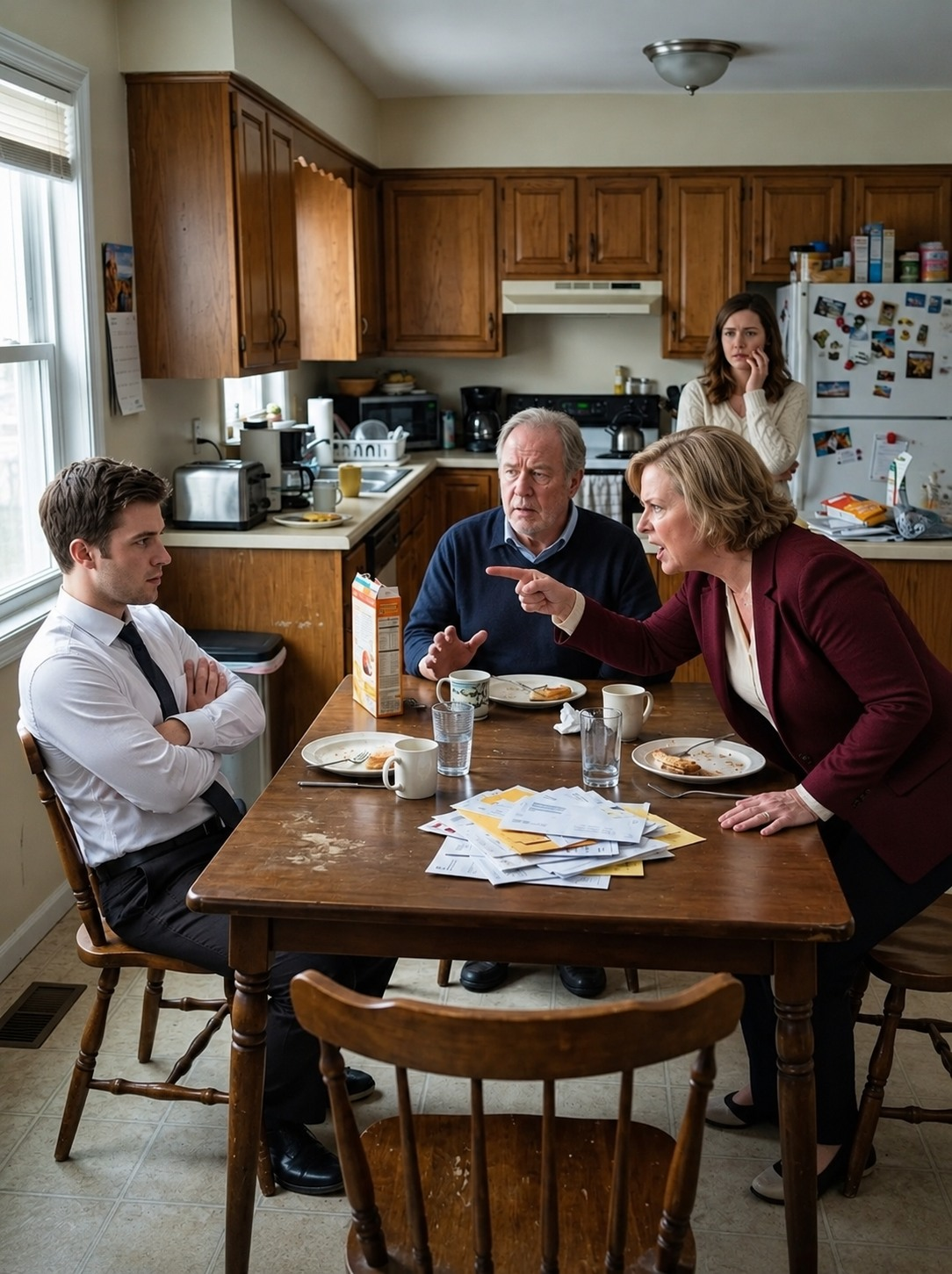
"Your extension has been denied."
The man's voice came through my father's phone clearly enough that I could hear every word.
Then there was silence.
Not the ordinary kind of silence that happens when someone stops talking.
This was different.
I could hear my father breathing. I could hear the faint sound of the television in the kitchen. Somewhere in the background, my mother was crying.
But nobody seemed willing to say what those five words actually meant.
"Dad?"
No answer.
"Dad, are you still there?"
I heard footsteps.
A chair scraped against the floor.
Then my father's voice returned, barely above a whisper.
"Daniel, I have to go."
"Who was at the door?"
"Someone from the lender."
"What lender?"
He didn't answer.
"Dad, are you losing the house?"
A long pause followed.
Then he said something I had never heard him say before.
"I don't know how to fix this."
The call ended.
I sat motionless at my kitchen table.
My phone was still pressed against my ear.
For several seconds, I didn't even lower it.
My father had always been the person who told everyone not to worry.
When the washing machine broke, he said he'd figure it out.
When the furnace stopped working in January, he said things would be fine.
When Britney missed another payment, he said the family would find a way.
He had spent decades using reassurance as a substitute for actual solutions.
And now, for the first time in my life, he had admitted that he didn't know what to do.
I looked at the photograph Britney had sent me.
NOTICE OF DEFAULT.
My father's name.
A date from the previous month.
The handwritten words:
Final extension denied.
I felt the familiar urge to get in my car and drive north.
To take control.
To ask questions.
To organize paperwork.
To make phone calls until somebody explained what was happening.
That was what I did.
At work.
In emergencies.
And, for most of my adult life, with my family.
But this time, I stopped myself.
I had spent the previous two days trying to protect my identity from a financing application I hadn't authorized.
My sister had thrown hot coffee in my face.
My parents had hidden information from me.
And now they were apparently facing a serious financial problem involving their home.
I needed facts.
Not another emotional emergency.
I opened my laptop.
Then I created a new folder.
Parents — Property Financial Documents.
I stared at the name for a moment.
Then I added the photograph Britney had sent me.
Whatever was happening, I wasn't going to make decisions based on panic.
Not again.
My parents had lived in that house for more than twenty-five years.
It wasn't large.
Three bedrooms.
Two bathrooms.
A narrow driveway.
A small front porch with a planter that held a faded American flag every summer.
The kitchen cabinets were older than Britney's first car.
The refrigerator made a rattling sound whenever the compressor started.
And the oak dining table had a dark stain near one corner from the time I spilled grape juice during a birthday party when I was twelve.
It was an ordinary middle-class home in suburban Colorado.
Nothing about it suggested wealth.
But to my parents, it represented everything they had worked for.
My father had spent most of his career supervising maintenance operations for a regional distribution company.
My mother had worked in administrative support before retiring.
They weren't careless people by nature.
At least, they hadn't always been.
Growing up, I remembered my mother balancing the checkbook at the kitchen table every Sunday evening.
My father kept receipts in labeled envelopes.
They compared grocery prices.
They saved for vacations.
They drove cars until the repairs became more expensive than replacing them.
When I was seventeen, my father gave me a lecture about credit cards.
"Never borrow money just because somebody offers it," he told me.
"Borrow only when you understand exactly how you're going to pay it back."
I remembered those words now.
I wondered when he had stopped believing them.
Or whether he still believed them but had decided the rules didn't apply when Britney needed help.
That possibility bothered me more than I wanted to admit.
Because if my parents were facing default on a loan secured by their house, it probably hadn't happened overnight.
There would have been statements.
Payment notices.
Warnings.
Calls.
Opportunities to ask questions.
And somewhere along the way, they had chosen not to tell me.
Until the situation became too serious to hide.
At 7:14 the next morning, my father called.
I was already awake.
I had slept badly, waking several times to check my phone.
When his name appeared, I answered immediately.
"Dad."
"Morning, son."
His voice sounded rough.
"Are you okay?"
He gave a humorless laugh.
"Not really."
I waited.
Then he said, "Your mother and I need to talk to you."
"About the house?"
"Yes."
"Okay."
He seemed surprised by my response.
"Okay?"
"Tell me what's happening."
He cleared his throat.
"Well, it's complicated."
"Start with the loan."
A pause.
"What loan?"
"The one connected to the default notice."
He sighed.
"It's a home equity line of credit."
I closed my eyes.
There it was.
A home equity line of credit.
A HELOC.
A loan secured by the equity in their house.
I knew enough about financial paperwork to understand the seriousness.
If payments weren't made and the lender followed the required legal process, my parents could eventually face foreclosure.
But I also knew that a default notice didn't automatically mean someone would lose a home the next morning.
There were procedures.
Deadlines.
Options.
And details that mattered.
"How much do you owe?" I asked.
My father was silent.
"Dad."
He cleared his throat.
"About forty-eight thousand."
I stared at the wall.
Forty-eight thousand dollars.
For a moment, I thought I'd misheard.
"Forty-eight thousand?"
"Approximately."
"How much of that is past due?"
He hesitated.
"I don't know the exact amount."
I took a slow breath.
"Then what do you know?"
"The lender says we're behind."
"How far behind?"
"Several months."
I closed my eyes.
Several months.
My parents had been behind on a loan secured by their home for several months.
And nobody had told me.
"Why did you take out the line of credit?"
My father didn't answer immediately.
Then he said, "We needed some flexibility."
I stared at the phone.
"Flexibility for what?"
"Expenses."
"What expenses?"
He sighed.
"Daniel, please don't start interrogating me."
I felt my patience tighten.
"Dad, you called me because you're facing default on a forty-eight-thousand-dollar home equity loan. If you want my help understanding the situation, I need actual information."
He went quiet.
I continued.
"I'm not asking to embarrass you. I'm asking because the details matter."
He exhaled slowly.
"Your mother and I had some medical bills."
"Okay."
"And repairs."
"Okay."
"And we helped Britney."
There it was.
I waited.
He didn't continue.
"How much did you give Britney?"
Another silence.
"Daniel—"
"How much?"
He sounded exhausted.
"I don't know."
I looked down at my notes.
"Was it ten thousand?"
No answer.
"Twenty?"
He cleared his throat.
"Maybe more."
I sat back.
The room suddenly felt smaller.
My parents had borrowed against their house.
They had helped Britney.
And now the lender was demanding payment.
I rubbed my forehead.
"Dad, I need to know whether Britney understands what's happening."
He gave a tired laugh.
"She knows."
"How much does she know?"
"More than I wish she did."
I frowned.
"What does that mean?"
He hesitated.
Then said, "She keeps saying she's going to fix it."
I closed my eyes.
Of course she did.
Britney was always going to fix things.
Next paycheck.
Next job.
Next boyfriend.
Next loan.
Next opportunity.
There was always some future event that would solve everything.
And somehow, that event never arrived.
I asked my father to send me the loan documents.
Not because I intended to pay the debt.
Because I wanted to understand the situation before deciding whether there was any practical guidance I could offer.
He resisted at first.
"Your mother doesn't want our private finances spread around."
I almost laughed.
"Dad, you're calling me for help."
"I know."
"Then I need to see what you're asking me to help with."
He was silent.
Finally, he agreed.
Twenty minutes later, my email began filling with photographs.
Blurry photographs.
Crooked photographs.
Pages cut off at the edges.
A statement with my father's thumb covering the account balance.
I stared at the attachments.
Then I called him back.
"Dad, can you scan these?"
"What's wrong with the pictures?"
"I can't read half the numbers."
He sighed.
"I don't know how to scan things."
"Use the document scan feature on your phone."
Another sigh.
"Daniel, I'm not good with all that."
I closed my eyes.
This was familiar territory.
A simple task became an obstacle.
The obstacle became frustration.
And eventually, somebody expected me to take over.
I kept my voice calm.
"Ask Mom to help you. Or take the documents to a place that offers scanning. I need complete, readable copies."
He didn't like that.
I could hear it in his silence.
But I wasn't going to drive north and organize the paperwork for him.
Not this time.
By late morning, I had enough information to understand the basic problem.
My parents had opened the home equity line several years earlier.
Initially, the balance had been manageable.
They had used some of the funds for home repairs and other household expenses.
Then the withdrawals increased.
There were transfers.
Cash advances.
Payments to outside accounts.
And a series of withdrawals that my father couldn't immediately explain.
The balance had grown.
The required payments had become difficult.
Then they had missed payments.
Then more.
Now the lender had issued a default notice and denied a requested extension.
I reviewed the available statements.
The numbers didn't tell the entire story.
But they told enough.
This wasn't a sudden emergency caused by one unexpected bill.
It was the result of financial pressure building over time.
And a significant portion of that pressure appeared connected to Britney.
I called my father again.
"Dad, I have a question."
He sounded tired.
"What now?"
"Who had access to the HELOC funds?"
"Your mother and I."
"Anyone else?"
"No."
"Did Britney have access to the online account?"
A pause.
"She helped your mother set it up."
I stared at the ceiling.
That sentence again.
She helped set it up.
The same explanation he'd given about the dealership account.
I sat upright.
"Dad, did Britney know the login information?"
He hesitated.
"Probably."
I closed my eyes.
"Did she ever make transfers for you?"
"Sometimes."
"Did you review them?"
"Your mother handled most of that."
I rubbed my forehead.
The pattern was becoming difficult to ignore.
Britney helped create accounts.
Britney knew passwords.
Britney handled paperwork.
And my parents trusted her because she was their daughter.
I wasn't ready to conclude that she'd done anything unauthorized with the HELOC.
But I was concerned.
Very concerned.
"Dad, you need to review every transaction with the lender."
He sighed.
"That's going to take forever."
"Then start today."
"Can't you just look at it?"
"I can help you understand what the statements say. But you and Mom need to speak directly with the lender."
He was silent.
I continued.
"Ask about the default status, the exact amount needed to cure it, the deadlines, and any available assistance options."
He didn't respond.
"Dad?"
"I'm listening."
"Also, change your online banking passwords and make sure only authorized people have access."
He sighed.
"Britney isn't a criminal."
I stared at the wall.
"I didn't say she was."
"Then why are you acting like she is?"
"Because your financial accounts need to be secure."
He was quiet.
Then he said, "You're making this family sound terrible."
I looked down at the documents.
Forty-eight thousand dollars.
A default notice.
A denied extension.
A daughter who had apparently been handling financial accounts without clear boundaries.
And a son whose credit information had appeared in a financing application without permission.
"Dad," I said quietly, "I'm not making anything sound like anything. I'm reading the paperwork."
That afternoon, my mother called.
She sounded as though she'd been crying.
"Daniel, your father says you're refusing to help us."
I closed my eyes.
"I'm helping you understand the situation."
"That's not what I mean."
"I know."
She was silent.
Then she said, "We could lose the house."
"I understand."
"This is your childhood home."
"I know."
"Everything we have is here."
I waited.
Then she whispered, "I don't know what we'd do."
I felt the old pressure begin to build.
The familiar expectation.
The emotional weight of being the responsible child.
I could almost hear the next sentence before she said it.
"You've always been so good with money."
I looked at the wall.
"Mom."
"You have savings."
There it was.
I took a slow breath.
"How much are you asking me for?"
She hesitated.
"We don't know exactly."
"Then you need to find out."
"Daniel, please."
"Mom, I'm not writing a check without understanding the debt, the repayment plan, and what caused the problem."
She began crying.
"I can't believe you're talking to us like this."
"Like what?"
"Like we're strangers asking for a business loan."
I closed my eyes.
"Mom, this is a loan."
"But we're your parents."
"I know."
"We raised you."
I felt something tighten in my chest.
There it was.
The sentence that always appeared when the practical arguments ran out.
We raised you.
As though raising a child created a permanent financial claim on that child's adult life.
I kept my voice steady.
"I'm grateful for everything you did for me."
She sniffed.
"Then why won't you help?"
"Because I don't know whether giving you money would solve the problem or just delay it."
She was silent.
I continued.
"If the spending continues, you'll be right back here."
"Britney promised she's going to help."
I looked down at the statements.
"With what money?"
My mother didn't answer.
"Mom, does Britney have savings?"
Silence.
"Does she have a stable income?"
"She's working."
"Is she current on her own bills?"
"Daniel."
"Has she repaid the money you already gave her?"
My mother began crying harder.
I waited.
Then she said, "You're being cruel."
I closed my eyes.
There was that word again.
Cruel.
Apparently, asking where forty-eight thousand dollars had gone was cruel.
Refusing to take on another person's debt was cruel.
Protecting my credit was cruel.
But throwing hot coffee in someone's face?
That was simply losing your temper.
I took a breath.
"Mom, I want you and Dad to keep your house."
She sniffed.
"Then help us."
"I am trying to."
"Not the way we need."
I stared at the phone.
That sentence explained more than she realized.
They didn't want help understanding the problem.
They wanted me to make the consequences disappear.
After the call, I went for a walk.
I needed air.
The afternoon was clear, and the mountains stood sharply against the sky.
I walked for nearly forty minutes.
No phone calls.
No messages.
No spreadsheets.
Just movement.
I thought about the house.
The front porch.
The kitchen table.
The old refrigerator.
The bedroom where I'd slept as a teenager.
I thought about my father teaching me how to change a tire in the driveway.
My mother helping me study for exams.
Christmas mornings.
Birthday dinners.
Ordinary memories.
Good memories.
I wasn't pretending my childhood had been miserable.
It hadn't.
My parents had loved me.
They had worked hard.
They had made sacrifices.
But somewhere along the way, their love for Britney had become tangled with their fear of disappointing her.
And that fear had changed the way they treated everyone else.
Especially me.
I could love my parents and still recognize that they were making dangerous decisions.
I could want them to keep their home without agreeing to become responsible for their debt.
I could feel sorry for Britney without giving her access to my credit.
Those truths could exist at the same time.
I just wished my family understood that.
When I returned to my apartment, I had a voicemail from a number I didn't recognize.
The caller identified herself as a housing counselor from a nonprofit organization my father had contacted.
I listened carefully.
She didn't discuss his private financial details.
She simply said that my father had listed me as a family contact and asked whether I wanted general information about available housing counseling services.
I called her back.
Her name was Elaine Porter.
She spoke calmly and professionally.
I explained that I wasn't a borrower on the loan and hadn't agreed to assume any financial responsibility.
She understood immediately.
"That's important to clarify," she said.
"I want my parents to understand their options."
"Of course."
She explained that homeowners facing default could sometimes explore repayment arrangements, loss mitigation options, or other assistance depending on the loan, lender, and circumstances.
She emphasized that my parents needed to communicate directly with the lender and understand the deadlines in their notices.
I took notes.
Then I asked whether she could help them organize their financial information.
"That's part of what we do."
I thanked her.
For the first time since my father called, I felt a small measure of relief.
There were people who could help my parents without requiring me to become their emergency bank account.
I sent my father Elaine's contact information.
Then I wrote:
Please work directly with the housing counselor and lender. Get the exact amount due, deadlines, and available options in writing. I'm willing to help you understand the paperwork, but I cannot agree to take responsibility for the debt.
He didn't respond immediately.
Twenty minutes later, he sent:
Thank you, son.
I stared at the message.
It was simple.
No accusation.
No guilt.
No demand.
Just thank you.
I wanted to believe it meant something.
That evening, Britney called.
I answered.
"What?"
She sounded offended.
"Nice greeting."
"What do you need?"
"Mom says you're refusing to help them save the house."
I closed my eyes.
"I'm not discussing their finances with you."
She laughed.
"Of course you're not."
"Britney."
"You know, you could fix this."
I sat upright.
"How?"
"You've got excellent credit."
There it was again.
The same sentence that had started everything.
I felt a cold calm settle over me.
"What are you suggesting?"
She hesitated.
"Maybe you could take out a personal loan."
I stared at the wall.
"A personal loan?"
"Just temporarily."
I almost laughed.
Temporarily.
That word had cost me thousands of dollars over the years.
"How much?"
"Enough to get them current."
"And who would repay it?"
She sighed.
"Why do you always have to make everything so complicated?"
I closed my eyes.
"Because loans have to be repaid."
"Mom and Dad would pay you back."
"With what income?"
"They'd figure it out."
"And if they couldn't?"
She didn't answer.
I continued.
"Would you repay it?"
She scoffed.
"I don't have that kind of money."
"Then why are you asking me to borrow it?"
"Because you can!"
Her voice rose.
I waited.
Then she said, "You're sitting there with all your savings while Mom and Dad could lose everything."
I felt my jaw tighten.
"Britney, how much of their home equity money went to you?"
Silence.
"Britney?"
"That's none of your business."
"It becomes my business when you're asking me to borrow money to replace it."
She laughed sharply.
"You think you're so smart."
I didn't respond.
Then she said something that caught my attention.
"Besides, Dad made his own decisions."
I sat forward.
"What decisions?"
"Ask him."
"Britney."
"I'm not getting blamed for everything."
"What did Dad do?"
She hesitated.
Then said, "He wanted the money too."
I frowned.
"For what?"
She didn't answer.
"Britney, what are you talking about?"
Her voice changed.
Quieter.
Almost satisfied.
"You really don't know, do you?"
I felt my stomach tighten.
"Know what?"
She gave a short laugh.
"Never mind."
Then she ended the call.
I stared at my phone.
My sister had a talent for dropping just enough information to make everyone else anxious.
Sometimes it was manipulation.
Sometimes it was a genuine clue.
I couldn't tell which this time.
I opened the HELOC statements again.
I reviewed the withdrawals.
Several were ordinary.
Home repairs.
Insurance.
Medical expenses.
Transfers to checking.
But there were others.
Larger amounts.
Round numbers.
Transfers that didn't clearly identify their purpose.
I highlighted them.
Then I noticed something.
Three withdrawals had occurred within a short period several months earlier.
Each was several thousand dollars.
Together, they represented a significant amount.
I checked the dates.
Then I looked at my messages from Britney around the same time.
She had been complaining about a business opportunity.
Something involving a friend.
She had mentioned it once during a phone call.
I remembered telling her to be careful.
She had laughed.
"Not everything is a scam, Danny."
I hadn't thought about it again.
Now I wondered whether that opportunity had anything to do with the withdrawals.
I called my father.
No answer.
I sent a message.
Dad, I reviewed the statements. There are several large transfers I don't understand. Can you tell me what they were for?
He didn't reply.
An hour passed.
Then another.
Finally, at 10:16 p.m., he sent:
We'll talk tomorrow.
I stared at the screen.
I wanted to push.
Demand an explanation.
Call again.
But I stopped myself.
I had spent enough years chasing answers from people who didn't want to give them.
I put the phone down.
Then I went to bed.
The next morning, I received an email from Allison Grant.
The dealership's review was continuing.
The disputed financing application remained on hold.
She confirmed that the company had received my written statement denying authorization.
She also advised that additional information might be requested.
I saved the email.
Then I checked my credit reports.
No new accounts.
No additional inquiries.
That was good.
I was beginning to feel that the immediate risk to my credit had been contained.
But the larger family situation was getting worse.
At 9:42 a.m., my mother sent a message.
Your father didn't sleep last night.
I replied:
Has he spoken with the housing counselor?
She answered:
He says he will.
I typed:
He needs to do it today.
A minute later:
You don't understand how frightened we are.
I stared at the message.
Then I wrote:
I understand you're frightened. That's why you need accurate information and professional help.
She didn't respond.
At 11:03 a.m., my father called.
I answered.
"Dad."
"Daniel."
His voice sounded exhausted.
"I looked at the statements."
"Okay."
"There are some things I need to explain."
I sat upright.
"I'm listening."
He hesitated.
"Your sister got involved in something last year."
I felt my pulse quicken.
"What kind of something?"
"A business."
I closed my eyes.
"What business?"
"She said she had an opportunity to invest."
I stared at the wall.
"Invest in what?"
He sighed.
"Some kind of online retail operation."
I remembered Britney mentioning it.
A friend.
An opportunity.
Quick returns.
I had warned her.
She had dismissed me.
"How much did you give her?"
My father didn't answer.
"Dad."
He took a shaky breath.
"Twenty-six thousand."
I stopped moving.
Twenty-six thousand dollars.
I looked at the HELOC statements.
The withdrawals.
The dates.
The amounts.
They matched closely enough to make my stomach turn.
"Twenty-six thousand?"
"Yes."
"From the home equity line?"
"Yes."
I closed my eyes.
"Did she repay any of it?"
Silence.
"Dad?"
"Not yet."
I rubbed my forehead.
"Was there a written agreement?"
"No."
"Did you verify the business?"
He hesitated.
"She showed us some paperwork."
"What paperwork?"
"I don't remember."
I stared at the ceiling.
Twenty-six thousand dollars.
Borrowed against their home.
Given to Britney for an investment they apparently hadn't independently verified.
And now they were facing default.
I took a slow breath.
"Dad, did you ever see proof that the business existed?"
He was silent.
Then he whispered, "I don't think so."
I closed my eyes.
The room felt very quiet.
I had expected financial irresponsibility.
I hadn't expected this.
"Why didn't you tell me?"
He sighed.
"Because we knew what you'd say."
I stared at the phone.
That sentence again.
They had hidden the truth because they knew I would question it.
Then they expected me to rescue them when the consequences arrived.
I wanted to be angry.
I was angry.
But beneath the anger was something else.
Fear.
Not for my own finances.
Those were protected as well as I could manage.
I was afraid my parents had been deceived.
And that Britney might have been deceived too.
"Dad, I need to ask you something."
"What?"
"Did Britney ever show you where the twenty-six thousand went?"
He hesitated.
"She said it was invested."
"Did you see statements?"
"No."
"Did you see a business account?"
"No."
"Did you see any returns?"
Silence.
I closed my eyes.
"Dad, you need to gather every document related to that investment."
He sounded frightened.
"Why?"
"Because we need to understand whether the money went where she said it went."
He didn't answer.
I continued.
"Don't accuse anyone. Don't destroy anything. Just collect the records."
He took a shaky breath.
"Okay."
Then he said something that made me sit upright.
"Daniel, there's another problem."
I felt my stomach tighten.
"What problem?"
He hesitated.
"Britney told us the investment money wasn't completely lost."
I frowned.
"What does that mean?"
"She said she could recover it."
"How?"
"With another payment."
I closed my eyes.
Of course.
Another payment.
Another promise.
Another opportunity to fix everything.
"How much?"
My father was silent.
"Dad."
He whispered, "Ten thousand."
I stared at the wall.
"She wants another ten thousand dollars?"
"She says it's necessary to release the original funds."
I felt a cold sensation spread through my chest.
That sounded disturbingly similar to an advance-fee scam.
I couldn't determine that from one conversation.
But the warning signs were obvious.
"Dad, do not send any more money."
He was silent.
"Dad, I'm serious. Don't send another dollar until you've had the documents independently reviewed."
He took a shaky breath.
"Okay."
"Promise me."
"I promise."
I exhaled.
Then he said, "Daniel?"
"Yes?"
"There's something I haven't told your mother."
I sat completely still.
"What?"
He hesitated.
Then whispered, "I already sent part of it."
My stomach dropped.
"How much?"
He didn't answer immediately.
Then he said, "Five thousand."
I closed my eyes.
"From where?"
A long silence followed.
Then my father said, "I used the last of our emergency savings."
For several seconds, I couldn't speak.
The emergency fund.
The money my parents had spent years building.
The money meant for medical bills, repairs, and unexpected expenses.
Gone.
Sent in the hope of recovering money they'd already lost.
I rubbed my forehead.
"Dad, when did you send it?"
"Yesterday."
My eyes opened.
Yesterday.
After the default notice.
After the denied extension.
After he'd told me he didn't know how to fix the problem.
He had sent another five thousand dollars.
"Dad, we need to contact the bank immediately."
He sounded frightened.
"Why?"
"Because if this is a scam, there may be a limited opportunity to report the transfer and ask whether anything can be recovered."
He didn't answer.
I continued.
"Do you have the transaction receipt?"
"Yes."
"Send it to me."
He hesitated.
"Daniel, your mother doesn't know."
"I understand."
"Please don't tell her yet."
I closed my eyes.
I wasn't going to promise secrecy about something that could affect her financial future.
"Dad, first we need to contact the bank. Then you need to tell Mom."
He sighed.
"Okay."
A minute later, the receipt arrived.
I opened it.
The transfer amount was exactly five thousand dollars.
The date was yesterday.
The receiving institution was unfamiliar.
And the recipient name was not Britney's.
I stared at it.
Then I read the name again.
It was a business entity I didn't recognize.
I searched my notes.
Nothing.
I searched the earlier messages Britney had sent about her investment.
Still nothing.
Then I noticed the reference field.
A short code.
Followed by a name.
B. Mercer.
Britney Mercer.
I felt my pulse quicken.
I looked at the receipt again.
The recipient was a business entity.
But the payment reference included my sister's name.
I opened my laptop.
Then I searched the business name.
The first result was a warning posted by a consumer protection organization.
The second was a complaint from someone who claimed to have lost money.
The third was a notice about suspicious investment activity.
I stared at the screen.
Then my phone vibrated.
A message from my father.
Daniel, please don't tell Britney I sent you the receipt.
I looked at the warning on my laptop.
Then at the transfer.
Then at the name in the reference field.
I was about to call my father back when another message arrived.
This one was from Britney.
I know Dad told you.
I sat completely still.
A second message appeared.
You need to stay out of this.
Then a third.
Because if you keep digging, you're going to find something about Mom that you really don't want to know.
I stared at the screen.
Before I could respond, an email notification appeared from an unfamiliar sender.
The subject line read:
Regarding the Mercer Family Investment — Confidential Documents
There was one attachment.
A PDF.
I opened the email.
The message contained only a single sentence.
Mr. Mercer, your sister is not the only person whose name appears on these records.
I clicked the attachment.
The first page loaded.
At the top was a list of account holders.
Britney's name appeared first.
My father's appeared second.
And beneath them was a third name.
I leaned closer.
The screen finished loading.
It was my mother's name.
But beside it was a designation I had never seen before.
Primary Beneficiary — Pending Distribution.
Then my phone rang.
It was my mother.
I answered.
"Mom?"
Her voice was shaking.
"Daniel, don't open anything they sent you."
I stared at the document.
"Who sent it?"
She began crying.
"Please. Just delete it."
"Mom, what is this?"
She didn't answer.
Then I heard Britney shouting in the background.
"Mom! Hang up!"
My mother whispered, "Daniel, there's something in those papers that isn't true."
I sat upright.
"What isn't true?"
She took a shaky breath.
Then said, "They used your name again."
Before I could ask another question, the call disconnected.
I looked back at the PDF.
There was a second page.
Then a third.
At the bottom of the document was a section labeled:
Additional Authorized Party.
I scrolled down.
A name appeared.
My name.
Daniel Mercer.
And directly beneath it was a signature field.
Already completed.
I stared at the screen.
Then a new message appeared from the unknown sender.
Mr. Mercer, please look at page four.
I scrolled.
The page was still loading.
Then the heading appeared.
PERSONAL GUARANTEE AGREEMENT.
Beneath it was a date.
A loan amount.
And a signature.
My signature.
Except I had never signed it.
And the amount listed beside my name was far larger than anything my family had admitted.
I leaned toward the screen.
The final line of the agreement came into focus.
Guaranteed Obligation: $125,000.
I stopped breathing.
Then another message arrived.
Mr. Mercer, the person who submitted this document is requesting payment tomorrow morning.






Comments 0