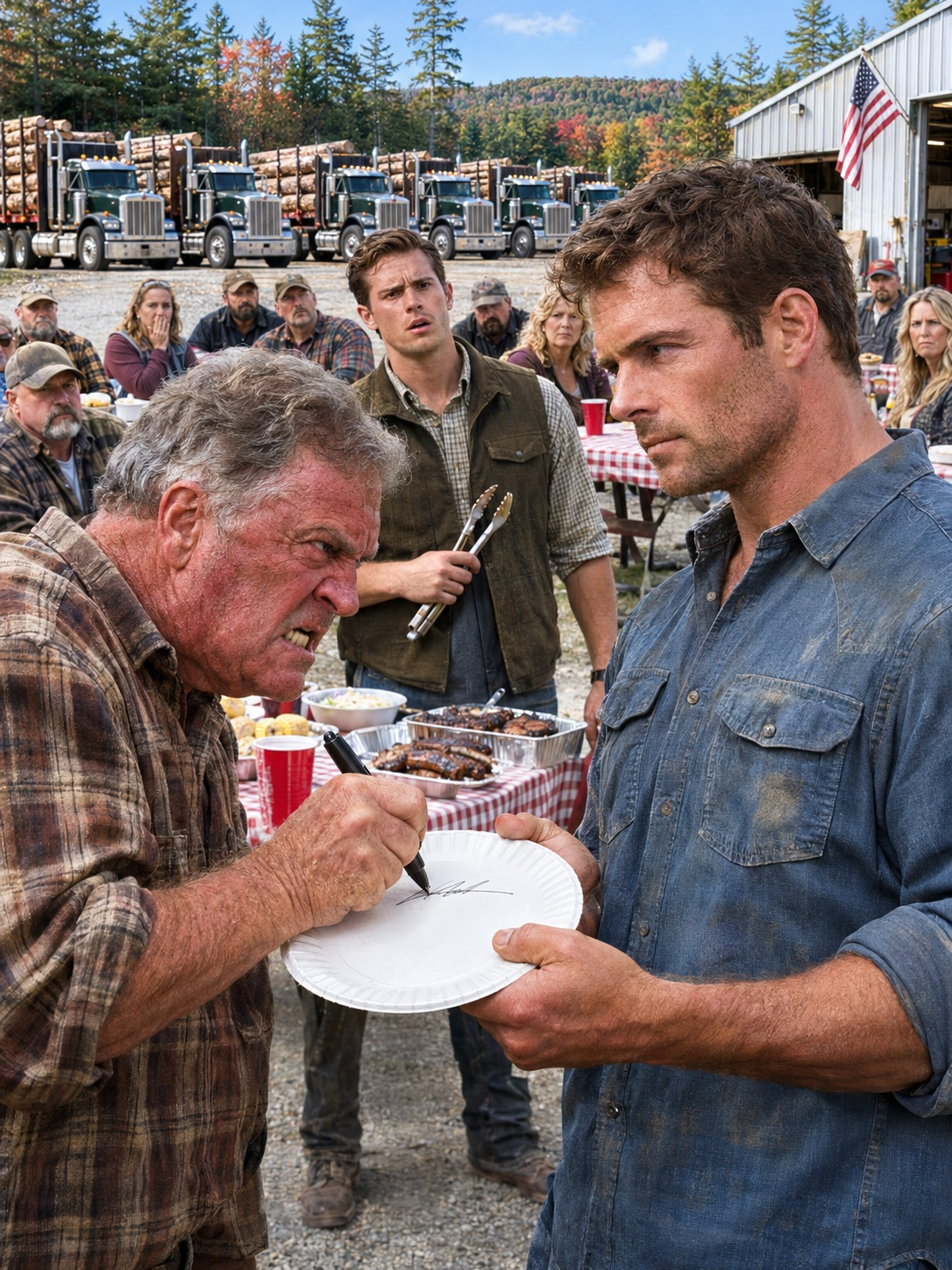
"Nobody gets special treatment anymore."
That was the first thing Justin said after I drove away from my father's retirement barbecue.
Lionel sent me those words at 9:47 that night.
I was sitting inside my Kenworth at Orel Bouchard's yard, seventeen miles north of the trucking company I'd spent most of my life building. The engine was off. My phone was glowing against the steering wheel.
I read Lionel's message twice.
Then another appeared.
He says we're all signing new agreements Monday morning. Pay structure, fuel deductions, equipment policies. Everything.
I stared through the windshield at Orel's darkened shop.
Justin had been president for less than six hours.
He was already rewriting the rules.
I typed a response.
Did he give you copies?
Lionel answered almost immediately.
No. Said we'd get them Monday.
I considered calling him, but Lionel was sixty-one, had been driving trucks longer than Justin had been alive, and didn't need me telling him how to handle his employment.
Instead, I wrote:
Read everything before you sign. Take copies home. If you don't understand something, ask questions.
Three dots appeared.
Disappeared.
Then appeared again.
You know what he said when Flip asked about the pay?
I waited.
He said, "If you don't like it, there's the gate."
I closed my eyes.
That sounded exactly like Justin.
He'd always confused having authority with deserving respect.
When we were kids, Dad had put him in charge of feeding the chickens for one summer. Justin immediately started ordering our cousins around, telling them which buckets to carry and which pens to clean.
By the third day, nobody would help him.
He complained to Dad that everyone was lazy.
Dad gave him five dollars for being responsible.
I remembered watching that happen from the barn doorway, wondering how two brothers could grow up under the same roof and learn completely different lessons.
Now Justin had twelve drivers and an entire trucking company.
And Dad had given him something much more dangerous than five dollars.
He'd given him the power to make other people's lives miserable.
My phone buzzed again.
This time it was Nicole.
Are you coming home tonight?
I looked at the clock.
9:56.
I had been sitting in the truck for nearly two hours, going through insurance documents and figuring out which customers I could legally contact without creating trouble.
I typed:
Leaving now.
Her response came immediately.
Good. Your daughter saved you some cake.
I smiled.
Then I opened my banking app.
Fish River Hauling had a little over forty-one thousand dollars available.
It wasn't nothing.
But it wasn't enough to build a trucking company overnight.
One serious engine failure could wipe out half of it.
Insurance, fuel, repairs, permits, tires, payroll—every expense in trucking seemed to arrive before the money did.
I'd managed Dad's books long enough to know that a company could look profitable on paper while slowly drowning in unpaid invoices.
I wasn't going to make that mistake.
Not with Nicole and our daughter depending on me.
I started the pickup I'd borrowed from Orel and headed home.
Nicole was waiting at the kitchen table when I arrived.
There was a slice of chocolate cake beneath a plastic cover.
She pushed it toward me.
"Eat."
I sat down.
She studied my face.
"How bad?"
"Justin's changing the drivers' agreements."
She didn't look surprised.
"Of course he is."
"He's talking about new deductions."
"Can he do that?"
"Depends on the contracts. Depends on what they sign."
Nicole leaned back.
"And you're going to spend the next month worrying about twelve men who don't work for you anymore."
I looked down.
"Probably."
She reached across the table and covered my hand.
"Ernie, I love those people too. But you can't save everybody by destroying yourself."
"I know."
"Do you?"
I didn't answer.
She squeezed my fingers.
"You came home today with one truck. That's not failure."
I looked toward the hallway where our daughter was sleeping.
"It feels like I lost twenty-three years."
Nicole shook her head.
"No. Your father lost twenty-three years of having you beside him. You still have everything you learned."
I wanted to believe her.
But that night, lying awake beside her, all I could think about was the row of trucks behind Dad's garage.
And the men who would climb into them Monday morning.
By Tuesday, Justin had made his first major decision.
He cut the company drivers' share of earnings from twenty-eight percent to twenty-four.
Four percentage points might not sound like much to somebody who'd never driven a loaded logging truck through a Maine winter.
But on a decent week, that difference could mean hundreds of dollars.
Money for groceries.
Mortgage payments.
Heating oil.
Medicine.
For Mike, whose wife was seven months pregnant, it meant the difference between putting something aside before the baby arrived and hoping nothing went wrong.
Justin also reduced the owner-operators' share and introduced a new fuel markup.
I heard about it from three different drivers before lunch.
Flip called first.
"Ernie, you got a minute?"
"Always."
He was sitting outside a treatment center with Louise.
I could hear traffic passing behind him.
"Justin says the company needs to improve margins."
"That's what he said?"
"Pretty much. Says Dad let us get comfortable."
I gripped the phone.
"What did he put in writing?"
"New compensation schedule. Effective immediately, he says."
"Did you sign anything?"
"No."
"Then keep your old agreement and the new one. Don't throw anything away."
Flip sighed.
"I don't understand it. We made money last year."
"We did."
"Good money."
"Yes."
"So where's the problem?"
I looked at the three covered trucks beside Orel's shop.
"I don't know, Flip."
That was the truth.
I knew what the company's expenses had been before I left.
I knew the mill contract was profitable.
I knew our maintenance costs were under control.
But I didn't know what Justin had promised the bank, what Dad had transferred, or whether some new expense had appeared.
And I wasn't going to pretend I did.
Flip went quiet.
Then he said, "Louise asked me something this morning."
"What?"
"She asked whether I'd still have a job if I kept taking her to treatments."
My stomach tightened.
"Flip—"
"Don't say anything. I'm not asking you to fix it."
He paused.
"I just wanted you to know."
After we hung up, I sat on an overturned bucket outside Orel's shop.
I'd known Flip for fifteen years.
He was the kind of driver who checked his chains twice, never left a load unsecured, and once drove forty miles back to return a wallet he'd found at a truck stop.
He'd stayed with Misho Trucking through bad winters and lean summers.
When Louise got sick, we'd adjusted his routes so he could take her to appointments.
It wasn't charity.
It was what decent people did.
Justin apparently saw things differently.
Orel found me sitting there.
He carried two mugs of coffee.
"You look like somebody stole your dog."
I accepted a mug.
"Justin cut driver pay."
"Already?"
"Tuesday morning."
Orel whistled.
"Kid moves fast."
"He's going to lose people."
"Maybe."
"There's no maybe about it."
Orel sat beside me.
"Then why are you sitting here worrying about his company?"
I stared at the gravel.
"Because those men have families."
"So do you."
I didn't respond.
He took a sip of coffee.
"Your grandfather had a saying."
I glanced over.
"Which one?"
"'Never confuse the man holding the keys with the man who knows how to drive.'"
I laughed despite myself.
"Sounds like Grandpa."
Orel nodded toward the covered trucks.
"Those three haven't moved commercially in a while. Two are in decent shape. Third needs work."
"I noticed."
"Did you also notice the empty office beside my shop?"
"Yeah."
"Got a desk. Phone line. Heat works when it feels like it."
I looked at him.
"What are you getting at?"
He shrugged.
"Seems a shame to let all that space sit empty."
"Orel, I can't afford to rent your whole yard."
"Didn't ask you to."
"I can't take your trucks for free."
"Didn't offer them for free."
He smiled.
"I offered you coffee. You're the one making assumptions."
I shook my head.
He stood.
"Come look at something."
Inside the shop, he pulled a canvas cover off an old green tractor.
It had rust around the steps and dust on the hood, but the frame looked solid.
"Ran good when I parked her."
"When was that?"
"Three years ago."
I raised an eyebrow.
"That's a long time."
"Not for a truck that was maintained right."
I climbed onto the step and looked inside.
The seats were worn.
The dashboard was dusty.
But the cab smelled familiar.
Diesel.
Leather.
Old coffee.
The smell of work.
Orel stood below me.
"You want to build something, Ernie, start with what you've got. Not what you lost."
I looked across the shop at the other two trucks.
For the first time since the barbecue, I could see something beyond the next day's bills.
Not a twelve-truck company.
Not revenge.
Just a possibility.
Wednesday morning, I started making calls.
Not to Dad's customers.
Not to the mill whose contract I'd negotiated while working for Misho Trucking.
I wanted no accusation that I'd taken confidential information or interfered with existing agreements.
Instead, I called businesses I'd known from years of working in northern Maine.
Small lumberyards.
Independent sawmills.
Construction suppliers.
A farm equipment dealer who occasionally needed machinery moved.
Most were polite.
Some were interested.
None offered enough work to support more than one truck.
By noon, I'd heard "Call us next month" six times.
At 1:15, a dispatcher at a small wood-products operation offered me two loads for Friday.
The rate wasn't great.
But it covered fuel and expenses and left something for the bank account.
I took it.
Then I called Nicole.
"Got two loads."
"That's good."
"It's a start."
"That's what I said."
I could hear her smiling.
Before I could say anything else, another call appeared.
Dad.
I stared at the screen.
Nicole heard my silence.
"Who is it?"
"My father."
"Are you answering?"
I let it ring twice more.
Then I did.
"Hello."
Dad didn't bother with a greeting.
"Where's the maintenance binder for truck seven?"
I blinked.
"What?"
"The maintenance binder. Justin can't find it."
"Second filing cabinet in the office. Bottom drawer. Green folder."
A pause.
"That's not where he looked."
"Then tell him to look there."
Dad exhaled sharply.
"Don't get smart."
I closed my eyes.
Three days.
I'd been gone three days.
And he was already calling because nobody knew where the paperwork was.
"Anything else?" I asked.
"Who handles the tire account?"
"The vendor's number is on the invoice."
"Ernie."
"What?"
"You don't have to be difficult."
I looked at the desk in Orel's office.
A legal pad.
Two freight quotes.
A half-empty cup of coffee.
My own paperwork.
For the first time in years, every document on that desk belonged to my business.
"I'm not being difficult, Dad. I'm answering your questions."
He went quiet.
Then his voice hardened.
"You think this company can't run without you?"
I looked out the window.
"No, sir."
"Because it can."
"I hope it does."
That seemed to confuse him.
He waited, perhaps expecting an argument.
I gave him none.
Finally, he said, "Justin's got some good ideas."
"Then I hope they work."
He hung up.
I set the phone down.
My hands were shaking.
Not because I was afraid.
Because after twenty-three years, I was finally learning how to end a conversation with my father without apologizing.
Thursday afternoon, Mike stopped by Orel's yard.
He drove his own pickup.
I saw him pull in while I was checking the Kenworth's tires.
He climbed out looking exhausted.
"Got a minute?"
"Sure."
He leaned against his truck.
For a while, he watched me work.
Then he said, "Justin told us we aren't supposed to talk to you about company business."
I stopped.
"He did?"
"Called it protecting confidential operations."
I set down my tire gauge.
"Mike, you shouldn't share anything confidential with me."
"I know."
"And I don't want you getting in trouble."
"I know that too."
He rubbed his face.
"But I need advice."
I waited.
"My wife and I bought that house last spring."
"I remember."
"Baby's due in November."
"Right."
He swallowed.
"With the new pay structure, I don't know if we can keep up."
I leaned against the Kenworth.
"Have you talked to Justin?"
"Yeah."
"What'd he say?"
Mike gave a humorless laugh.
"Said I should drive more loads."
I looked at him.
"You already run close to your legal hours."
"That's what I told him."
"And?"
"He said I needed a better attitude."
I stared at the ground.
There were a hundred things I wanted to say.
None would help Mike.
So I asked, "What do you want to do?"
He looked toward Orel's shop.
"I don't know."
"Then don't make a decision today."
He nodded.
"Keep your paperwork. Talk it through with your wife. Figure out what you need each month."
Mike looked at me.
"Would you hire me?"
The question landed harder than I expected.
I glanced toward the covered trucks.
I could picture Mike behind the wheel of one.
He was reliable.
Careful.
The kind of man who'd stop to help another driver even when he was running late.
But I had two loads booked.
Two.
I couldn't promise him a paycheck.
"Not today," I said.
His face fell.
I continued.
"Not because I wouldn't want you. Because I don't have enough work to pay you what you deserve."
He nodded slowly.
"I appreciate you being straight."
"If that changes, I'll tell you."
He shook my hand.
Then he climbed into his pickup and drove away.
I watched his taillights disappear.
For the first time, I understood exactly how much responsibility came with the possibility Orel had offered me.
It wasn't about owning trucks.
It was about being able to look a man in the eye and promise that his family would eat.
And then keeping that promise.
Friday morning, I hauled my first load under Fish River Hauling without Misho Trucking involved.
The delivery went smoothly.
The customer signed the paperwork.
I drove back toward Orel's yard with an empty trailer and a strange feeling in my chest.
I had earned that money myself.
No Dad.
No Justin.
No family argument.
Just a truck, a load, and an agreement between two businesses.
At 3:20 that afternoon, Flip called.
I answered through the truck's hands-free system.
"Hey, Flip."
He didn't say hello.
"Justin docked me two days."
I tightened my grip on the wheel.
"What happened?"
"I took Louise to treatment yesterday."
"Was it approved?"
"Dispatch knew. I told them Tuesday."
"Did you have paid time available?"
"According to my records, yes. Justin says the new policy changed how it's handled."
I let a logging truck pass before answering.
"Did he put the reason in writing?"
"On my pay statement."
"What does it say?"
"'Unauthorized absence.'"
I felt heat rise into my face.
"Flip, keep that statement."
He gave a short laugh.
"That's what Louise said."
"How is she?"
"Tired."
He paused.
"She cried when I told her."
I couldn't speak for a moment.
Flip cleared his throat.
"Not about the money. She thinks she's costing me my job."
I pulled into a turnout.
Turned off the engine.
And sat staring at the road.
"Tell Louise she hasn't done anything wrong."
"I did."
"Tell her again."
Flip was quiet.
Then he said, "You know what makes me mad?"
"What?"
"I've driven for that company fifteen years. Never abandoned a load. Never missed a delivery without calling. And now my wife gets sick, and I'm treated like I stole something."
I pressed my thumb against the steering wheel.
"I'm sorry, Flip."
"Don't be. You didn't do it."
He breathed out.
"I've got to go. Louise needs me."
After the call ended, I remained parked for several minutes.
I wanted to drive straight to Dad's office.
I wanted to ask him how he could stand by while Justin treated a loyal driver that way.
But I knew what would happen.
Dad would accuse me of interfering.
Justin would claim I was trying to undermine him.
And Flip would be the one paying the price.
So I started the engine.
And drove back to Orel's yard.
By the following Monday, I had booked enough work to keep my Kenworth moving most of the week.
Orel helped me inspect the first of his covered trucks.
We found a leaking air line, two tires that needed replacing, and a battery that wouldn't hold a charge.
Nothing impossible.
Nothing cheap, either.
We spent the morning making a repair list.
At lunch, Orel brought sandwiches into the shop.
"How's business?"
"Moving."
"Good."
He sat on a toolbox.
"How's your father?"
I looked at him.
"Wouldn't know."
Orel nodded.
"Probably best."
I took a bite of my sandwich.
Then my phone rang.
Lionel.
I answered.
"Everything okay?"
He sounded different.
Quieter.
"Ernie, you at the yard?"
"Yeah."
"Can I come by?"
"Of course."
He hesitated.
"I need to show you something."
"What is it?"
"Better if you see it."
He hung up.
Twenty minutes later, his pickup pulled into Orel's driveway.
Lionel climbed out carrying something wrapped in an old shop towel.
He was a tall, lean man with silver hair and hands permanently stained by grease.
He'd been driving for Misho Trucking since 1999.
He'd worked through ice storms, equipment shortages, and the year Dad nearly lost the business.
I'd never seen him look so defeated.
He walked into the shop.
Set the wrapped object on the workbench.
And carefully unfolded the towel.
Inside was a wooden dashboard nameplate.
Red letters.
Black shadows.
One name.
Margaret.
His wife.
She'd died three winters earlier.
I'd painted that plate for Lionel on their twenty-fifth wedding anniversary.
After Margaret passed, he kept it on his dashboard.
He told me once that seeing her name helped him remember why he'd spent so many years on the road.
I looked up.
"What happened?"
Lionel's jaw tightened.
"New policy."
"What policy?"
"Justin says personal items have to come off company dashboards."
I stared at him.
"He made you remove Margaret's plate?"
Lionel nodded.
"Called them distractions."
I looked down at the wood.
There was a small scratch near the letter M.
I remembered making it.
I'd slipped with the brush and offered to start over.
Margaret had laughed.
"Leave it," she'd said. "Nothing worth keeping is perfect."
I ran my thumb along the edge.
Lionel watched me.
"Justin said company trucks aren't scrapbooks."
Orel, who'd been standing by the tool cabinet, slowly set down his coffee.
For a moment, nobody spoke.
Then Lionel reached into his jacket.
He pulled out a folded piece of paper.
"I gave notice."
I looked at him.
"Lionel—"
"Two weeks. In writing."
"You didn't have to do that because of me."
"I didn't."
His voice was firm.
"I did it because I'm sixty-one years old, and I've spent enough of my life working for people who think a paycheck buys the right to humiliate me."
He picked up Margaret's nameplate.
"If she isn't welcome in that truck, neither am I."
I swallowed.
"Do you have something lined up?"
"No."
I looked toward Orel's trucks.
Then at the repair list on the workbench.
I wanted to tell Lionel I had a job waiting.
I wanted to promise him everything would be fine.
But I wasn't going to become another Misho man making promises he couldn't keep.
"Give me a little time," I said.
Lionel nodded.
"That's all I'm asking."
He wrapped the nameplate again.
Then he paused at the shop door.
"There's something else."
I looked up.
"What's that?"
"Justin didn't just tell us to remove the plates."
He reached for his phone.
"He sent a company-wide memo. And Ernie, there's a paragraph in there about you."
My stomach tightened.
"What paragraph?"
Lionel unlocked the screen.
Scrolled.
Then turned the phone toward me.
At the top was the Misho Trucking company letterhead.
Below it, a bold heading read:
EMPLOYEE LOYALTY AND OUTSIDE BUSINESS CONTACT POLICY
I leaned closer.
Lionel's finger stopped halfway down the page.
"Read the part under your name."
I started reading.
And then I saw the sentence Justin had written...






Comments 0