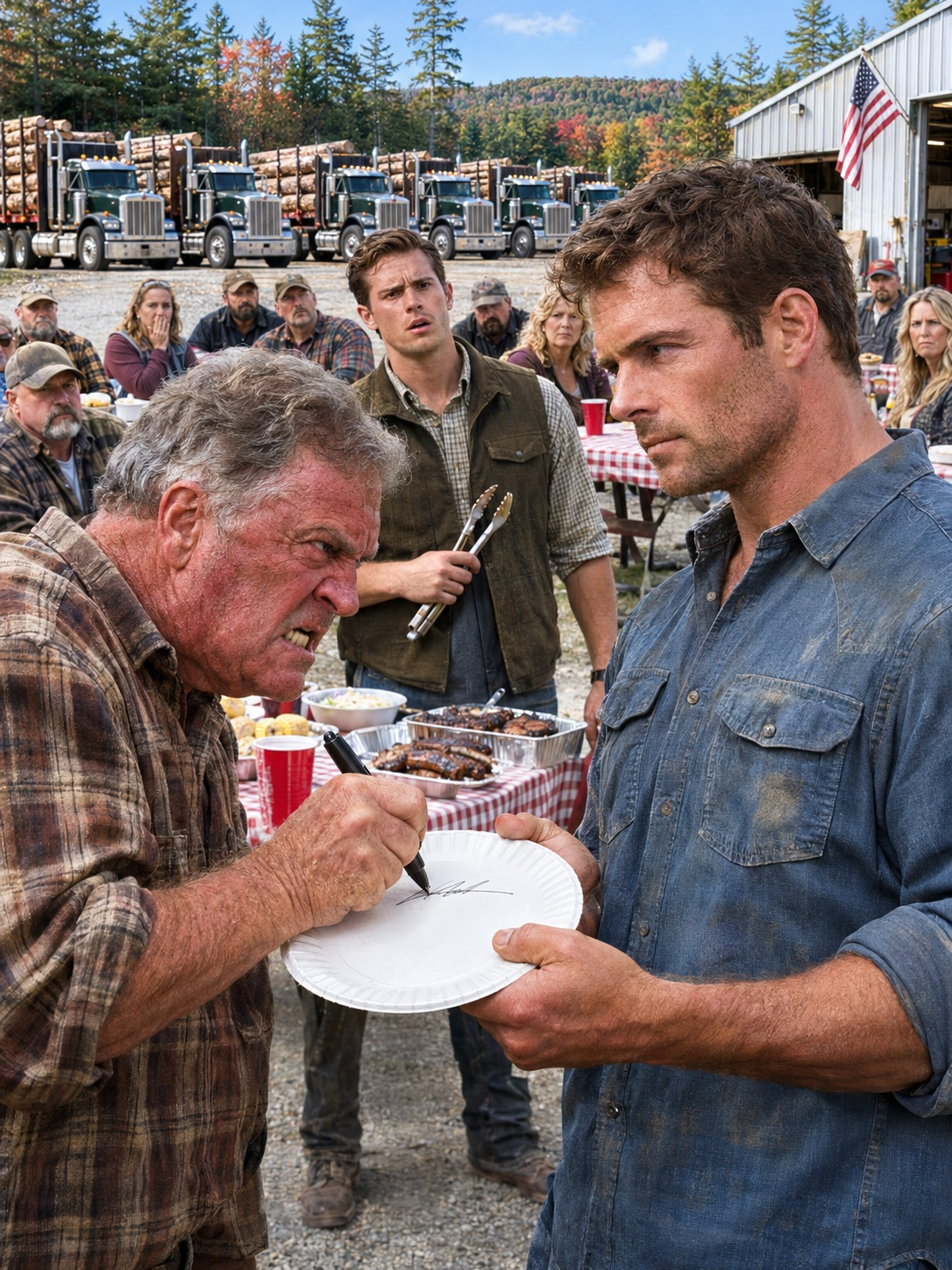
"Read the part with your name on it," Lionel said, holding his phone beneath the fluorescent light in Orel's repair shop.
I leaned closer.
Halfway down the company memo, beneath a heading about employee loyalty, my younger brother had written:
Employees are prohibited from discussing company operations, compensation, scheduling, or internal policies with Ernest Misho or any representative of Fish River Hauling. Such communication may be considered a breach of company loyalty and grounds for disciplinary action, up to and including termination.
I read it twice.
Then I looked at Lionel.
"Justin actually sent this to everybody?"
"All twelve drivers. Dispatch too."
"When?"
"Yesterday afternoon."
I looked back at the screen.
My brother had inherited a company worth more than anything he'd ever managed in his life, and within two weeks, he'd decided that talking to me was an offense serious enough to cost a man his job.
I wasn't surprised he disliked me.
I was surprised he'd put it in writing.
Orel stepped closer.
"Let me see that."
Lionel handed him the phone.
Orel adjusted his reading glasses, studied the paragraph, and made a low sound in his throat.
"Well," he said, "that's one way to tell your employees you're scared of somebody."
I almost laughed.
Almost.
But Lionel wasn't smiling.
He stood beside the workbench, holding Margaret's wooden nameplate against his chest like it was something fragile.
"There's more," he said.
I looked at him.
"What else?"
"Justin called me into his office after I gave notice."
"Why?"
"Said he wanted to know whether you'd offered me a job."
"What did you tell him?"
"The truth. You hadn't."
I nodded.
Lionel continued.
"Then he asked whether you'd told me to quit."
"And?"
"I told him you'd specifically asked everybody not to quit on your account."
Orel folded his arms.
"Bet that went over well."
Lionel gave a tired smile.
"Justin said I was protecting you."
I shook my head.
"He doesn't understand."
"No," Lionel said. "He doesn't."
He put the nameplate back into its towel.
"Then he told me something I thought you should hear."
I waited.
"He said Dad had finally figured out who his real son was."
The words landed harder than I wanted them to.
For a moment, the shop seemed unusually quiet.
I'd spent most of my life telling myself that Dad treated Justin differently because Justin needed more help.
Justin was younger.
Justin was less dependable.
Justin made mistakes.
I was the responsible one.
That was the story I'd repeated whenever Dad excused something Justin did.
But there was a difference between helping one son and humiliating the other.
And lately, Dad seemed determined to prove he didn't know where that difference was.
I took a breath.
"Did Justin say anything else?"
Lionel nodded.
"He said you'd be begging to come back before Christmas."
Orel snorted.
"That boy's got a lot of confidence for somebody who can't find his own maintenance records."
I looked toward the three trucks parked inside the shop.
The first one had a new battery installed.
The second needed tires.
The third hadn't been started in three years.
They weren't much to look at.
But they represented something I hadn't had at Misho Trucking.
A choice.
"Lionel," I said, "would you send me a copy of that memo?"
He hesitated.
"Is that going to cause trouble?"
"I don't know. But if Justin's putting accusations about me in writing, I'd like to know exactly what he's saying."
Lionel studied my face.
Then he nodded.
"I'll forward it."
"Thank you."
He tucked his phone away.
Before leaving, he stopped beside the shop door.
"Ernie?"
"Yeah?"
"I didn't leave because of that memo."
"I know."
"I didn't even leave because of the money."
I looked at the nameplate in his hands.
"I know that too."
He swallowed.
"Margaret used to tell me a job should help you get home to the people you love. Not make you ashamed of loving them."
He looked down.
"I think she'd have liked this place."
After he drove away, I stood in the doorway watching the dust settle behind his pickup.
Orel came up beside me.
"You going to hire him?"
"If I can find enough work."
"You trust him?"
"With my life."
"Then maybe finding the work ought to be your next problem."
That evening, Nicole read Justin's memo at our kitchen table.
She didn't say anything at first.
She read the whole page, turned back to the beginning, and read it again.
Then she placed my phone facedown.
"He's trying to make you the enemy."
"Looks that way."
"No, Ernie. He's trying to make every driver choose between keeping a paycheck and speaking to you."
I rubbed my forehead.
"I didn't ask anybody to leave."
"I know."
"I told them to give him a fair shot."
"I know that too."
She leaned forward.
"But Justin doesn't care what you actually did. He cares what he can convince your father you did."
I stared at her.
Nicole had always been better at understanding people than I was.
I understood engines.
I understood freight rates.
I understood why a driver would lose money taking a certain route.
But I had spent twenty-three years failing to understand why my father kept breaking promises while insisting he was doing what was best for the family.
Nicole reached across the table.
"Have you talked to a lawyer?"
"Not yet."
"You should."
"I haven't done anything wrong."
"That's not why you hire a lawyer."
I looked at her.
"Then why?"
"Because somebody who thinks he's losing control can make a mess before anybody proves he's wrong."
She was right.
I hated that she was right.
The last thing I wanted was to spend money on legal advice when I was trying to get a trucking business moving.
But Justin had already made my name part of his company policy.
Ignoring that wouldn't make it disappear.
The next morning, I called a small business attorney in Presque Isle.
Her name was Rebecca Shaw.
I'd met her once at a chamber of commerce breakfast when she helped a local contractor resolve a payment dispute.
She remembered me.
"Ernie Misho. The trucking company?"
"Used to be."
There was a pause.
"That sounds like a story."
"It is."
I explained the retirement barbecue, Dad's ownership transfer, the paper-plate lease termination, and Justin's memo.
Rebecca listened without interrupting.
When I finished, she asked one question.
"Do you have the original written lease?"
"Yes."
"And the paper plate?"
"In a folder at home."
"Keep both."
"I will."
"Do not write anything on the plate. Do not laminate it. Do not alter it. Put it somewhere safe."
I almost smiled.
"Never thought I'd need legal advice about a paper plate."
"People have fought over stranger things."
She asked me to email copies of the lease, the memo, and any communications from Justin.
Then she said something that stayed with me.
"Ernie, employees can make their own decisions about where they work. But you need to be careful about how you communicate with people who still have obligations to another company."
"I haven't recruited anybody."
"Good. Keep it that way. Don't ask for confidential customer lists. Don't encourage anyone to violate a contract. And document your own business development."
"That's what I've been doing."
"Then continue."
I hesitated.
"Can Justin really fire somebody for talking to me?"
"That depends on the circumstances and applicable law. His memo raises questions, but I wouldn't make broad promises to anyone about their legal rights without reviewing the details."
I appreciated that answer.
It wasn't dramatic.
It wasn't what somebody in a movie would say.
But it was careful.
And careful was exactly what I needed.
Before hanging up, Rebecca asked whether Dad had ever put his promise of one-third ownership in writing.
"No."
"Any witnesses?"
"My mother."
"Anyone else?"
"Not that I remember."
She paused.
"All right. For now, let's focus on protecting the business you actually own."
That was the first time anyone had said it that way.
The business I actually owned.
Fish River Hauling.
Not the business Dad had promised me.
Not the one Justin had inherited.
Mine.
By the middle of September, I had settled into a routine.
I left home before dawn.
Ran loads in the Kenworth.
Returned to Orel's yard in the afternoon.
Then spent evenings calling potential customers.
Orel worked on the covered trucks while I was away.
Sometimes I'd come back to find him sitting under a hood with grease up to his elbows.
Other times he'd have a list of parts waiting on my desk.
He never asked when I planned to pay him.
That bothered me.
One afternoon, I brought it up.
"Orel, we need an agreement."
He looked up from a toolbox.
"About what?"
"Rent. Equipment. Repairs. Everything."
He smiled.
"Your father ever tell you family doesn't need paperwork?"
I stared at him.
Orel laughed.
"Your grandfather used to complain about that."
"I'm serious."
"So am I."
He wiped his hands on a rag.
"Draw something up. Fair rates. Clear responsibilities. No surprises."
I nodded.
"That's what I want."
"Good. Then we'll both know where we stand."
It was such a simple conversation.
No shouting.
No guilt.
No lecture about loyalty.
Just two men agreeing that a business arrangement should be understood by both sides.
I wondered how different my life would have been if Dad had approached things that way.
That afternoon, Orel showed me the first truck he'd finished inspecting.
The engine started after a little hesitation.
Then settled into a steady idle.
I stood beside the open door listening.
"Sounds good," I said.
"She'll need a proper road test."
"Of course."
"Then inspections and insurance before she earns a dollar."
I nodded.
Orel leaned against the fender.
"You know what your problem is, kid?"
"Only one?"
"You keep looking at those trucks like they're a reminder of what you lost."
I glanced at the green tractor.
"What should I see?"
"Three trucks that could work again."
He handed me the keys.
"Start there."
The next day, Mike called.
He sounded nervous.
"Ernie, you got a second?"
"Sure."
"Justin had another meeting."
I sighed.
"What happened?"
"He says the company needs to tighten expenses."
"Okay."
"He's changing how fuel costs get charged to the owner-operators."
I knew the numbers well enough to understand why that could hurt.
Fuel was one of the biggest expenses in trucking.
A small markup could turn a profitable run into a losing one.
"What did the new agreement say?" I asked.
Mike told me what he understood.
I listened.
Then I stopped him.
"Mike, don't send me confidential company pricing."
"I'm not trying to."
"I know. But I don't want you getting accused of anything."
He exhaled.
"That's what everybody's afraid of now."
I leaned back in my chair.
"What do you mean?"
"Nobody talks in the break room anymore. Justin keeps asking who we've been calling."
I closed my eyes.
"Mike—"
"And he took down the schedule board."
That made me sit upright.
"What?"
"Said drivers don't need to see everybody else's assignments."
I stared at the wall.
The schedule board had been in the garage for nearly twenty years.
Every driver could see which truck was assigned to which load.
It helped prevent mistakes.
It also helped drivers plan their lives.
If Lionel needed to be home Friday afternoon, we could arrange around it.
If Flip had an appointment with Louise, everybody knew who was covering his run.
The system wasn't fancy.
But it worked.
Justin apparently thought information was something employees shouldn't have.
"How's your wife?" I asked.
Mike hesitated.
"Tired. Baby's kicking all night."
"That part's good, right?"
He laughed softly.
"Yeah. That's the good part."
Then his voice changed.
"Ernie, I can't keep doing this."
I looked down at my notes.
"Doing what?"
"Wondering every Friday whether the check's going to cover the bills."
I didn't answer immediately.
He continued.
"I've been talking to my wife. We could manage a few weeks if I had to change jobs."
"Don't make a move without a plan."
"I know."
"And don't quit because you're angry."
"I'm not angry."
He paused.
"I'm scared."
That was harder to hear.
I looked through the office window toward the trucks.
"Mike, I can't promise you a position today."
"I understand."
"But I'm working on it."
He was quiet.
Then he said, "That's more than Justin's told us."
After we hung up, I opened my notebook.
I wrote down the loads I'd secured.
The estimated expenses.
The money I needed for insurance.
The cost of bringing Orel's first truck into service.
Then I wrote one more line.
One additional driver.
I circled it.
For the first time, the possibility felt real.
Three days later, I received a call from a small sawmill outside Fort Kent.
The owner, a man named Harold Pierce, had heard I was hauling independently.
He needed regular deliveries moved to a processing facility farther south.
Nothing enormous.
Three or four loads a week.
But steady.
I drove out to meet him.
Harold was in his late fifties, with a gray beard and a handshake that felt like a vise.
He showed me the loading area.
Explained the schedule.
Then asked what I charged.
I gave him a number.
He studied me.
"You're not the cheapest."
"No, sir."
"Why should I hire you?"
"Because I'll tell you when a load can be delivered, and if something goes wrong, you'll hear it from me before you hear it from your customer."
He watched me for a moment.
"Your father used to say something similar."
I felt my shoulders tighten.
Harold noticed.
"You two working together?"
"No."
He nodded slowly.
"Family trouble?"
"Business differences."
He didn't push.
Instead, he walked toward his office.
"Come inside. Let's see whether we can make the numbers work."
An hour later, I had a tentative agreement.
It wasn't enough to build an empire.
But combined with the work I'd already found, it might support a second truck.
I drove back to Orel's yard feeling something I hadn't felt since the barbecue.
Hope.
Not the kind that comes from somebody making a promise.
The kind that comes from doing the math and realizing the numbers might actually work.
When I told Orel, he grinned.
"Guess we'd better get that green truck inspected."
I nodded.
"And call the insurance agent."
He raised his coffee mug.
"Now you're talking."
That evening, I sat with Nicole at the kitchen table.
Our daughter was working on a school project in the next room.
I spread my paperwork across the table.
"Look at this."
Nicole studied the numbers.
"Three or four loads every week?"
"That's what Harold wants."
"And the other customers?"
"Enough to keep me busy."
She looked up.
"You're thinking about hiring somebody."
"Maybe."
"Lionel?"
"He's still working his notice."
She nodded.
"Would he want the job?"
"I think so."
"Can you afford him?"
I took a breath.
"Not unless the work stays steady."
She looked back at the numbers.
"Then don't rush."
"I won't."
She smiled.
"That sounded almost convincing."
I laughed.
For the first time in days, we talked about something other than Dad and Justin.
We discussed insurance.
Equipment.
Whether Orel's office needed a better heater.
Nicole offered to help with bookkeeping until I could afford someone part-time.
I told her I didn't want her carrying another responsibility.
She looked at me over the papers.
"Ernie, I've been married to a truck driver for seventeen years. You think invoices scare me?"
I smiled.
"No, ma'am."
She pointed at the spreadsheet.
"Then stop arguing and show me where the fuel costs go."
We worked until nearly ten.
When I finally closed the laptop, Nicole rested her head against my shoulder.
"Whatever happens," she said, "I want you to remember something."
"What?"
"You don't have to prove your father was wrong to build something good."
I looked at the paperwork.
"I know."
She lifted her head.
"Then promise me you won't turn this into a war."
I thought about Justin's memo.
Dad's angry face.
Lionel carrying Margaret's nameplate out of the truck he'd driven for decades.
"I won't start one," I said.
Nicole studied me.
Then she nodded.
It was the most honest promise I could make.
The following morning, I arrived at Orel's yard just after five.
The air was cold enough that I could see my breath.
I started the Kenworth and let it warm while I checked the day's paperwork.
At 5:18, my phone buzzed.
A message from Flip.
You awake?
I called him.
He answered on the first ring.
"Ernie."
Something in his voice made me straighten.
"What's wrong?"
"Justin called another meeting yesterday."
I waited.
"He says everybody has to sign the new employee acknowledgment by Friday."
"Okay."
"There's a section about outside business contacts."
I looked toward the shop.
"Like the memo?"
"Worse."
My stomach tightened.
"What does it say?"
Flip hesitated.
"That we've been warned about interference from former management."
I closed my eyes.
"Flip, don't send me anything you're not allowed to share."
"I know."
He lowered his voice.
"But there's something you need to understand. Justin isn't just saying we can't talk to you."
"What is he saying?"
"He's telling people you're trying to steal the company."
I stared through the windshield.
"That's ridiculous."
"Maybe. But Dad believes him."
I didn't answer.
Flip continued.
"Yesterday, Dad told the guys you were trying to destroy everything he built."
I felt the old familiar pressure behind my ribs.
Everything he built.
As if I'd spent twenty-three years watching from the sidelines.
As if the mill contracts had negotiated themselves.
As if the drivers had hired and trained themselves.
As if every winter breakdown had been fixed by somebody else.
I took a slow breath.
"Flip, listen to me. Don't get involved in my family problems. You've got Louise to think about."
He was silent.
Then he said, "That's exactly why I'm calling."
I waited.
"Justin changed my schedule again. He put me on a run that conflicts with her next treatment."
"Did you tell him?"
"Yes."
"What did he say?"
Flip's voice hardened.
"He told me I had to decide whether I wanted to be a truck driver or a nurse."
I closed my eyes.
For several seconds, I couldn't speak.
Then I said, "Flip, document everything. And take care of Louise."
He let out a long breath.
"That's what I'm going to do."
We ended the call.
I sat motionless behind the wheel.
The Kenworth idled beneath me.
Its dashboard nameplate caught the first pale light of morning.
My daughter's name.
Red letters.
Black shadows.
I reached out and touched the edge.
Then I picked up my phone and called Rebecca Shaw.
Her office wasn't open yet, so I left a message.
"Rebecca, it's Ernie Misho. Justin's making more accusations about me, and I think things are getting worse. Call me when you can."
I put the phone down.
Shifted into gear.
And headed toward my first pickup.
I had a business to run.
I couldn't spend every day reacting to Justin.
But by noon, I understood that ignoring him wasn't going to be enough.
Because when I returned to Orel's yard, there was an unfamiliar black pickup parked outside the shop.
A man in a dark jacket stood beside it.
He was holding a thick envelope.
Orel met me as I climbed down from the Kenworth.
"Ernie," he said quietly, "this fellow's been waiting for you."
The stranger stepped forward.
"Ernest Misho?"
"That's me."
He glanced at the name on my truck.
Then at the building behind me.
"I'm here on behalf of Misho Trucking."
He held out the envelope.
I took it.
My name was printed across the front.
Beneath it were four words.
NOTICE OF LEGAL ACTION.
I looked at the man.
"What is this?"
He didn't answer.
He simply pointed toward the envelope.
I slid my finger beneath the flap.
Pulled out the first page.
And saw that my father had accused me of something far worse than stealing his drivers...






Comments 0