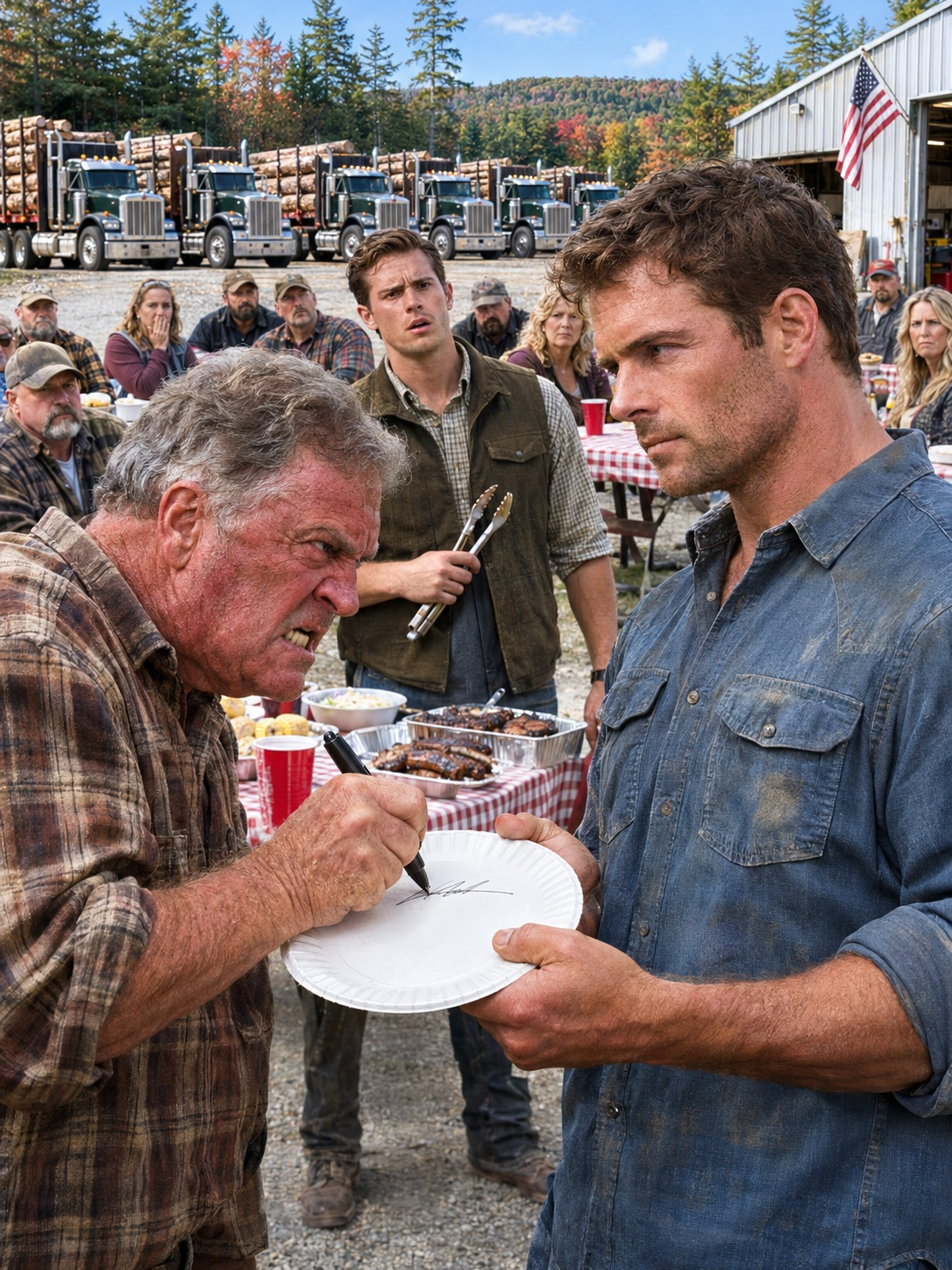
"Your guys will work for me now!" Justin announced, pointing his barbecue tongs at the men sitting behind me.
My father stood beside the grill, holding the signed ownership-transfer documents.
One signature on those papers had given my younger brother the entire company.
But the white paper plate in my hand was about to change something neither of them understood.
And Dad had no idea what he was signing away.
"Ernie can keep driving."
That was what my father had said five minutes earlier.
Not that I would remain operations manager. Not that I would receive the one-third ownership he'd promised me eleven years ago. Not even that he appreciated the twenty-three years I'd spent helping him turn three aging logging trucks into a business that supported twelve drivers and their families.
Just that I could keep driving.
Like I was some hired hand he was doing a favor for.
I was thirty-seven years old, standing in the gravel yard of Misho Trucking in northern Maine, listening to the man who had taught me how to shift a truck before I was old enough to drive one explain that my future depended on my younger brother's generosity.
Six Western Star logging trucks stood behind the barbecue grill, their chrome stacks catching the afternoon sunlight.
I'd helped buy four of them.
Not with my own money, exactly. With the money I'd helped the company earn. With contracts I'd negotiated, routes I'd reorganized, and weekends I'd spent repairing equipment instead of taking my wife and daughter fishing.
Every truck in that line represented something I'd sacrificed.
The second truck from the left had been purchased after I convinced a lumber mill to give us a trial contract nobody thought we could handle.
The fourth had arrived the year Nicole and I canceled our anniversary trip because one of our drivers needed emergency repairs on his rig.
The sixth was the one I'd fought Dad to buy when he wanted to keep pouring money into an old machine that spent more time in the shop than on the road.
But none of that seemed to matter anymore.
Justin was president now.
And I was apparently lucky to have a job.
"Well?" Dad said.
He was sixty-eight, with thick gray hair and a face permanently reddened by wind, cold, and stubbornness. His brown plaid shirt was stretched tight across his stomach, and he stood with the same rigid posture he'd used whenever I questioned one of his decisions.
"What do you have to say?"
Around us, the barbecue had gone silent.
Flip sat with his wife, Louise, near the end of the nearest picnic table. She wore a knit cap despite the mild September weather. Her treatments had left her tired, but she'd insisted on coming because she said she wanted to see Fernand retire.
Mike sat beside his pregnant wife, one hand resting protectively on her back.
Lionel, who had driven for Dad since 1999, stared into his paper cup.
These weren't strangers.
I'd attended their weddings, visited them in hospitals, helped fix their furnaces, and driven overnight loads when their children were sick.
They were the people who had made the company possible.
And now Justin was pointing at them like they were trucks included in the sale.
I looked at my father.
"Dad, you promised me a third."
He shifted his weight.
"That was a long time ago."
"Eleven years."
"Things change."
"You told me at the kitchen table. You said we'd get the paperwork done."
Dad looked toward the grill.
"That was whiskey talk."
Something inside my chest went strangely quiet.
Whiskey talk.
I remembered that night perfectly.
He'd poured two glasses of Canadian whiskey after we'd landed our first major mill contract. He'd put his hand on my shoulder and told me he couldn't have built the business without me.
Then he'd said, "One-third is yours, son. I'll have the lawyer draw it up."
I'd believed him.
For eleven years.
I glanced toward my mother.
She stood beside the garage holding a dish towel against her mouth. Her eyes were wet, but she wouldn't meet mine.
That hurt more than I expected.
Because Mom knew.
She'd been sitting at the kitchen table when Dad made that promise.
She'd smiled and told me my grandfather would have been proud.
Now she stood silent while Dad pretended the whole conversation had been nothing more than a few drinks.
Justin laughed.
"Come on, Ernie. Don't make it weird."
He was thirty-two, five years younger than me, and he'd spent most of his adult life moving between jobs that never seemed to last.
He'd worked at a dealership, tried selling insurance, and once talked Dad into investing in a snowmobile rental business that folded before the second winter.
But he was charming.
Dad loved that about him.
Justin could walk into a room, shake three hands, tell a joke, and make everybody feel like they were his best friend.
I was the one who stayed late balancing fuel invoices.
Justin was the one Dad introduced at Christmas parties.
And now he owned everything.
"Your guys will work for me now," he repeated, lifting his tongs toward the drivers.
I looked at Flip.
His expression had changed.
He wasn't angry yet.
He looked disappointed.
That was worse.
I turned back toward Justin.
"They were never mine to give."
Justin blinked.
"What?"
"The drivers. They aren't mine. They aren't yours. They're grown men who decide where they work."
Dad slammed his palm against the picnic table.
"That's enough."
Nobody moved.
He took two steps toward me.
"This is my retirement party, and you're standing here making a scene because you didn't get what you wanted."
I could feel my heartbeat in my throat.
But my voice stayed level.
"I didn't ask for everything, Dad."
"You always think you deserve more."
"I asked for what you promised."
"Well, you aren't getting it."
There it was.
No misunderstanding.
No paperwork delayed at the lawyer's office.
No intention of making things right later.
He had made his choice.
And he wanted me to smile while he announced it.
I looked down at my plate.
Baked beans. A piece of cornbread. Half a rib.
I'd barely eaten.
I sat down.
Picked up my fork.
And took another bite.
Justin stared at me.
"What are you doing?"
"Finishing lunch."
A few people shifted uncomfortably.
Dad's face darkened.
"If you're going to sulk at my party, you can take your truck and go tonight."
I stopped chewing.
There was one thing Dad had forgotten.
Or maybe he'd convinced himself it didn't matter.
My Kenworth T800 wasn't owned by Misho Trucking.
It belonged to Fish River Hauling.
My company.
I'd bought it with a loan in my own name, after Dad borrowed twenty-two thousand dollars I'd saved toward my first truck and never paid it back.
That had happened twelve years earlier.
He'd needed money to cover payroll during a rough winter.
I'd handed it over without hesitation.
When I asked about repayment six months later, he told me family didn't keep score.
A year after that, he told me family didn't need paperwork.
That was when I stopped taking his advice about money.
I formed Fish River Hauling.
Bought the Kenworth.
Signed a written lease agreement allowing Misho Trucking to use it.
And kept every document.
Dad knew the truck was mine.
But he had never really accepted it.
To him, anything parked in his yard belonged to him.
I set my fork down.
"All right."
Dad frowned.
"All right, what?"
"I'll take my truck."
Justin gave a little laugh.
"Seriously? You're going to throw a tantrum over this?"
I ignored him.
I reached across the table, picked up a clean white paper plate, and took a black pen from my shirt pocket.
The lease agreement contained a provision allowing termination by mutual written consent.
I knew because I'd insisted on it.
Dad had laughed at the time.
"Always with the paperwork, Ernie."
Now I turned the plate over and wrote carefully.
Effective September 1, the equipment lease between Misho Trucking and Fish River Hauling is terminated by mutual agreement.
I signed my name beneath it.
Then I slid the plate toward my father.
"Sign here."
He stared at it.
"What the hell is this?"
"You're telling me to leave with my truck. I'm agreeing. This makes it official."
Justin leaned over.
"You're writing a contract on a paper plate?"
"It's an agreement," I said. "And we both know what it says."
Dad looked around.
Every driver was watching.
His pride wouldn't let him back down.
He snatched the pen from my hand.
"Fine."
He pressed the tip so hard against the paper that it tore.
Then he threw the pen onto the table.
"There. Happy?"
I picked up the plate.
Checked the signatures.
Folded it once.
"Thank you."
Dad stared at me as though I'd insulted him.
"You think you can just walk away?"
I looked him in the eye.
"You told me to."
For a moment, he seemed ready to say something else.
But Justin stepped forward.
"Let him go, Dad. We'll be fine."
I stood.
My wife, Nicole, was already beside our daughter.
She hadn't said a word during the confrontation.
She didn't need to.
She knew how much that company had cost me.
She'd spent twenty years watching me answer calls at two in the morning, miss birthdays, and come home smelling like diesel fuel.
She'd watched Dad take credit for contracts I'd won.
She'd watched Justin receive praise for showing up.
And she'd watched me make excuses for both of them.
Now she simply looked at me and asked, "Are we going?"
I nodded.
"Yeah."
Our daughter reached for my hand.
I squeezed it.
Mom took one step toward us.
"Ernie..."
I waited.
Her eyes moved toward Dad.
Then back to me.
"I wish you wouldn't leave like this."
I looked at her for a long moment.
"Neither do I, Mom."
She lowered her eyes.
I walked across the gravel toward my Kenworth.
The truck stood beside the garage, its dark paint dusty from the previous week's runs.
I'd washed it myself the night before the barbecue.
Inside the cab, a small hand-painted nameplate rested on the dashboard.
My daughter's name.
Beneath it was an old tin plate my grandmother had lettered decades earlier.
I'd painted nameplates for every driver in the company.
Red letters.
Black shadows.
Each one carried the name of someone the driver wanted to get home to.
Flip's said Louise.
Mike's carried his wife's name.
Lionel's bore the name of the woman he'd lost three winters earlier.
I'd asked each man the same question before painting his plate.
"Who are you driving home to?"
It had become a tradition.
One Dad never understood.
And one Justin had never bothered to ask about.
I climbed into my truck.
The seat creaked beneath me.
For several seconds, I sat with my hands resting on the steering wheel.
Twenty-three years.
That was how long I'd worked in this yard.
At fourteen, I'd swept the garage floors.
At sixteen, I'd learned to change brake chambers.
At nineteen, I'd started running dispatch calls.
By twenty-five, I was negotiating contracts.
By thirty, I was managing most of the operation.
And at thirty-seven, I was leaving with one truck and a signed paper plate.
I turned the key.
The Kenworth's engine rumbled to life.
Through the windshield, I saw Dad standing beside the picnic table.
Justin had his arms crossed.
Neither waved.
But Flip stood up.
Then Lionel.
Then Mike.
Nobody cheered.
Nobody made a speech.
They just stood there watching.
I lifted two fingers from the steering wheel.
Flip nodded.
That was enough.
I pulled out of the yard.
The tires crunched over gravel.
In the side mirror, the six Western Stars grew smaller.
Then the garage disappeared behind the trees.
Seventeen miles north, I turned onto a narrow road leading toward Orel Bouchard's property.
Orel was an old logger who'd known my grandfather.
He was seventy-four, walked with a limp, and had a habit of calling everybody under fifty "kid."
He'd retired from hauling timber years earlier but still kept three unused trucks under cover beside his shop.
When I pulled into his yard, he was standing outside with a coffee mug.
He looked at my Kenworth.
Then at my face.
"That bad?"
I climbed down.
"Worse."
He nodded toward the house.
"Soup's on."
I followed him inside.
His kitchen smelled like onions, potatoes, and woodsmoke.
He poured me a bowl without asking questions.
For a while, we ate in silence.
Then he said, "Your grandfather ever tell you why he quit working for his brother?"
I looked up.
"No."
Orel stirred his soup.
"Thought not."
He glanced toward the window.
"Your family has a habit of forgetting who does the work."
I didn't answer.
He didn't push.
After dinner, he showed me a place beside the shop where I could park the Kenworth.
"No rent until you're moving freight again," he said.
"I can pay."
"I know you can."
He looked toward the three covered trucks.
"Question is whether you plan to stay a one-truck operation."
I stared at him.
"I don't know what I'm planning."
"Then figure it out tomorrow."
That night, I sat in the Kenworth and looked at my phone.
Twelve drivers.
Twelve men whose families depended on paychecks from Misho Trucking.
I knew Justin.
I knew his temper.
And I knew how he talked about employees when he thought nobody was listening.
I didn't want any of those men getting caught in the middle of a family fight.
So I sent the same message to all twelve.
Don't quit on my account. Give Justin a fair shot. If you decide to leave, give proper notice. You've got families to take care of.
I read it twice.
Then pressed send.
Within minutes, three men responded.
Flip sent a thumbs-up.
Mike wrote, Understood.
Lionel replied, You always were your grandfather's boy.
I stared at that last message.
I hadn't thought about Grandpa in years.
He'd died when I was twenty-two.
He'd been the kind of man who could repair a transmission with borrowed tools and never charged a neighbor for help.
Dad used to say Grandpa was too soft to run a successful business.
But Grandpa had never missed a payroll.
And when he died, every driver who'd ever worked for him came to the funeral.
I put my phone down.
Outside, the yard was quiet.
No dispatch radio.
No drivers calling about routes.
No Dad shouting about fuel prices.
For the first time since I was fourteen, nobody expected me to solve Misho Trucking's problems in the morning.
I should have felt relieved.
Instead, I felt like somebody had cut a rope I'd been holding for half my life.
I leaned back in the driver's seat and closed my eyes.
Then my phone vibrated.
A message from Nicole.
We're home. Your daughter wants to know if you're still a truck driver.
I smiled despite everything.
I typed back.
Tell her I'll always be a truck driver.
A second message arrived.
This one wasn't from Nicole.
It was from Lionel.
Ernie, I know you said to give Justin a chance. But there's something you need to know about what happened after you left.
I sat upright.
Before I could answer, another message appeared.
Justin called us all into the garage. He had a stack of new paperwork.
Then Lionel sent one final message.
And the first thing he said was...






Comments 0