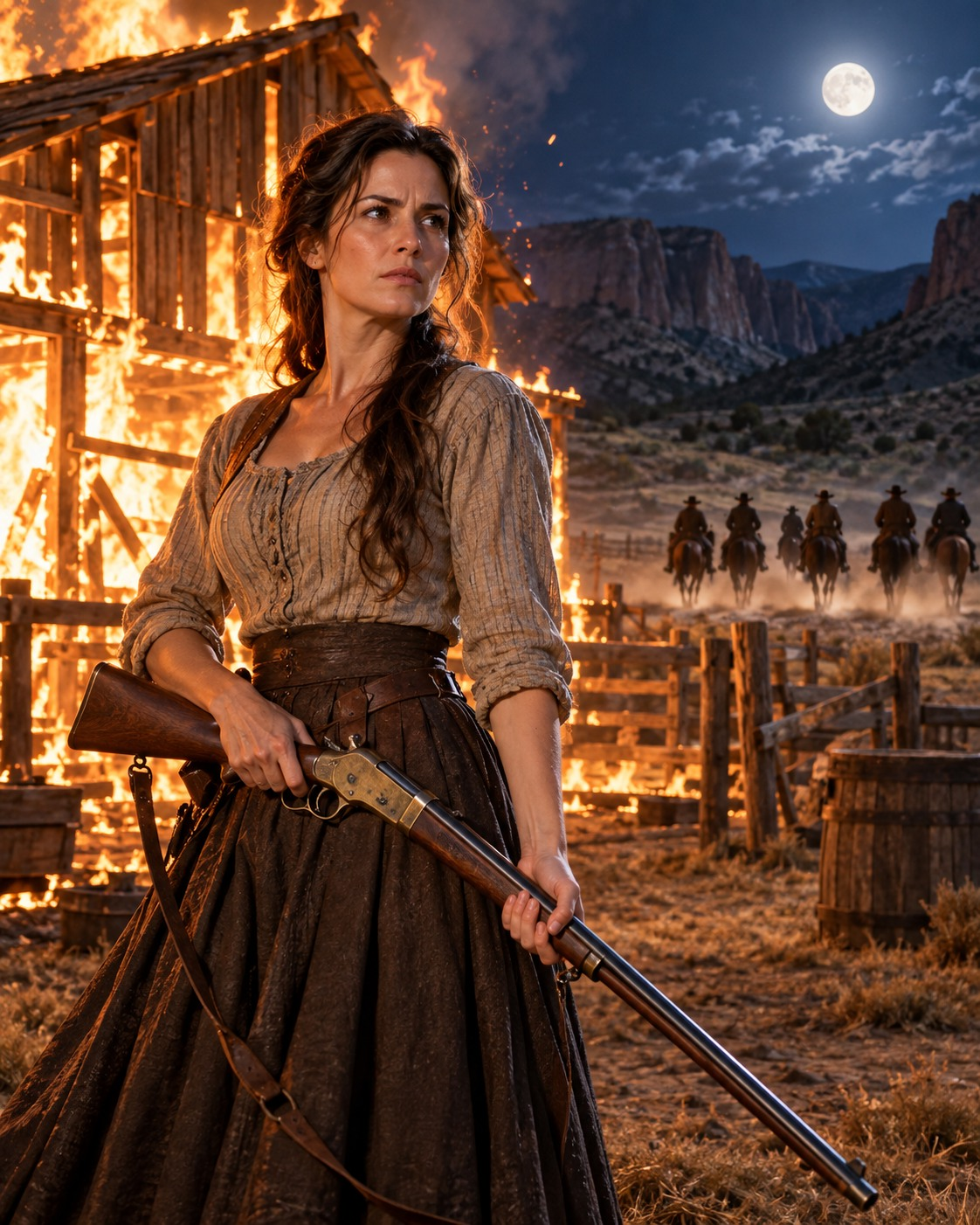
I stepped away from the window.
The rider remained outside.
For several seconds, neither of us moved.
Then the horse shifted its weight, and the moonlight caught the rider's face.
It was one of Pike's men.
The same man who had laughed when the barn caught fire.
He was riding Ruth's horse.
I felt something tighten inside my chest.
They had not simply burned my barn.
They had taken Ruth's horse.
Perhaps they had threatened her.
Perhaps they had done worse.
I looked at the rifle beside my bed.
Then I looked toward the door.
The man outside called my name.
"Eleanor!"
I did not answer.
He laughed.
"Come on out. The boss wants to know whether you enjoyed the show."
I moved toward the bedroom door.
He called again.
"Don't make me come inside."
I picked up the rifle.
My hands were steady now.
I walked downstairs and stopped beside the front window.
The man was still sitting on the horse.
He looked impatient.
I could see the red scarf around his neck.
He was not Silas Pike.
He was one of the younger members of the gang, perhaps thirty years old, with a narrow face and a scar running beneath his left eye.
I remembered him from the yard.
He had been the one who laughed loudest.
"Where's Ruth?" I asked.
He leaned forward.
"That's not your concern."
"Where is she?"
"Maybe she'll come visit you tomorrow."
I tightened my fingers around the rifle stock.
He smiled.
"Boss says you have until morning to decide whether you want to sell this place."
I stared at him.
"And if I don't?"
He shrugged.
"Then we'll finish what we started."
He turned his horse.
Before leaving, he looked back at the burning barn.
"Nice fire, wasn't it?"
I watched him ride away.
This time, I did not look down.
I waited until the sound of his horse disappeared.
Then I returned to the bedroom.
I placed the rifle on the bed and opened the leather document case again.
There were papers inside.
Old papers.
Some bore my father's handwriting. Others were written in a hand I recognized as my own.
I had kept them for five years.
Not because I wanted to remember.
Because I had never found the courage to destroy them.
I read the first page.
Then the second.
My father had taught me many things before he died.
He had taught me to ride.
He had taught me to read the weather across the mountains.
He had taught me how to remain patient when everything around me seemed determined to move too quickly.
But most importantly, he had taught me that skill meant nothing without judgment.
He had always said that a weapon was not an answer to every problem.
Sometimes walking away required more courage.
Sometimes standing still was the hardest decision a person could make.
And sometimes, when every other choice had been taken away, a person had to decide whether the next generation would inherit the same fear.
I folded the papers.
Then I looked at the rifle.
I had made my decision.
Before dawn, I prepared to leave.
I changed into my dark riding clothes and pulled my hair into a tight braid.
I put on my worn leather boots.
I wrapped a small cloth around the rifle stock to protect it from the cold night air.
I carried no unnecessary belongings.
The house was quiet.
The kitchen table still held the coffee cup Ruth had used two mornings earlier.
I stopped beside it.
I remembered her warning.
You should come into town.
I had refused.
Now I wished I could tell her why.
I walked outside.
The barn was almost completely destroyed.
Only a few blackened beams remained standing.
The ground was covered in ash.
I approached the place where the front entrance had once been.
A small metal horseshoe lay beside a burned piece of wood.
I picked it up.
It belonged to my husband.
He had kept it above the barn door for good luck.
I placed it inside my pocket.
Then I mounted my horse.
The canyon was east of the property.
Pike's men had ridden in that direction.
I knew the country better than they did.
I knew the narrow passages, the old cattle trails, and the ridges where the wind changed direction without warning.
But more than that, I knew what kind of men I was following.
They would not expect me.
They believed they had already won.
That was their weakness.
I rode into the darkness.
The first pale light appeared behind the mountains as I reached the eastern ridge.
I stopped.
Below me, the canyon stretched between two enormous walls of rock.
The wind moved through the pass.
It carried the smell of dry earth and distant smoke.
I dismounted and tied my horse where it would remain hidden.
Then I looked down the trail.
There were tracks.
Five horses.
They had passed through not long before.
I followed the trail until I reached a narrow overlook.
From there, I could see the men.
They had stopped near a bend in the canyon.
Their horses were drinking from a shallow stream.
Silas Pike sat on a rock, speaking to the man with the red scarf.
The others were laughing.
One of them was eating.
Another was examining a stolen saddle.
They looked completely relaxed.
I watched them for a long time.
I remembered the faces of the ranchers who had come to town asking the sheriff for help.
I remembered the families who had left their homes because they could no longer sleep safely.
I remembered Ruth's expression when she said Pike's name.
And I remembered the flames consuming my barn.
The anger came.
But I did not allow it to control me.
My father had taught me that anger could make a skilled person careless.
I needed to remain calm.
I needed to think.
I took one last look at the five men.
Then I stepped back from the ridge.
The first report echoed through Black Canyon.
The men below scattered.
A horse reared.
Someone shouted.
The laughter disappeared.
I remained where I was, breathing steadily.
The first man fell beside the trail.
The others searched the surrounding rocks.
Pike shouted orders.
The gang had never imagined that anyone would challenge them here.
They were accustomed to being the hunters.
Now they were looking for someone they could not see.
Another report cracked through the canyon.
A second man went down.
The red-scarfed rider turned toward the sound.
He shouted something I could not hear.
Pike pulled his horse around.
The remaining men tried to find shelter among the rocks.
But Black Canyon was full of deceptive echoes.
The sound moved differently between its walls.
They could not tell where the shots were coming from.
I remained composed.
The third report followed.
Then the fourth.
After that, the canyon became silent.
I waited.
I did not hurry.
I listened to the wind and watched the narrow trail.
There was one man left.
Silas Pike.
He stood beside his horse, staring toward the eastern slope.
His black hat had fallen into the dirt.
For the first time since I had known his name, he looked uncertain.
He shouted toward the cliffs.
"Who are you?"
I did not answer.
He raised his rifle toward the rocks.
"Show yourself!"
The fifth report echoed through the pass.
Then silence returned.
I lowered my rifle.
Five men.
Five shots.
I remained on the ridge for several minutes.
I wanted to make certain there was no movement.
Then I walked down toward the canyon floor.
The morning light had begun to illuminate the rocks.
I looked at the men lying along the trail.
There was no satisfaction in what I saw.
No victory.
No happiness.
Only the terrible weight of what had happened.
I knew what would come next.
The sheriff would investigate.
The town would demand answers.
Ruth would wonder whether I had survived the night.
And sooner or later, someone would recognize the rifle.
I picked up a fallen brass casing near the second body.
It was heavy.
The metal caught the morning light.
I held it for a moment.
Then I placed it beside the trail.
I did not want to carry a reminder of the night with me.
I turned toward my horse.
Before leaving, I looked once more at the canyon.
Five men had ridden into that pass believing they owned the valley.
None of them would ride out.
I returned to the ranch as the sun began rising.
The barn was nothing more than a smoking ruin.
I dismounted.
My legs felt heavy.
I had not slept.
I carried the rifle into the house and placed it beside the old wooden chest.
Then I washed my hands.
I changed my clothes.
I made coffee.
I sat alone at the kitchen table.
For the first time in five years, I had opened the chest and brought the past into the present.
I did not know whether I had done the right thing.
I only knew that Pike would never threaten another rancher.
The valley would be safer.
At least, that was what I hoped.
A few hours later, I heard distant voices.
Then horses.
I walked toward the front window.
Several riders were approaching the property.
The man at the front wore a sheriff's badge.
William Garrett.
I had seen him many times in town.
He was an honest man, but he had spent two years fighting a gang that always seemed to remain one step ahead of him.
He dismounted near the gate.
I watched him look toward the burned barn.
Then he looked at the farmhouse.
His hand rested near his belt.
He was not smiling.
He had come to ask questions.
And I knew that one of those questions would be about the brass casing in Black Canyon.






Comments 0