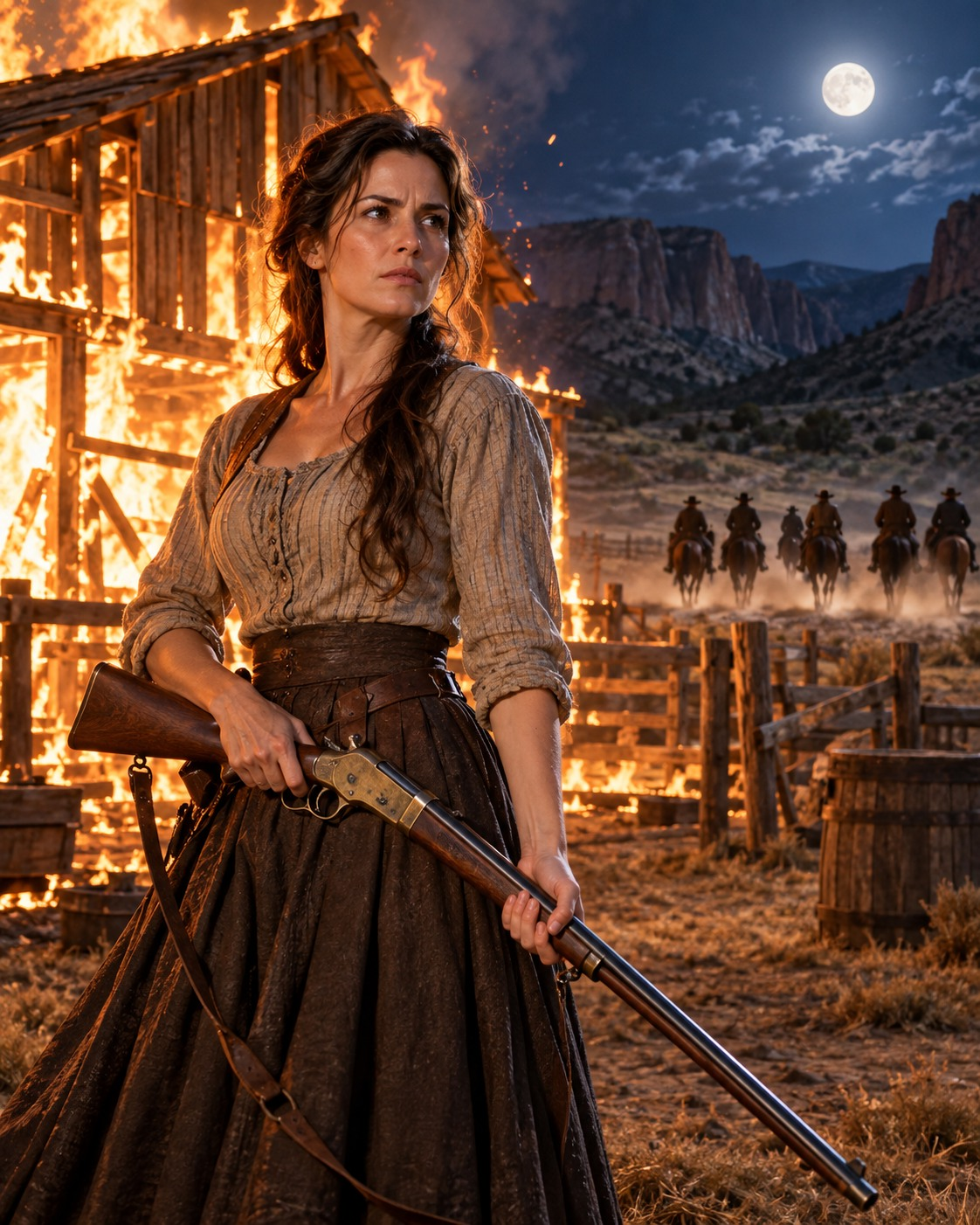
I did not open the door immediately.
I moved toward the window and looked through the narrow gap in the curtains.
A man stood on the porch.
He wore a dark coat and a dusty hat.
His face was unfamiliar.
But his voice was not.
"Mrs. Cross, I know you're inside."
I picked up the old rifle from beside the bedroom door.
I kept it lowered.
"Who are you?"
"My name is Nathaniel Crowe."
I looked at the photograph in my other hand.
The man on my porch was the same man who had stood beside my husband.
I opened the door but did not step aside.
Crowe removed his hat.
"May I come in?"
"No."
He glanced toward the rifle.
Then he looked at me.
"Your father taught you well."
My expression did not change.
"You knew my father?"
"I knew him better than you think."
"Then tell me why you're here."
Crowe looked past me into the house.
"Because you have something that belongs to me."
I held the rifle steady.
"The land?"
He shook his head.
"The original deed."
"Why do you want it?"
"Because it proves something that was never supposed to be proved."
I waited.
He looked toward the burned barn.
"Silas Pike was a crude man. He believed fear could solve everything. I told him there were better ways to deal with people."
"Like burning their homes?"
Crowe's expression remained calm.
"I never ordered that."
"You paid him."
"I paid people to handle a difficult business matter."
I stared at him.
"Is that what you call it?"
He sighed.
"Eleanor, I know you're angry."
"Angry?"
I glanced toward the photograph.
"My husband is dead."
Crowe looked at the picture.
For the first time, something moved across his face.
"Thomas was a good man."
"Don't speak about him."
"He was stubborn."
I took one step forward.
"Tell me what happened."
Crowe remained silent.
I raised the photograph.
"You were with him."
"Yes."
"You knew about the land."
"Yes."
"You knew he had found the original boundary marker."
Crowe looked toward the door.
Then he lowered his voice.
"Your husband discovered that the land company had altered several territorial records. He found evidence that the northern spring belonged to the original ranch families."
"Who changed the records?"
"Men who believed they could turn a remote valley into a private estate."
"And you helped them."
He did not deny it.
"Thomas wanted to take the evidence to the authorities."
"What happened?"
Crowe looked directly at me.
"He was warned."
"By whom?"
"By me."
I felt my jaw tighten.
"And when he refused?"
Crowe looked away.
"I was not present when he died."
"That isn't what I asked."
He said nothing.
I stepped back.
"Leave."
He put his hat on.
"You don't understand the situation."
"I understand enough."
He looked toward the rifle.
"That weapon belonged to your father."
"Yes."
"I remember the last time I saw it."
I remained silent.
Crowe gave a small, humorless smile.
"He told me you would never use it unless you had no other choice."
I looked at him.
"Then he knew you."
Crowe's smile disappeared.
For several seconds, neither of us moved.
Finally, he stepped away from the porch.
"This is not over, Mrs. Cross."
I watched him walk toward his horse.
He mounted.
Before riding away, he turned.
"You should have sold the ranch when Pike offered."
I closed the door.
I locked it.
Then I stood in the hallway, holding the photograph.
My husband had not died by accident.
I had spent five years mourning a man whose final days I had never truly understood.
And now the person who knew the truth had come to my door.
I did not sleep.
At sunrise, I rode into town.
Garrett was already at his office.
When I showed him the photograph, he examined it carefully.
Then I told him about Crowe's visit.
He listened without interrupting.
When I finished, he stood and walked to the window.
"He's admitted involvement."
"Yes."
"Did he threaten you?"
"Not directly."
Garrett turned.
"That's how men like him operate."
He placed the photograph on his desk.
"I want to bring him in."
"Then do it."
"We need evidence that connects him to Pike's gang and the land company."
I opened my leather case.
"I have the documents."
Garrett examined the original deed.
Then he looked at the letter Thomas had written to my father.
"This could be enough to reopen the old investigation."
"Will it prove what happened to Thomas?"
"Not by itself."
I looked down.
Garrett continued.
"But I know someone who may be able to help."
"Who?"
"Judge Samuel Whitcomb. He handled the original land dispute."
I recognized the name.
The judge had retired several years earlier.
"Do you think he'll speak?"
"I'll find out."
He placed the documents inside a folder.
Then he looked at me.
"Eleanor, I want you to be careful."
"I've been careful for five years."
"I know. But Crowe is different from Pike."
"How?"
"Pike wanted people to fear him. Crowe wants people to believe he doesn't exist."
I considered that.
Garrett was right.
Pike had announced his presence.
He had burned my barn in front of me.
Crowe preferred letters, false documents, and men who carried out his orders.
One was openly cruel.
The other was quietly dangerous.
That afternoon, I returned to the ranch with Ruth.
She had heard about Crowe's visit and insisted on accompanying me.
When we reached the house, I noticed the gate was open.
I had closed it that morning.
Ruth stopped her horse.
"Did you leave it like that?"
"No."
We dismounted.
I approached the gate carefully.
There were fresh tracks in the dirt.
Two horses.
One had entered the yard.
The other had remained near the road.
I looked toward the farmhouse.
The front door was closed.
But the window beside it had been opened.
Ruth whispered, "Someone's been inside."
I nodded.
We entered together.
The kitchen appeared untouched.
The bedroom was different.
The wooden chest beneath my bed had been moved.
Its lid was open.
The contents had been disturbed.
I knelt.
The folded cloth was still there.
The old photograph was still there.
But the sealed envelope containing my father's original land papers was gone.
I stood.
Ruth looked at me.
"They took the deed."
I shook my head.
"No."
I reached into the chest and removed a small wooden panel beneath the lining.
It opened.
Inside was a second envelope.
The original deed was still there.
I had moved it before going into town.
Ruth exhaled.
"Thank goodness."
But I was not relieved.
Someone had searched my bedroom.
Someone knew about the chest.
And someone had been inside my home while I was away.
I examined the room.
On the floor beside the bed lay a small object.
A brass button.
I picked it up.
It had a distinctive mark stamped into the center.
The same circle with a line through it.
Ruth looked at the button.
"Where have I seen that before?"
I turned it over.
There was a number scratched into the back.
17.
I stared at it.
Then I remembered the old territorial records.
My father had mentioned a locked cabinet at the courthouse.
Cabinet seventeen.
The place where the original land agreements had been stored before they disappeared.
I looked at Ruth.
"I think I know where we need to go."
Before she could answer, a horse galloped into the yard.
Garrett dismounted and ran toward the house.
"Eleanor!"
I stepped outside.
He was holding a folded telegram.
His face was pale.
"Judge Whitcomb is dead."
I felt my stomach tighten.
"When?"
"Last night."
Garrett unfolded the telegram.
"Someone found him in his study this morning."
He looked directly at me.
"Before he died, he sent one final message."
"What did it say?"
Garrett handed me the paper.
There were only eight words.
CABINET SEVENTEEN. THE ORIGINAL RECORD IS STILL THERE.
I looked up.
Garrett's expression was grave.
"And Eleanor, Crowe is already on his way to the courthouse."






Comments 0