I held the letter for several minutes before opening it.
My hands were trembling.
The handwriting was unmistakable.
Thomas had always written slowly, with careful letters and wide spaces between his words.
I remembered the way he used to leave little notes beside my coffee cup.
Sometimes they were reminders about the ranch.
Sometimes they were jokes.
Sometimes they were simply two words.
Love you.
I sat down.
Garrett quietly stepped toward the door.
"Would you like me to give you some time?"
I nodded.
He placed his hat on his head.
"I'll be outside."
Ruth remained beside me.
She reached for my hand.
I opened the envelope.
Inside was a single folded letter.
It was dated five years earlier.
I began reading.
My dearest Eleanor,
If you're reading this, it means something happened that I was unable to prevent.
I hope I am wrong.
I hope this letter remains hidden for another fifty years, and that you never need to understand why I wrote it.
But I have discovered something about the northern property.
The spring beneath the ridge belongs to the original families of this valley. Your father was right. The documents Nathaniel Crowe has been using are false.
I have copies of the original records, and I have given the most important document to your father.
If anyone ever comes asking about the land, do not trust their promises.
I know you will want to fight for what is yours. I know how stubborn you can be.
But please remember that your life is worth more than any piece of land.
I have loved you every day since we married.
If something happens to me, I want you to live.
Not hide.
Not spend your life being afraid.
Live.
And if the day ever comes when you must stand up for yourself, remember that you are stronger than you believe.
Your loving husband,
Thomas.
I stopped reading.
For a moment, the words blurred.
I pressed the letter against my chest.
Ruth said nothing.
She simply held my hand.
I had spent five years believing that Thomas's final days had been ordinary.
I had believed that his death was an accident and that the life we had built together had ended without warning.
But he had known something was wrong.
He had tried to protect me.
Even in the final days of his life, he had been thinking about my safety.
I looked at the last line.
Live.
It was the one thing I had forgotten how to do.
The investigation continued for several weeks.
Garrett sent the documents to the territorial authorities.
Judge Whitcomb's records were examined.
The original land agreement was verified.
The territorial commissioner confirmed that the spring and surrounding property belonged to the original ranch families.
Nathaniel Crowe was charged with fraud, conspiracy, intimidation, and involvement in the threats against Thomas Cross.
The two men arrested at the courthouse agreed to testify.
Their statements revealed how Crowe had used Pike's gang to force ranchers into selling their property.
They also confirmed that Crowe had ordered Thomas to be followed after he discovered the altered records.
One of the men admitted that Thomas had been confronted on the northern trail.
The details were difficult to hear.
But they finally answered the questions I had carried for five years.
Thomas had not died because he had been careless.
He had died because he had refused to surrender something that belonged to his family and his neighbors.
Crowe had believed that removing him would end the matter.
He had been wrong.
The truth had survived.
And now it had witnesses.
The town changed slowly.
Not everything became easy overnight.
Some families still struggled financially.
Several ranches had lost cattle.
Others needed repairs.
My barn remained a pile of blackened timber.
But something important had changed.
People began speaking to one another again.
Samuel Reed organized a group to help rebuild the damaged fences.
The two brothers from the western pasture offered their horses and equipment.
Margaret Bell arranged for food to be delivered to families who had lost their livestock.
Garrett spent most of his days collecting statements and organizing the legal records.
Ruth became the person everyone visited when they needed advice.
She insisted she was too old to be useful.
Nobody believed her.
One afternoon, she arrived at my ranch carrying a basket.
"What is that?" I asked.
"Food."
"I can see that."
"Then why did you ask?"
I laughed.
It was the first time I had laughed properly since the fire.
Ruth noticed.
She placed the basket on the porch.
"That's better."
"What is?"
"That."
She pointed at my face.
"You've been looking like someone stole your last cup of coffee."
I shook my head.
"Perhaps they did."
She laughed.
Then her expression softened.
"Eleanor, people are asking when you'll rebuild."
I looked toward the burned barn.
"I haven't decided."
"You don't have to."
I sat beside her.
For a while, we watched the sunlight move across the empty pasture.
Then I said something I had not expected to say.
"I don't want to rebuild it exactly as it was."
Ruth looked at me.
"What would you change?"
I considered the question.
"More windows. A larger stable. Better storage."
She nodded.
"And perhaps a proper place for the horses."
I smiled.
"Perhaps."
Ruth took my hand.
"Your husband would have liked that."
I looked toward the remains of the barn.
"Yes. He would."
Three months later, Nathaniel Crowe stood before the territorial court.
The proceedings lasted several days.
Witnesses described the threats against their families.
The ranchers presented the letters they had kept hidden.
Garrett testified about the investigation and the discovery of the original records.
The two men who had worked for Crowe described how the land company had used Pike's gang to frighten people into surrendering their properties.
Then I was called.
I stood before the judge.
Crowe sat at the opposite table.
He looked older.
His expensive coat was gone.
His hair was untidy.
For the first time, he appeared like an ordinary man.
The judge asked me to describe what had happened at my ranch.
I told him about Ruth's warning.
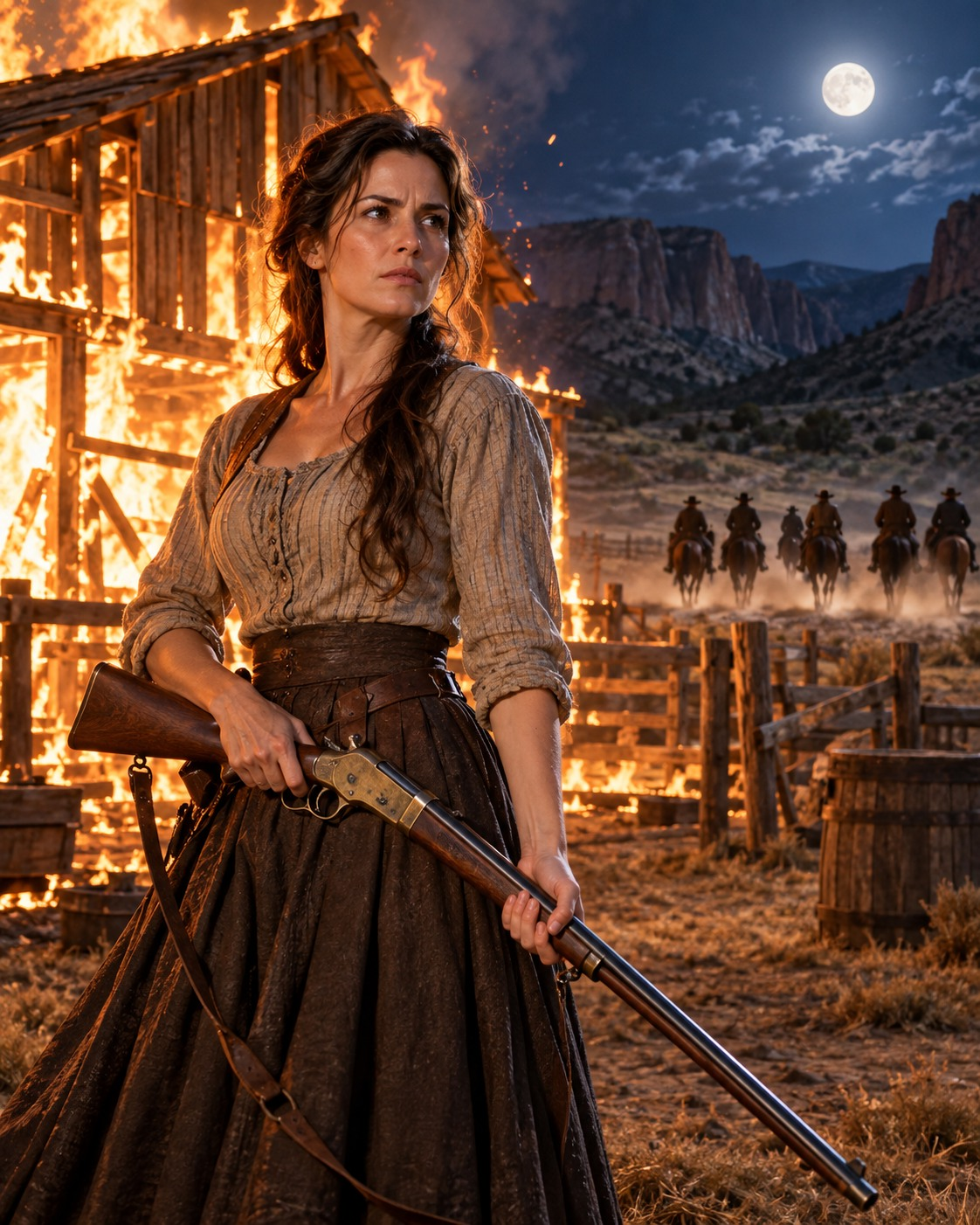
I described the five riders.
I explained how they had burned the barn and threatened my home.
I told him about the old chest and the buffalo rifle.
I did not exaggerate.
I did not add details that I could not remember.
I simply told the truth.
Then the judge asked about Thomas.
I looked toward Crowe.
"Five years ago, my husband discovered that the northern land records had been altered. He refused to sell our property because he knew the spring belonged to the valley's original families."
The judge listened.
I continued.
"He was threatened. He was followed. And he died before he could bring the evidence forward."
The courtroom was silent.
I held up the letter.
"This is what my husband left behind."
The judge examined it.
Then he asked whether I had anything else to say.
I looked at Crowe.
For a moment, I remembered the burning barn.
I remembered his words.
I remembered the way he had stood on my porch and told me that Thomas had been an obstacle.
But I did not raise my voice.
I did not threaten him.
I simply said:
"My husband believed this valley belonged to the people who built their lives here. He was right. And no amount of money should give another man the right to take that away."
I returned to my seat.
Crowe looked down.
That was the last time I ever spoke to him.
The court found him guilty of the crimes supported by the evidence.
His land company lost its claim.
The original ranch boundaries were restored.
And the families of the valley were allowed to keep their homes.
Justice had taken longer than I wanted.
But it had finally arrived.
By early autumn, my new barn was nearly finished.
The ranchers had helped me build it.
Samuel brought timber.
The brothers from the western pasture worked on the roof.
Margaret brought food for everyone.
Ruth supervised the entire operation despite insisting she had no intention of lifting a single board.
She was the first person to complain whenever someone measured something incorrectly.
I stood in the yard one afternoon, looking at the new structure.
It was larger than the old barn.
The wood was lighter.
The roof was stronger.
And above the entrance, I had placed my husband's old horseshoe.
I had found it in the ashes after the fire.
I cleaned it carefully and mounted it above the door.
Ruth stood beside me.
"Looks good."
"It does."
"Thomas would approve."
I nodded.
Then I looked toward the northern ridge.
The land was quiet.
The spring continued flowing.
The grass was beginning to return.
For the first time in years, I no longer looked at the mountains and wondered who might be watching.
One morning, Sheriff Garrett visited the ranch.
He arrived without an escort.
I was feeding the horses when I heard him call from the gate.
"Morning, Eleanor."
I turned.
"Morning, Sheriff."
He dismounted.
"I brought something."
He held out a small wooden box.
I opened it.
Inside was the heavy brass casing recovered from Black Canyon.
I looked at him.
"Why are you giving this to me?"
"Because the investigation is finished."
He paused.
"And because I think you deserve to decide what happens to it."
I examined the casing.
It was the same one I had left beside the second body.
The same one Garrett had placed on my kitchen table.
The object that had started so many questions.
I closed the box.
"Thank you."
Garrett looked toward the barn.
"You've done a remarkable job rebuilding."
"The town helped."
"I know."
He looked at me for a moment.
Then he said, "There's something I've wanted to ask you."
I waited.
"Why didn't you tell me about the rifle when I first came here?"
I considered the question.
"Because I didn't know what would happen afterward."
He nodded.
"Fair enough."
I looked at him.
"Would you have believed me?"
He smiled slightly.
"Honestly?"
"Honestly."
"Probably not."
I laughed.
Garrett laughed, too.
Then his expression became serious.
"I was wrong about something."
"What?"
"I thought the valley needed someone to save it."
He looked around the ranch.
"But what it needed was for people to stop believing they were powerless."
I thought about Samuel.
Margaret.
Ruth.
The brothers from the western pasture.
He was right.
The five men in Black Canyon had been dangerous.
But their greatest weapon had never been their guns.
It had been the fear they had planted in everyone else.
Once that fear began to disappear, their power disappeared with it.
Winter came.
The first snow covered the northern ridge.
My new barn was full.
The horses were warm.
The fences were strong.
And the farmhouse was no longer as quiet as it had once been.
Ruth visited every Sunday.
Sometimes Samuel came by with news from town.
Margaret occasionally brought fresh bread.
Garrett stopped whenever he had a reason to check on the northern property.
They had become part of my life.
I had not expected that.
For years, I had believed that being alone was the safest way to live.
Now I understood that solitude and peace were not the same thing.
One evening, Ruth arrived carrying an old photograph.
She placed it on the kitchen table.
It showed Thomas and me standing beside the original barn.
We were younger.
Thomas had one arm around my shoulders.
I was laughing at something outside the frame.
I picked it up.
"I haven't seen this in years."
"I found it in one of the old town records," Ruth said.
I looked at the photograph.
For a moment, the memories came back.
Thomas repairing the fence.
Thomas complaining about the horses.
Thomas leaving notes beside my coffee cup.
I smiled.
Ruth noticed.
"You're allowed to be happy, Eleanor."
I looked at her.
"I know."
She shook her head.
"No. I mean really happy. Not just relieved that things are finally quiet."
I looked through the kitchen window.
The new barn stood beneath the winter moon.
Its windows glowed warmly.
The horses were sleeping.
The valley was safe.
And for the first time in five years, I could imagine a future without feeling guilty for leaving the past behind.
"I think I'm getting there," I said.
Ruth smiled.
"Good."
The following spring, the valley held a gathering to celebrate the restoration of the original land records.
Families came from every ranch.
Children played near the courthouse.
The blacksmith prepared food.
Samuel gave a short speech about the people who had refused to surrender their homes.
Garrett stood beside the judge who had overseen the final legal proceedings.
Ruth sat in the front row.
I stood near the back.
I had never enjoyed being the center of attention.
But when Samuel called my name, everyone turned.
He invited me to stand beside him.
I walked forward.
The crowd became quiet.
Samuel looked at me.
"Five men believed they could frighten this valley into giving up everything it had built."
He paused.
"They were wrong."
He turned toward me.
"And one woman reminded us that courage doesn't always announce itself."
People began applauding.
I lowered my head.
I did not feel like a hero.
I had simply refused to let fear make every decision for me.
Samuel continued.
"Today, the spring remains ours. The ranches remain ours. And our children will grow up knowing they don't have to surrender their homes to anyone."
The applause grew louder.
I looked across the crowd.
I saw Ruth smiling.
Garrett nodded.
Margaret wiped her eyes.
And I realized that the valley had finally become what my husband had always wanted it to be.
A place where ordinary people could live without being afraid.
That evening, I returned home alone.
The sun was setting behind the canyon.
I walked toward the barn and stopped beneath the horseshoe above the entrance.
Then I looked toward the old wooden chest inside the farmhouse.
The buffalo rifle was there.
I had cleaned it and wrapped it in fresh cloth.
But I no longer kept it beside my bed.
I had placed it in the chest.
Not because I was ashamed of it.
Because I no longer needed to carry the past everywhere I went.
I closed the barn doors.
I walked across the yard.
The air smelled of fresh grass and wood.
I stopped beside the old water trough.
My husband had repaired it several times.
I ran my hand across the worn wooden edge.
"I think we made it," I whispered.
The wind moved gently through the pasture.
For a moment, I could almost imagine Thomas standing beside me.
I remembered his letter.
Live.
I finally understood what he had meant.
He had not wanted me to spend the rest of my life defending his memory.
He had wanted me to have a life of my own.
So I looked toward the farmhouse.
The kitchen lamp was already glowing.
There was coffee waiting on the table.
Ruth would probably arrive on Sunday.
Samuel would likely ask for help repairing another fence.
And tomorrow morning, the horses would need feeding.
Ordinary things.
Wonderful things.
Things I had nearly forgotten how to appreciate.
I walked toward the house.
Behind me, the barn stood strong beneath the evening sky.
The valley was quiet.
Not the frightened silence that had once covered every ranch.
But the peaceful silence of people who finally knew they were safe.
I opened the front door.
Then I turned for one last look at the land.
Five men had ridden into Black Canyon believing they could take everything from me.
They had burned my barn.
They had threatened my home.
They had tried to erase the truth about my husband.
But they had never understood what made this valley strong.
It was not the land.
It was not the water.
It was not the money.
It was the people who refused to abandon one another.
And as I stepped inside, I knew that Thomas would have been proud.
For five years, I had lived as a widow trying to forget the past.
Now I was Eleanor Cross again.
A woman with a home.
A family of friends.
A future.
And a reason to wake up every morning.






Comments 0