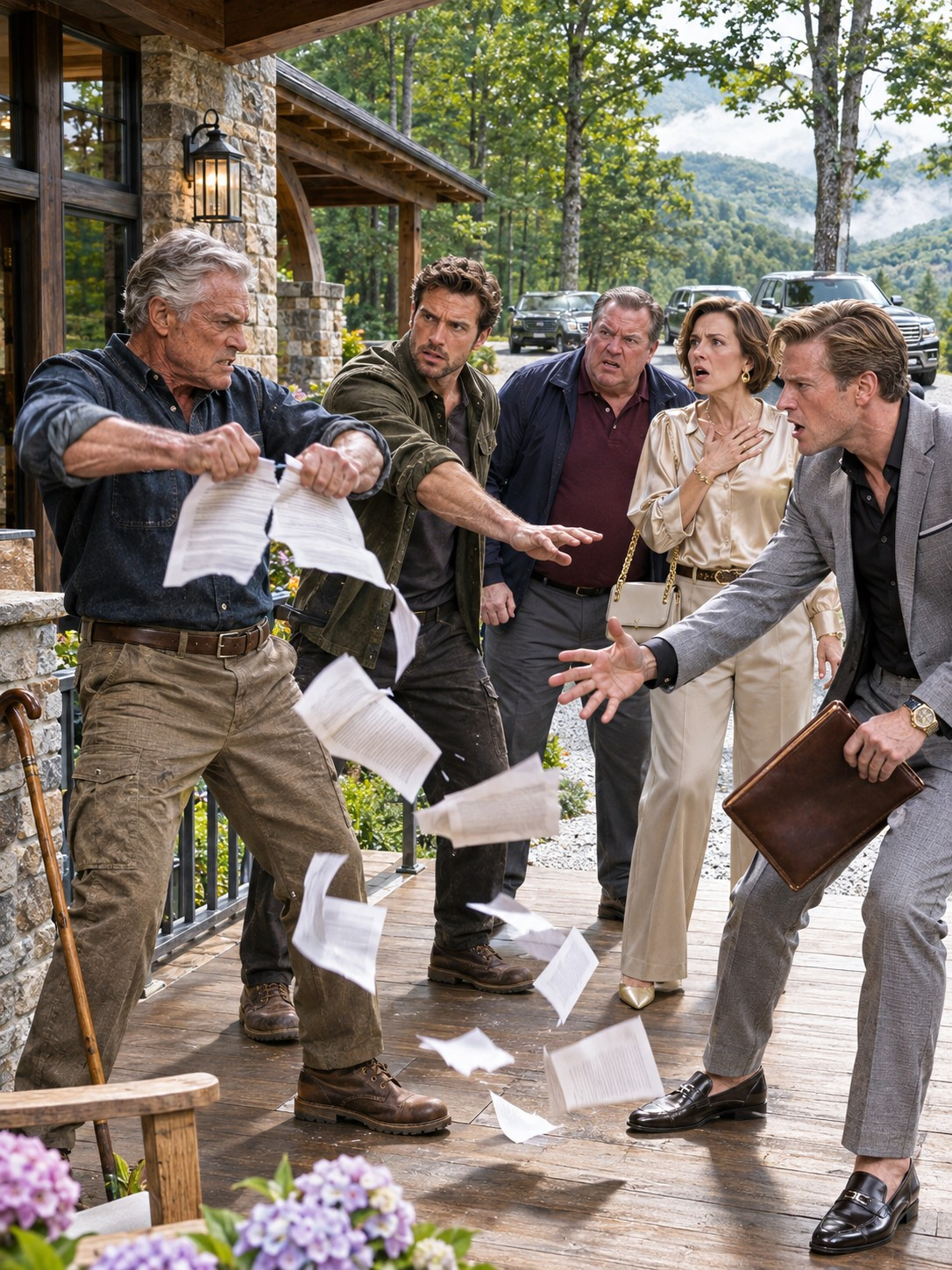
My signature was on the document.
I had never signed it.
Someone had used my name to surrender my grandmother's conservation agreement, and the notarized declaration claimed I had voluntarily abandoned my position as the successor representative.
For several seconds, I couldn't move.
Reed stood beside me, examining the scanned authorization on his phone.
Grandpa Harlon looked furious.
Evelyn had gone completely silent.
"Who submitted this?" I finally asked.
Reed scrolled through the email.
"The independent trustee's office received it yesterday afternoon. It was accompanied by a notarized identity declaration and a request for immediate transfer of the original agreement."
"Who delivered it?"
"An attorney representing Malcolm Voss."
I stared at the document.
"How can they transfer anything without verifying my identity?"
"They should have verified it. That's why we're going to contact the trustee immediately."
Grandpa struck his cane against the courthouse floor.
"Call them now."
Reed nodded and stepped away.
I continued studying the document.
The signature looked convincing.
My name was written in the same style I used on business contracts. Even the small mark beneath the final letter appeared familiar.
But I knew I hadn't signed it.
Someone had copied my signature from an existing document.
And whoever had done it understood exactly which papers to imitate.
"Callum."
I looked at Grandpa.
"Do you remember signing anything related to the conservation agreement recently?"
"No."
"Any authorization allowing someone else to represent you?"
"Absolutely not."
He studied the document.
"Your grandmother made you responsible for protecting that land. Why would you ever surrender it?"
I didn't answer.
Because I already knew.
Someone wanted me removed.
And they had decided that forging my signature was easier than persuading me to cooperate.
Reed returned several minutes later.
His expression was grim.
"The trustee has agreed to suspend the transfer request while they investigate."
I exhaled.
"Good."
"But there's a problem."
Of course there was.
"What?"
"They received the authorization through a registered legal representative. The accompanying paperwork includes a notarized declaration stating that you appeared in person before a notary."
I stared at him.
"I was working at my office yesterday."
"Do you have records proving that?"
"Yes. Security cameras, employee records, electronic access logs."
Reed nodded.
"Good. We'll need all of them."
Grandpa looked toward the courthouse doors.
"Who was the notary?"
Reed checked his phone.
"His name is Harold Benton."
Evelyn suddenly looked up.
"Harold?"
Reed turned toward her.
"You know him?"
She hesitated.
"I've known that name for years. He used to handle property documents for Malcolm's investment company."
I felt my stomach tighten.
"Are you saying he's connected to Voss?"
"Possibly. I don't know whether he still works with him."
Reed immediately wrote down the name.
"We'll verify his commission and obtain the original notarization records."
I looked at the document again.
Something else caught my attention.
The date of the supposed signing was Tuesday.
That was the same evening Rhett had called me to announce Grandpa's death.
The same evening my brother and parents had laughed while Grandpa was eating dinner across from me.
I turned toward Reed.
"This wasn't something they planned after the guardianship petition."
He studied the date.
"No. It was already underway."
Grandpa's expression hardened.
"Then they've been preparing this for a long time."
We returned to Reed's office.
He wanted to examine the original estate documents and compare the disputed signature with my previous legal records.
I provided copies of my business contracts, bank documents, and consulting agreements.
Reed placed them beside the forged authorization.
He examined the signatures carefully.
After several minutes, he leaned back.
"Someone copied this from an existing document."
"Can you prove that?"
"Not conclusively without forensic examination. But the similarities are too precise to be accidental."
He called a document examiner he regularly worked with.
Then he asked his assistant to retrieve the original conservation agreement from the secure archive.
While we waited, I received a message from my office manager.
She had located the security footage from the previous afternoon.
It showed me entering the office at 8:12 a.m. and leaving shortly after 6:00 p.m.
I forwarded the recording to Reed.
"That should establish where I was."
He nodded.
"It will help."
Grandpa sat near the window.
He looked exhausted.
I walked over.
"Are you okay?"
He gave me a tired smile.
"I've been better."
I sat beside him.
"Do you think Dad knows someone forged my signature?"
He remained quiet.
Then he spoke.
"Your father has always been afraid of disappointing people who have money."
I looked at him.
"Malcolm?"
"Men like Malcolm know how to recognize weakness. They offer help, make promises, and slowly convince people that they cannot survive without them."
Grandpa rubbed his forehead.
"Your father never understood that the price of accepting money from the wrong person can be much higher than the original debt."
I remembered the $1.8 million.
"Do you think Malcolm is controlling him?"
"I think Curtis has made promises he cannot keep."
That afternoon, Reed received the first response from the trustee.
The original conservation agreement had not been transferred.
However, the office had received another request.
This one asked for a temporary replacement of the successor representative.
The proposed replacement was my brother.
Rhett Harlon.
I stared at the screen.
"Why would they appoint him?"
Reed examined the paperwork.
"Because the forged resignation claims you voluntarily surrendered your position. The accompanying declaration argues that Rhett is a suitable replacement."
Grandpa shook his head.
"That boy couldn't protect a houseplant."
Reed almost smiled.
But his expression quickly became serious again.
"The trustee hasn't approved anything. However, we need to act immediately."
He began preparing a formal objection.
I watched him work.
Then I noticed something.
The replacement request contained a reference to a supporting document.
It was identified as Exhibit C.
I pointed toward it.
"What's Exhibit C?"
Reed opened the attachment.
It was a letter bearing my grandmother's name.
The document claimed that she had personally recommended Rhett as the future representative of the conservation agreement.
I read the paragraph twice.
It was completely false.
My grandmother had never trusted Rhett with anything important.
She had specifically named me because she believed I understood the responsibility of protecting the land.
"That's forged too," I said.
Reed nodded.
"We'll need to authenticate it."
Grandpa took the document.
His hands began trembling.
"That isn't her handwriting."
He turned the page.
Then he stopped.
A small detail appeared near the bottom.
A reference to an old family trust number.
Grandpa stared at it.
"Wait."
He leaned closer.
"This number belongs to a different agreement."
Reed immediately took the paper.
He examined the reference.
"You're right."
Grandpa looked at Evelyn.
"Your grandmother never used this number for the conservation arrangement."
Evelyn shook her head.
"She wouldn't have."
Reed placed both documents side by side.
The forged letter referenced an account established years before the conservation agreement existed.
Someone had combined details from two separate legal arrangements.
And that meant whoever prepared the document had access to old family records.
Possibly even the originals.
The next morning, Reed arranged for a forensic document examiner to review the disputed signatures.
Her name was Margaret Ellis.
She was a specialist in questioned documents who had worked on financial fraud cases for more than twenty years.
She arrived carrying a secure case containing examination equipment.
After introducing herself, she examined my signature samples.
Then she reviewed the disputed authorization.
She didn't offer an immediate opinion.
Instead, she photographed the documents, measured the letter spacing, and examined the ink patterns.
"These documents will need laboratory analysis," she explained. "But I can already identify several features worth investigating."
She pointed toward my signature.
"The pressure pattern appears unusually uniform."
"What does that mean?" I asked.
"It may indicate that the signature was reproduced from an image rather than written naturally."
Reed leaned forward.
"Could someone have traced it?"
"Possibly. I won't make a definitive conclusion until I examine the originals."
She packed the documents carefully.
"I'll prepare a preliminary report as soon as possible."
After she left, Reed called the trustee again.
This time, he demanded that all disputed documents be preserved and that no changes be made to the conservation arrangement until the authenticity investigation was complete.
The trustee agreed.
For the first time, I felt we were making progress.
But the relief didn't last.
My phone rang.
It was my mother.
I considered ignoring it.
Then I answered.
"Hello?"
"Callum, we need to talk."
Her voice was unusually soft.
"What do you want?"
"Your father is very upset."
I looked toward Grandpa.
"That's unfortunate."
"Don't be disrespectful."
"Then don't call me to defend him."
She sighed.
"You're making this much worse than it needs to be."
I almost laughed.
"Mom, someone forged my signature."
"Your father says you signed the document voluntarily."
"My father is lying."
"That's not true."
I stood and walked toward the hallway.
"Did you know about the forged authorization?"
There was a pause.
"Callum, listen to me. Your father is trying to protect the family."
"From what?"
"From losing everything."
I closed my eyes.
"Who is Malcolm Voss?"
Silence.
Then my mother spoke.
"Why are you asking about him?"
That answer told me more than she intended.
"Because his company is trying to take Grandpa's land."
"That's business. You don't understand these arrangements."
"Then explain them."
She lowered her voice.
"Your father borrowed money because he wanted to help Rhett. Things became complicated."
"How complicated?"
Another pause.
"Callum, there are people who are owed money. Your father is trying to resolve everything before it becomes public."
I felt my anger rising.
"By stealing Grandpa's estate?"
"Nobody is stealing anything!"
"Then why did you sign a statement claiming Grandpa had requested guardianship?"
She didn't answer.
I could hear her breathing.
Finally, she whispered, "I did what your father told me."
I stared at the wall.
"Did you know it was false?"
"Callum—"
"Did you?"
She began crying.
I had heard my mother cry before.
Usually when someone refused to give Rhett what he wanted.
But this sounded different.
"I thought it would be temporary," she said.
My stomach tightened.
"What would be temporary?"
She whispered something.
I asked her to repeat it.
"Your grandfather's guardianship. Your father said once everything was transferred, they would restore his independence."
I felt sick.
They weren't planning to help Grandpa.
They were planning to take control first and apologize afterward.
"Mom, what exactly were they trying to transfer?"
She didn't answer.
Then the call ended.
I returned to Reed's office and told him everything.
He listened carefully.
When I mentioned my mother's statement about restoring Grandpa's independence after the transfer, he immediately began taking notes.
"That could be important," he said.
"Can we use it?"
"Not without further verification. But we should preserve the call records and ask your mother to provide a formal statement through the appropriate legal process."
Grandpa looked deeply disappointed.
"Lucinda knew?"
I nodded.
He lowered his head.
"Your grandmother would never have believed this."
Evelyn reached across the desk and touched his arm.
"Harlon, I'm sorry."
He looked at her.
"Everyone seems sorry now."
Nobody spoke.
Then Reed's assistant entered.
She carried a sealed envelope.
"Mr. Reed, this was delivered by courier. The sender requested immediate attention."
Reed opened it.
His expression changed almost immediately.
"What is it?" I asked.
He placed the contents on the desk.
It was a copy of the original conservation agreement.
Or at least, it appeared to be.
The document contained several pages of legal language, property descriptions, and signatures.
But one page was missing.
The final page.
The page that identified the independent trustee.
Reed examined the remaining pages.
"This is serious."
Grandpa leaned forward.
"Where did this come from?"
The assistant checked the delivery receipt.
"It was sent from the office of Malcolm Voss."
Reed turned the envelope over.
Something had been written inside the flap.
A short handwritten message.
You have forty-eight hours to cooperate.
I stared at it.
Then I noticed another sheet beneath the agreement.
It was a photocopy of an old photograph.
My grandmother stood beside a younger man outside the southern property office.
I recognized the man immediately.
It was Reed.
But he looked almost thirty years younger.
On the back of the photograph was a handwritten message.
Ask your attorney what happened to the missing final page.
I slowly turned toward Reed.
He hadn't moved.
His eyes were fixed on the photograph.
"Reed?"
He swallowed.
Grandpa leaned forward.
"What is it?"
Reed finally looked up.
And the words that came out of his mouth made the entire room go silent.
"Your grandmother never intended me to be the trustee."
He paused.
"She appointed someone else."
I stared at him.
"Who?"
Reed looked at the missing-page reference.
Then he quietly said a name none of us had expected.
"Malcolm Voss."






Comments 0