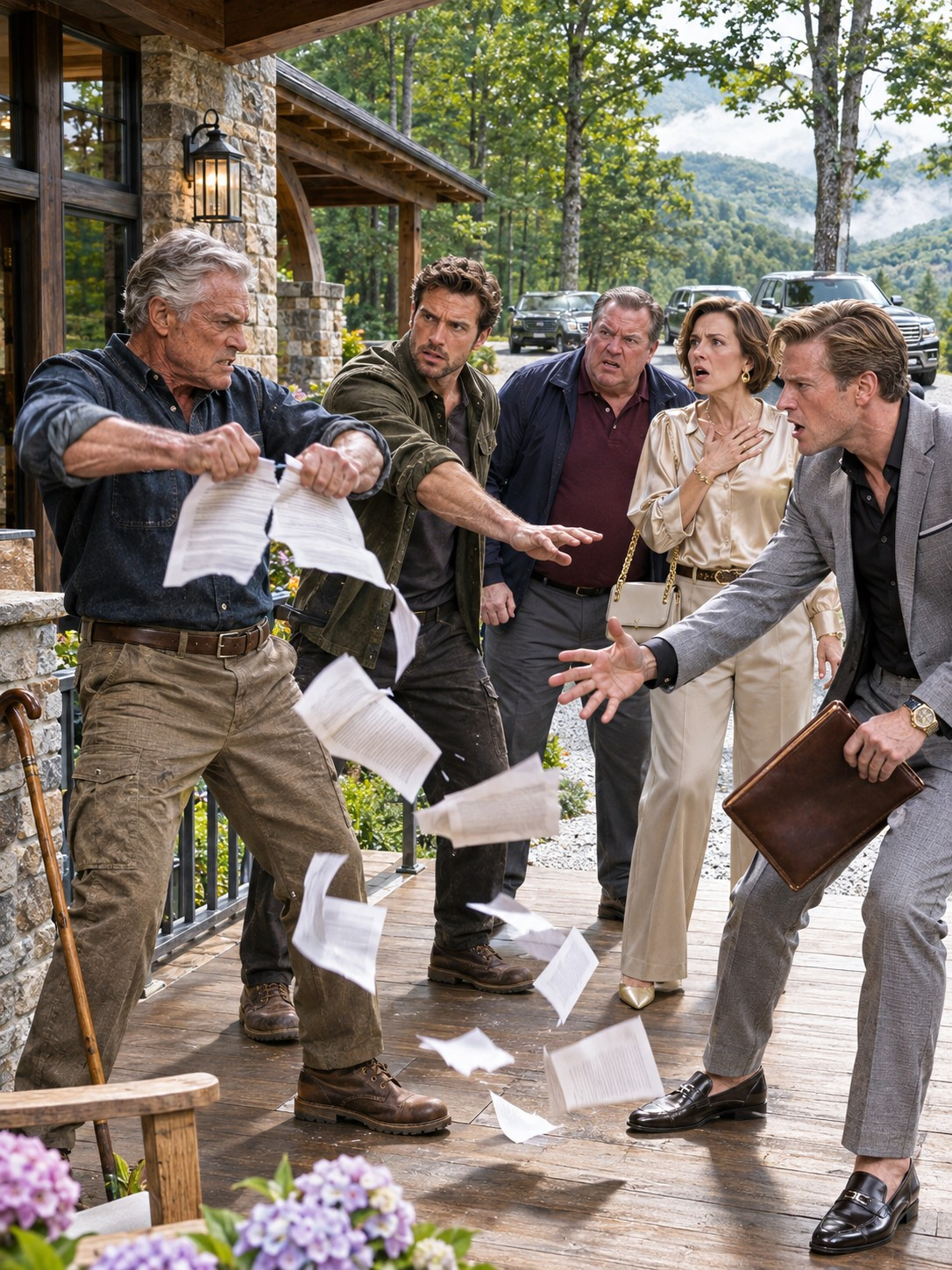
The signature at the bottom of the document belonged to Reed.
For several seconds, nobody spoke.
Abigail stared at the page, her fingers trembling.
Grandpa Harlon looked toward his attorney with an expression I had never seen before.
"Reed?"
Our attorney slowly removed his glasses.
"I need to explain something."
I stepped forward.
"You signed this document?"
He nodded.
"Yes. But not the document Malcolm is claiming it to be."
Abigail placed the paper on the table.
"It says I must surrender my inheritance when I turn forty-two."
Reed took a careful breath.
"That sentence was added to a document your grandmother drafted as a contingency. The original agreement contained several conditions designed to protect you. Malcolm has taken one paragraph out of context and combined it with a separate authorization."
I shook my head.
"Then why is your signature there?"
"Because I witnessed the original document before your grandmother died. I never witnessed the version Malcolm is showing you."
He opened his briefcase and removed a sealed envelope.
"I kept the certified copy of the original."
He placed it beside Malcolm's document.
The differences were immediately obvious.
The original agreement stated that Abigail would gain full control of her protected inheritance upon reaching forty-two, provided her identity was independently verified.
There was no requirement to surrender anything.
In fact, the document specifically prohibited anyone from forcing her to relinquish her rights.
Reed pointed toward the final paragraph.
"Your grandmother wanted you to become completely independent of anyone who might attempt to control your inheritance. She deliberately chose forty-two because it was the age at which the protected trust would transfer into your sole authority."
Abigail covered her mouth.
"So Malcolm lied?"
"Yes," Reed answered. "And he altered a legal document to make that lie appear legitimate."
Grandpa lowered his head.
"My wife knew exactly what he would try to do."
Walter nodded.
"She knew he would eventually come after the trust."
I looked at Reed.
"Can we prove the document was altered?"
He placed the original beside the disputed version.
"With the original, the forensic examination, and the registration history, we have strong evidence."
Then he turned toward Abigail.
"And there is something else you should know. Your inheritance was never conditional on giving up the conservation agreement. You are one of its two permanent protectors."
For the first time since discovering her identity, Abigail smiled.
Not because of the money.
Because someone had finally told her the truth.
The following morning, Reed filed an emergency motion with the probate court.
He submitted the original conservation agreement, the certified adoption records, the disputed documents, and Margaret Ellis's forensic findings.
Walter provided a sworn statement confirming his appointment as the original trustee and identifying the purported resignation as fraudulent.
Abigail also submitted a formal declaration confirming that she had never signed the authorization presented by Malcolm.
I supplied the security footage proving that I had been at my office when someone supposedly witnessed my resignation.
The evidence was overwhelming.
But Malcolm still had one advantage.
He controlled the development company and had spent years building financial relationships with Curtis and Rhett.
Reed warned us that he might attempt to negotiate a settlement before the hearing.
We refused.
Grandpa was tired of negotiating with people who had spent years trying to steal his property.
"We finish this in court," he said.
Abigail agreed.
So did I.
The hearing took place three days later.
The courtroom was crowded.
Curtis sat beside his attorney.
Lucinda was behind him, looking pale and exhausted.
Rhett sat several seats away, repeatedly checking his phone.
Malcolm entered last.
He wore a dark suit and carried a leather briefcase.
His expression remained confident.
He seemed convinced that the family would eventually surrender.
But when he saw Walter sitting beside Reed, his confidence faltered.
The judge entered.
After the preliminary proceedings, Reed presented the original conservation agreement.
He explained how my grandmother had appointed Walter as the independent trustee and named me as the successor representative.
He then demonstrated that Malcolm's purported resignation had never been registered.
Walter testified that he had never resigned.
Margaret Ellis presented her forensic findings.
She explained that several signatures had likely been reproduced from existing documents rather than written naturally.
Then Reed introduced the forged authorization bearing my name.
He showed the court the original business contract from which the signature had apparently been copied.
Malcolm's attorney objected repeatedly.
But each objection was answered by another document.
Another date.
Another authenticated record.
Finally, Reed presented the disputed letter supposedly written by my grandmother, recommending Rhett as her successor.
The handwriting examination showed significant inconsistencies.
The document was also based on an outdated trust reference that did not exist when the letter was supposedly written.
The judge examined the evidence.
Then she turned toward Malcolm.
"Mr. Voss, do you have an explanation for these discrepancies?"
Malcolm stood.
"Your Honor, these documents were prepared by various representatives over many years. Any irregularities were administrative."
Reed immediately stood.
"Your Honor, we have evidence that the defendant knowingly submitted documents containing forged signatures."
Malcolm's expression tightened.
The judge ordered him to answer the questions directly.
For the first time, he looked uncomfortable.
The most important testimony came from Abigail.
She walked to the witness stand carrying the original hospital records.
She explained that she had recently discovered her biological identity and had been approached by Malcolm before meeting her family.
She described the document he had presented to her.
She confirmed that he had encouraged her to sign away her inheritance and release the groundwater protection restrictions.
Then she looked directly at him.
"You told me my grandmother had abandoned me because she didn't want another child."
Malcolm remained silent.
"You told me my inheritance didn't exist."
She paused.
"You knew my grandmother had spent forty years protecting me. Yet you tried to use the same family secret she created to protect me."
The courtroom was silent.
Abigail continued.
"I don't know whether my biological family made every decision correctly. But I know my grandmother loved me. And I will not sign away something she worked her entire life to protect."
She returned to her seat.
Grandpa wiped his eyes.
I reached over and held his hand.
Then came the testimony that finally destroyed Malcolm's position.
Reed called a financial investigator who had examined Curtis's outstanding debts and the transactions involving Voss Development Holdings.
The investigator presented records showing that Malcolm had financed several of Rhett's failed real estate ventures.
He had also provided money to Curtis through private loans.
In exchange, Curtis had repeatedly promised access to the southern property.
Some agreements included anticipated profits from a development project that had never received legal approval.
The investigator also presented communications showing that Malcolm had paid legal expenses associated with the guardianship petition.
Then came the most damaging document.
A private email from Malcolm to Curtis.
It contained a detailed plan to establish temporary guardianship over Harlon, remove Callum as the successor representative, and secure Abigail's signature before the conservation restrictions could be enforced.
The email ended with one sentence.
Once both beneficiaries are removed from the process, the land becomes ours.
Curtis stared at the floor.
Rhett stopped looking at his phone.
Lucinda began crying.
Malcolm's attorney requested a recess.
The judge granted it.
When proceedings resumed, Malcolm's position had changed completely.
The court issued an immediate injunction preventing any transfer or development activity involving the protected property.
It also rejected the emergency guardianship request for lack of credible evidence of incapacity.
The forged documents were referred for further investigation.
The court ordered preservation of all relevant financial and legal records.
Malcolm's attempt to take control had failed.
And for the first time in decades, the southern forest was protected from his development company.
Outside the courtroom, Curtis approached Grandpa.
"Dad, please."
Grandpa stopped.
Curtis looked exhausted.
"I never wanted things to go this far."
Grandpa stared at him.
"You announced my death while I was eating dinner."
Curtis lowered his eyes.
"I know."
"You helped Rhett break into my workshop."
"I was trying to fix the financial situation."
"You helped someone forge Callum's signature."
Curtis began crying.
"I made mistakes."
Grandpa's voice remained steady.
"No, Curtis. You made choices. Repeatedly."
My father looked toward me.
"Callum, you know I never wanted to hurt you."
I remembered every holiday dinner.
Every insult.
Every time my parents had praised Rhett while dismissing my work.
Every time they had treated my independence as a personal failure.
I looked at him.
"You didn't want to hurt me. You just didn't care whether you did."
He had no answer.
Lucinda approached next.
She looked at Abigail.
"I am your mother."
Abigail stared at her.
"Are you?"
Lucinda began crying.
"I was young. I was frightened. Your grandmother convinced me that separating you from the family would protect you."
Abigail shook her head.
"You had forty-two years to tell me."
"I know."
"You could have written. You could have called. You could have explained."
Lucinda covered her face.
Abigail's voice softened slightly.
"I don't know whether I can forgive you. But I won't spend the rest of my life carrying your shame."
She turned away.
That was the last conversation she had with Lucinda that day.
The investigation continued for several months.
Malcolm's company faced regulatory scrutiny over the forged documents, misleading financial representations, and attempted unauthorized property transactions.
The authorities also investigated the financial arrangements involving Curtis and Rhett.
The evidence established that both men had knowingly participated in efforts to obtain control of assets they did not own.
Malcolm eventually lost his position in the development company.
The proposed southern development was permanently abandoned.
The financial investigation exposed additional misconduct involving several of his other investment projects.
Curtis cooperated with the investigation and admitted his role in the attempted property transfer.
He accepted legal responsibility for his actions.
Rhett's financial situation was even worse than we had imagined.
His failed real estate ventures had left him owing substantial sums to private lenders.
Once Malcolm's financial support disappeared, his expensive lifestyle collapsed.
The leased sports car was repossessed.
Several investment accounts were frozen.
He eventually entered a repayment arrangement and agreed to cooperate with investigators.
Neither man received a share of Grandpa's estate.
Lucinda also faced consequences for signing false statements and assisting with the fraudulent paperwork.
She eventually acknowledged her involvement.
Grandpa did not immediately forgive them.
He understood that forgiveness did not require restoring trust.
And he refused to allow anyone to pressure him into pretending the betrayal had never happened.
The most important change came when the original conservation agreement was officially restored.
Walter resumed his position as independent trustee.
I became the recognized successor representative.
Abigail's identity was verified, and her protected financial account was transferred into her sole control.
The balance was approximately $6.4 million.
She was stunned when Reed showed her the final statement.
But she made one decision that surprised all of us.
She established a charitable foundation dedicated to protecting rural communities, environmental resources, and families affected by financial exploitation.
She also agreed to work with me on the conservation project.
Together, we commissioned an independent environmental assessment of the southern property.
The results confirmed that my grandmother had been right.
The underground water system was significant.
Protecting it would benefit the surrounding region for generations.
We established permanent conservation protections covering the eight hundred acres of timberland.
The forest would never become a commercial development project.
Grandpa signed the final documents in Reed's office.
His hands trembled slightly as he held the pen.
But this time, nobody was trying to take anything away from him.
He was simply confirming the future he and my grandmother had wanted.
Six months later, Abigail moved closer to Asheville.
She purchased a comfortable home within driving distance of the forest.
We began spending weekends together.
At first, our conversations were awkward.
We had forty-two years of missing memories to work around.
But gradually, we discovered how much we had in common.
We both loved old family photographs.
We both preferred quiet evenings to crowded social events.
And we both inherited our grandmother's stubbornness.
Abigail also developed a close relationship with Grandpa.
He took her to the places he had visited with my grandmother.
He showed her the old garden, the workshop, and the creek running through the southern property.
One afternoon, I found them sitting together beneath an enormous oak tree.
Grandpa was telling her about the day she was born.
Abigail was laughing.
For a moment, I imagined my grandmother sitting beside them.
I knew she would have been happy.
My consulting business also recovered.
The development company that had suspended my contract reinstated our agreement after reviewing the evidence.
Several new clients approached me because of my work protecting the watershed.
I expanded my firm and hired additional environmental specialists.
But I never returned to the lifestyle my parents had always expected me to pursue.
I didn't need expensive cars or impressive parties.
I had my work, the forest, and a family that was finally learning what honesty meant.
One year after the first phone call, Grandpa invited everyone to dinner.
Not the entire extended family.
Just the people who had stood beside him during the investigation.
Reed came.
Walter came.
Abigail brought her husband and children.
We gathered around the same oak dining table where the original estate crisis had begun.
Grandpa insisted on cooking the steaks himself.
He was slower than he used to be, but he refused to let anyone take over the kitchen.
When everyone was seated, he raised his glass.
"I spent a long time believing that protecting a family meant keeping everyone together."
He looked at me.
"Your grandmother taught me something different."
Then he looked at Abigail.
"Family isn't simply the people who share your name. It's the people who choose to stand beside you when standing beside you costs them something."
Abigail reached for his hand.
I raised my glass.
"To Grandma."
Everyone repeated it.
We drank.
After dinner, Grandpa brought out a small wooden box.
Inside were several photographs my grandmother had taken over the years.
He handed one to Abigail.
It showed her as a baby, sleeping peacefully in her grandmother's arms.
On the back, my grandmother had written:
One day, all my grandchildren will know they were loved.
Abigail began crying.
I placed my hand on her shoulder.
Grandpa smiled.
For the first time, the family photograph on the wall included all of us.
Not a perfect family.
Not a family without scars.
But a family that had finally stopped hiding the truth.
Later that evening, I walked outside with Grandpa.
The forest was quiet.
The creek moved steadily through the trees.
He looked toward the southern property.
"Your grandmother would have loved seeing this."
I nodded.
"She got what she wanted."
Grandpa smiled.
"And so did we."
I looked back toward the warm lights of the cabin.
Abigail was laughing with her children.
Walter was telling Reed an old story.
The dinner table was full of people who had chosen honesty over money.
My grandfather rested his hand on my shoulder.
"Take care of this place, Callum."
"I will."
And I knew I would.
Not because of the millions of dollars attached to it.
Not because of the inheritance.
But because the forest represented everything my grandmother had believed in: patience, loyalty, protection, and the courage to preserve something valuable even when powerful people wanted to destroy it.
The people who had tried to steal our legacy had lost their power over us.
The truth had restored Abigail's identity, protected Grandpa's independence, and given our family a chance to heal.
And as the evening settled over the Appalachian mountains, I finally understood that my grandmother had left us something worth far more than ten million dollars.
She had left us the freedom to choose what kind of family we wanted to become.
For the first time in my life, I felt completely at home.






Comments 0