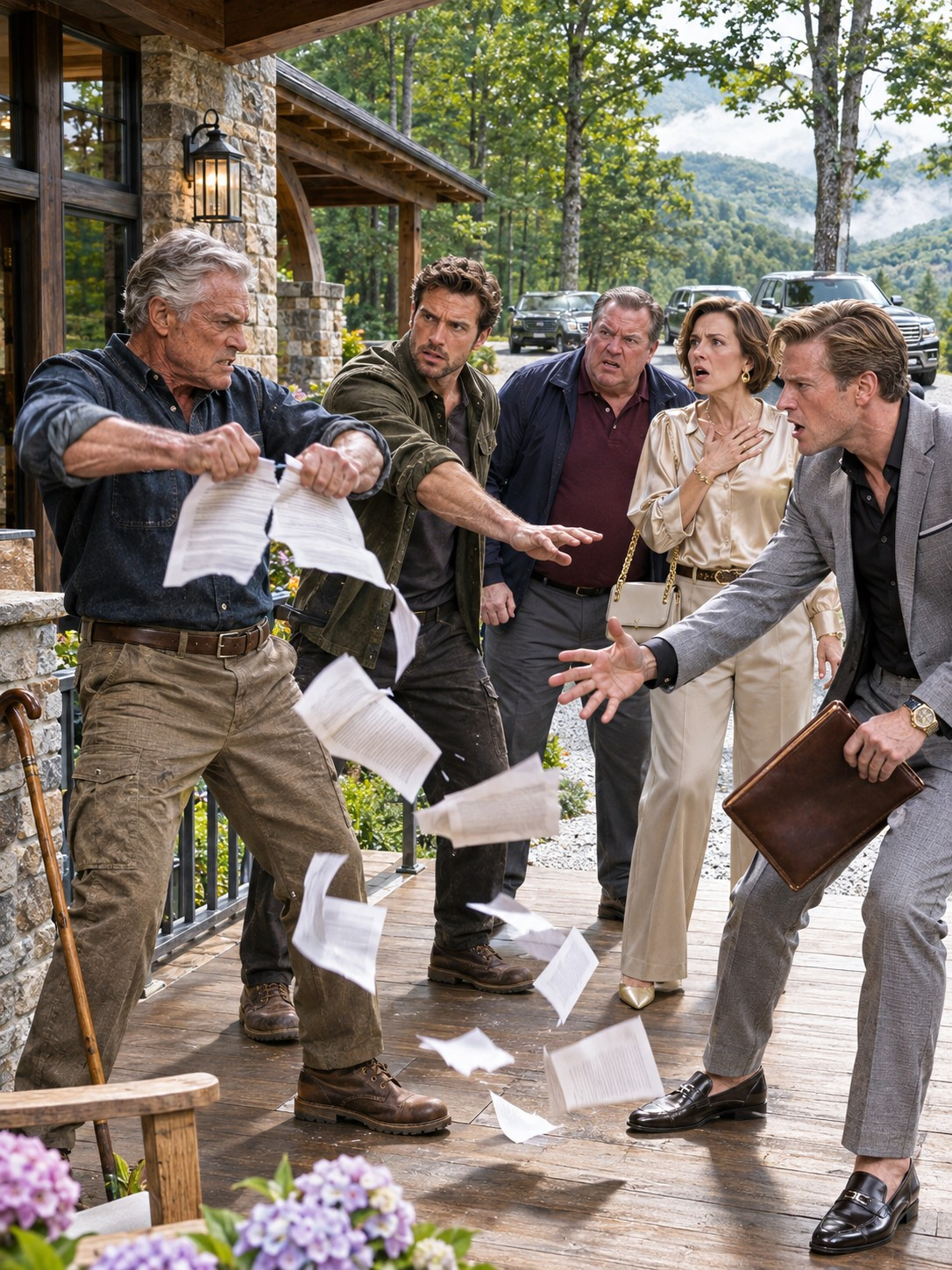
My father had tried to access my grandmother's private storage box.
Not once.
Not by accident.
He had gone there with my younger brother, carrying paperwork designed to get inside before Grandpa could arrive.
I stood inside the old workshop, holding my phone against my ear, struggling to process what Daniel Price had just told me.
"Are you absolutely certain the second visitor was my father?" I asked.
"Yes, sir. Curtis Harlon. His identification was checked at reception. He submitted a written request for access to storage box 417."
I looked at Grandpa.
His face had become pale beneath the wrinkles.
"Did he have authorization?" I asked.
"No. The account specifically states that access is restricted to the original account holder or an individual named in a separate sealed instruction."
"Did he try to force access?"
There was a pause.
"He became rather argumentative when our staff refused his request. Your brother eventually left with him."
I thanked Daniel and ended the call.
For several seconds, the workshop remained silent.
Grandpa slowly lowered himself onto an old wooden chair.
"Your father knew about that box," he whispered.
I leaned against the workbench.
"How?"
"Your grandmother told him it existed shortly before she died. But she never told him what was inside."
"Why would she tell him at all?"
Harlon looked toward the broken safe.
"Because she believed her son could still be trusted."
His voice carried a sadness that made my anger feel almost insignificant.
I pulled another chair closer.
"Grandpa, what exactly did Grandma put inside that box?"
He rubbed his forehead.
"I don't know everything. Your grandmother was a private woman. She handled certain financial matters herself. She kept documents, letters, and records that even I never examined."
"Then why did she give you the key?"
"She didn't."
He looked at the small brass key resting on the workbench.
"She gave it to me the week before she died. She told me to keep it somewhere safe and never open the box unless someone attempted to take control of the family estate dishonestly."
I stared at him.
"She predicted something like this?"
"She knew people better than I did."
I thought about Rhett.
Then Curtis.
Then Lucinda.
My family had spent years pretending that their greed was ambition and their manipulation was concern.
Apparently, my grandmother had recognized the problem long before I did.
"We're going to the bank," I said.
Grandpa nodded.
"But first, Callum, I want you to understand why your grandmother was worried."
He reached into the pocket of his flannel shirt and removed an old photograph.
It showed my grandmother standing beside a younger version of Grandpa in front of the timberland.
Between them stood two little boys.
Me and Rhett.
I recognized the picture immediately.
It had been taken when I was eight and Rhett was four.
Grandpa handed it to me.
"Your grandmother always said you were different from your brother."
I smiled faintly.
"She liked Rhett."
"She loved both of you. But she worried about him."
He tapped the photograph.
"She used to say that one boy wanted to understand the world, while the other wanted the world to admire him."
I looked down at the picture.
I remembered those days.
I remembered running through the forest with Grandpa, collecting leaves, studying insects, and learning how to identify different trees.
Rhett preferred sitting inside with expensive toys.
Our parents encouraged that difference.
When I brought home a school project about forest preservation, Curtis barely glanced at it.
When Rhett received an ordinary certificate for participating in a school business competition, my parents framed it and placed it in the living room.
I had learned early that approval in our family was not given according to effort.
It was given according to usefulness.
And Rhett had always been better at making himself look impressive.
By the time we returned to the house, the afternoon sun had begun disappearing behind the mountains.
I helped Grandpa settle into his favorite chair before preparing coffee.
He was quiet.
I knew he was thinking about his son.
I also knew that he would never admit how much the betrayal hurt.
My phone vibrated.
An email notification appeared from one of my consulting clients.
I opened it.
The message came from a commercial development company I had worked with for six months. Their executive director wanted to arrange a meeting regarding an environmental assessment for a major construction project.
Normally, I would have welcomed the opportunity.
My consulting business was the one part of my life my parents knew almost nothing about.
They believed I was an ordinary forestry engineer earning a modest salary.
They had no idea that I owned an independent ecological consulting firm operating through several business entities.
For five years, I had built that company from nothing.
I worked with developers, reviewed environmental regulations, assessed protected land, and helped businesses navigate complicated permitting requirements.
It was difficult work.
But I enjoyed it.
I had no interest in designer clothes, expensive sports cars, or impressing people at country clubs.
I preferred early mornings, quiet forests, and knowing that something I had worked on actually mattered.
The business eventually became far more successful than I had expected.
My income reached the high six figures.
I had built a substantial investment portfolio.
I owned my truck outright.
I carried no personal debt.
And I had enough money saved to live comfortably without working for several years.
My family knew none of this.
Only Grandpa knew the truth.
He had discovered my success accidentally when he found a stack of business documents on my desk one evening.
Instead of demanding explanations, he had simply smiled.
"Looks like the dirt digger knows what he's doing after all."
That was the first time anyone in my family had acknowledged my work without making a joke about it.
I kept my success hidden because I understood what would happen if Rhett found out.
He would ask for money.
Curtis would call it a family obligation.
Lucinda would explain that I had more than enough and that helping my brother was the decent thing to do.
And when I refused, they would accuse me of being selfish.
I had seen that pattern too many times.
A few years earlier, Rhett had started a real estate company.
He convinced my parents to invest their savings and persuaded Curtis to take out a second mortgage on his house.
The business collapsed.
Several investors lost money.
Rhett blamed the market.
My parents blamed the economy.
Nobody blamed Rhett.
Instead, they helped him lease a luxury sports car and encouraged him to start another venture.
Meanwhile, I paid my own university tuition by working weekends at a hardware store.
When I graduated, my father told me that environmental consulting was not a real career.
He suggested I apply for a job at a lumberyard.
I never forgot that conversation.
But I had never needed their approval.
Grandpa understood that.
He had taught me that wealth was not measured by the price of the things a person owned.
It was measured by what remained after the person stopped trying to impress everyone else.
Now, sitting in his kitchen, I wondered whether my hidden success might become important.
If Rhett discovered my financial position, he might realize I was not nearly as vulnerable as he believed.
But I also knew he could use that information against me.
I closed the email.
Grandpa looked up.
"Work?"
"Just a client."
"Good news?"
"Nothing urgent."
He studied my face.
"You're worried about something."
I hesitated.
"Rhett is desperate, Grandpa. People who owe money to the wrong people don't always behave rationally."
Harlon nodded.
"Reed said the same thing."
"Do you know how much he owes?"
"No."
"Do you think Dad knows?"
Grandpa stared into his coffee.
"Your father knows more than he admits."
That answer stayed with me.
The following morning, we drove to the bank's new storage facility.
It was located inside a modern commercial building several miles from downtown Asheville.
Daniel Price met us near the reception desk.
He was a neatly dressed man in his early forties, with dark glasses and a professional manner.
"Mr. Harlon," he said, shaking Grandpa's hand. "I'm glad you could come."
He looked at me.
"And you must be Callum."
I nodded.
Daniel led us into a private office.
A security camera was mounted in one corner.
He placed several forms on the desk.
"Before we proceed, I need to verify the original account holder's identity."
Grandpa handed over his identification.
Daniel examined it and compared it with the account records.
Everything matched.
Then he opened a secure cabinet and removed a thick file.
"I want to explain something about your grandmother's instructions."
Grandpa leaned forward.
"Go ahead."
"Storage box 417 was established more than twenty years ago. The account was later transferred to our institution when First Appalachian Bank closed its local branches."
Daniel turned a page.
"However, the original access restrictions were never removed."
"What restrictions?" I asked.
"Your grandmother left instructions that the box could only be opened in the presence of the original account holder and one additional authorized family member."
Grandpa looked confused.
"One additional family member?"
Daniel nodded.
"According to the original document, that person must be a direct descendant."
I glanced at Grandpa.
"Does that mean me or Rhett?"
"Either one, provided the account holder confirms the identity."
Grandpa looked at me.
Then he nodded.
"Callum will accompany me."
Daniel made a note.
"Very well."
He pressed a button on his desk.
A security employee appeared moments later.
We followed him through a locked corridor into the storage area.
Rows of metal compartments lined the walls.
The atmosphere was cold and strangely quiet.
Daniel stopped at a narrow cabinet near the end of the corridor.
He checked the identification number.
417.
My grandfather took the brass key from his pocket.
For a moment, he simply held it.
Then he inserted it into the lock.
It turned smoothly.
The cabinet opened.
Inside was a rectangular metal box wrapped in an old piece of dark blue cloth.
Grandpa lifted it carefully.
I noticed his hands trembling again.
We carried it back to the private office.
Daniel closed the door behind us.
"Would you like me to remain?" he asked.
Grandpa considered the question.
"Yes. I'd prefer a witness."
Daniel nodded.
Harlon placed the box on the desk.
He carefully unfolded the cloth.
The metal surface was scratched, but the lock remained intact.
He used the brass key.
A soft click sounded.
The lid opened.
Inside were several envelopes, a leather-bound notebook, old bank statements, and a small collection of legal documents.
I leaned closer.
The first envelope had my grandmother's handwriting.
It was addressed to Harlon.
The second was addressed to Curtis.
The third had my name written across the front.
I froze.
"Grandpa?"
He looked down.
His expression changed completely.
"My grandmother wrote me a letter?"
Harlon picked it up.
He turned it over.
The envelope was sealed with an old red wax stamp.
"She never mentioned this to me."
I stared at my name.
It had been written in careful, deliberate handwriting.
Not a general family letter.
Not a note intended for everyone.
It was meant specifically for me.
Grandpa reached for the first envelope and began reading.
His eyes moved across the page.
At first, his expression remained neutral.
Then his eyebrows drew together.
He read the final paragraph twice.
"What does it say?" I asked.
He didn't answer.
Instead, he placed the letter on the desk and picked up the leather notebook.
He opened the first page.
A date appeared at the top.
Twenty years earlier.
Beneath it were several handwritten entries about land purchases, financial transfers, and meetings with people whose names I recognized from Grandpa's business records.
Then he stopped.
His finger rested on a line near the bottom of the page.
I leaned closer.
The entry contained three names.
My grandmother's.
My father's.
And Malcolm Voss's.
Grandpa slowly looked at me.
"Callum, I think we need to call Reed."
"Why?"
He turned the notebook toward me.
A handwritten sentence had been underlined twice.
It read:
If Curtis ever approaches this property arrangement again, do not allow him to speak for the family.
I felt a chill move through my body.
My father had been involved in something twenty years ago.
Something connected to Malcolm Voss.
Something my grandmother had considered dangerous enough to document.
Before I could ask another question, Daniel suddenly returned to the desk.
He was holding a newly printed security report.
"Mr. Harlon," he said quietly.
Grandpa looked up.
"What is it?"
Daniel placed the report beside the notebook.
"There's something you should see. Our security system recorded your son's visit yesterday."
I stared at the photograph attached to the report.
It showed Curtis standing outside the storage facility.
But he wasn't alone.
Beside him stood a woman I had not seen in years.
And she was holding a photograph of my grandmother...






Comments 0