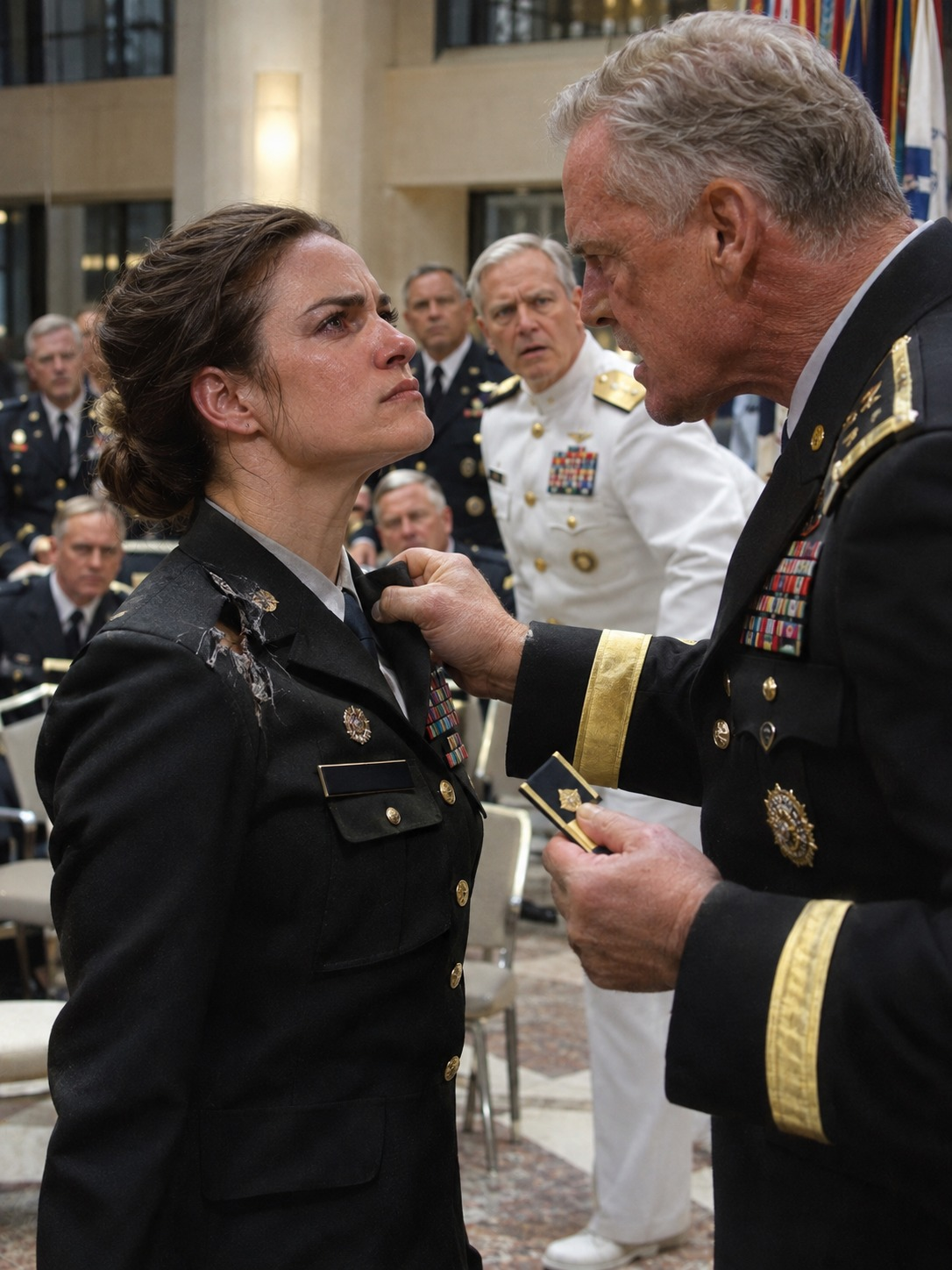
My father ripped the insignia from my uniform and shouted, "You are a traitor!"
Hundreds of military officers watched as General Harris grabbed his own daughter's collar.
Then Admiral Row noticed something beneath my torn jacket.
Three words changed everything.
I had imagined standing before hundreds of officers at the Pentagon many times throughout my military career.
In some versions, I received a commendation. In others, I delivered a briefing that changed the course of an operation. Occasionally, I imagined my father sitting in the front row, finally looking at me with something resembling pride.
Never once had I imagined him tearing my uniform apart.
"Look at me when I'm speaking to you!"
General Harris tightened his grip on my collar.
I raised my eyes.
"I'm looking at you, General."
His expression hardened.
"Don't use that title with me."
I said nothing.
He pulled another ribbon from my jacket. It came away with a sharp tearing sound, and the small decoration fell onto the marble floor.
Nobody moved to pick it up.
I was Captain Ursula Kaine, thirty-four years old, and I had spent nearly half my life serving the United States Army.
I had completed deployments, endured training that left experienced soldiers questioning their decisions, and accepted assignments that I would never be permitted to discuss with my own family.
Yet none of that mattered to the man standing in front of me.
To him, I was no longer an officer.
I was his daughter, accused of betraying everything he believed in.
"Do you understand what you've done?" he demanded.
I glanced briefly at the officers surrounding us.
"Yes, sir."
"Five Americans are dead!"
His voice echoed beneath the enormous ceiling.
"An American weapons facility was destroyed. Classified operational intelligence was compromised. And your name appeared in the investigation!"
"I know what happened."
"Then explain it!"
"I can't do that here."
His face turned red.
"Can't? Or won't?"
I held his gaze.
"Those aren't the same thing."
For a moment, something almost familiar crossed his expression.
It was the look he used when I was a child and challenged one of his instructions.
He hated being questioned.
Especially by me.
"Arrest her," he ordered.
The words seemed to travel farther than his voice.
Several officers exchanged glances.
A security officer near the front row shifted his weight, but nobody approached.
My father noticed.
"Did you hear me? I said arrest her!"
I remained still.
That was when I realized something important.
My father had brought me into this room expecting a confession.
He had not prepared himself for the possibility that I might know more than he did.
And he certainly had not considered that someone else in the room might recognize me.
But before that moment could arrive, I had to endure something I had spent years trying to avoid.
My father's judgment.
Growing up as General Harris's daughter meant that ordinary childhood experiences came with unusual expectations.
Other children brought home drawings.
I brought home report cards.
Other fathers asked their daughters what they wanted to become.
Mine asked whether I had considered the responsibilities attached to our family name.
When I was eight, he made me stand in our backyard while he corrected my posture.
"Feet shoulder-width apart," he instructed.
I adjusted my stance.
"Again."
I tried again.
"Your shoulders are uneven."
I straightened them.
"Better."
I waited for him to tell me I had done well.
Instead, he walked around me and pointed out another mistake.
My mother used to say he had difficulty expressing affection.
She believed his military career had trained him to measure everything in discipline, responsibility, and results.
I believed her because I wanted to.
Whenever my father entered a room, I instinctively stood straighter.
Whenever he praised another officer, I wondered what I needed to accomplish to receive the same words.
I won marksmanship competitions.
I graduated near the top of my class.
I volunteered for assignments that other young officers avoided.
Every achievement became another opportunity to seek his approval.
And every time, he found something that needed improvement.
When I announced that I wanted a military career, he finally looked satisfied.
"Good," he said.
I remember smiling.
Then he added, "At least you understand that the family name comes with obligations."
I was nineteen when I received my first deployment orders.
My father visited me at Fort Bragg while I was packing my equipment.
He examined the straps on my duffel bag and adjusted one of them.
"You don't have to go," he said.
For a brief moment, I thought he was worried.
Then he looked directly at me.
"But if you go, you'd better come back with results. The family name doesn't tolerate failure."
"Yes, sir."
I had wanted to say, "I'll miss you, Dad."
Instead, I watched him leave.
That was how our relationship worked.
He gave instructions.
I followed them.
And somewhere along the way, I stopped expecting anything else.
The Army became my life.
I learned to recognize danger before it became visible. I learned how to remain calm when everyone around me was losing control.
I learned that the loudest person in a room was rarely the most dangerous.
And eventually, someone noticed.
The recruitment conversation happened after a particularly difficult assignment overseas.
I was twenty-six.
A senior intelligence officer requested a private meeting and asked whether I had ever heard of a program called Orion Phantom Unit.
I had not.
He explained that Orion was not an ordinary military formation.
It was a classified operational unit responsible for missions that required extraordinary secrecy and specialized personnel.
Its existence was concealed behind layers of authorization.
Its personnel were rarely acknowledged publicly.
Its records were fragmented.
And its members were selected not simply for their abilities, but for their capacity to function when conventional systems could no longer be trusted.
I listened without interrupting.
Finally, he placed a folder on the table.
"Captain Kaine, we believe you may be suitable."
I opened it.
The first page contained a photograph of several military personnel standing in front of an aircraft.
There were no visible unit markings.
No names.
No conventional identification.
Only a small symbol printed in black at the bottom of the page.
Two wings.
One star.
I looked up.
"What happens if I accept?"
The officer folded his hands.
"You may spend years serving your country without being able to explain your work to the people closest to you."
I thought about my father.
He had always taught me that duty came before everything.
I signed.
I had no idea how completely that decision would change my life.
Orion's training was unlike anything I had experienced.
My instructors demanded precision under exhaustion, discipline under uncertainty, and cooperation when personal survival instincts encouraged the opposite.
I met McKenzie first.
She handled communications and possessed an unusual ability to remain sarcastic even when everyone else was exhausted.
Then came Reyes, a specialist whose calmness around explosives made the rest of us uncomfortable.
Chen was our medic.
He rarely spoke about himself, but he remembered every injury, every medication, and every detail about the people under his care.
They became my family.
Not because we shared a name.
Not because we had the same history.
But because they cared whether I returned safely.
During my first major operation, everything went wrong.
Our communications system failed.
The extraction point became inaccessible.
And for several hours, we had no reliable way to know whether the rest of the team was alive.
I remember sitting beside McKenzie after we finally returned.
She handed me a bottle of water.
"Congratulations, Valkyrie."
I looked at her.
"What?"
"That's your call sign now."
Reyes laughed from across the room.
"She earned it."
Chen nodded.
"Don't let it go to your head."
I smiled for the first time that day.
Later, I received the Orion mark.
The black-and-silver wings framing a single star were tattooed across my shoulder blades.
It was not an ordinary decoration.
It represented an identity that could not be displayed on a public service record.
For years, I kept it hidden beneath my uniform.
My father never knew.
He believed I was serving in conventional military assignments.
When he asked where I had been, I gave him the answers I was authorized to give.
When he asked why I sometimes disappeared for months, I told him my assignments were classified.
He never asked another question.
He simply assumed I was hiding something from him.
Perhaps, in a way, I was.
But I was protecting an operation that protected people like him.
Now, standing inside the Pentagon's great hall, I looked at the man who had raised me.
He was still holding the torn edge of my jacket.
His four-star insignia gleamed beneath the ceremonial lights.
"You have no idea how much damage you've caused," he said.
I swallowed.
"General, I am requesting an independent review."
He laughed bitterly.
"You're in no position to request anything."
"I disagree."
His expression changed.
He grabbed the front of my jacket again.
This time, the fabric tore farther across my upper back.
A few officers in the front row leaned forward.
I felt the cool air touch my skin.
My father released the fabric and turned toward the assembled officers.
"She is relieved of duty pending investigation. I want her security credentials suspended immediately."
A young officer near the aisle looked toward Admiral Row.
The admiral had been seated several rows behind us.
He had remained silent throughout the confrontation.
Until now.
He was an older man with silver-blond hair, a distinguished naval uniform, and an expression that gave away almost nothing.
But I noticed his eyes.
They were fixed on my shoulder.
Not on the damaged uniform.
Not on the ribbons lying on the floor.
On the tattoo.
His face had changed.
He slowly leaned forward.
Then he stood.
The movement caught the attention of the officers closest to him.
My father turned.
"Admiral?"
Row did not answer immediately.
He stepped into the aisle.
His eyes remained on the exposed emblem.
For several seconds, the room was completely silent.
Then he spoke.
"General Harris, step away from her."
My father frowned.
"This is an Army matter."
"Not anymore."
The general released my jacket.
Admiral Row approached until he was standing only a few feet away.
He studied the wings and the single star.
Then he looked at me.
His expression softened slightly.
"Captain Kaine."
"Admiral."
He nodded once.
Then he turned toward my father.
His voice carried across the hall.
"She outranks you."
My father stopped moving.
I watched the color disappear from his face.
For the first time in my life, General Harris had no immediate response.
But Admiral Row wasn't finished.
He looked toward the security officers.
"Nobody touches Captain Kaine until her authorization has been independently verified. Suspend this proceeding immediately."
A murmur spread through the hall.
My father stepped forward.
"You cannot possibly be suggesting that this woman has authority over me."
Admiral Row looked directly at him.
"I'm suggesting that you have just publicly humiliated an officer whose operational identity you were never authorized to know."
My father's mouth opened.
Nothing came out.
Then Admiral Row turned toward me.
And, quietly enough that only those standing nearby could hear, he used the name I had not heard spoken aloud in years.
"Valkyrie."
My stomach tightened.
There was something in his voice that told me this was no ordinary recognition.
He knew the emblem.
He knew the unit.
But more importantly, he seemed to know something about the operation that had brought me back to Washington.
He glanced toward the security officer beside him.
"Prepare the restricted briefing room. We need to speak privately."
I nodded.
As I turned away, I heard my father call my name.
"Ursula!"
I stopped.
For a second, I thought he might finally ask whether I was all right.
Instead, he said, "You will explain yourself."
I looked back at him.
"I've been trying to do that all morning."
Then Admiral Row opened the secure access door.
And standing just beyond it was a man I had believed was dead for eleven months...






Comments 0