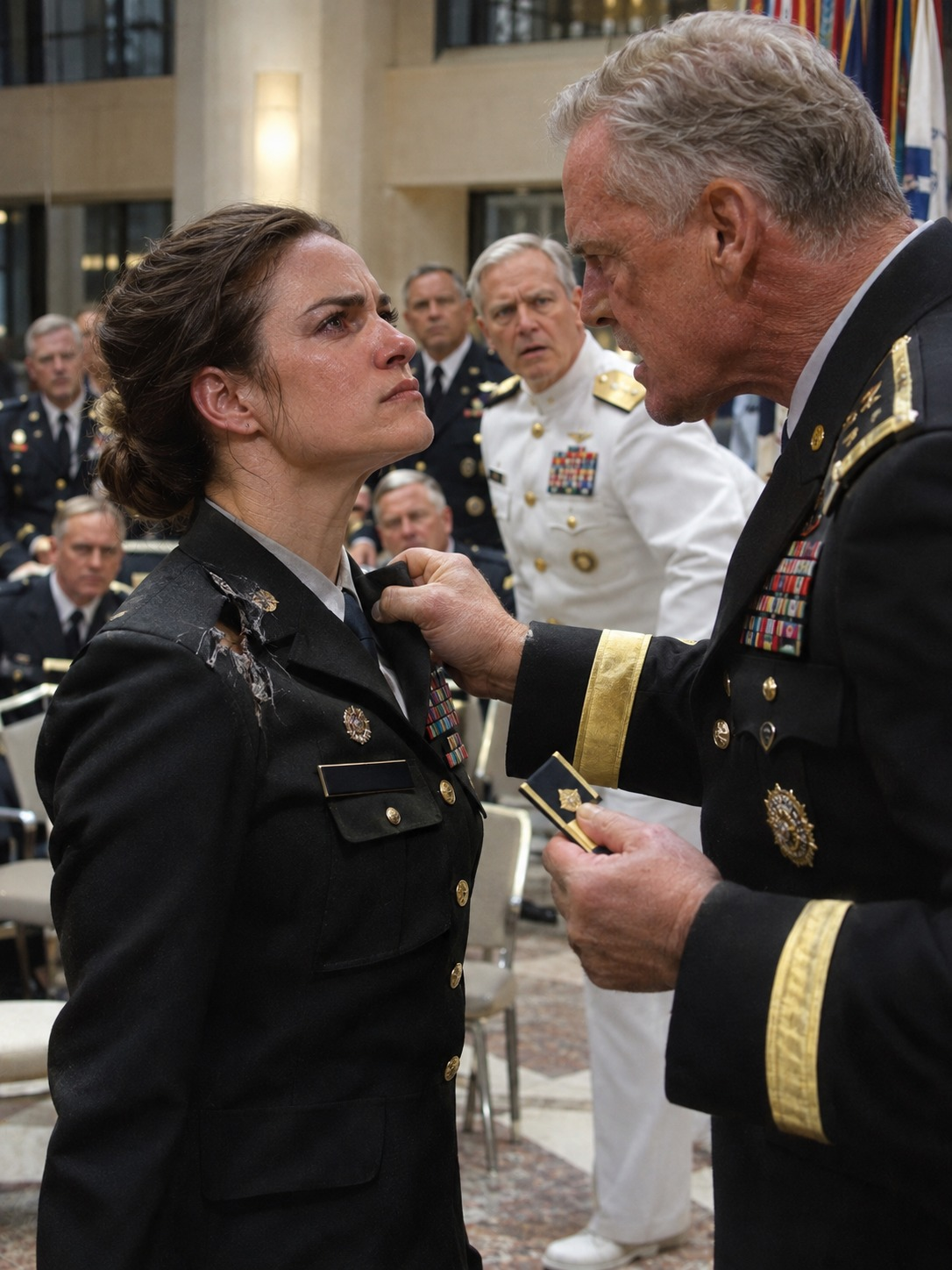
My father reached for the communication terminal and shouted, "Shut it down!"
But the voice had already delivered its final warning.
"General, tell your daughter who was sitting in the passenger seat that night."
I stared at him.
He didn't move.
For eleven years, I had believed my mother died in a car accident. I had attended her funeral, watched my father accept condolences, and learned to live with the emptiness she left behind.
Now a stranger inside the Pentagon was suggesting that the story I had grown up believing was a lie.
"Father?"
He rubbed his forehead.
"Not now, Ursula."
I stepped closer.
"No. You're going to answer me."
Admiral Row moved between us.
"General Harris, I think we need to establish exactly what that message means."
My father looked at him.
"It means someone is attempting to manipulate my daughter."
"Then tell us the truth."
"There is nothing to tell."
I watched his expression.
He wasn't angry anymore.
He was frightened.
And that frightened me more than anything the anonymous caller could have said.
Reyes slowly approached the terminal.
"The transmission originated from inside the Pentagon."
Admiral Row nodded.
"Can you identify the source?"
"I'm trying."
My father suddenly slammed his palm against the table.
"Enough! This entire situation is becoming a circus."
I didn't look at him.
"Who was in the passenger seat?"
He closed his eyes.
For a moment, I thought he might finally answer.
Instead, he turned toward the door.
"I need to speak with my legal adviser."
Admiral Row blocked his path.
"General, nobody leaves until we finish verifying the security breach."
My father stared at him.
"Are you detaining me?"
"No. I'm asking you to remain available while we investigate."
I stepped closer.
"Father, please."
He looked at me.
And for the first time, I saw something in his eyes that I had never seen before.
Regret.
My mother, Eleanor Harris, had been the only person in our family who could make my father forget his rank.
She was gentle without being weak.
She believed people deserved kindness even when they made mistakes.
When I was young, she would sit beside my bed and listen to me describe my day.
Sometimes I talked about school.
Sometimes about my father's expectations.
Sometimes I asked why he seemed disappointed even when I did everything correctly.
She never criticized him.
Instead, she would brush my hair away from my face and say, "Your father loves you, sweetheart. He just doesn't always know how to show it."
I believed her.
She was the person who encouraged me to become an officer for my own reasons.
Not to impress my father.
Not to protect the family reputation.
But because she believed I had something valuable to offer.
The night she died, I was twenty-three.
I had been attending an advanced military training course several states away.
My father called just after midnight.
His voice was unusually quiet.
"Ursula, your mother has been in an accident."
I remember dropping my phone.
I remember asking whether she was alive.
I remember the silence before he answered.
"No, sweetheart."
It was the first time in years he had called me that.
I flew home the following morning.
The funeral was small and private.
My father stood beside the coffin wearing his dress uniform.
He barely spoke.
When I asked what had happened, he told me a truck had crossed the center line during heavy rain.
My mother had been returning from a charity event.
The other driver had died at the scene.
The investigation concluded that the collision was unavoidable.
I accepted the explanation because I had no reason not to.
My father arranged everything.
The funeral.
The paperwork.
The insurance.
The police correspondence.
Even the personal belongings recovered from the vehicle.
I never questioned him.
I was too devastated.
And he never volunteered another detail.
Back inside the briefing room, I turned toward Admiral Row.
"I want the original accident report."
He studied me.
"Captain, we don't know whether the message was authentic."
"I understand."
"Your father's personal history is not automatically connected to the depot investigation."
"Then there should be no reason to hide the report."
He nodded.
"I'll request it."
My father immediately objected.
"That accident has nothing to do with this investigation."
I looked at him.
"Then you shouldn't be concerned."
He opened his mouth.
Then stopped.
Reyes was still working at the terminal.
"Admiral, I've got something."
We gathered around him.
A small section of the communication log had been recovered.
The anonymous transmission had entered the system through an old military communications relay.
Its origin was listed as an archived network used by Orion personnel.
I felt my stomach tighten.
"That's impossible."
Reyes shook his head.
"Not entirely. Someone preserved the old infrastructure."
"Who has access?"
"Only a handful of people should."
Admiral Row examined the transmission details.
"Can you recover the sender's identity?"
Reyes enlarged the authentication record.
A sequence of letters appeared.
OR-17.
I recognized the code.
It belonged to an Orion communications officer who had disappeared before the unit was officially disbanded.
I looked at Reyes.
"That's not McKenzie's credential."
"No."
"Then whose is it?"
He stared at the screen.
"Thomas Reed."
My breath caught.
Reed had been one of the five Americans declared dead in the weapons depot explosion.
"That's impossible," I whispered.
Reyes didn't answer.
I remembered Reed standing beside the aircraft during our final deployment briefing.
He had been holding a paper cup of coffee and complaining that the machine made everything taste like burned rubber.
He had laughed when I told him to stop complaining.
"After this operation, Captain, I'm buying a real coffee machine."
Those had been his last words to me.
According to the official report, he had died in the explosion.
But his communications credential had just been used to contact us.
"Could someone have copied his identification?" I asked.
Reyes nodded.
"Possibly."
Admiral Row looked at the terminal.
"Or someone wants us to believe he's alive."
I stared at the code.
Either explanation was disturbing.
But there was another possibility.
One I didn't want to consider.
"What if the casualty report was wrong?"
My father sat down again.
He had become unusually quiet.
I watched him from across the room.
"General, did you know Thomas Reed?"
He looked up.
"Who?"
"One of the five soldiers killed at the depot."
"No."
"His communications credential was used to send that message."
My father frowned.
"How would I know anything about that?"
I studied him.
"You were involved in reviewing the casualty report."
"I reviewed hundreds of pages."
"Did you see his name?"
"Probably."
"Did you speak with his family?"
My father shook his head.
"That wasn't my responsibility."
I felt something tighten in my chest.
"His family received a folded flag."
He looked at me.
"What?"
"His mother received the flag at his memorial. His younger brother stood beside her. They believed he was dead."
My father looked away.
I continued.
"Did anyone verify his remains?"
He didn't answer.
Reyes slowly turned toward us.
"That's a good question."
Admiral Row opened another document.
"The casualty report identifies all five personnel as deceased. However, the supporting identification records are incomplete."
I moved closer.
"What does that mean?"
"Some remains were identified through personal effects and available medical records. The final confirmation was completed through a restricted process."
"By whom?"
The admiral examined the file.
"An intelligence liaison."
I looked at Reyes.
"Colonel Bennett?"
He shook his head.
"No. The authorization carries another name."
Admiral Row enlarged the page.
The signature field appeared.
MALCOLM VOSS.
Again.
The same official connected to the original mission authorization.
The same man whose name appeared on the document that had placed my father's command credentials under suspicion.
I leaned back.
"Everything leads to him."
My father stood abruptly.
"I want to speak to Voss."
Admiral Row looked at him.
"Not without independent authorization."
"He has answers."
"Then we'll ask him."
My father shook his head.
"You don't understand. If Voss is involved, we may already be too late."
I stared at him.
"Why?"
He didn't answer.
Then his secure telephone began ringing.
He looked at the display.
His expression changed.
It was a call from Colonel Bennett.
Admiral Row ordered him not to answer.
My father hesitated.
The phone continued vibrating.
"General, put it down."
My father looked at the admiral.
"I need to hear what he has to say."
"Not through that device."
I moved closer.
"Put it on speaker."
He stared at me.
Then he accepted the call.
"General Harris."
Colonel Bennett's voice came through clearly.
"Sir, I need to know whether Captain Kaine is still with you."
My father looked toward me.
"Why?"
"Because the situation has changed."
"What situation?"
A pause.
Then Bennett spoke.
"Her father has been compromised."
Nobody moved.
My father frowned.
"What did you say?"
"I believe General Harris has been exposed to classified information that could endanger the investigation."
Admiral Row reached for the phone.
"Colonel Bennett, this is Admiral Row."
Silence.
Then Bennett replied.
"Admiral, I wasn't expecting you to be there."
"Explain your presence in the restricted archival wing."
"I'm not in the archival wing."
I looked at the screen.
The communication indicator showed an active video channel.
A small camera icon appeared.
"Then where are you?" I asked.
Bennett ignored me.
"General, you need to leave the briefing room immediately."
My father gripped the phone.
"Why?"
"Because the people around you cannot be trusted."
Admiral Row's expression hardened.
"Colonel, your access is being suspended pending investigation."
Bennett laughed quietly.
"That won't help you."
Then the call ended.
For several seconds, nobody spoke.
Reyes looked at the phone.
"He wanted us to know he could reach the general directly."
Admiral Row nodded.
"He's testing our security."
I looked at my father.
"How long have you been receiving calls from Bennett?"
My father hesitated.
"Since the investigation began."
"How many?"
"Several."
"Did he ever ask you to do anything outside normal procedure?"
My father rubbed his forehead.
"Not initially."
"Initially?"
He looked at me.
Then he said something that made my blood run cold.
"He asked me to sign a transfer order for you three days ago."
I stared at him.
"What transfer order?"
"An order moving you from your overseas assignment to a temporary intelligence review facility."
"Did you sign it?"
He nodded.
"Yes."
Reyes stood.
"General, where was she supposed to be transferred?"
My father looked at the floor.
"I wasn't told."
I felt the room tilt.
Three days before the depot explosion, someone had already arranged an order to move me.
Before the accusation.
Before the casualty report.
Before my father tore my uniform apart.
They had planned to isolate me.
And my father had helped them.
Admiral Row immediately requested the transfer document.
My father provided the authorization number.
The system returned a restricted record.
The order had been signed by General Harris and countersigned by an intelligence liaison.
But the destination was not a military facility.
It was a private medical research center outside Washington.
I stared at the address.
"Why would I be transferred there?"
My father shook his head.
"I was told it was a secure debriefing location."
"Did you verify it?"
"I was given an authorization."
"Father, did you verify it?"
He looked at me.
"No."
Reyes leaned toward the display.
"There's another problem."
He enlarged the destination information.
The facility had been closed for more than two years.
Its official records showed that it had been sold to a private contractor.
I looked at Admiral Row.
"Who owns it now?"
He entered the registration number.
A corporate name appeared.
NORTHSTAR STRATEGIC SERVICES.
Reyes went completely still.
I recognized the name.
It had appeared in one of Orion's early procurement reports.
A private defense contractor that had supplied communications equipment and specialized transport systems.
But its contract had been terminated after an internal audit.
"Why is Northstar connected to this?" I asked.
Admiral Row looked at me.
"Because the company is currently under investigation for unauthorized access to military logistics records."
I glanced at my father.
"Did Bennett mention Northstar?"
He shook his head.
"Never."
"Then how did he arrange a transfer to a facility owned by them?"
My father looked genuinely confused.
For the first time, I wondered whether he had been manipulated into signing something much worse than an ordinary transfer order.
He had trusted Bennett's credentials.
He had trusted the paperwork.
And he had trusted his own authority enough to believe he didn't need to verify anything.
That trust had nearly placed me inside an abandoned facility controlled by a private contractor connected to the depot operation.
Admiral Row picked up the telephone.
"Get me the independent security director."
Before he could complete the call, the lights flickered.
Once.
Twice.
Then the entire room went dark.
A low mechanical sound came from the ceiling.
Reyes immediately reached for his sidearm.
"Nobody move."
I heard a chair scrape against the floor.
Then the emergency lighting activated.
Red lights illuminated the room.
The main security display came back online.
A new message appeared.
TRANSFER ORDER EXECUTED.
I stared at it.
"That's impossible."
Admiral Row stepped toward the terminal.
"Cancel the order."
He entered his credentials.
The system rejected them.
ACCESS DENIED.
He tried again.
ACCESS DENIED.
My father moved toward the screen.
"That's my command authorization."
He entered his own credentials.
The same response appeared.
ACCESS DENIED.
Reyes looked at the lower corner.
"Someone has overridden the entire security system."
Then a live camera feed opened.
It showed a transport vehicle entering the Pentagon's underground loading area.
Two armed men stepped out.
A third person followed.
He wore a dark civilian suit.
He held a folder.
And I recognized him immediately.
Colonel Bennett.
He looked directly into the camera.
Then he raised his identification badge.
A message appeared beneath his face.
CAPTAIN URSULA KAINE — TRANSFER CONFIRMED.
I turned toward Admiral Row.
"He's coming for me."
The admiral reached for the emergency communication device.
But before he could activate it, another message appeared.
This time, it contained my mother's name.
ELEANOR HARRIS.
Beneath it was a photograph of a woman standing beside a black military vehicle.
I moved closer.
The photograph was old.
The date in the corner was eleven years earlier.
And standing beside my mother was a young Colonel Bennett.
But he wasn't alone.
A second man stood behind them.
A man whose face I had seen only once before.
In the photograph from my mother's funeral.
My father stared at the screen.
His lips parted.
Then he whispered:
"That's the man who was driving the car that night..."






Comments 0