The authorization carried my signature.
Eleven years before I had entered Fort Meridian, before I had discovered Orion Phantom, before I had even understood the truth about my mother's disappearance, someone had used my identity to approve the final Sentinel protocol.
I stared at the screen.
"That's impossible."
Reyes examined the timestamp again.
"Captain, this authorization was created using your original biometric profile."
"But I wasn't there."
"I know."
My father stepped closer.
"Someone used her identity."
Admiral Row nodded.
"Margaret had access to the original family medical records. She could have obtained the biometric information necessary to construct a false authorization."
I looked at the screen.
THOMAS REED — FINAL CUSTODIAN APPROVAL REQUIRED.
Beneath it appeared another message.
SUCCESSOR AUTHORIZATION ALREADY REGISTERED.
My mother was still trapped at Fort Meridian.
Thomas was being held by Bennett.
And Richard Row had somehow activated a system that could destroy the evidence we needed to expose everyone involved.
"Can we reverse it?" I asked.
Reyes shook his head.
"Not through the ordinary command interface."
"Then find another way."
He examined the original Sentinel agreement.
"There is one."
"What?"
"The original agreement allows the successor to revoke an unauthorized authorization if the original custodian confirms that the signature was obtained through coercion or deception."
I looked at my mother on the security screen.
"Can she do that?"
"Yes. But we need her live confirmation."
I moved closer to the terminal.
"Then we're going back to Fort Meridian."
My father immediately picked up his equipment.
Admiral Row nodded.
"This time, we're bringing everyone home."
We reached Fort Meridian less than thirty minutes later.
The facility was in lockdown.
But the Sentinel network had already been frozen through preservation mode, preventing Richard from transferring the original archive.
Our team entered through the western service corridor.
Reyes remained at the command terminal, monitoring the network.
Admiral Row led the security officers.
My father walked beside me.
For the first time, he wasn't trying to control my decisions.
He simply trusted me to make them.
At the end of the corridor, we found a reinforced door.
Behind it was the original command chamber.
I could hear voices.
Margaret's.
Richard's.
And my mother's.
Admiral Row signaled the officers to take positions.
I looked at my father.
"Ready?"
He nodded.
I pushed the door open.
Margaret turned immediately.
For a second, surprise crossed her face.
Then she smiled.
"Ursula. You really are determined to ruin everything."
My mother stood beside her.
Her hands were restrained.
Thomas was sitting against the opposite wall.
Bennett stood behind him.
Richard Row was near the central terminal.
He looked exactly like the admiral who had accompanied us earlier.
Except this time, I knew who he was.
"Step away from them," I ordered.
Richard laughed.
"You're very confident for someone who doesn't understand the system."
"I understand enough."
"No, you don't. You have inherited authority, but you have no idea how to use it."
I looked toward Thomas.
He gave me a small nod.
Then I looked at my mother.
"Mom, I need your confirmation."
Margaret immediately stepped between us.
"Don't."
My mother lifted her head.
"Eleanor Harris," I said clearly, "do you confirm that the original Sentinel successor authorization was created without my knowledge or consent?"
My mother looked directly at me.
"I do."
The command terminal beeped.
CUSTODIAN CONFIRMATION RECEIVED.
Margaret's smile disappeared.
Richard moved toward the terminal.
"Stop the authorization!"
Bennett released Thomas and reached for the control panel.
But my father intercepted him.
The two men struggled.
A security officer moved in and restrained Bennett.
Richard attempted to access the command interface.
Admiral Row entered behind us with the remaining officers.
"Richard Row, you're under arrest."
Richard turned.
"You have no authority here."
The admiral removed his identification.
"I have more authority than you think."
He looked directly at his brother.
"You stole my identity. You falsified military orders. You used my credentials to conceal illegal operations and frame innocent officers."
Richard laughed bitterly.
"You always were the obedient one."
"No. I was the one who understood what service meant."
My father helped Thomas stand.
I approached the terminal.
A new message appeared.
SUCCESSOR AUTHORIZATION REVOCATION AVAILABLE.
I pressed the confirmation field.
The system requested a final biometric signature.
I placed my hand against the scanner.
Then I spoke.
"I, Captain Ursula Kaine, revoke every authorization created through deception, coercion, or unauthorized use of my identity."
The screen flashed.
AUTHORIZATION REVOKED.
Another message appeared.
PROJECT DAWN — PRESERVATION MODE ACTIVE.
The original Sentinel records were copied into an independent government evidence archive.
Every communication.
Every unauthorized transfer.
Every forged signature.
Every operational order connected to Northstar.
Nothing was destroyed.
Richard stared at the screen.
For the first time, he looked frightened.
"You don't understand what you've done."
I looked at him.
"I understand exactly what I've done."
I turned toward the security officers.
"Take them."
Margaret tried to pull away.
"Ursula, listen to me!"
I didn't move.
"You could have been part of something extraordinary."
"No," I answered quietly. "I could have been part of something honorable. You made that impossible."
The officers escorted Richard, Margaret, and Bennett from the room.
My father remained beside Thomas.
Admiral Row approached me.
"Captain, the network is secure."
I looked at my mother.
She was free.
And this time, nobody was going to take her away.
The investigation lasted several months.
The evidence recovered from Sentinel exposed a network of corruption extending through military procurement, intelligence operations, and private defense contracting.
Malcolm Voss was arrested after investigators recovered financial records linking him to the unauthorized weapons transfers.
General Nathaniel Whitmore was found at a Northstar safe house.
He was arrested before he could leave the country.
Richard Row was charged with impersonation, conspiracy, unlawful access to classified military systems, and multiple counts of fraud.
Margaret Harris faced charges connected to the disappearance of my mother, the falsification of military records, and her role in the destruction of the weapons depot.
Colonel Bennett cooperated with investigators after learning that Richard and Margaret had planned to abandon him.
His testimony helped establish the full sequence of events surrounding the five deaths.
Thomas Reed's original casualty declaration was officially overturned.
The five American service members received corrected military records and full posthumous recognition.
Their families were finally given the truth.
I attended the memorial ceremony.
Five names were engraved on a new stone.
I placed a small American flag beside each one.
My father stood behind me.
He didn't speak until the ceremony ended.
Then he placed his hand on my shoulder.
"They deserved better."
I nodded.
"They did."
For the first time, he didn't try to explain away the past.
He simply stood with me.
Thomas recovered slowly.
The years of concealment and imprisonment had taken their toll.
When the medical team finally cleared him to leave the facility, my mother was waiting outside.
She embraced him so tightly that neither of them spoke for several minutes.
I stood nearby.
I still wasn't entirely comfortable calling him my brother.
Not because I didn't want him in my life.
But because eleven years of missing memories couldn't be replaced overnight.
Thomas seemed to understand.
He approached me carefully.
"Ursula?"
I looked up.
"Yes?"
He smiled faintly.
"I suppose I should introduce myself properly."
I laughed despite myself.
"Thomas Reed?"
He extended his hand.
"Your older brother."
I shook it.
Then I pulled him into an embrace.
He held me tightly.
"I'm sorry you had to find out this way."
I shook my head.
"You didn't choose any of this."
He looked toward our mother.
"Neither did she."
We stood together.
Three people who had been separated by a conspiracy finally sharing the same room.
It wasn't the childhood I had imagined.
But it was a beginning.
My father also had to answer for his actions.
An independent review examined his conduct, including his public accusation against me, his handling of the original accident investigation, and his failure to report the threats he had received.
He accepted responsibility.
He testified before the review board and provided every document he had preserved.
His cooperation helped establish that he had not knowingly authorized the illegal operations.
He was cleared of involvement in the conspiracy, although the board formally criticized his decisions.
He never asked me to defend him.
He never demanded forgiveness.
Instead, he began rebuilding our relationship one conversation at a time.
One afternoon, several weeks after the investigation concluded, he visited me at my apartment.
He carried a small wooden box.
Inside were my childhood military certificates, photographs, and the first letter I had sent him from basic training.
He placed the letter on the table.
"I kept everything."
I looked at the faded paper.
"You never told me."
"I thought you knew."
I shook my head.
He took a breath.
"Ursula, I spent years believing that being a good father meant preparing you to survive the world."
He looked directly at me.
"I forgot that you also needed someone who would believe you."
My eyes filled.
He continued.
"I'm proud of your service. But I'm more proud that you never became the kind of person I was afraid you might become."
I reached across the table and held his hand.
"I don't need you to be General Harris when we're together."
He nodded.
"Then I'll try to remember to be your father."
For the first time in years, I called him Dad.
And he cried.
The Sentinel program was permanently dismantled.
Its legitimate oversight responsibilities were transferred to an independent government office with strict civilian supervision and transparent reporting requirements.
The original archive was preserved as evidence.
The Orion Phantom Unit was officially acknowledged for its classified service.
Its surviving members received corrected records and recognition for their contributions.
McKenzie returned to communications work.
Reyes accepted a position helping rebuild the military's security oversight systems.
Chen, who had survived the original depot operation, finally received confirmation that the official account of the explosion had been corrected.
Our team reunited at a small gathering organized by Admiral Row.
Nobody wore their old operational uniforms.
Nobody needed to pretend that everything had been fine.
We spoke about the people we had lost.
We laughed about the strange things that had happened during training.
And for the first time, we discussed our future without wondering whether someone was listening.
Thomas joined us.
My mother sat beside him.
My father arrived late, carrying a photograph of our family.
It was the first picture in eleven years that included all of us.
I kept it.
Not because it erased what had happened.
But because it reminded me that the people we loved could still find their way back to one another.
Six months later, I stood inside the Pentagon's great hall.
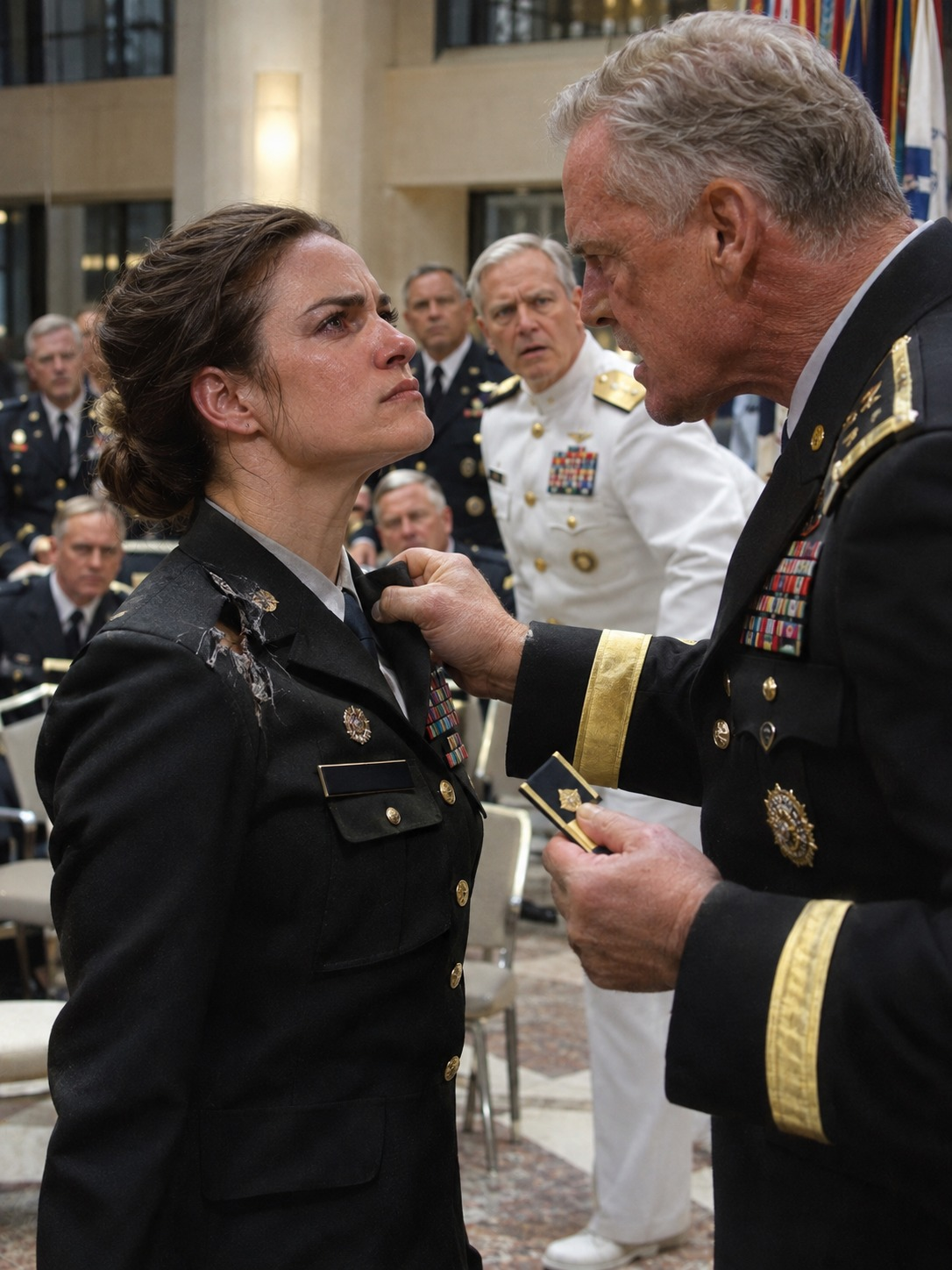
The same hall where my father had once called me a traitor.
The same place where he had torn the insignia from my uniform in front of hundreds of officers.
This time, the room was quiet for a different reason.
Admiral Row stood at the podium.
Behind him was a display honoring the surviving members of Orion Phantom.
My name appeared beside the call sign VALKYRIE.
The admiral spoke about the investigation, the five fallen service members, and the importance of accountability.
Then he invited me forward.
I walked toward the podium.
My uniform was new.
My insignia had been restored.
Across my shoulder blades, beneath the fabric, the Orion mark remained.
I looked toward the front row.
My mother was there.
Thomas sat beside her.
My father stood behind them.
McKenzie and Reyes were smiling.
I began speaking.
"My service was never about a symbol, a rank, or a family name. It was about the people who trusted me to bring them home."
I paused.
"Some of us were betrayed. Some were silenced. Some never returned. But the truth survived because people refused to abandon one another."
I looked at my father.
Then at my mother.
"And I learned that loyalty is not blind obedience. It is the courage to protect what is right, even when the truth is difficult."
The officers rose.
The applause filled the hall.
My father stood first.
And this time, when he looked at me, there was no accusation in his eyes.
Only pride.
That evening, our family gathered for dinner.
My mother cooked her favorite meal.
Thomas brought dessert.
My father insisted on setting the table, although he had never been particularly good at it.
For once, nobody discussed classified operations, military investigations, or missing personnel.
We talked about ordinary things.
My mother's plans for a small veterans' charity.
Thomas's new apartment.
My father's retirement.
And the possibility of taking a family trip together.
After dinner, my mother handed me a small envelope.
Inside was the original photograph of the seven Sentinel members.
I turned it over.
The old warning was still there.
But beneath it, my mother had written something new.
The truth survived. So did we.
I smiled.
She touched my cheek.
"I wish I could give you back those eleven years."
I shook my head.
"You can't."
Her eyes filled.
"But you can be here for the years we have left."
She embraced me.
And this time, when I held my mother, I knew there would be no locked doors, false death certificates, or secret orders waiting to separate us.
Later, I placed the photograph in a small frame beside the family picture.
The old Sentinel emblem remained visible.
But it no longer represented a secret organization or a dangerous inheritance.
It represented the people who had fought to protect one another.
My father had finally learned to trust his daughter.
My mother had come home.
My brother had found his family.
And I had discovered that the greatest honor of my life wasn't the insignia on my uniform.
It was having the people I loved beside me when I finally took it off.
For the first time in eleven years, our family was complete.






Comments 0