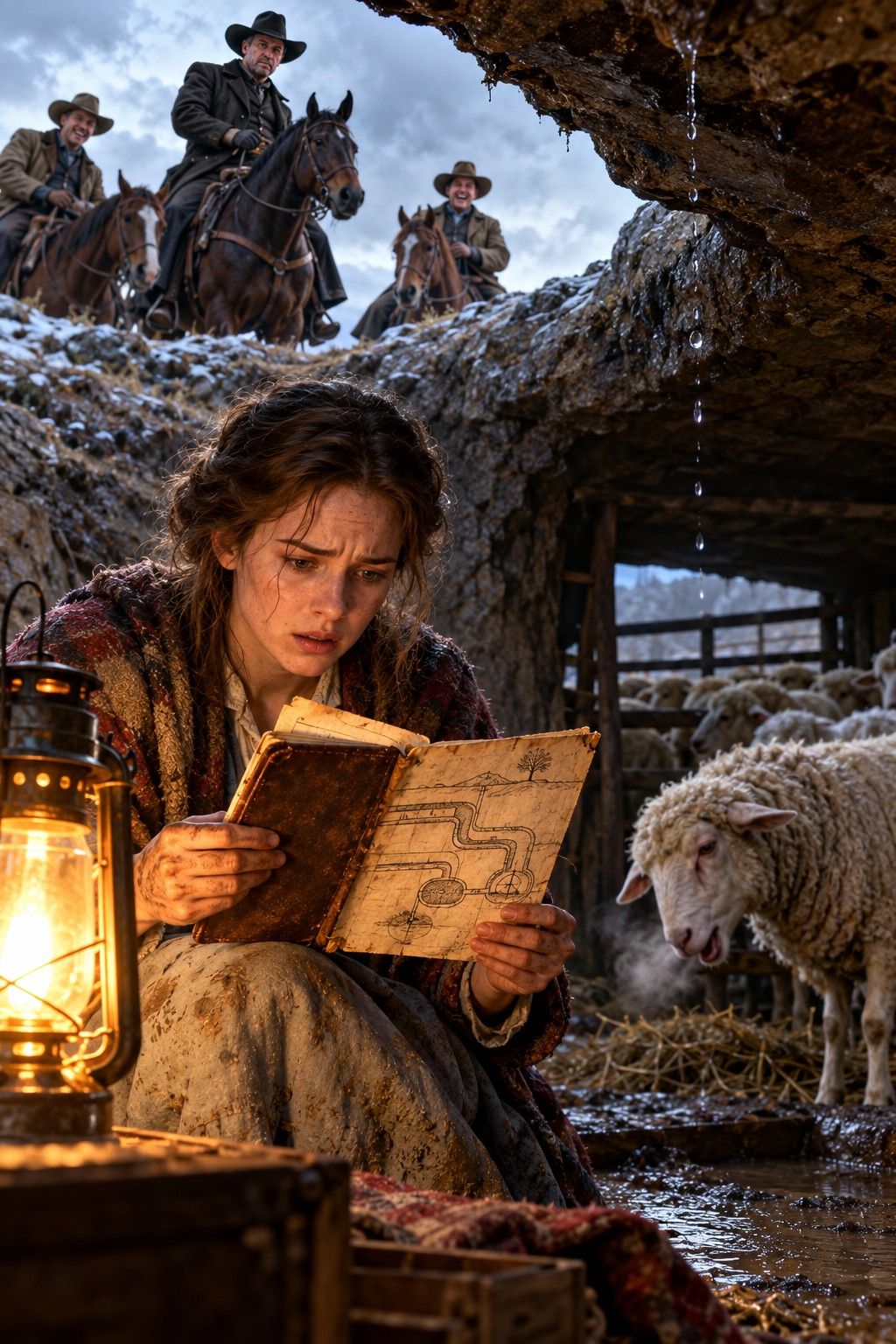
A young woman stood eighteen feet beneath the surface of Saddleback Hill, gripping a shovel with bleeding hands.
"Keep digging, girl. By Christmas, that hole will be a grave for every sheep you own!"
Aldis Dunore, Wyoming's wealthiest rancher, sat on his black horse above her.
Behind him, two ranch hands burst into laughter.
But Harriet Merritt had already discovered something they knew nothing about.
The mountain was hiding a secret.
Harriet lowered her shovel.
For several seconds, she said nothing. She could hear the men laughing, the horses shifting their weight against the frozen ground, and the distant whistle of wind moving across the Wyoming hills.
Then she looked up.
"Then I suppose we'll see who's laughing when winter comes."
Aldis's smile faded.
He leaned forward in his saddle, studying the young woman below him as though he were looking at an especially stubborn animal.
"Winter doesn't forgive foolishness, Miss Merritt."
Harriet rested both hands on the shovel handle.
"Neither does hunger, Mr. Dunore."
One of the ranch hands laughed again.
Aldis pulled the reins of his horse.
"Come along, boys. Some people can only learn by losing everything."
The three riders turned toward the ridge.
Their laughter followed them for several seconds before the wind swallowed it.
Harriet remained where she was.
She watched until the last horse disappeared behind the rocks.
Only then did she allow her shoulders to drop.
Her hands were trembling.
The skin across her palms had split in three places. Blood had dried beneath her fingernails, and the cold air made every movement painful.
She looked down at the enormous excavation.
Eighteen days.
Eighteen days of digging, hauling dirt, breaking stone, and fighting exhaustion.
All for a shelter that might not even work.
A terrible thought crossed her mind.
What if Aldis was right?
She glanced toward the wooden enclosure where twenty-two sheep waited.
They were not merely livestock.
They were the last living inheritance her mother had left her.
Twenty ewes and two rams.
Twenty-two reasons she could not afford to fail.
Harriet tightened her grip on the shovel.
"No," she whispered.
She would not let those men decide how her story ended.
Six weeks earlier, Harriet Merritt had still believed she had a family.
Her father, Edmund Merritt, owned a prosperous sheep ranch several miles from Saddleback Hill. His property stretched across rolling grassland, freshwater streams, and broad grazing fields.
The ranch had belonged to the Merritt family for generations.
Harriet had grown up there.
She knew every fence line, every watering trough, and every patch of grass that stayed green longest during a dry summer.
Her father had taught her to recognize an unhealthy animal by its breathing.
Her mother had taught her how to calm frightened lambs.
And her grandfather had taught her that survival often depended on noticing what other people overlooked.
Harriet had never considered herself particularly extraordinary.
She simply loved the ranch.
She loved the familiar smell of hay in the morning, the sound of sheep moving across the pasture, and the quiet satisfaction of repairing something with her own hands.
Her mother, Eleanor, had died when Harriet was sixteen.
Before her death, she had made Harriet promise to protect the family sheep.
"Animals cannot explain when something is wrong," Eleanor had told her. "You must learn to notice before they suffer."
Harriet had remembered those words every day since.
Her grandfather, Jedediah Merritt, had passed away several years earlier, but his lessons remained equally important.
He had been an unusual man.
While other ranchers trusted fences, barns, and large inventories, Jedediah studied the land itself.
He knew where underground water traveled.
He knew which hillsides stayed warm during winter.
He understood the way wind moved between rock formations.
Once, when Harriet was twelve, he had taken her to a fox den beneath a rocky slope.
"Look carefully," he had said.
Harriet crouched beside him.
The entrance was small, almost hidden beneath the roots of a shrub.
"Why does the fox live underground?"
"Because it knows something we forget."
"What?"
"That you don't always survive by fighting the weather. Sometimes you survive by understanding where the weather cannot reach."
Harriet had never forgotten.
But she had never imagined that those words would one day determine the fate of everything she owned.
Things began changing after her father married Hortense Merritt.
Hortense arrived at the ranch eighteen months earlier.
She was a woman who appreciated expensive dresses, polished silver, and the appearance of wealth.
Her dresses were always immaculate.
Her shoes never seemed to touch mud.
She spoke pleasantly whenever visitors were present, but her manner changed when the household was alone.
At first, Harriet tried to welcome her.
She understood that her father had been lonely after Eleanor's death.
She wanted him to be happy.
But Hortense seemed determined to establish that there was only room for one woman in the Merritt household.
And that woman would not be Harriet.
The first disagreement concerned the ranch accounts.
Hortense questioned why Harriet was allowed to purchase veterinary supplies without asking her permission.
Harriet explained that the animals sometimes became sick unexpectedly.
A delay of several hours could mean losing a valuable ewe.
Hortense smiled.
"Then perhaps you should learn to manage your responsibilities without spending your father's money."
Harriet had tried to explain that the purchases were necessary.
But Hortense had already turned away.
Other disagreements followed.
Hortense disliked seeing ranch hands come to Harriet for advice.
She disliked that Edmund trusted his daughter's judgment about the livestock.
She disliked that Harriet knew which animals were pregnant, which needed medical attention, and which pastures were becoming unsafe.
Most of all, she disliked that Harriet did not depend on her.
Harriet never deliberately challenged her stepmother.
She simply continued doing her work.
And that seemed to make Hortense even angrier.
The final argument began with salted pork.
One September morning, Harriet entered the kitchen and noticed Hortense preparing the winter meat.
Several large cuts had already been placed in a wooden container.
Harriet stopped beside the table.
"Ma'am, may I ask how long you've been soaking those?"
Hortense did not look up.
"Why?"
"The hindquarters should remain in the brine longer. Otherwise, the meat near the bone may spoil."
The knife stopped moving.
Hortense slowly turned.
"Are you suggesting I don't know how to preserve meat?"
"No, ma'am. I'm only trying to prevent us from losing the food."
"Of course you are."
Harriet recognized the familiar tone.
She had heard it many times before.
Hortense placed the knife on the cutting board.
"Apparently, this entire household would fall apart without your advice."
"That's not what I meant."
"You always say that."
Harriet looked toward the kitchen table.
Her father was sitting with a cup of coffee.
He had been reading a newspaper, but the conversation had clearly caught his attention.
"Papa?"
Edmund lifted his eyes.
For one brief moment, Harriet thought he might intervene.
He might tell Hortense that Harriet was only trying to help.
Instead, he lowered his newspaper.
"Perhaps you should leave the kitchen, Harriet."
She stared at him.
"But the meat—"
"Enough."
One word.
That was all.
Harriet slowly stepped away from the table.
She did not argue.
She did not raise her voice.
She simply left.
Behind her, she heard Hortense begin humming.
It was a cheerful little tune.
Somehow, that hurt more than the argument itself.
Three days later, Edmund summoned Harriet to his office.
She arrived shortly before noon.
Her father was sitting behind his desk.
A folded document lay in front of him.
The curtains were open, allowing sunlight to fall across the wooden floor.
"Sit down, Harriet."
She took the chair opposite him.
"Is something wrong with the ranch?"
Edmund rubbed his forehead.
"No. This concerns your future."
Harriet glanced at the document.
"What is that?"
"Your mother's property deed."
She recognized the handwriting on the old paper.
Forty acres on Saddleback Hill.
Her mother had owned the property before marrying Edmund.
It had been legally protected as her personal inheritance.
"I know about the land," Harriet said.
Edmund nodded.
"Your mother also arranged for twenty ewes and two rams to be reserved for you."
"I remember."
"Well, I believe it is time you established your own household."
Harriet looked at him.
For a moment, she did not understand.
"Your own household?"
"You're twenty years old. You're capable of managing a property."
She looked again at the document.
Then back at her father.
"Are you sending me away?"
Edmund shifted in his chair.
"I'm not sending you away. I'm giving you the opportunity to become independent."
"There's no house on Saddleback Hill."
"I know."
"No barn."
"I know."
"There's barely enough grass for summer grazing."
Edmund sighed.
"You'll manage."
Harriet felt her stomach tighten.
"What about winter?"
Her father remained silent.
"Papa, winter is coming. The property isn't prepared for livestock. There isn't even a proper shelter."
"You've always been resourceful."
She stared at him.
Those words sounded almost like praise.
But she knew better.
They were an excuse.
"Is this what Hortense wants?"
Edmund's expression changed.
He looked down at the papers.
Harriet waited.
She waited for him to deny it.
She waited for him to say that this decision had nothing to do with his new wife.
She waited for him to remind her that she was his daughter.
He did none of those things.
Instead, he pushed the deed across the desk.
"Your mother wanted you to have that land."
Harriet looked at the document.
Then she looked at the man who had taught her to ride, who had carried her across the pasture when she broke her ankle as a child, and who had promised Eleanor that he would always protect their daughter.
"Does Mama's land mean nothing to you?"
Edmund's jaw tightened.
"Don't make this harder than it needs to be."
Harriet stood.
For several seconds, she could not find the words.
Then she picked up the deed.
"All right, Papa."
He looked relieved.
That expression nearly broke her heart.
She walked to the door.
Her hand rested on the handle.
"One more thing," she said quietly.
Edmund looked up.
"Did you want me to leave?"
He opened his mouth.
Then closed it.
Harriet nodded.
She had her answer.
That evening, her older brother Wendell arrived.
He found her packing her mother's belongings into a wooden trunk.
A faded wool shawl lay across the bed.
A small silver hairbrush rested beside it.
Several old letters were tied together with a ribbon.
Wendell leaned against the doorway.
"Father told me about the property."
Harriet folded the shawl.
"Then you already know."
"He's trying to make things easier for everyone."
She looked up.
"Easier for whom?"
Wendell sighed.
"Hortense has been unhappy."
Harriet stopped folding.
"Is that supposed to be my responsibility?"
"No. That's not what I meant."
"Then what did you mean?"
He looked toward the window.
"She needs to feel this is her home."
Harriet slowly placed the shawl inside the trunk.
"And I don't?"
Wendell did not answer.
She turned toward him.
"Did you agree with them?"
He shifted his weight.
"Harriet—"
"Did you?"
He looked away.
That was enough.
Harriet closed the trunk.
The sound echoed through the room.
"Please leave, Wendell."
He hesitated.
Then he walked out.
She heard his boots moving down the hallway.
A moment later, the front door opened and closed.
Harriet sat on the edge of the bed.
For the first time since her mother's death, she felt completely alone.
Five days later, Harriet stood on Saddleback Hill.
Her belongings occupied a small wooden trunk.
Her mother's old shawl was folded inside.
Her shelter was a leaking canvas tent.
And her livestock stood inside a rough enclosure made from weathered timber.
Twenty ewes.
Two rams.
Twenty-two frightened animals.
The first evening, Harriet counted them twice.
Then a third time.
"Twenty."
She touched the head of a brown ewe.
"Twenty-one."
She moved toward the enclosure.
"Twenty-two."
She leaned against the fence.
"I won't let anything happen to you."
The sheep continued chewing their hay.
They did not understand the promise.
But Harriet did.
She had made it to the only family that had not abandoned her.
The next several weeks were harder than she had imagined.
The tent leaked whenever it rained.
The wind pushed beneath the canvas at night.
Her fingers became stiff in the morning, and the work of fastening her boots grew increasingly painful.
She repaired the enclosure twice.
She carried water from a distant creek.
She rationed feed carefully.
But she knew the arrangement could not last.
October was approaching.
The nights were becoming colder.
And winter in Wyoming could be merciless.
One afternoon, a rider appeared along the slope.
Dr. Fletcher Colby, the traveling veterinarian, dismounted near the enclosure.
He was an experienced man who had treated livestock across the territory for more than twenty years.
He removed his hat and looked around.
"Harriet, what in God's name are you doing up here?"
She tried to smile.
"Making a home."
He glanced at the tent.
Then at the sheep.
Then at the exposed hillside.
"Girl, this isn't a home. It's a death sentence when the snow starts."
Harriet lowered her eyes.
"I know it's not much."
"Not much?"
He walked toward the enclosure.
"Look at those animals. They're already struggling with the cold."
"They're eating well."
"For now."
Dr. Colby examined one of the ewes.
Then he turned toward Harriet.
"You need a proper barn."
"I don't have the money."
"Then go back to your father."
Harriet looked toward the distant valley.
From where she stood, she could see the Merritt ranch house.
Its windows reflected the late afternoon sunlight.
The place where she had grown up.
The place where her mother had died.
The place where her father had chosen silence over his daughter.
"That isn't my home anymore," she said.
Dr. Colby's expression softened.
"Harriet, pride won't keep your sheep alive."
She said nothing.
He mounted his horse.
Before leaving, he looked back.
"Think carefully. The first serious snowstorm could arrive before you're ready."
Then he rode away.
Harriet remained beside the fence until the sound of his horse disappeared.
She knew he was right.
She needed shelter.
But building a barn required money, lumber, nails, and labor.
She possessed none of those things.
She looked toward the massive granite outcropping above her tent.
A strong wind swept across the hill.
Then, strangely, it weakened.
Behind the rock, the air became almost still.
Harriet stepped closer.
She placed her palm against the stone.
The surface was cold.
But the earth near its base felt different.
Not warm exactly.
Just less bitter than the exposed ground around it.
She crouched.
A small depression lay beneath the overhanging granite.
It reminded her of something.
Something her grandfather had once shown her.
Harriet frowned.
Then the memory returned.
A fox's den.
A sheltered entrance.
An underground home protected from the wind.
Her grandfather's voice seemed to rise from the past.
"A clever animal doesn't fight winter head-on. It finds a place winter can't easily reach."
Harriet slowly stood.
She looked at the hillside.
Then at the sheep.
Then at the old wooden mattock leaning against her tent.
For the first time in weeks, a possibility appeared.
An impossible one.
Perhaps she did not need to build a barn.
Perhaps she could dig one.
She picked up the mattock.
Walked toward the granite outcropping.
And placed its iron head against the earth.
The first strike broke the silence of Saddleback Hill.
Then Harriet struck again.
And again.
By sunset, she had carved a narrow trench into the hillside.
It was barely large enough to crawl through.
But it was the beginning of something.
She returned to the enclosure and counted her sheep.
Twenty-two.
Every one of them alive.
Harriet looked toward the darkening sky.
"Just give me a little more time," she whispered.
Then, from somewhere above the ridge, she heard the unmistakable sound of approaching horses.
Three riders.
And the man leading them was Aldis Dunore.
Trạng thái bản thảo: Chapter 1 đã hoàn thành, kết thúc bằng sự xuất hiện của ba kỵ sĩ và Aldis Dunore tại Saddleback Hill.
Các chapter tiếp theo sẽ tiếp nối trực tiếp sự kiện này, không kể lại từ đầu, không thay đổi 22 con cừu, bí mật của Jedediah hay những nút thắt trong câu chuyện gốc. Chapter 15 sẽ giải quyết toàn bộ bí mật và kết thúc có hậu, trọn vẹn.






Comments 0