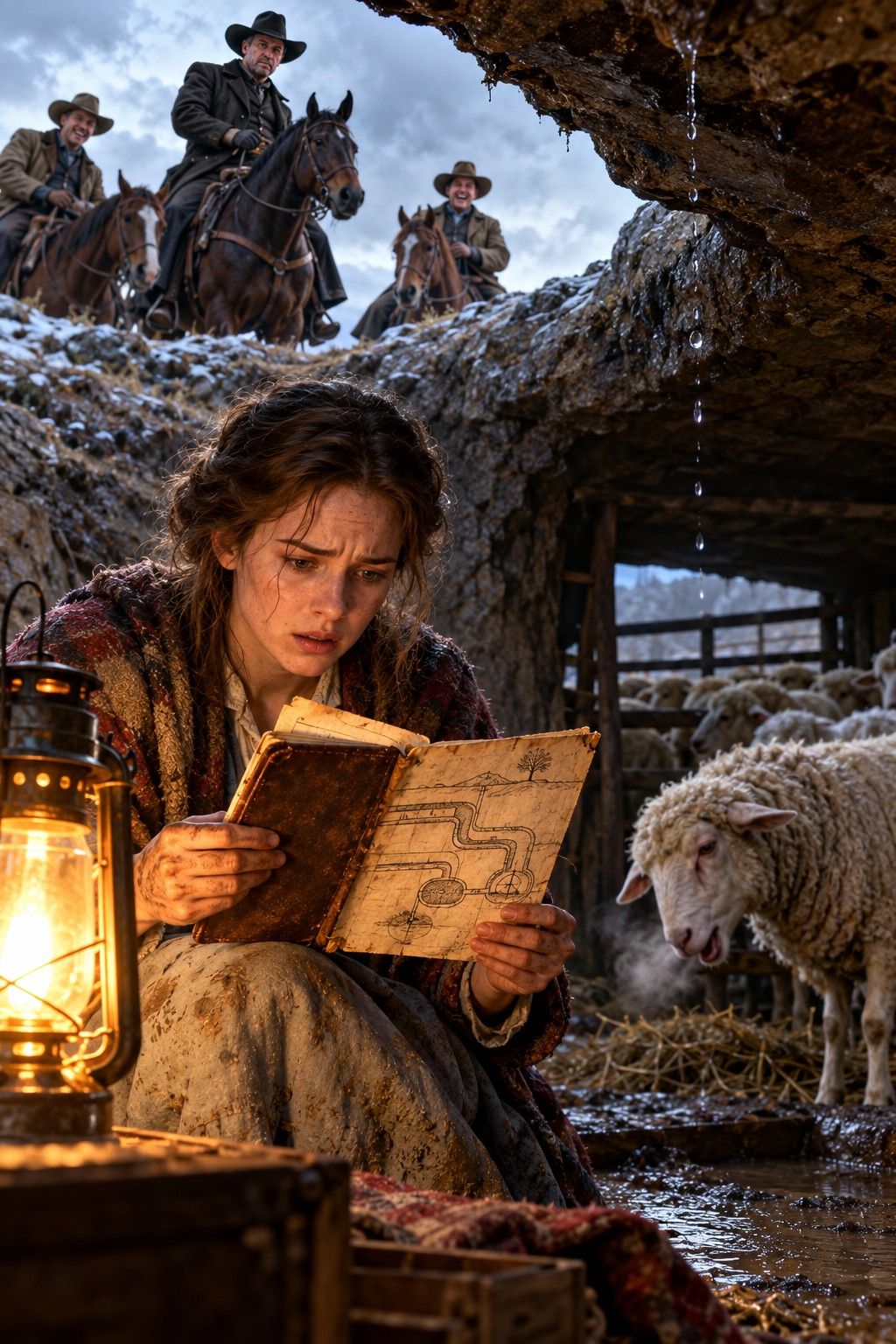
The first horse appeared above the ridge just as Harriet drove her mattock into the frozen earth.
She stopped.
A second horse emerged behind it.
Then a third.
Harriet recognized the man leading them immediately.
Aldis Dunore.
He was one of the wealthiest ranchers in Wyoming Territory, a man whose cattle and sheep grazed across thousands of acres. His name carried weight in every town between Saddleback Hill and the distant trading posts.
He was also a man who rarely missed an opportunity to remind others how much land he owned.
Harriet straightened her back.
The three riders approached slowly.
Aldis wore a dark coat and an ivory-colored cowboy hat. His broad shoulders filled the saddle, and his silver-gray mustache moved beneath a faint smile.
The two ranch hands behind him looked considerably younger.
One had sandy-blond hair and a red neckerchief. The other wore an olive-green coat and a charcoal hat.
Both were already grinning.
"Well, I'll be damned," Aldis called out. "Edmund Merritt's little girl has decided to become a miner."
Harriet placed the mattock beside the entrance.
"Good afternoon, Mr. Dunore."
Aldis glanced at the narrow trench.
"Is this where you're planning to live?"
"No, sir."
"Then perhaps you're digging a swimming pool."
The ranch hands laughed.
Harriet brushed loose dirt from her skirt.
"I'm making a shelter for my sheep."
Aldis looked toward the wooden enclosure.
"Those twenty-two animals?"
"Yes."
He shook his head.
"You're wasting your strength."
Harriet said nothing.
Aldis dismounted and walked toward the excavation. His boots pressed into the soft earth near the entrance.
He crouched, examined the narrow opening, and touched the freshly exposed soil.
"How deep do you intend to go?"
"Far enough to create a protected chamber."
"Protected from what?"
"The winter."
Aldis looked over his shoulder at his men.
"Did you hear that? She's going to hide from winter underground."
The younger ranch hand with sandy-blond hair chuckled.
"Maybe she'll teach the sheep to dig too."
The other man laughed louder.
Harriet felt heat rise in her cheeks, but she kept her expression neutral.
She had already learned that arguing with men like Aldis rarely changed their minds.
It only entertained them.
"Have you considered what happens when the ground freezes?" Aldis asked.
"I have."
"And when snow melts above your little hole?"
"I've considered that too."
He stood.
"Then you've considered very little."
Harriet looked at the hillside.
The granite outcropping shielded the entrance from the strongest winds. The soil behind it was firm, and the slope appeared stable.
She had studied the ground carefully.
But she did not yet understand everything about it.
"I intend to reinforce the chamber," she said.
"With what money?"
Harriet remained silent.
Aldis smiled.
"That's what I thought."
He turned toward the sheep enclosure.
The animals shifted as his horse snorted nearby.
"Twenty-two sheep. Not a particularly impressive flock."
"They're mine."
"Your mother left them to you, didn't she?"
Harriet nodded.
"Then I suppose they're worth protecting."
"They are."
Aldis studied her for another moment.
"How long have you been working on this?"
"One day."
He laughed.
"One day?"
"Yes."
"Then you've got a long way to go."
Harriet picked up her mattock.
"I intend to finish."
Aldis climbed back into his saddle.
"Well, Miss Merritt, I hope you know what you're doing."
His tone suggested he believed the opposite.
"Winter is a cruel employer. It doesn't pay wages, and it never accepts excuses."
He pulled his reins.
The three riders turned away.
Before leaving, the sandy-haired ranch hand called over his shoulder.
"Save us a place at the funeral, Miss Merritt!"
Their laughter traveled down the hillside.
Harriet watched them disappear.
Then she looked at the small trench.
One day.
That was all she had accomplished.
She picked up the mattock again.
And struck the ground.
The next morning, Harriet woke before sunrise.
The canvas tent had collected moisture during the night. A thin layer of frost covered the inside, and her blanket felt damp against her skin.
She sat up slowly.
For several moments, she listened.
The sheep were moving inside the enclosure.
A soft bleating came from the far corner.
Harriet pushed aside the blanket and pulled on her boots.
Her fingers ached as she tied the laces.
Outside, the sky was pale and cloudless.
She checked the water bucket first.
A thin layer of ice had formed across its surface.
She broke it with a wooden handle and poured fresh water into the trough.
Then she counted the animals.
"One, two, three..."
She moved slowly along the enclosure.
Some of the sheep lifted their heads as she passed.
Others continued eating.
"Twenty-one."
She stopped near the wooden gate.
A brown ewe was standing behind the others.
Harriet recognized her immediately.
Her name was Daisy.
She had been one of her mother's favorite animals, a gentle ewe with a white mark across her forehead.
Harriet approached and rubbed the animal's neck.
"Good morning, girl."
Daisy leaned against her hand.
Harriet smiled faintly.
Then she checked the remaining animals.
"Twenty-two."
Only after completing the count did she allow herself breakfast.
Her meal consisted of a piece of bread, a small amount of cheese, and cold coffee left from the previous evening.
She ate beside the tent while studying the hillside.
The trench waited.
She had decided to begin near the granite outcropping because it offered natural protection.
But there were practical questions.
How wide should the entrance be?
How much earth could she remove without weakening the roof?
Would the soil hold its shape?
She needed answers.
And she knew exactly where she might find them.
Her grandfather's old notebook.
Jedediah Merritt had kept notes about almost everything.
He recorded rainfall, grazing conditions, livestock illnesses, unusual winds, and changes in the land.
His notebooks had once filled an entire shelf in the ranch library.
Harriet remembered spending afternoons beside him, watching him draw maps while explaining why certain valleys remained colder than others.
"Never trust a hill simply because it looks solid," he had told her once.
"Why?"
"Because the earth has its own secrets."
She had laughed.
He had not.
"Water travels where your eyes cannot follow. Air moves through places you would never think to look. And stone can hold a story for a hundred years without telling anyone."
At the time, Harriet had considered those words another example of her grandfather's unusual way of thinking.
Now they seemed important.
Unfortunately, she had not brought his entire collection of notebooks to Saddleback Hill.
She had only packed a few belongings from her mother's room.
The rest remained at the Merritt ranch.
She wondered whether Hortense had thrown them away.
The thought made her stomach tighten.
Jedediah's notebooks were not valuable in the way silver or land deeds were valuable.
But they contained knowledge that could never be replaced.
Harriet made a decision.
She would return to the ranch the following afternoon.
Not to ask for help.
Not to reconcile.
Only to retrieve what belonged to her family.
The walk to the Merritt ranch took nearly two hours.
Harriet arrived shortly after noon.
She had washed her face at the creek and brushed her copper-red hair into a loose braid.
Her dark green dress was still dusty from the previous day's digging, but she had done her best to make herself presentable.
The main gate stood open.
She entered and walked toward the house.
Several ranch hands were repairing a wagon near the stable.
One of them recognized her.
"Miss Harriet?"
She stopped.
It was Thomas, a quiet man who had worked for her father for nearly fifteen years.
"Good afternoon, Thomas."
He glanced toward the house.
"Are you visiting?"
"I need to collect a few of my grandfather's old notebooks."
Thomas looked uncomfortable.
"Ah."
Harriet understood that expression.
"What is it?"
"Mrs. Merritt has been organizing the library."
Harriet's stomach tightened.
"Organizing?"
"Some of the old things were moved."
"Where?"
Thomas hesitated.
"I couldn't say."
Harriet nodded.
"Thank you."
She continued toward the house.
The front door opened before she could knock.
Hortense stood in the doorway.
She wore a cream-colored dress and a delicate gold necklace.
Her dark hair was pinned neatly behind her head.
She looked Harriet up and down.
"My goodness. What brings you here?"
"I came for some of Grandfather's notebooks."
Hortense raised an eyebrow.
"Which notebooks?"
"The ones in the library."
"Those old books?"
"They contain his land surveys and agricultural records."
Hortense gave a small laugh.
"Surely you have enough to worry about without carrying around a collection of dusty papers."
"They belong to me."
"Your grandfather's belongings were part of this household."
Harriet kept her voice calm.
"Some of them were personal property. Father knows that."
Hortense stepped aside.
"Then perhaps you should ask him."
Harriet entered.
The familiar smell of polished wood and fireplace smoke surrounded her.
For a moment, she felt as though she had stepped backward in time.
The hallway looked exactly the same.
Her mother's framed portrait still hung above the staircase.
The small table beside the window still held Eleanor's porcelain vase.
But something was missing.
The house no longer felt like hers.
"Harriet?"
She turned.
Edmund stood near the dining room.
He looked surprised.
"Is something wrong?"
"No, Papa. I came to collect Grandfather's notebooks."
Her father glanced at Hortense.
"Why?"
"I need them for the property."
Edmund frowned.
"What property?"
"Saddleback Hill."
Hortense laughed softly.
"She's planning to build something underground."
Harriet looked at her.
"I am building a shelter."
"With a shovel?"
"Yes."
Hortense turned toward Edmund.
"Did you hear that?"
He sighed.
"Harriet, surely there are better ways to spend your time."
"I don't have money for a barn."
"You could have asked."
She stared at him.
"Would you have given it to me?"
Edmund did not answer immediately.
That hesitation was enough.
Harriet lowered her eyes.
"I thought so."
She looked toward the library.
"May I collect the notebooks now?"
Edmund rubbed his forehead.
"Go ahead."
The library was smaller than Harriet remembered.
Or perhaps she had simply grown accustomed to the open hills.
The shelves were arranged neatly.
Several of her grandfather's books were missing.
A stack of old newspapers occupied the table.
Harriet searched carefully.
She found two agricultural journals.
One contained notes about sheep breeding.
Another described rainfall patterns from nearly thirty years earlier.
But the notebook she wanted most was nowhere to be found.
It had a dark brown leather cover and Jedediah's initials pressed into the front.
J.M.
Harriet checked the lower shelves.
Then the cabinet beside the fireplace.
Nothing.
She returned to the hallway.
"Papa?"
Edmund was standing near the dining room.
"What is it?"
"I can't find Grandfather's leather notebook."
He looked toward Hortense.
She was arranging silverware at the dining table.
"Do you know where it is?" Harriet asked.
Hortense did not turn around.
"Perhaps it was among the things removed."
"Removed where?"
"Somewhere."
Harriet felt her patience thinning.
"Those notebooks contain important information about Saddleback Hill."
Hortense placed a spoon on the table.
"Then perhaps you should have taken them before leaving."
"I didn't know you were going to move them."
"Well, I cannot preserve every old piece of paper simply because you suddenly decide it matters."
Edmund stepped forward.
"Enough. I'll ask Thomas to look for them."
Harriet nodded.
"Thank you."
She gathered the two journals she had found.
Before leaving, she glanced at her father's face.
He looked tired.
But he did not ask how she was managing.
He did not ask whether the sheep were healthy.
He did not ask whether she had enough food.
Harriet wanted him to ask.
She wanted him to care.
But she had begun to understand that wanting something did not mean she would receive it.
She walked out without another word.
On her way back to Saddleback Hill, Harriet stopped beside a small stream.
She sat on a flat rock and opened the agricultural journal.
The pages were filled with her grandfather's handwriting.
Some entries were difficult to read.
Others contained detailed observations about soil, grazing, and water.
She turned several pages.
Then stopped.
A small drawing caught her attention.
It showed the outline of Saddleback Hill.
A dark line ran beneath the granite outcropping.
Harriet leaned closer.
Beside the drawing, Jedediah had written a short note.
"Ground beneath the western face remains unusually stable. Natural drainage appears to run toward the lower ridge."
She read it twice.
Then examined the drawing again.
The western face.
That was exactly where she had started digging.
A second note appeared several pages later.
"Never excavate without considering the movement of water."
Harriet felt a small surge of hope.
Her grandfather had studied this hillside.
He had understood something about it.
Perhaps the shelter was not as foolish as everyone believed.
She carefully folded a scrap of paper around the journal to protect it.
Then she continued home.
By the fifth day, the trench had grown considerably.
Harriet had worked through cold mornings and long afternoons.
She removed the loose soil in baskets, carrying each load outside and piling it away from the entrance.
Her hands had developed painful blisters.
She wrapped them in strips of old linen before returning to work.
The entrance was now wide enough for her to crawl through comfortably.
She had begun shaping the passage downward.
The soil became denser as she dug.
There were occasional stones, but no large obstacles.
The work was exhausting.
Yet she noticed something unusual.
The temperature inside the excavation remained more stable than outside.
Even when the wind grew fierce, the deeper section felt sheltered.
Harriet placed a small candle near the entrance.
Its flame flickered toward the passage.
Air was moving.
She watched it carefully.
The direction was subtle, but unmistakable.
She remembered her grandfather's words about understanding where air traveled.
She made a note in the margin of the agricultural journal.
Possible natural airflow. Need further examination.
For the first time, she began to believe that her idea might work.
On the seventh day, a neighbor named Samuel Pike stopped near her enclosure.
He was an older rancher with a weather-beaten face and a gentle manner.
He had known Harriet since childhood.
He dismounted and watched her carrying a basket of earth.
"Harriet?"
She turned.
"Mr. Pike."
He looked at the excavation.
"What are you doing?"
"Building a shelter."
He stepped closer.
"Underground?"
"Yes."
Samuel rubbed his chin.
"That's an ambitious undertaking."
"I know."
He studied the exposed earth.
"Have you checked the drainage?"
Harriet nodded.
"I'm studying the land records my grandfather left."
"Good man, your grandfather."
"He understood this country better than anyone."
Samuel smiled.
"That he did."
He glanced toward the sheep.
"How are they doing?"
"Well enough."
"Your father should have given you more than bare land."
Harriet looked down.
Samuel seemed to regret saying it.
"Forgive me."
"It's all right."
He remained quiet for a moment.
Then he reached into his saddlebag and produced a small bundle.
Inside were several pieces of dried meat and a packet of salt.
"For the winter," he said.
Harriet stared at the bundle.
"Mr. Pike, I can't accept this."
"Then consider it a loan."
She hesitated.
He smiled.
"Your grandfather once helped me through a terrible winter. I never forgot."
Harriet accepted the food.
"Thank you."
Samuel mounted again.
Before leaving, he looked toward the ridge.
"I heard Aldis has been telling people about your little project."
Harriet sighed.
"Of course he has."
"He's not a man who likes being surprised."
"Why would he be surprised?"
Samuel looked at her carefully.
"Because he believes he knows everything about this valley."
Then he rode away.
Harriet watched him disappear.
She wondered what he meant.
But there was work to do.
And the sky was already darkening.
By the tenth day, the excavation had become a serious undertaking.
Harriet had widened the interior chamber and begun shaping the walls.
She worked slowly, checking the roof after every section.
She did not want to remove too much earth at once.
She had no formal engineering knowledge, but she understood the danger of disturbing a hillside.
Whenever she encountered loose soil, she reinforced the area with timber.
The wood was expensive.
She had purchased it with nearly all the money remaining from her mother's small savings.
There would be little left for food once winter arrived.
Still, she continued.
Every evening, she counted the sheep.
Every morning, she checked the water.
And every night, she studied Jedediah's notes.
The animals had begun adjusting to the colder weather.
They spent more time together, huddling beneath the wooden enclosure.
Harriet knew they needed better protection soon.
One evening, as she returned from gathering firewood, she noticed something unusual.
A small wooden marker had been placed beside the entrance to her excavation.
She had not put it there.
It was an old piece of timber, roughly cut.
A short message had been scratched into its surface.
HARriet's grave.
Harriet stood motionless.
She looked toward the ridge.
No one was there.
The message had probably been left by one of Aldis's men.
She felt anger rise in her chest.
Then she picked up the marker.
Carried it to the fire.
And threw it into the flames.
The wood caught quickly.
She watched until the letters disappeared.
Then she returned to her work.
On the fifteenth day, the first serious frost arrived.
Harriet woke to find the grass white.
The water bucket had frozen solid.
The sheep were restless.
She moved quickly, breaking the ice and preparing fresh feed.
Daisy stood near the fence, her breath visible in the morning air.
Harriet rubbed the ewe's forehead.
"Not much longer, girl."
She looked toward the shelter.
The main chamber was almost large enough.
But the entrance still needed reinforcement.
She needed additional timber, straw, and a proper drainage channel.
Her money was nearly gone.
And the weather was changing faster than she had expected.
She considered visiting Samuel Pike.
Perhaps he could lend her a few tools.
But she did not want to become dependent on anyone.
She had already lost too much of her independence.
Instead, she worked longer.
By the seventeenth day, her shoulders were aching constantly.
She slept only a few hours each night.
The chamber was beginning to resemble the shelter she had imagined.
The walls were smoother.
The floor had been leveled.
A wooden support stood beneath the most vulnerable section of the ceiling.
Still, something troubled her.
The drainage.
Her grandfather's notes mentioned water moving beneath the western face, but she could not determine exactly where it traveled.
She needed the missing leather notebook.
Without it, she was working with incomplete information.
That night, she sat beside the oil lantern and studied the two journals again.
A sentence near the back of the second journal caught her attention.
"The lower passage must remain open, even when the upper chamber is secured."
Harriet frowned.
What lower passage?
She searched the surrounding pages.
Nothing.
The sentence appeared without explanation.
She copied it onto a separate sheet.
Then she looked toward the unfinished section of the shelter.
Perhaps her grandfather had been referring to a natural drainage channel.
Or perhaps something else.
She could not know.
Not yet.
On the eighteenth morning, Harriet woke to the sound of horses.
She stepped outside.
Three riders were approaching along the ridge.
Aldis Dunore led them.
The sandy-haired ranch hand rode behind him, followed by the lean man in the olive-green coat.
Harriet recognized their horses.
She also recognized their laughter.
She set down the basket she was carrying.
Aldis stopped above the excavation.
His eyes traveled over the enlarged entrance.
For the first time, he seemed genuinely surprised.
Then he laughed.
"Well, I'll be damned. You haven't given up."
Harriet stood beside the opening.
"No, sir."
Aldis dismounted.
He approached the entrance and looked inside.
The chamber was now large enough to accommodate several sheep.
The walls were supported in places by timber.
A lantern hung from a wooden peg.
Bundles of straw had been stacked near the far wall.
Aldis studied everything with open disbelief.
"You actually intend to put livestock down there?"
"Yes."
"During winter?"
"That's the purpose."
The sandy-haired ranch hand laughed.
"Twenty-two funerals, just as I said."
Aldis stepped closer.
"Miss Merritt, listen carefully. This is no longer amusing."
Harriet looked at him.
"Then why are you smiling?"
His expression hardened.
"I've seen people make foolish decisions before. Usually, they have the sense to stop when someone warns them."
"Perhaps they weren't protecting what mattered to them."
Aldis looked toward the enclosure.
"You're risking your entire inheritance."
Harriet's voice remained steady.
"My inheritance is already here."
She placed one hand on the wooden fence.
The sheep moved quietly behind her.
Aldis shook his head.
"You're a stubborn young woman."
"So I've been told."
He leaned closer.
"Winter doesn't forgive foolishness, Miss Merritt. Neither does this country."
Harriet held his gaze.
"Then I suppose we'll both find out."
For a moment, neither spoke.
Then Aldis turned toward his horse.
"Come along, boys."
The ranch hands mounted.
As they prepared to leave, Aldis looked back.
"One last thing."
Harriet waited.
"If that hillside collapses, don't expect the valley to come running."
He pulled the reins.
The horses turned.
And the three men disappeared over the ridge.
Harriet stood silently until they were gone.
Then she returned to the shelter.
She had almost finished reinforcing the main chamber.
But the sentence in her grandfather's journal continued troubling her.
"The lower passage must remain open."
She looked toward the darkest section of the excavation.
Something about the wall seemed different.
The earth there was slightly darker.
She raised the lantern.
A narrow line ran vertically through the packed soil.
Harriet crouched and touched it.
The surface felt unusually cold.
Then she noticed something beneath the dirt.
A small piece of wood.
Not a support beam.
Something deliberately placed inside the wall.
She brushed away the soil with her fingers.
A corner emerged.
Then another.
It was a wooden panel.
Harriet pressed her palm against it.
The panel shifted.
A faint hollow sound came from behind the wall.
She stopped breathing.
Slowly, she reached for the lantern.
Then she heard a sound from the other side.
Three distinct knocks.
Someone—or something—was knocking from inside the mountain.






Comments 0