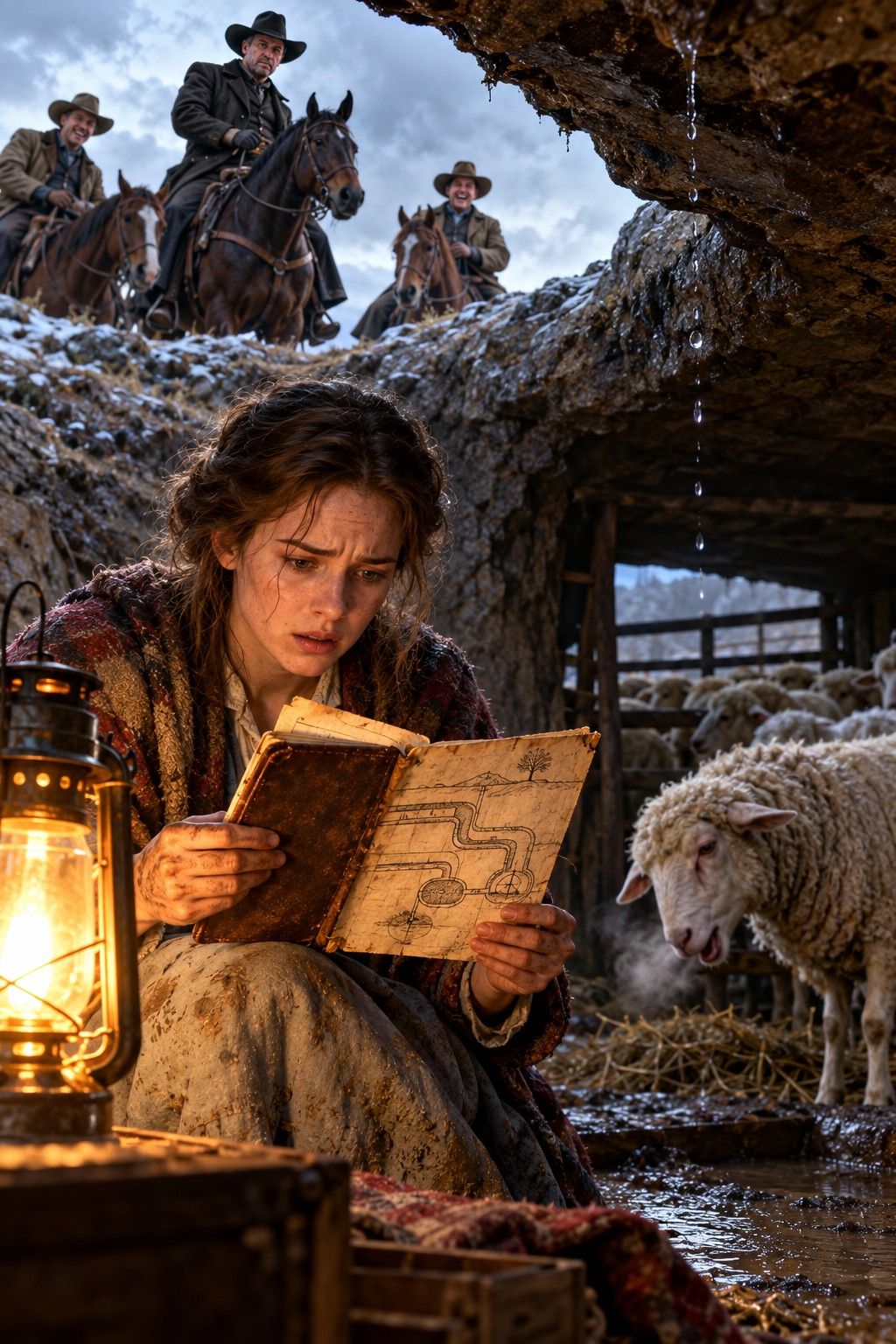
Three knocks came from behind the wall.
Harriet froze.
The lantern trembled in her hand.
She stared at the wooden panel buried beneath the earth, hardly daring to breathe.
Then came another sound.
A faint scraping.
Something was moving behind it.
Harriet took one step backward.
Her first instinct was to run outside and fetch help. But the thought of leaving the shelter unfinished, with the winter approaching and twenty-two sheep depending on her, stopped her.
She raised the lantern.
"Hello?"
Her voice sounded strangely small inside the underground chamber.
No answer.
She waited.
Nothing.
Then she heard it again.
Knock.
Knock.
Knock.
Harriet's fingers tightened around the lantern handle.
She approached the wall carefully and placed her free hand against the wooden panel.
It was cold.
Much colder than the surrounding earth.
She leaned closer.
"Is somebody there?"
Silence.
A sudden gust of wind swept across the entrance, making the lantern flame dance.
Harriet turned toward the opening.
For a moment, she considered leaving the panel alone.
She had no idea what lay behind it. The hillside might contain an old animal den, a natural cavity, or a forgotten storage chamber.
Opening an unknown passage could be dangerous.
Her grandfather had always warned her against disturbing things she did not understand.
But he had also taught her never to ignore evidence simply because it frightened her.
Harriet examined the panel again.
A small iron ring was attached near its center.
It was almost completely hidden beneath dirt.
She brushed away the soil.
The ring moved slightly.
A thin line appeared around the wooden frame.
It was not part of the natural hillside.
Someone had deliberately built this.
And someone had gone to considerable trouble to conceal it.
Harriet stepped back and looked at the chamber.
The shelter she had spent eighteen days creating was beginning to reveal something she had never expected.
She needed to understand what her grandfather had left behind.
But not tonight.
Not without knowing whether the structure was safe.
She covered the panel with an old blanket and placed a wooden crate in front of it.
Then she climbed out of the excavation.
The night air struck her face.
Above the ridge, the sky had turned almost black.
She hurried toward the sheep enclosure.
The twenty-two sheep were restless.
Several stood close together near the far fence, their wool moving in the wind.
Harriet counted them.
One.
Two.
Three.
She moved along the enclosure, touching the backs of the animals as she passed.
By the time she reached the final ewe, her breathing had settled.
Twenty-two.
All alive.
She rested her forehead against the wooden fence.
For a moment, she closed her eyes.
The mysterious knocking still echoed in her mind.
But there were more immediate problems.
The water supply was becoming unreliable.
The remaining hay was limited.
The shelter needed additional straw and timber.
And she had almost no money.
She could not afford to become distracted by mysteries, no matter how unusual they were.
Harriet opened the gate and entered the enclosure.
Daisy approached immediately.
The brown ewe nudged Harriet's hand.
"You're hungry again, aren't you?"
Harriet reached into the feed sack and scattered a small portion of grain.
The other sheep gathered around.
She watched them eat.
Her mother had once told her that animals recognized kindness through consistency.
A person did not need to make grand promises to earn their trust.
They simply had to show up every day.
Harriet remembered standing beside Eleanor in the old barn, watching her mother tend to a lamb that had been rejected by its mother.
The little animal had been weak and frightened.
Eleanor had wrapped it in a blanket and carried it into the house.
"You cannot save every creature, Harriet," her mother had explained.
"But we should try."
"Yes. We should always try."
Harriet looked at the flock.
She had made that promise to herself long before she understood how difficult it would become.
She would not abandon them.
Not because they were valuable.
Not because they could earn her money.
But because they trusted her.
The following morning, Harriet began inspecting the shelter.
She carried the lantern inside and removed the crate from the hidden panel.
In daylight, the underground chamber looked less frightening.
The panel was still there.
Its edges were clearly visible now that she had brushed away the loose earth.
Harriet examined the iron ring.
It was old, but not badly corroded.
She tried pulling gently.
Nothing happened.
She pressed against the wood.
A faint creaking sound followed.
Then she noticed a narrow metal latch concealed beneath the lower edge.
It was positioned differently from the hinges she had seen on ordinary doors.
She crouched and studied it.
The mechanism seemed simple enough, but dirt had collected around the metal.
Harriet found a small iron tool among her supplies and carefully cleared the packed soil.
A few minutes later, the latch moved.
She stopped.
The panel remained closed.
Harriet could feel her pulse beating in her throat.
She looked toward the entrance.
The sheep were making their usual morning noises.
A breeze moved through the opening.
Everything outside appeared ordinary.
She returned her attention to the panel.
Then she heard a soft rustling sound.
Not from behind the wood.
From somewhere above it.
A few grains of earth fell onto her shoulder.
Harriet looked up.
The ceiling near the hidden passage had developed a small crack.
Her expression changed.
Whatever was behind the panel would have to wait.
She moved away immediately.
The crack was narrow, but she knew better than to ignore it.
She examined the surrounding earth and checked the nearest timber support.
The wood had shifted slightly.
Perhaps the vibration from the previous evening had disturbed the structure.
Harriet placed a temporary brace beneath the vulnerable section.
Then she climbed outside to retrieve another beam.
As she worked, she remembered Jedediah's warning.
"Never excavate without considering the movement of water."
And another sentence.
"The lower passage must remain open, even when the upper chamber is secured."
Harriet looked back toward the entrance.
The two instructions seemed connected.
She just did not know how.
By midday, a familiar rider appeared on the eastern trail.
Samuel Pike.
Harriet recognized his horse and waved.
He approached the enclosure and dismounted.
"Morning, Miss Merritt."
"Good morning."
His eyes traveled toward the excavation.
"Looks like you've been busy."
"I have."
Samuel stepped closer to the entrance.
"That's quite a hole you've dug."
Harriet gave a tired smile.
"It's becoming a little more than a hole."
He chuckled.
"Fair enough."
He examined the wooden supports.
"Where did you get the timber?"
"Bought it from the trading post."
"With what money?"
Harriet looked away.
Samuel understood.
"Well, you certainly didn't inherit your father's habit of keeping a comfortable reserve."
Harriet almost laughed.
"Perhaps not."
He removed his gloves.
"May I have a look?"
She hesitated.
Then nodded.
Samuel entered the shelter slowly.
He examined the chamber, touching the timber supports and looking carefully at the ceiling.
"You're doing this properly."
"Do you think it will hold?"
"Hard to say without understanding the ground."
He crouched near the entrance.
"How far have you gone?"
"About eighteen feet from the opening, though the chamber widens toward the back."
Samuel nodded.
"Have you considered drainage?"
"Yes. My grandfather wrote about water moving beneath this hillside."
Samuel turned toward her.
"Jedediah studied this place?"
"I think so."
"What makes you think that?"
Harriet retrieved the agricultural journal and showed him the sketch.
Samuel studied it.
His expression became serious.
"Where did you find this?"
"In one of his old notebooks."
He traced the western side of the drawing with his finger.
"Your grandfather knew this hill better than most men knew their own property."
"Did he ever tell you anything about it?"
Samuel remained silent for several seconds.
Then he looked at the excavation.
"Not much."
Harriet noticed his hesitation.
"What did he tell you?"
Samuel rubbed his jaw.
"Once, many years ago, he asked me to help him move some timber near the western ridge."
"Here?"
"Not exactly here. A little farther up."
"What was he building?"
"I never found out."
Harriet looked down at the drawing.
"Was there an underground passage?"
Samuel's eyes moved toward her.
"Why would you ask that?"
She hesitated.
Then decided to show him.
She moved toward the back wall and pulled away the blanket.
The wooden panel appeared.
Samuel stared at it.
For the first time since he had arrived, he looked genuinely unsettled.
"Where did that come from?"
"I found it yesterday."
He approached carefully.
"Did you open it?"
"No."
"Good."
Harriet frowned.
"Why?"
Samuel ran his fingers along the wooden frame.
"Because I don't know what's behind it."
"Neither do I."
He examined the iron ring.
Then he noticed the small latch.
His expression changed again.
"This wasn't built recently."
"Do you recognize it?"
Samuel shook his head.
"No. But I remember Jedediah asking about iron fittings once. He wanted something that wouldn't rust easily."
Harriet looked at him.
"Why didn't you tell me?"
"I didn't know he had built anything here."
Samuel stepped away from the wall.
"Harriet, I think you should find the rest of his records before you open this."
She nodded.
That was exactly what she intended to do.
But the missing leather notebook remained somewhere at the Merritt ranch.
And she had no idea whether Hortense would let her have it.
Samuel stayed for another hour.
Before leaving, he helped Harriet reposition one of the support beams.
He also offered to bring additional timber from his property.
Harriet initially refused.
But he insisted.
"Your grandfather once told me that a good neighbor doesn't wait until someone is drowning before offering a hand."
She smiled faintly.
"That sounds like him."
Samuel mounted his horse.
"One more thing."
Harriet looked up.
"Be careful around that panel."
"I will."
"And don't let Aldis know you've found it."
Her expression changed.
"Why?"
Samuel adjusted his reins.
"Because Aldis has spent a long time believing that everything on this side of the valley belongs to somebody who can afford to take it."
He looked toward the western ridge.
"Some things are worth keeping hidden."
Then he rode away.
Harriet remained near the enclosure.
She watched until he disappeared.
His words troubled her.
What did Aldis have to do with her grandfather's secret?
And why had Samuel seemed so uncomfortable?
That afternoon, Harriet visited the small trading post near the main road.
She needed nails, a length of rope, and a new shovel handle.
The shopkeeper, Mrs. Abigail Turner, greeted her with a sympathetic expression.
"Harriet Merritt."
"Good afternoon, Mrs. Turner."
"How are you managing?"
"I'm doing all right."
Abigail looked at her hands.
"Those don't look like the hands of someone doing all right."
Harriet smiled.
"They're getting used to the work."
Mrs. Turner placed a small parcel on the counter.
"I heard about your shelter."
Harriet lowered her eyes.
"People seem to be discussing it."
"People discuss everything in this valley."
"That much I've noticed."
Abigail leaned closer.
"Don't pay attention to Aldis Dunore."
Harriet looked up.
"He's been telling people I'm foolish."
"He's been telling people more than that."
"What do you mean?"
Abigail glanced toward the shop window.
Then she lowered her voice.
"He's been asking questions about your mother's land."
Harriet went still.
"What questions?"
"Whether the deed is properly registered. Whether the property boundaries are accurate. Whether your father still has any claim to the land."
Harriet felt her stomach tighten.
"My mother left the property to me."
"I know."
"Father gave me the deed."
"Then keep it somewhere safe."
Harriet stared at her.
"Why would Aldis care about forty acres of rocky hillside?"
Abigail shook her head.
"I don't know, dear."
She placed the supplies into a paper-wrapped bundle.
"But wealthy men don't usually spend their time investigating land they have no interest in."
Harriet paid for the goods.
Before leaving, Abigail caught her hand.
"Be careful."
Harriet nodded.
But her thoughts were already racing.
Aldis had mocked her shelter.
He had called her foolish.
Yet he was also asking questions about the property.
Perhaps he simply wanted to buy it.
Perhaps he believed she would eventually fail and sell the land cheaply.
Or perhaps there was something about Saddleback Hill that she had not yet discovered.
The weather changed that evening.
Dark clouds gathered over the mountains.
A cold wind pushed across the valley, carrying the smell of snow.
Harriet finished feeding the sheep and checked the enclosure twice.
She repaired a loose section of fencing and covered the remaining hay with canvas.
Then she entered the shelter.
The lantern burned steadily.
She placed the supplies beside the wooden chest and opened her grandfather's journal.
For nearly an hour, she studied the drawings.
There were references to underground water.
Measurements.
Notes about the western slope.
And several mysterious symbols she could not identify.
One sketch showed the hillside from beneath.
Two narrow passages extended from the main chamber.
One appeared to connect to the lower ridge.
The other ended at a circular shape.
Harriet leaned closer.
The circular shape had been drawn several times.
Beside it were measurements.
But no explanation.
She turned the page.
Another sentence appeared.
"Air must travel freely through both levels. Never close the lower opening during heavy snow."
Harriet read it twice.
Then a third time.
Her heart began beating faster.
The shelter was not simply an underground room.
It had been designed with two levels.
Perhaps the lower passage was an air channel.
Perhaps it was connected to drainage.
Perhaps both.
She looked toward the wooden panel.
Her grandfather had built something here.
Something he had intended to remain functional.
But why had he hidden it?
And why had the final instructions been scratched out in the other notebook?
Harriet reached for the lantern.
She wanted to examine the panel again.
But before she could stand, a sheep bleated sharply outside.
She turned toward the entrance.
Another bleat followed.
Then another.
Harriet hurried outside.
The flock had gathered near the eastern fence.
Daisy was standing apart from the others.
Her head was lowered.
Harriet approached quickly.
"What's wrong, girl?"
The ewe lifted her head.
A thin stream of moisture ran from one nostril.
Harriet placed her hand against the animal's neck.
The skin felt warmer than usual.
She listened to the breathing.
It was shallow.
Uneven.
Harriet's expression tightened.
She examined Daisy's mouth and checked her eyes.
The animal shifted uncomfortably.
"Easy. Easy."
Harriet returned to the tent and retrieved the small veterinary supplies Dr. Colby had left behind during his previous visit.
She checked Daisy again.
Then she looked toward the other sheep.
One of the younger ewes was also breathing heavily.
Harriet felt a wave of anxiety.
The cold was getting worse.
And if an illness spread through the flock, she might lose several animals before winter even began.
She worked through the night.
She separated Daisy from the others as carefully as possible, placed dry straw beneath her, and made sure she had clean water.
She kept the lantern burning.
Every hour, she returned to check the animal.
At dawn, Daisy's breathing had improved slightly.
Harriet sat beside her.
Her back ached.
Her eyes burned from exhaustion.
But the ewe was still alive.
Harriet stroked her forehead.
"You can't leave me now."
Daisy moved her head against Harriet's shoulder.
The small gesture nearly brought tears to her eyes.
Harriet swallowed hard.
Then she stood.
She needed Dr. Colby.
And she needed him quickly.
The veterinarian arrived shortly after noon.
He examined Daisy and listened to her breathing.
Then he checked the younger ewe.
"Cold stress," he said.
"Is it serious?"
"It can become serious."
Harriet's face tightened.
"What should I do?"
"Keep them dry. Separate the weaker animals. Make sure they have proper ventilation."
Harriet looked toward the shelter.
"That's what I'm trying to build."
Dr. Colby followed her gaze.
"How close are you?"
"Almost finished with the main chamber."
He studied the entrance.
"Have you tested the air circulation?"
"Not properly."
"Then don't move the flock inside yet."
Harriet nodded.
He packed his medical supplies.
"Listen to me. An underground shelter can protect animals from wind and extreme cold, but only if moisture and ventilation are controlled."
"I understand."
"Do you?"
His tone was not unkind.
But it was serious.
"Poor ventilation can make healthy animals sick. Too much moisture can be just as dangerous as freezing temperatures."
Harriet thought about the mysterious lower passage.
Her grandfather's warning suddenly seemed much more important.
"Dr. Colby, do you know anything about underground ventilation systems?"
He looked at her.
"Why?"
"My grandfather left some drawings."
"Then I'd like to see them."
Harriet showed him the journal.
He studied the sketches for several minutes.
Then he pointed to the circular symbol.
"Do you know what this represents?"
"No."
"It could be a ventilation shaft."
"Could it?"
"Possibly. But I'd need to examine the entire design."
Harriet turned the page.
"There are two passages."
Dr. Colby frowned.
"Two?"
She nodded.
He looked at the diagram again.
"Harriet, where exactly did your grandfather build this?"
"I don't know. The drawings don't give a precise location."
The veterinarian looked toward the rocky entrance.
Then back at the journal.
"Your grandfather may have understood this hillside better than any of us."
Harriet felt a flicker of hope.
"That's what I've been thinking."
Dr. Colby returned the journal.
"Find the rest of his records. And don't take unnecessary risks until we know what this structure was designed to do."
She nodded.
He mounted his horse.
Before leaving, he turned back.
"Harriet?"
"Yes?"
"If you discover an underground passage, don't enter it alone."
She watched him ride away.
The warning stayed with her long after he disappeared.
That evening, Harriet returned to the shelter.
The wind had grown stronger.
A thin layer of snow had begun collecting against the rocks.
She placed the lantern beside the hidden panel.
Then she removed the blanket.
The wooden frame was still there.
The iron ring hung motionless.
Harriet studied it.
She remembered Samuel's warning.
She remembered Dr. Colby's advice.
And she remembered the sentence in her grandfather's journal.
"Air must travel freely through both levels."
She could no longer ignore the possibility that the lower passage was essential to the shelter.
If she failed to understand the design, twenty-two sheep might die.
She crouched and examined the latch.
This time, she noticed a small mark beneath the iron ring.
Three letters had been carved into the wood.
J.M.
Her grandfather's initials.
Harriet touched them gently.
Then she noticed something else.
A narrow piece of paper had been trapped between the wooden frame and the earth.
It was almost completely hidden.
She carefully pulled it free.
The paper was brittle and yellowed.
Only a few lines remained legible.
She held it close to the lantern.
The handwriting was unmistakable.
Jedediah Merritt.
Harriet read the first line.
"If you have found this entrance, then the upper chamber has already been opened."
Her heart began to pound.
She continued.
"Do not mistake the chamber for the shelter. The real protection lies below."
Harriet stopped.
She read the sentence again.
The real protection lies below.
A cold sensation moved through her chest.
She turned the paper over.
There was another line.
But most of it had been damaged by moisture.
Only a few words remained.
"Before the first heavy snow, find the..."
The rest was missing.
Harriet looked toward the lower section of the wall.
The three knocks from the previous night returned to her memory.
She slowly reached for the iron ring.
Then she heard a horse outside.
She froze.
A man's voice called from the entrance.
"Miss Merritt?"
Harriet recognized it immediately.
It was Thomas, her father's ranch hand.
But he sounded frightened.
"Miss Harriet! You need to come outside!"
She hurried toward the entrance.
Thomas stood beside his horse, holding a folded piece of paper.
His face was pale.
"What happened?" Harriet asked.
He glanced toward the hidden shelter.
Then he looked directly at her.
"Your father sent me."
Harriet stared at the paper.
"What does he want?"
Thomas swallowed.
"He's received a visit from Aldis Dunore."
Harriet's fingers tightened around the lantern.
"And?"
Thomas looked toward the valley.
Then he unfolded the document.
"Miss Harriet, I think you should read this before you open that door again."
He held out the paper.
At the top was her mother's name.
Beneath it was a property description.
And at the bottom, in fresh ink, was a signature that Harriet recognized immediately.
Edmund Merritt had signed away something that did not belong to him.






Comments 0