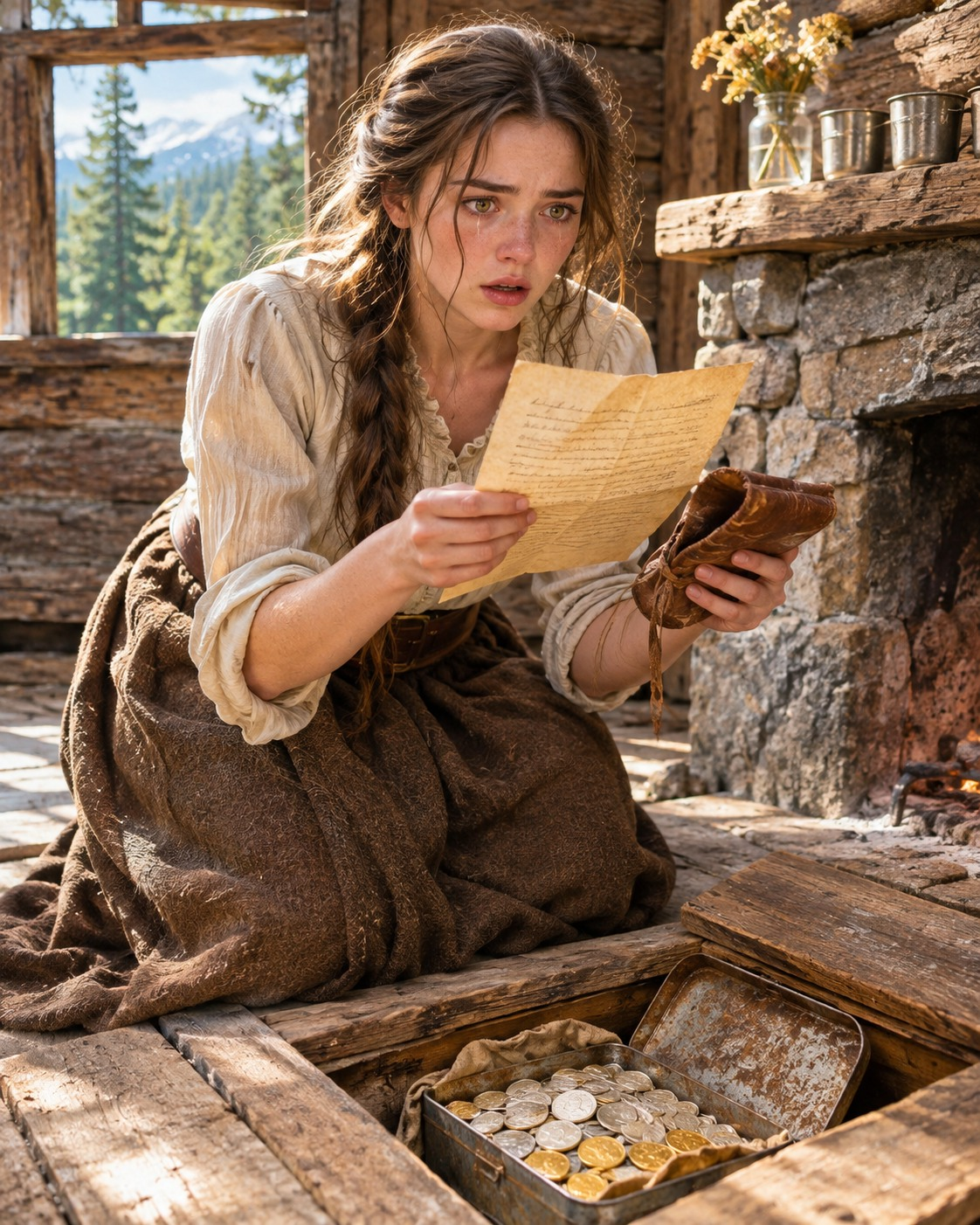
"Put that locket down, Alara."
Samuel Cain stood in the doorway with a rifle pointed at his daughter's chest.
For nineteen years, Alara had believed her father was a man who had lost everything.
Now, looking at the weapon in his hands, she wondered whether he had spent those years protecting something far more valuable than his family.
"Father?"
Her voice barely carried across the room.
Samuel did not answer.
His eyes moved from the silver locket in her hand to the open tin box beside her knees.
The moment he saw the gold coins, his expression changed.
Not surprise.
Recognition.
Alara noticed it immediately.
"You knew," she whispered.
Samuel shifted his weight against the doorway.
His injured leg had always made walking difficult. He usually leaned heavily on a wooden cane, but today the cane was tucked beneath his arm while both hands supported the rifle.
"Put the locket down."
"How did you find me?"
"That doesn't matter."
"You threw me out yesterday."
"Alara."
"You locked the door. Mother watched me leave. You gave me three dollars and told me to make my own arrangements."
His jaw tightened.
"And now you're standing in my house with a rifle."
Samuel glanced around the cabin.
"Your house?"
"Yes."
"Don't be foolish."
Alara reached toward the folded deed lying beside her wooden crate.
"I bought it. Forty acres. The county recorded my name yesterday."
Samuel's face darkened.
"From Hadley?"
"Yes."
"That miserable old fool."
Alara felt something cold settle in her stomach.
Her father knew the county assessor.
He knew the property.
And somehow, he had followed her to a place she had never visited before.
"Why are you here?" she asked.
Samuel stepped inside.
The floorboards groaned beneath his boots.
"Because you have no idea what you've gotten yourself into."
"Then explain it."
"First, give me that locket."
Alara looked down.
The small silver object rested against her palm.
Inside was the miniature portrait of a child wearing a blue ribbon.
She remembered that ribbon.
It had been tied around her hair on her sixth birthday.
Her grandmother had given it to her, telling her that blue suited her eyes.
But the portrait looked older than that memory.
The child couldn't have been more than three.
And beneath the tiny painting was a name she had never heard anyone call her.
Elara Holm.
Only one letter separated it from the name she had carried all her life.
Alara Cain.
Elara Holm.
Her fingers closed around the locket.
"Who is Elara Holm?"
Samuel's expression hardened.
"Nobody you need to concern yourself with."
"Then why does she look like me?"
"Children resemble one another."
"Why did Annika Holm write my name in a letter eleven years ago?"
His eyes flickered.
It was a small movement.
But Alara saw it.
"Where is the letter?"
She said nothing.
Samuel raised the rifle slightly.
"Alara, I'm not going to ask again."
For the first time since he entered, fear moved through her.
Not the ordinary fear she had known as a child when her father came home angry.
This was different.
He had brought a weapon.
He had traveled miles into the mountains despite an injured leg.
And he was standing over a box of hidden money demanding a letter written by a missing woman.
Whatever he wanted, it mattered enough to frighten him.
Alara slowly placed the locket on the floor.
Then she laid the letter beside it.
Samuel exhaled.
"Good girl."
The words made her skin crawl.
He stepped forward and reached for the papers.
Alara moved her hand over them.
"Tell me what happened on October seventeenth."
Samuel froze.
The silence was immediate.
Even the faint crackling from the fireplace seemed suddenly loud.
"What did you say?"
"October seventeenth."
His face lost color.
"Where did you hear that date?"
"It's in the letter."
Samuel stared at her.
For a moment, Alara thought he might lower the rifle and finally tell her the truth.
Instead, he said something that changed the way she saw him forever.
"That woman should have burned everything before she disappeared."
Alara's heart pounded.
"What woman?"
Samuel looked at the letter.
"Annika Holm."
"You knew her?"
He gave a bitter laugh.
"Everybody knew Annika."
"Not everybody came looking for her belongings eleven years later."
His eyes narrowed.
"You've become very bold."
"I've become homeless."
"Watch your tongue."
Alara stood slowly.
She was careful not to make sudden movements.
Her grandmother had taught her that frightened animals could be dangerous, especially when cornered.
She had never imagined using that lesson against her own father.
"Why did you throw me out?" she asked.
Samuel looked confused by the question.
"What?"
"Yesterday morning. Why?"
"You know perfectly well."
"No. I know what you wrote on the door. I know you refused to speak to me. I know Mother watched me leave. But I don't know why."
Samuel's grip tightened around the rifle.
"You were becoming a burden."
"Then why follow me?"
He looked away.
Alara took one careful step toward him.
"You didn't come because you were worried about me."
"Stay where you are."
"You came because you knew I might find this place."
His silence answered her.
Alara glanced toward the box.
The coins caught the sunlight.
"Did you know about the money?"
Samuel's face changed again.
"How much is there?"
She stared at him.
"That's what you want to know?"
"Answer me."
"I haven't counted it."
He moved toward the box.
Alara stepped between him and the fireplace.
Samuel stopped.
"Move."
"No."
"Alara, don't make me regret coming here."
She looked directly at the rifle.
"Are you going to shoot me?"
He said nothing.
"Your own daughter?"
His mouth opened.
Then closed.
For one terrible second, Alara saw something she had never noticed before.
Her father did not look angry because she had disobeyed him.
He looked angry because she had asked a question he couldn't answer.
She lowered her voice.
"Am I your daughter?"
Samuel went completely still.
The rifle trembled slightly in his hands.
Alara had not intended to ask the question.
It had risen from somewhere deeper than thought.
From the strange locket.
From the letter.
From her grandmother's final warnings.
From nineteen years of feeling like a stranger in her own family.
Samuel swallowed.
"Of course you are."
The answer came too quickly.
"Then why does Annika Holm call me her daughter?"
"Because she was a disturbed woman."
"She knew my name."
"Your grandmother talked too much."
"She knew about October seventeenth."
Samuel's face tightened.
"Enough."
"She left a portrait of me."
"Enough!"
His shout echoed through the cabin.
Alara flinched.
Samuel saw it.
For a moment, something resembling satisfaction crossed his face.
It was the same expression he had worn whenever his anger silenced an argument at home.
But Alara did not lower her eyes.
She had spent her childhood obeying him.
She had spent her adolescence trying to please him.
And yesterday, after all those years, he had locked her out anyway.
There was nothing left for him to take from her.
Except the truth.
"You can shout," she said quietly. "But I'm still going to ask."
Samuel stared at her.
"That stubbornness came from Bett."
"Then she taught me something useful."
His expression twisted.
"Your grandmother filled your head with foolish ideas."
"She taught me how to survive."
"She taught you to question everything."
"Maybe because she knew you were lying."
Samuel took a sudden step forward.
Alara instinctively moved backward.
Her heel caught the edge of a loose floorboard.
She stumbled.
The rifle shifted.
A sharp metallic click filled the room.
Alara froze.
Samuel had cocked the hammer.
Neither moved.
For several seconds, she could hear nothing except her own breathing.
Then Samuel looked down at the weapon.
His expression changed.
He slowly lowered it.
"Don't make me do something we'll both regret."
Alara felt her stomach turn.
He had not said he would never hurt her.
He had warned her not to make him.
She looked at the open doorway.
The forest beyond it was bright with afternoon sunlight.
If she could get outside, she might be able to run.
But Samuel stood between her and the exit.
And his rifle was still loaded.
"Listen carefully," he said.
"The Holm property is dangerous."
"Because of the roof?"
"Because of what happened here."
"What happened?"
Samuel glanced toward the fireplace.
"Annika's husband, Henrik, died after a long illness. She wasn't the same afterward."
"Mr. Hadley said she disappeared."
"She ran away."
"Why?"
"Because she couldn't face what she'd done."
Alara waited.
Samuel seemed to regret speaking.
"What had she done?"
He shook his head.
"Some things are better left buried."
"Is that why you came? To keep them buried?"
He ignored her.
"Give me the letter. Give me the locket. I'll take care of the rest."
"And the money?"
Samuel's eyes shifted toward the tin box.
"That money doesn't belong to you."
"Whose is it?"
"Mine."
Alara almost laughed.
"You just said you didn't know how much was there."
"I don't have to explain my affairs to a child."
"I'm nineteen."
"And still foolish enough to buy a collapsing cabin."
"It's my cabin."
His expression hardened.
"You think a piece of paper makes you safe?"
Alara looked toward the deed.
"That's what the county says."
"The county makes mistakes."
"Then take it up with Mr. Hadley."
Samuel moved so suddenly that she barely had time to react.
He seized the deed from beside her crate.
Alara lunged forward.
"Give that back!"
He pulled it away.
"Stay out of this."
"That's mine!"
Samuel held the paper over the fireplace.
A small flame flickered beneath the stone mantel.
Alara stopped breathing.
"Father, don't."
"You're coming home."
"No."
"You're going to forget this place."
"No."
"And you're going to stop asking questions about Annika Holm."
Alara stared at the deed.
Her name was written on it.
The first thing she had ever owned.
Samuel lowered one corner toward the flames.
She moved before she could think.
Grabbing his wrist with both hands, she pulled it away from the fire.
The rifle slipped against his shoulder.
Samuel shouted.
His injured leg buckled.
They stumbled against the hearth.
The deed fell between them.
The rifle struck the stone floor.
A deafening explosion tore through the cabin.
Alara dropped to her knees.
For an instant, she thought she had been shot.
Her ears rang.
Smoke drifted from the rifle barrel.
A splintered hole appeared in the wooden wall behind her.
Samuel had fallen against the fireplace.
He stared at the weapon in horror.
Neither spoke.
Then Alara realized she was unharmed.
She looked down at her hands.
No blood.
No wound.
Only trembling fingers.
Samuel reached for the rifle.
Alara moved first.
She grabbed it by the stock and pulled it across the floor.
"Alara!"
She stood, holding the weapon awkwardly.
Her grandmother had taught her how to handle a hunting rifle.
She knew enough to keep the barrel pointed away from both of them.
"Stay there."
Samuel stared at her.
"You wouldn't dare."
"Don't make me find out."
His face darkened.
"You point that thing at me, and you'll regret it."
"I'm not pointing it at you."
She kept the barrel toward the floor.
"I'm making sure you can't point it at me again."
Samuel tried to stand.
Pain crossed his face.
He leaned against the stone mantel.
"You're behaving like a madwoman."
Alara looked at the hole in the wall.
"You brought a loaded rifle into my house."
"I never meant—"
"Stop."
The word surprised them both.
She had never spoken to him that way.
Not once.
Samuel fell silent.
Alara took a breath.
Then another.
"You're leaving."
His eyes widened.
"What?"
"Get out."
"You can't order me around."
"Yes, I can."
"Alara—"
"You threw me out of your home. You don't get to come into mine and threaten me."
Samuel stared at her.
Something ugly moved behind his eyes.
But he was injured.
The rifle was out of his reach.
And the open doorway stood several feet behind him.
Finally, he gave a bitter laugh.
"You think you've won something?"
Alara said nothing.
"You have no idea what that land is worth."
"Then why did nobody buy it?"
Samuel's smile vanished.
He looked toward the tin box.
"Because the people who knew its history were smart enough to stay away."
Alara waited until he had moved toward the doorway before lowering the rifle.
Samuel stopped at the threshold.
"You'll come crawling back before winter."
"Maybe."
"You can't repair that roof alone."
"I can try."
"You don't have money for supplies."
She glanced at the coins.
Samuel noticed.
His expression hardened.
"Don't spend a single piece of that gold."
"Why?"
"Because it isn't yours."
"Then tell me whose it is."
He said nothing.
"Tell me why Annika Holm knew my name."
Silence.
"Tell me who Elara Holm was."
Samuel's face went pale.
For a moment, his eyes looked almost frightened.
Then he spoke so quietly that she nearly missed the words.
"That name was supposed to die with her."
Alara felt the air leave her lungs.
"With Annika?"
Samuel looked toward the forest.
"Burn the letter," he said. "It's the only decent thing you can do."
Then he stepped outside.
Alara watched him descend the narrow trail.
His injured leg made every step uneven.
Twice, he stopped and looked back.
But he did not return.
Only when he disappeared among the trees did Alara close the door.
She stood against it for a long time.
Then her knees gave way.
She sank onto the floor.
And began to shake.
The tears came without warning.
Not because she wanted her father back.
Not because she regretted ordering him out.
She cried because she finally understood how close she had come to dying.
The rifle had fired inches from her body.
A different angle.
A single step.
A moment of bad luck.
And the letter would have remained unfinished in her hands.
Alara covered her mouth.
She remembered her father's expression when she asked whether she was his daughter.
The hesitation.
The fear.
The way he had looked at the locket.
Something was terribly wrong.
She sat until the trembling eased.
Then she stood.
Her first task was securing the cabin.
The front door hung crookedly, but the heavy wooden bar inside remained intact.
She fitted it into place.
Next, she checked the windows.
One could be closed with a damaged shutter.
Another needed a temporary covering.
She found a loose plank near the kitchen and wedged it against the frame.
It wasn't much.
But it would slow anyone trying to enter.
Then she examined the rifle.
The shot had discharged, but she could not assume the weapon was empty.
Following Bett's lessons, she carefully checked the chamber and removed the remaining ammunition.
She placed the cartridges inside a tin cup and hid them separately from the rifle.
Only then did she return to the fireplace.
The deed lay on the floor.
One corner had been scorched.
Alara picked it up.
The paper was damaged, but her name remained legible.
ALARA CAIN — OWNER.
She pressed the document against her chest.
Samuel had tried to destroy it.
But he had failed.
For the second time in two days, she had been forced to defend her right to exist somewhere.
And for the first time, she had succeeded.
Alara spent the next hour examining the contents of the tin box.
She spread a clean section of her grandmother's blanket across the floor.
Then she carefully arranged the coins.
There were forty-seven silver pieces.
Twelve gold coins.
Several smaller denominations.
And one unusual coin bearing a mark she did not recognize.
She had never handled so much money.
The temptation to count its value was overwhelming.
But she forced herself to focus.
The money was important.
The letter was more important.
She unfolded Annika Holm's pages again.
The handwriting was elegant but uneven toward the end.
The first portion described the homestead.
Annika had written about planting apple trees beside the eastern fence.
About Henrik building the stone fireplace.
About the terrible winter when their well froze and they survived by melting snow.
There was affection in those memories.
Real affection.
Alara could almost imagine the couple sitting beside the fire, planning a future they believed would last forever.
Then the tone changed.
Henrik believed a person's word was worth more than a signed document. I loved him for that. In the end, it was the weakness that destroyed us.
Alara read the sentence twice.
Below it, Annika described a disagreement over money.
Someone had borrowed against property that did not belong to him.
Someone had used Henrik's trust to secure an arrangement that could ruin the homestead.
The names were missing from the first pages.
Perhaps deliberately.
Then came a reference to a child.
I never imagined that loving her would require me to surrender everything.
Alara's throat tightened.
She turned the page.
Bett says the child must remain where she is until the danger passes. I have agreed because I trust Bett more than anyone living. But I will not allow them to erase her name.
Alara stared at the words.
The child.
The name.
The locket.
Her hands began trembling again.
She turned to the final page.
If Bett Pruitt has kept her promise, the child will one day find what I have hidden here.
Then the warning.
Do not show this to Samuel Cain.
And finally:
If he tells you I abandoned you, ask him what happened on the night of October seventeenth.
Alara closed her eyes.
Her father had said Annika ran away.
But the letter suggested something else.
A woman trying to protect a child.
A trusted friend named Bett.
And a man whose name appeared in a warning written eleven years ago.
She looked at the locket.
Elara Holm.
For years, she had wondered why her grandmother sometimes called her "little Ellie."
Her mother had always disliked the nickname.
Once, when Alara was seven, she had asked why.
Her mother had dropped a plate.
The porcelain shattered across the kitchen floor.
Samuel had entered and demanded to know what happened.
When Alara repeated the question, he had slapped the table so hard that she jumped.
"Her name is Alara. That's the end of it."
She had never asked again.
Until now.
By late afternoon, Alara knew she needed help.
She could repair a roof.
She could sharpen tools.
She could survive a winter if she had enough time to prepare.
But she could not untangle eleven years of lies alone.
And she certainly could not protect herself if Samuel returned with another weapon.
James Hadley was the only person she knew in Corbin Valley.
He had recognized her grandmother's name.
He had known about Annika.
And he had hesitated before selling her the property.
Perhaps he knew more than he had admitted.
Alara carefully folded the letter.
She wrapped the locket in a clean piece of cloth.
Then she returned most of the coins to the tin box.
She considered hiding everything beneath the floor again.
But Samuel knew about the compartment now.
If he returned, it would be the first place he searched.
Instead, she carried the box into the kitchen.
Beneath a narrow shelf, she found a loose stone in the wall.
She examined the mortar.
Old.
Cracked.
The stone moved when she pressed it.
Behind it was a small gap.
Large enough for the box.
Alara slid it inside.
Then replaced the stone.
She brushed dust across the edges until the hiding place looked undisturbed.
The letter and locket she kept with her.
Before leaving, she examined the damaged door once more.
She needed to secure it better.
But there was no time.
If she started immediately, she could reach Corbin Valley before dark.
She lifted her wooden crate, then reconsidered.
It was too heavy for the journey.
Instead, she took her grandmother's knife, the deed, the letter, and two silver coins.
She tucked them into the folds of her clothing.
Then she stepped outside.
The forest seemed different now.
That morning, the trees had looked welcoming.
Their tall branches had surrounded a place she could finally call home.
Now every movement in the undergrowth made her stop.
Every snapping twig sounded like a footstep.
Samuel had followed her once.
He could follow her again.
Alara kept to the narrow trail.
She walked quickly.
At the first bend, she noticed something strange.
A fresh boot print marked the damp earth beside the creek.
She crouched.
The impression was deep.
A man's boot.
Larger than Samuel's.
And the heel had a distinctive triangular repair.
Alara frowned.
She looked farther down the path.
Another print.
Then another.
Someone had walked toward the cabin recently.
Someone other than her father.
She stood slowly.
The forest was quiet.
Too quiet.
She considered returning to the cabin.
But what would she do there?
Hide behind a broken door?
Wait for someone to come?
She continued toward town.
Half a mile later, she found a second set of tracks.
These belonged to a horse.
The animal had been tied beside a fallen pine.
The ground showed where it had shifted its weight.
A small piece of dark blue fabric clung to a branch nearby.
Alara touched it.
Fine wool.
Not the kind worn by a poor traveler.
Someone had come into these mountains wearing expensive clothing.
Someone had stopped close enough to the homestead to observe it.
Her stomach tightened.
She released the fabric and hurried onward.
The sun was low when she reached the outskirts of Corbin Valley.
Smoke rose from chimneys.
A wagon rattled along the main street.
The blacksmith's hammer rang against hot iron.
Ordinary sounds.
Comforting sounds.
Alara had never been so relieved to see a town.
She went directly to the land office.
The door was closed.
A notice hung beside the entrance.
OFFICE HOURS: SUNRISE TO FOUR.
Alara knocked anyway.
No answer.
She tried again.
"Mr. Hadley?"
Silence.
She stepped backward.
Perhaps he had gone home.
She turned toward the blacksmith's shop.
The man who had allowed her to sleep in his shed stood outside, wiping his hands on a rag.
He recognized her.
"Well, look who's back. How's the mountain palace?"
Alara tried to smile.
"Still standing."
"That's more than I expected."
"Do you know where Mr. Hadley lives?"
The blacksmith's expression changed.
"Why?"
"I need to speak with him."
"About the Holm property?"
She nodded.
He looked toward the land office.
Then lowered his voice.
"Miss, I'd be careful asking questions about that place."
Alara felt a familiar chill.
"Why does everyone keep saying that?"
The blacksmith hesitated.
"Because people who ask questions about the Holms have a habit of regretting it."
"Did you know Annika?"
He glanced down the street.
"Everybody knew Annika."
"Then tell me something about her."
"Like what?"
"Did she have a daughter?"
The blacksmith went still.
His rag stopped moving.
For a moment, he simply stared at her.
Then he said, "Who told you that?"
Alara's heart began pounding.
"Did she?"
He looked toward the street again.
"Miss Cain, you need to go home."
"I don't have a home in town."
"Then go back to the cabin."
"Why?"
"Because some things are safer left alone."
Alara felt anger rise.
She had heard enough warnings.
Enough evasions.
Enough people telling her what she should not know.
"Please," she said. "I'm asking you because I think someone has lied to me my entire life."
The blacksmith's expression softened.
He opened his mouth.
Then stopped.
His eyes moved past her shoulder.
Alara turned.
A dark carriage stood across the street.
Its polished wooden panels reflected the evening light.
Two horses waited in front.
A driver sat motionless above them.
Beside the carriage stood a tall man in a charcoal coat.
His boots were clean.
His gloves were black.
And a dark blue wool scarf hung around his neck.
Alara remembered the fabric caught on the branch.
The triangular repair on the boot print.
She looked down.
The man's right heel bore a distinctive patch.
Her blood went cold.
He had been near her cabin.
The stranger looked directly at her.
Then he smiled.
Not warmly.
Not kindly.
Like a man who had finally found something he had been searching for.
The blacksmith stepped closer.
"Don't speak to him," he whispered.
"Who is he?"
The blacksmith swallowed.
"Edmund Vale."
"Who?"
"A man who claims the Holm property was promised to his family."
Alara stared at the stranger.
Edmund Vale crossed the street.
He moved with the confidence of someone accustomed to being obeyed.
When he reached them, he removed one glove.
"Miss Cain, I presume."
Alara said nothing.
He smiled again.
"James Hadley tells me you've made a rather unfortunate purchase."
The blacksmith stiffened.
Alara looked toward the closed land office.
"You spoke to Mr. Hadley?"
"This afternoon."
"Where is he?"
Vale's smile faded.
"I'm afraid Mr. Hadley is unavailable."
"What does that mean?"
"It means you and I should have a conversation."
Alara stepped backward.
"I don't know you."
"No. But I knew Annika Holm."
Her heart jumped.
Vale noticed.
"Ah," he said softly. "So you've found something."
Alara kept her expression still.
"I don't know what you're talking about."
"Of course not."
He looked toward the blacksmith.
"Would you excuse us?"
The blacksmith did not move.
Vale's eyes hardened.
"I wasn't asking."
For several seconds, neither man spoke.
Then the blacksmith slowly stepped back.
Alara felt suddenly alone.
Vale turned toward her.
"Miss Cain, the property you purchased contains certain items that do not legally belong to you."
"What items?"
"Documents."
She said nothing.
"Personal effects."
Still she said nothing.
"And money."
Alara felt her stomach tighten.
Vale watched her carefully.
"Have you found anything beneath the floor?"
She forced herself to breathe.
"No."
He studied her face.
Then he leaned closer.
"Your father is a very frightened man."
Alara froze.
"You've spoken to him?"
"Samuel and I have known each other a long time."
"Then you can ask him whatever you want."
Vale's smile returned.
"Oh, I already have."
He reached into his coat.
Alara instinctively stepped backward.
But he withdrew only a folded piece of paper.
He held it out.
"Perhaps this will help you understand."
She did not take it.
"What is that?"
"A copy of an old county record."
"About the land?"
"About you."
Alara stared at the document.
Vale unfolded it.
A name appeared near the top.
ELARA HOLM.
Beneath it was a date.
October seventeenth.
Eleven years earlier.
And below that, in dark ink, were the words:
CHILD DECLARED DECEASED.
Alara stopped breathing.
Vale watched her reaction.
"Interesting, isn't it?"
She stared at the paper.
The name from the locket.
The date from the letter.
A record declaring that a child had died.
But Alara was standing there.
Alive.
She looked up.
"Where did you get that?"
Vale folded the document.
"From a place your grandmother tried very hard to keep hidden."
"What does it mean?"
His expression became serious.
"It means someone committed a terrible deception eleven years ago."
"Who?"
Vale looked toward the carriage.
Then back at her.
"That depends on which version of the story you believe."
Alara's hands trembled.
"Tell me the truth."
He shook his head.
"Not here."
"Why not?"
"Because people have died protecting it."
The blacksmith made a small sound behind her.
Vale ignored him.
Instead, he reached into his coat again.
This time, he removed a narrow envelope sealed with dark red wax.
Across the front was written a name.
ALARA CAIN.
The handwriting was familiar.
Alara had seen it only hours earlier.
On the yellowed letter beneath the cabin floor.
Annika Holm's handwriting.
Vale held the envelope between two fingers.
"Annika left more than one letter, Miss Cain."
Alara stared at it.
"Where did you find that?"
"Somewhere Samuel Cain hoped no one would ever look."
She reached for it.
Vale pulled it away.
"First, you need to understand something."
"What?"
"The woman you called Mother was never the woman who gave birth to you."
Alara felt the street sway beneath her feet.
She looked at the envelope again.
Her name.
Annika's handwriting.
The red wax seal.
Then she noticed something scratched into the wax.
A tiny symbol.
A cedar tree.
The same symbol engraved inside the silver locket.
Vale lowered his voice.
"There's one more thing Annika wanted you to know."
He broke the seal.
Unfolded the paper.
And read the first line.
"To my daughter, Elara, if you are holding this letter, then the man who claimed to be your father has already—"






Comments 0