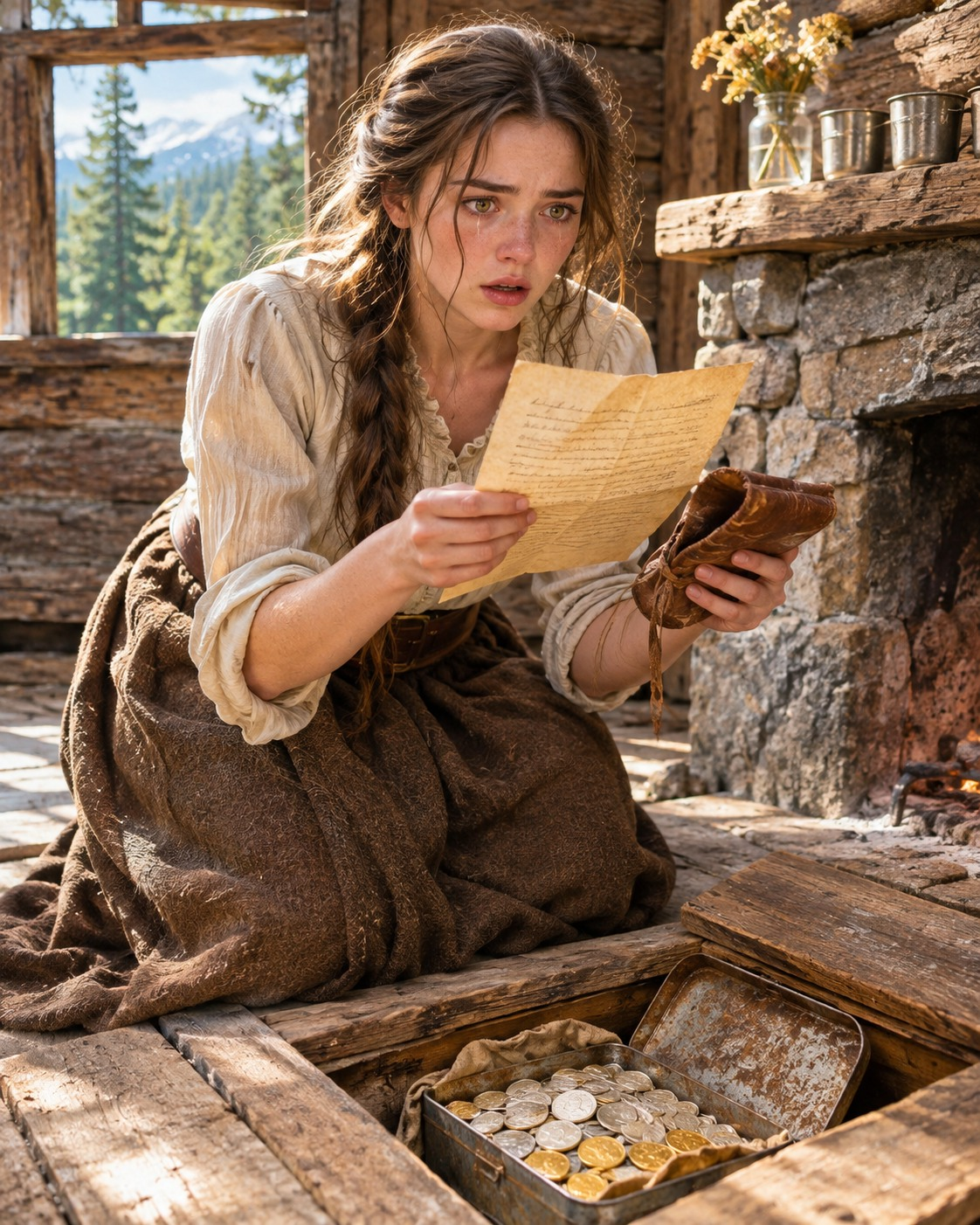
"Please hurry. They followed me."
The woman's voice came through Ruth Bell's front door.
Alara Cain stood frozen beside the kitchen table.
For eleven years, everyone in Corbin Valley had believed Annika Holm had disappeared.
For seven of those years, no one had received a single letter from her.
Now a woman was standing outside Ruth's farmhouse, claiming to be the mother Alara had spent her entire life believing was dead.
Ruth reached for the latch.
Alara caught her wrist.
"Wait."
Ruth turned.
"What?"
"How do we know it's her?"
The older woman's eyes filled with tears.
"I know that voice."
"Eleven years is a long time."
Ruth hesitated.
Outside, the woman knocked again.
"Ruth, please. I can't stay here."
Alara stepped toward the door.
Her grandmother's bone-handled knife rested against her hip.
She did not draw it.
Instead, she asked a question.
"What did Bett Pruitt give me when I was little?"
Silence.
Then the woman outside answered.
"A blue ribbon."
Alara's breath caught.
The voice continued.
"She bought it at the spring market. You wore it until the color faded."
Ruth covered her mouth.
Alara felt her knees weaken.
But she forced herself to ask another question.
"What did my father make for me?"
A pause.
Then a broken whisper.
"A wooden horse."
Tears blurred Alara's vision.
"He carved your name underneath it. You called him Papa Hen because you couldn't say Henrik."
Alara stepped backward.
The little wooden horse was hidden inside her clothing.
The woman outside knew.
She knew things no stranger should know.
Ruth lifted the latch.
The door opened.
And Annika Holm stepped into the house.
She was thinner than Alara expected.
Her dark hair, once described in Bett's stories as thick and beautiful, was streaked with silver.
Deep lines marked the corners of her eyes.
Her dress was plain and badly worn.
A dark bruise covered one wrist.
She looked like a woman who had spent years surviving rather than living.
But her eyes—
Alara recognized them immediately.
They were her own.
Annika stared at her.
For several seconds, neither woman moved.
Then Annika raised one trembling hand.
"Elara?"
Alara's throat tightened.
No one had called her that name with such tenderness before.
She tried to speak.
Nothing came.
Annika took one uncertain step forward.
"My little girl."
Alara felt something break inside her.
She had imagined this moment only since discovering the locket.
She had imagined anger.
Questions.
Accusations.
She had imagined demanding to know why her mother had left her.
But standing before this exhausted woman, she saw something that made every prepared question disappear.
Annika was terrified.
Not of Alara.
Of losing her again.
"Is it really you?" Alara whispered.
Annika nodded.
"I never stopped looking for you."
The words were barely audible.
Alara stepped forward.
Then stopped.
Nineteen years of life stood between them.
A childhood Annika had missed.
Birthdays.
Illnesses.
Winters.
The day Bett died.
The morning Samuel locked the boardinghouse door.
How could one embrace repair so much absence?
Annika seemed to understand.
She lowered her hand.
"You don't have to call me Mother."
Alara stared at her.
"I don't know what to call you."
"Annika is enough."
A tear slid down Annika's cheek.
"Just let me look at you."
Alara nodded.
Annika studied her face.
Her eyes.
Her mouth.
The shape of her chin.
Then she smiled through her tears.
"You have Henrik's expression when you're trying not to cry."
That did it.
Alara stepped into her arms.
Annika held her tightly.
Not with the certainty of someone claiming what belonged to her.
But with the desperate relief of someone who had spent eleven years fearing she would never hold her child again.
Alara buried her face against Annika's shoulder.
For the first time in her life, she understood what it felt like to be missed.
Ruth closed the door.
Then she pulled the curtains across the windows.
"We need to move quickly," she said.
Annika stepped away from Alara.
"They know I escaped."
"Who?"
"Vale's men."
Alara's expression hardened.
"Edmund Vale?"
Annika nodded.
"He had me moved three days ago. They were taking me somewhere farther north."
"Why?"
"Because someone had purchased East Fork."
Alara felt cold.
"Me."
Annika stared at her.
"What?"
"I bought the homestead."
Ruth looked between them.
"Annika, sit down."
But Annika remained standing.
"You bought our home?"
Alara nodded.
"For two dollars and eighty cents."
Annika covered her mouth.
A strange sound escaped her.
Half laughter.
Half sob.
"Two dollars and eighty cents."
She shook her head.
"Henrik spent twenty-one years building that place."
Alara swallowed.
"The roof needs work. But the foundation is sound."
Annika looked at her.
Then, unexpectedly, she laughed.
A real laugh.
Soft.
Broken.
Beautiful.
"That's exactly what Bett would have said."
Alara felt tears rise again.
"She taught me."
Annika reached for her hand.
"Of course she did."
Ruth guided them toward the table.
"Sit. Both of you. We need to understand what happened."
Annika lowered herself into a chair.
Her hands trembled so badly that Ruth had to help her hold a cup of water.
Alara sat opposite her.
For a moment, she simply watched.
This woman was her mother.
Not a portrait.
Not a name in an old letter.
Not a mystery hidden beneath floorboards.
A living person.
And someone had spent eleven years keeping them apart.
"Where have you been?" Alara asked.
Annika stared into her cup.
"At first, a private hospital outside Briar County."
Ruth nodded.
"That's where your letters came from."
Annika looked at her.
"You received them?"
"Until seven years ago."
Annika closed her eyes.
"I wondered."
"What happened after that?" Alara asked.
"They moved me."
"Where?"
"An estate owned by a man named Dr. Silas Mercer."
Ruth stiffened.
Alara noticed.
"Do you know him?"
"Only by reputation," Ruth said.
Annika's expression darkened.
"He was no doctor."
She gripped the cup.
"He wore the title. He kept records. He gave orders. But the place was a prison."
Alara leaned forward.
"Did he hurt you?"
Annika looked at her daughter.
For a moment, she seemed to consider lying.
Then she shook her head.
"Not in the ways you may imagine."
She paused.
"He kept me isolated. He told me you were dead. He said Bett had confessed to burying you beside the river."
Alara felt sick.
"He told you I died?"
"Every year."
Annika's voice trembled.
"Every birthday, I asked about you. Every year, they told me there was no child left to find."
Ruth wiped her eyes.
Annika continued.
"After a while, I stopped asking aloud."
"Why?"
"Because every question cost me something."
Alara reached across the table.
Annika took her hand.
"But I never believed them."
"How could you know?"
Annika's eyes filled.
"Because Bett promised me she would keep you alive."
Alara looked down.
Her grandmother.
The woman who had taught her to repair roofs and sharpen blades.
The woman who had insisted that survival mattered more than comfort.
She had been keeping a promise.
A promise Alara had never known existed.
"How did you escape?" Ruth asked.
Annika looked toward the window.
"Three days ago, two men arrived with transfer papers."
"Transfer to where?"
"I don't know. They said I was being moved beyond the state line."
Alara's stomach tightened.
"Because I bought the property?"
"That must have been the reason."
Annika continued.
"They put me in a covered wagon. We traveled most of the day. Near the northern crossing, one of the horses broke its harness."
"What happened?"
"The driver stopped to repair it. The second man went looking for water."
"And you ran?"
Annika nodded.
"I slipped through the rear canvas and climbed down the embankment."
"How did you get here?"
"I walked."
Alara stared at her.
"All the way?"
"Two nights. I hid during daylight."
Ruth shook her head.
"You could have died."
Annika looked at Alara.
"I had already lost eleven years."
Her voice became steady.
"I wasn't going to lose another day."
A sudden sound came from outside.
All three women froze.
A horse snorted.
Then footsteps crossed the yard.
Ruth stood.
"Stay here."
She moved toward the window.
Alara reached for her knife.
Annika gripped her hand.
"Don't."
Alara looked at her.
"They might be coming."
"I know."
"Then we have to protect ourselves."
Annika's expression became serious.
"Your grandmother taught you how to survive?"
"Yes."
"Then remember the first rule."
Alara frowned.
"What first rule?"
Annika whispered, "Never fight a battle when you can make the enemy fight the wrong one."
Alara stared at her.
The words sounded like Bett.
Ruth returned from the window.
"It's only my neighbor's horse."
She exhaled.
"But we can't stay here."
Annika nodded.
"Vale will search every house connected to Bett."
Alara looked at Ruth.
"Then where do we go?"
Ruth hesitated.
"There is one place."
"Where?"
"The old meetinghouse beyond the western ridge."
Annika's face changed.
"Is it still standing?"
"Yes."
"Then perhaps Bett's plan can still work."
Alara looked between them.
"What plan?"
Neither answered immediately.
Finally, Ruth said, "Your grandmother left instructions."
Alara felt her heartbeat quicken.
"What instructions?"
Ruth stood and crossed the room.
From a cupboard beneath the stairs, she removed a narrow wooden chest.
The chest was old.
Its corners were reinforced with iron.
A small brass lock secured the lid.
Alara stared at it.
"What's that?"
Ruth placed it on the table.
"Bett brought this to me three weeks before she died."
Alara felt a strange pressure in her chest.
"She never told me."
"She made me promise not to open it unless you came asking about Annika."
Ruth reached into her apron.
She removed a key.
Then paused.
"Alara, before we open this, you need to understand something."
"What?"
"Bett knew you might one day be forced out of Samuel's house."
Alara went still.
"How?"
Ruth looked at Annika.
Then back at Alara.
"Because she knew Samuel's debts were coming due."
Alara stared at the chest.
Her grandmother had known.
She had known Samuel might throw her out.
She had known the truth about Annika.
She had known the homestead was waiting.
And she had said nothing.
Anger rose unexpectedly.
"Why didn't she tell me?"
Ruth's expression softened.
"Because she was trying to keep you alive."
"Everyone keeps saying that."
Alara stood.
"Everyone keeps telling me they lied because they wanted to protect me."
Annika lowered her eyes.
Alara continued.
"Samuel lied. Margaret lied. The county records lied. And now you're telling me Bett knew everything."
Ruth said nothing.
Alara's voice shook.
"She was the only person I trusted."
Annika reached for her.
"Elara—"
"No."
Alara stepped backward.
"Please don't tell me she had no choice."
Annika slowly lowered her hand.
Alara looked toward the window.
She remembered Bett sitting beside the stove, sharpening a knife.
She remembered the old woman's rough hands.
Her quiet voice.
Her strange questions about the western mountains.
Had every lesson been preparation?
Had every warning been part of a secret plan?
Alara felt betrayed.
Then ashamed for feeling betrayed.
Bett had loved her.
That much she knew.
But love had not prevented the lies.
Ruth waited until Alara's breathing steadied.
Then she spoke.
"Bett wanted to tell you when you turned eighteen."
Alara turned.
"What stopped her?"
"Samuel."
The room fell silent.
Ruth continued.
"He found out she had contacted a lawyer. He threatened to have you taken away if she revealed the truth."
Alara stared.
"Taken where?"
"To the same institution where Annika was being held."
Annika closed her eyes.
Ruth's voice became quiet.
"Bett believed him."
Alara felt cold.
"Did he have that much power?"
"Not alone."
"Vale."
Ruth nodded.
"Vale had friends in the county offices. Judges. Physicians. Men who owed him favors."
Alara sat slowly.
For the first time, she understood the size of the trap.
Her grandmother had not been hiding a simple family secret.
She had been protecting a child from men who could erase names from records and imprison women without trial.
And Bett had been doing it alone.
Ruth inserted the key into the chest.
The lock clicked.
She lifted the lid.
Inside were several folded papers, a small leather pouch, and a sealed envelope.
Across the envelope was written:
For Elara, when she is finally safe.
Alara recognized the handwriting.
Bett.
Her grandmother's strong, uneven letters.
Ruth handed it to her.
Alara hesitated.
Then broke the seal.
The paper inside smelled faintly of cedar.
She unfolded it.
My darling girl,
If you are reading this, then I have failed to tell you the truth with my own voice.
Alara's eyes filled immediately.
I wanted to tell you every day.
When you learned to walk, I wanted to tell you whose hands first held you.
When you learned to read, I wanted to show you your mother's letters.
When you asked why Samuel never looked at you with kindness, I wanted to tell you that his cruelty had nothing to do with your worth.
Alara pressed a hand against her mouth.
The words blurred.
She forced herself to continue.
But I was afraid.
Not of Samuel.
Not of Edmund Vale.
I was afraid of what they would do to you if they knew you understood who you were.
A tear fell onto the paper.
So I taught you what I could.
I taught you to repair what others abandoned.
I taught you to recognize strong timber beneath a broken roof.
I taught you that a person's value is not decided by the people who refuse to love them.
Alara began crying silently.
Annika reached across the table and held her free hand.
Alara continued reading.
You were never unwanted, Elara.
You were loved before you were born.
Your father built a cradle from cedar.
Your mother sang to you every night.
And when they came to take you, I carried you through the cellar passage while your mother stayed behind to save your life.
Alara closed her eyes.
She could almost see it.
A frightened eight-year-old girl.
A dark tunnel.
Bett carrying her away.
Annika standing between her daughter and the men who wanted the property.
Alara opened her eyes and read the final paragraph.
There is one truth I have not written in the county records.
The land at East Fork was never meant to belong to Edmund Vale.
Henrik knew this.
Annika knew this.
And I know where the proof is hidden.
Alara's heart began pounding.
The next sentence was underlined.
The answer is not in the cabin.
She looked up.
Ruth watched her carefully.
Alara returned to the letter.
Go to the old meetinghouse beyond the western ridge.
Find the cedar tree marked with four cuts.
Beneath its roots is a stone box.
Inside is the name of the person who can destroy Edmund Vale's claim forever.
Alara lowered the letter.
"A stone box?"
Ruth nodded.
"Bett showed me the tree years ago."
"Did you open it?"
"No."
"Why not?"
"Because she told me it was for you."
Alara looked at Annika.
Her mother seemed equally stunned.
"Bett never told me about a stone box."
Ruth folded her hands.
"She had her reasons."
Alara looked down at the letter.
For the first time, she did not feel angry at Bett.
She felt the weight of what the old woman had carried.
For eleven years, Bett had protected a child.
For eleven years, she had waited.
And when death approached, she had prepared a path that might finally lead that child home.
They left Ruth's farmhouse shortly after sunset.
Ruth packed bread, dried apples, and a small flask of water.
Annika wore one of Ruth's old coats.
Alara carried the papers inside a cloth bundle tied beneath her skirt.
The three women followed a narrow path through the western woods.
Ruth led.
Annika walked beside Alara.
For a long time, neither spoke.
Then Annika said quietly, "I used to imagine what you would look like when you grew up."
Alara glanced at her.
"What did you imagine?"
"Sometimes I pictured you with Henrik's dark hair. Sometimes with mine."
She smiled faintly.
"I never imagined you would be taller than me."
Alara almost smiled.
"Samuel said I was too tall for a girl."
Annika's expression changed.
"Samuel said many things that were not true."
They walked in silence.
Then Alara asked, "Did you ever stop loving Henrik?"
Annika looked surprised.
"Never."
"Even after eleven years?"
"Especially after eleven years."
Alara looked down at the path.
"What was he like?"
Annika's eyes softened.
"He was patient. Terrible at singing. He always burned the first pancake."
Alara laughed unexpectedly.
Annika smiled.
"He believed every problem could be solved with enough wood, enough nails, and enough time."
"That sounds like Bett."
"They argued constantly."
"About what?"
"Everything."
Annika laughed softly.
"Your grandmother thought he was too trusting. Henrik thought Bett was too suspicious."
"Who was right?"
Annika's smile faded.
"Bett."
Alara felt the answer settle between them.
Then Annika touched her arm.
"But Henrik was a good man."
Alara nodded.
"I wish I'd known him."
Annika squeezed her hand.
"You did."
Alara looked at her.
"You were eight when he died. You knew him for eight years."
The words struck her.
She had memories.
Somewhere.
Buried beneath fear and years of silence.
Perhaps they could return.
Perhaps one day, she would remember his voice without needing someone else to describe it.
The meetinghouse appeared near midnight.
It stood in a clearing surrounded by enormous cedar trees.
The building was small.
Its windows were boarded.
The roof sagged.
A stone path led toward the entrance.
Ruth stopped.
"We're here."
Alara looked around.
"Which tree?"
Ruth pointed toward the northern edge of the clearing.
"The largest one."
They approached.
The cedar towered above them.
Its trunk was wider than three people standing shoulder to shoulder.
Alara lifted the lantern.
Four cuts marked the bark.
One above the other.
Her heart quickened.
"Bett's symbol."
Annika touched the marks.
"Henrik made these."
Alara turned.
"How do you know?"
"He used the same pattern on the cradle."
The women knelt beside the roots.
Alara examined the soil.
One section looked different.
The stones were arranged too neatly.
She removed them.
Then began digging with her knife.
The earth was packed tightly.
It took nearly twenty minutes to uncover the edge of something solid.
Stone.
A rectangular box.
Alara brushed away the dirt.
Ruth helped lift it free.
The box was heavy.
A flat stone lid covered the top.
Alara's hands trembled.
She looked at Annika.
Her mother nodded.
"Open it."
Alara slid the knife beneath the lid.
The stone shifted.
She lifted it carefully.
Inside lay a small metal cylinder wrapped in oilcloth.
Alara removed it.
The cylinder was sealed at both ends.
One cap unscrewed.
She opened it.
Inside was a rolled parchment.
Alara unfolded the paper.
A legal document.
The ink was faded but readable.
At the top were the words:
Original Land Trust Declaration.
Below it appeared the names of several witnesses.
Alara read them slowly.
Henrik Holm.
Annika Holm.
Bett Pruitt.
James Hadley.
And one more name.
A name she did not recognize.
Elias Whitcomb.
Ruth gasped.
Annika's face drained of color.
Alara looked between them.
"Who is Elias Whitcomb?"
Neither answered.
Then Ruth whispered, "He was the county judge."
Alara frowned.
"Was?"
"He disappeared twenty years ago."
Annika shook her head.
"No. That's what Edmund told everyone."
Alara felt cold.
"What do you mean?"
Annika pointed toward the document.
"Elias Whitcomb witnessed the original trust. He knew Edmund's claim was false."
"Then where is he?"
Annika looked toward the dark meetinghouse.
Her voice became almost inaudible.
"Henrik helped him escape."
Alara stared.
"Escape from whom?"
"Edmund Vale."
A sudden sound interrupted them.
A door creaked.
All three women turned.
The meetinghouse entrance stood open.
A lantern glowed inside.
Ruth's face went pale.
"That building was empty when we arrived."
Annika stepped closer to Alara.
"Put the document away."
Alara folded it quickly.
Footsteps sounded from within the meetinghouse.
Slow.
Measured.
Approaching.
Then a man's voice spoke from the darkness.
"Annika Holm."
Annika froze.
The voice continued.
"I've been waiting twenty years for someone to bring me that document."
Alara gripped her knife.
A tall figure appeared in the doorway.
His face remained hidden beneath the brim of an old hat.
He stepped into the lantern light.
Ruth gasped.
Annika covered her mouth.
And the stranger said:
"My name is Elias Whitcomb. But before you trust me, there's something Bett Pruitt never told you about the night your father died."






Comments 0