"Open the door, Mother. I know you're standing there."
Alara Cain pressed her palm against the locked boardinghouse door.
Behind it, her father stood holding a folded document bearing the county seal.
Three words had been written across the bottom.
NOT YOUR DAUGHTER.
Alara understood that morning was not about money.
It was about something her family had been hiding.
"Mother?"
Her voice was quieter the second time.
The curtain moved.
For one brief moment, she saw the outline of a woman's face behind the thin fabric. Her mother's hand rose toward the window, then disappeared.
The door remained locked.
Alara stepped backward.
She was nineteen years old, and everything she owned was packed inside a wooden crate at her feet.
One plain dress.
Two pairs of wool stockings.
A blanket that had belonged to her grandmother.
A bone-handled knife.
And thirty copper coins.
Three dollars.
That was the entire value of the life her parents had decided she could take with her.
A handwritten notice had been nailed to the door.
Alara, your mother and I believe it is best if you make your own arrangements going forward.
No explanation.
No apology.
Not even a signature.
Alara read it twice, although she already knew every word.
Then she looked at the window again.
"Did you know he was going to do this?"
The curtain stopped moving.
That silence hurt more than the locked door.
Her father, Samuel Cain, had always been a man of few words. Before the accident, those words had usually been instructions.
Bring the water.
Stack the firewood.
Stay out of the way.
After the falling tree crushed his leg and left him unable to work the timber camps, his instructions had turned into accusations.
Alara had spent six years trying to make herself useful enough to deserve a place in his house.
She repaired broken furniture.
She carried coal.
She mended clothing.
She took whatever small jobs the neighbors offered.
When money was scarce, she ate last.
When the roof leaked, she climbed the ladder.
When her father needed medicine, she walked miles to fetch it.
Yet somehow, none of it had been enough.
Three nights earlier, she had overheard her parents arguing behind their bedroom door.
Her mother had been crying.
"We promised Bett we wouldn't do this."
Her father answered with a sentence Alara would remember for the rest of her life.
"Bett is dead. Promises to dead people don't feed the living."
At the time, Alara had assumed they were arguing about money.
Now she wasn't so certain.
She bent down and lifted her wooden crate.
The weight pulled against her tired shoulders.
A cold breeze slipped through the narrow street.
She had no destination.
No relatives willing to shelter her.
No employer expecting her.
And no idea where she would sleep that night.
But she had something her grandmother had taught her long before the world began treating her like a burden.
She knew how to survive.
Bett Pruitt had never been a gentle woman in the way other grandmothers were gentle.
She did not fill her pockets with sweets or tell Alara that everything would turn out beautifully.
Instead, she handed the child tools.
When Alara was nine, Bett taught her how to sharpen a knife without ruining its edge.
At eleven, she showed her how to recognize rotten timber by the sound it made beneath a hammer.
At thirteen, Alara could repair a door hinge, replace a broken shingle, and split kindling without wasting half the wood.
"Everything has a nature," Bett used to say. "Understand it before you force it."
Alara had once asked why her grandmother insisted on teaching her things that men were supposed to know.
Bett had looked at her for a long moment.
"Because men aren't always there when the roof starts falling."
Then she had returned to sharpening her blade.
Bett died the previous winter.
Her passing had left a silence inside Alara that no amount of work could fill.
During her final illness, Bett had become strangely concerned with the western mountains.
Sometimes she woke from feverish dreams whispering about a valley.
Other times, she asked whether Alara had ever seen a house built from enormous cedar logs.
Once, she had gripped Alara's wrist so tightly that her fingernails left marks.
"If you ever have nowhere else to go, remember that a sound foundation matters more than a pretty roof."
Alara had promised she would remember.
Bett had closed her eyes.
Three days later, she was gone.
Now, walking west with her belongings, Alara found herself repeating those words.
A sound foundation.
A pretty roof.
She had no roof at all.
By noon, the town had disappeared behind her.
The road narrowed between fields and thick stands of pine.
Alara's boots were worn thin.
Her stomach had been empty since the previous evening.
Twice, she stopped beside the road to rest her shoulders.
Each time, she considered turning around.
Not to beg her parents to take her back.
She knew better than that.
But perhaps someone in town would hire her to scrub floors or wash laundry.
Perhaps the church would offer a bed.
Perhaps she could survive another week without spending her last three dollars.
Then she remembered the curtain moving.
Her mother had been there.
Her mother had heard her.
And her mother had chosen not to open the door.
Alara kept walking.
Six miles west of town, the road descended toward Corbin Valley.
A weathered sign stood beside a crossroads.
CORBIN VALLEY — 2 MILES.
Below it, someone had carved a smaller message into the wood.
Land Office.
Alara stopped.
Land.
The word seemed almost ridiculous.
People like her did not own land.
They worked it.
They rented rooms on it.
They buried their dead in corners of it.
But they did not own it.
Still, something made her turn down the road.
Perhaps it was hunger.
Perhaps exhaustion.
Or perhaps she had simply reached the point where an impossible idea seemed no more frightening than the life she had already lost.
The county land office occupied a squat stone building beside a blacksmith's shop.
Inside, shelves sagged beneath thick ledgers.
A coal stove stood near the wall.
Behind a wooden desk sat a man with thinning brown hair, wire-rimmed spectacles, and a face that suggested he had spent most of his life disappointed by other people's paperwork.
He looked up when Alara entered.
"Can I help you?"
"Maybe."
He waited.
Alara placed her crate on the floor.
"Can three dollars buy land?"
The man stared at her.
Then he removed his spectacles.
"Three dollars?"
"Yes, sir."
"Are you asking about renting?"
"Buying."
He leaned back in his chair.
"Young lady, I don't know what someone has told you, but three dollars won't buy much more than a decent pair of boots."
Alara glanced down at her own.
"Then I suppose I'm asking about something nobody wants."
That caught his attention.
He studied her for a moment.
"What's your name?"
"Alara Cain."
His expression changed.
It happened so quickly that she almost missed it.
His eyes narrowed.
Then he looked down at the ledger.
"Cain?"
"Yes."
"From Millbrook?"
She nodded.
"Any relation to Bett Pruitt?"
Alara's heart gave an unexpected thump.
"She was my grandmother."
The man went completely still.
For several seconds, the only sound in the office came from the stove.
Then he cleared his throat.
"James Hadley. County assessor."
He stood, crossed the room, and pulled a heavy ledger from the lowest shelf.
Alara watched him carry it back.
He opened it carefully.
The pages smelled of dust and old leather.
"Most of the properties in this county are worth considerably more than three dollars," he said.
"I understand."
"But there is one parcel."
He turned several pages.
"Forty acres at East Fork. Formerly the Holm property."
Alara leaned forward.
"Forty acres?"
"Cabin, well, root cellar, timber rights. The road's nearly impassable, and the roof collapsed years ago."
"How much?"
"Two dollars and eighty cents in unpaid taxes."
Alara blinked.
"That's all?"
"That's all the county requires to transfer the property under the applicable tax-sale proceedings."
"Why hasn't anyone bought it?"
Hadley looked toward the window.
"Because people remember what happened there."
Alara waited.
He lowered his voice.
"Annika Holm lived on that land with her husband for twenty-one years. They built the place themselves. Good people, by most accounts."
"What happened to them?"
"Her husband died."
"And Annika?"
Hadley hesitated.
"Disappeared eleven years ago."
Alara felt a chill.
"Disappeared how?"
"Nobody knows."
"Was there an investigation?"
"There were questions. Search parties. Rumors."
"What kind of rumors?"
Hadley closed the ledger halfway.
"Some claimed she left after her husband's death. Others said she hid money somewhere on the property. A few believed someone had killed her."
"Was anyone arrested?"
"No."
"Did she have children?"
"None that were known to the county."
Alara looked at the open ledger.
"And nobody has lived there since?"
"Not officially."
"What does that mean?"
Hadley rubbed his jaw.
"People have tried. Hunters. Drifters. A man who thought he could strip the cabin for lumber. Nobody stayed long."
"Why?"
He gave a humorless smile.
"People say that place doesn't want another owner."
Alara considered the statement.
Then she remembered Bett's voice.
Everything has a nature.
"Land doesn't want," she said.
Hadley stared at her.
For the first time, he smiled.
"No," he said quietly. "I suppose it doesn't."
The paperwork took nearly an hour.
Hadley examined the old tax records, copied the parcel description, and prepared the transfer documents.
Alara could barely believe what was happening.
She had entered the building with three dollars and nowhere to sleep.
Now a man was writing her name into a county ledger beside the words forty acres.
At one point, Hadley stopped writing.
"Are you certain about this?"
"Yes."
"You haven't seen the property."
"I know."
"The cabin may be beyond repair."
"Then I'll repair it."
"The road will be difficult in winter."
"I can walk."
"You'll need food, tools, seed, and probably more money than you can imagine."
Alara looked at him.
"Mr. Hadley, I understand you're trying to warn me."
"I am."
"But this morning, I had nowhere to go. If I leave here without buying that land, I'll still have nowhere to go."
He studied her face.
Then he returned to his paperwork.
When everything was ready, Alara counted thirty copper coins onto the desk.
Hadley arranged twenty-eight into a neat row and pushed two back toward her.
"Your change."
"Keep them."
"Young lady, you'll need every cent."
"You've been kind."
"Kindness doesn't cost twenty cents."
"It does when nobody else offers any."
He looked away.
For a moment, Alara thought she had embarrassed him.
Then he opened a drawer and removed a small folded map.
"Take this. The old trail is marked in red."
She accepted it.
"Thank you."
Hadley placed the completed deed on the desk.
"There is one thing I should tell you."
Alara waited.
He glanced at the closed door.
"Years ago, before Annika disappeared, she came into this office asking about property transfers."
"What kind?"
"She wanted to know whether land could be left to someone who hadn't yet come of age."
Alara frowned.
"Was she planning to leave it to a child?"
"She never said."
"What happened?"
"She left without filing anything."
He looked down at the ledger.
"Two weeks later, she was gone."
Alara thought about the information.
It was strange, certainly.
But the woman had disappeared eleven years earlier.
Whatever she had intended no longer seemed relevant.
"Maybe she had family somewhere," Alara said.
"Maybe."
Hadley did not sound convinced.
He turned the ledger toward her.
At the bottom of the page, written in careful black ink, were the words:
ALARA CAIN — OWNER.
Alara stared at them.
Her name.
Beside something that belonged to her.
Not borrowed.
Not rented.
Not granted by someone who could change his mind.
Hers.
She touched the edge of the paper.
For the first time that day, her eyes filled with tears.
Hadley pretended not to notice.
By the time Alara left the office, afternoon shadows had stretched across the street.
She found temporary shelter in an empty storage shed behind the blacksmith's shop after the owner agreed to let her sleep there in exchange for sweeping the workshop.
That evening, she ate a small piece of bread the blacksmith's wife gave her.
Then she unfolded the map.
East Fork lay several miles beyond Corbin Valley.
The route followed a creek, crossed a narrow ridge, and ended at a clearing marked with a tiny square.
HOLM HOMESTEAD.
Alara traced the route with her finger.
She had never owned anything larger than her wooden crate.
Now she owned forty acres.
Forty acres of neglected forest.
A ruined cabin.
A well.
A root cellar.
And a mystery.
She should have been frightened.
Instead, she felt something she had not experienced in years.
Possibility.
The following morning, Alara started before sunrise.
The trail climbed steadily through the mountains.
She carried her crate in short stretches, stopping whenever her arms began to ache.
By midmorning, the path had narrowed into a corridor between enormous pines.
The air smelled of cedar and damp earth.
A stream ran beside the trail.
Alara followed it uphill.
Then, through a break in the trees, she saw the cabin.
She stopped walking.
The building stood in an overgrown clearing surrounded by tall grass and wildflowers.
Its cedar roof had partially collapsed.
One window was missing its shutters.
The front door hung crookedly from a damaged hinge.
A fallen branch lay across the porch.
It looked like a place the world had forgotten.
For several seconds, Alara said nothing.
Then she set down her crate.
She approached slowly.
Her grandmother had taught her to examine a structure from the ground upward.
The foundation came first.
Alara crouched beside the nearest corner.
The stone footings were level.
No major cracks.
No signs of serious settling.
She walked around the cabin.
The chimney stood straight.
The lower logs were solid.
The roof was damaged, but the main beams remained sound.
She touched one of the massive cedar timbers.
Dry.
Strong.
Still useful.
A smile almost reached her face.
"You poor old thing," she whispered.
Then she looked at the broken roof.
"Well, I suppose that makes two of us."
Inside, the cabin smelled of dust, old timber, and years of abandonment.
Sunlight entered through the empty windows.
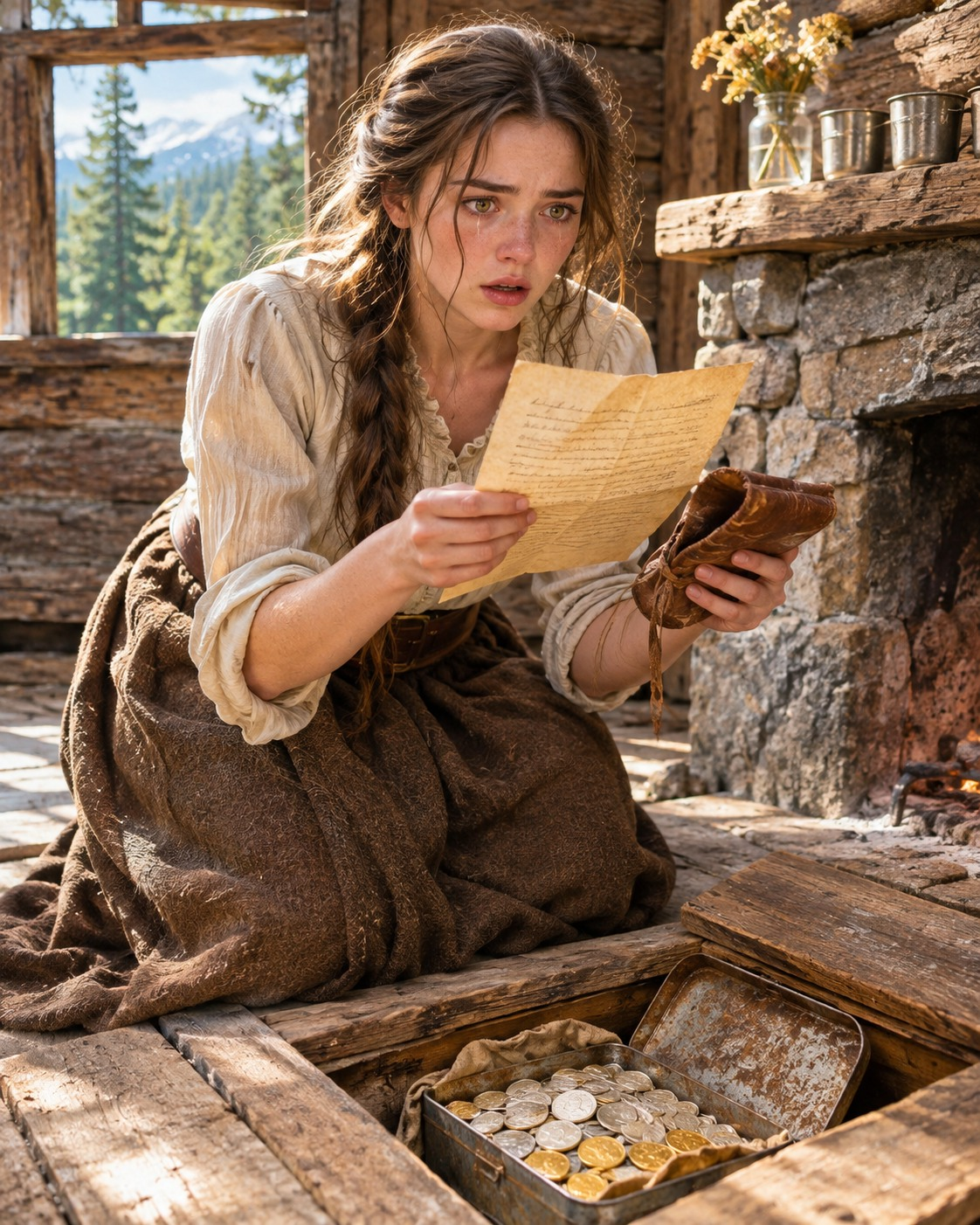
Three tin cups sat on a shelf.
A glass bottle held the brittle remains of yellow flowers.
Near the fireplace stood a wooden chair missing one leg.
The room was larger than Alara expected.
A narrow doorway led toward what had once been a sleeping area.
Another opened into a small kitchen.
The floorboards creaked beneath her boots.
Alara set her crate beside the fireplace.
Then she began examining the room.
The stone hearth was solid.
The chimney appeared clear.
Several wall joints needed repair.
A section of the ceiling would have to be rebuilt before winter.
It was a tremendous amount of work.
But it was work she understood.
And nobody could throw her out of a house she owned.
She knelt beside the fireplace to inspect the floor.
That was when she noticed something unusual.
Four floorboards rose slightly higher than the others.
Alara frowned.
She pressed her palm against the nearest board.
It shifted.
Not much.
Just enough.
She examined the nails.
They were old, but their placement was different from those securing the surrounding boards.
Someone had removed these planks before.
Then replaced them.
Carefully.
Her grandmother's voice returned to her.
A house reveals its secrets through its foundations.
Alara reached into her crate.
She removed the bone-handled knife Bett had given her on her sixteenth birthday.
The blade was short and sturdy.
Perfect for working beneath a loose board.
She slipped its tip into the narrow gap.
The wood resisted.
She adjusted the angle.
Applied pressure.
A soft crack sounded.
The first board lifted.
Dust rose into the sunlight.
Alara set it aside.
Then she removed the second.
And the third.
By the time she reached the fourth, her heartbeat had quickened.
Beneath the boards was a narrow hollow between the floor supports.
Something rested inside.
A rectangular shape.
Wrapped in darkened cloth.
Alara leaned closer.
She reached into the compartment.
Her fingers touched cold metal.
A box.
A small tin box.
She lifted it carefully.
It was heavier than expected.
For a moment, she simply stared at it.
Then she carried it toward the sunlight.
The wrapping was waxed cloth, stiff with age.
A thin cord held it in place.
Alara loosened the knot.
The fabric fell away.
Beneath it sat an old tin box with rust along the edges.
She opened the lid.
And forgot how to breathe.
Coins.
Dozens of them.
Silver coins filled the upper portion of the box.
Beneath them, she saw gold.
Real gold.
Alara touched one coin with her fingertip.
Then another.
She had spent the previous morning wondering whether three dollars would keep her alive.
Now she was staring at more money than she had ever seen.
Her first thought was that it couldn't be real.
Her second was that someone must have hidden it for a reason.
She carefully moved the upper layer of coins.
Beneath them lay a folded letter.
And a small object wrapped in soft brown leather.
Alara picked up the letter.
The paper was yellowed.
The edges had become brittle.
A woman's handwriting covered the first page.
At the top was a date.
Eleven years earlier.
Below it was a name.
Annika Holm.
Alara felt the back of her neck tighten.
The missing woman.
The woman who had owned this cabin before her.
She unfolded the pages.
The first paragraphs described the homestead.
Twenty-one years of marriage.
Long winters.
Difficult harvests.
A husband who had built the fireplace stone by stone.
Then the writing changed.
The sentences became shorter.
More urgent.
Annika wrote of a terrible event after her husband's death.
Of someone she had trusted.
Of a decision that had forced her to abandon everything.
Alara continued reading.
Then she reached a sentence that made her hands go cold.
If Bett Pruitt has kept her promise, the child will one day find what I have hidden here.
Alara stopped.
Bett Pruitt.
Her grandmother.
She read the sentence again.
Then a third time.
Her grandmother had known Annika Holm?
Why had she never mentioned her?
Alara lowered the paper.
For several seconds, she stared at the open tin box.
Then she returned to the letter.
The next paragraph began with words that seemed impossible.
To Alara Cain, if you are reading this, you must understand that the story you have been told about your family is not the truth.
Alara's breath caught.
Her own name.
Written eleven years ago.
She had been eight years old.
A child.
And somehow, a woman who had disappeared from this mountain had written a letter intended specifically for her.
Alara's hands began trembling.
She looked toward the leather-wrapped object.
A thin cord held it closed.
Something small and solid rested inside.
She reached for it.
Then stopped.
Because the final paragraph of Annika's letter contained a warning.
Do not show this to Samuel Cain.
Alara stared at her father's name.
Below it, Annika had written one final sentence.
If he tells you I abandoned you, ask him what happened on the night of October seventeenth.
Alara felt the room tilt around her.
Abandoned her?
What did Annika mean?
Her father had never spoken about the woman.
He had never mentioned this homestead.
And he had certainly never explained why a missing stranger would know his daughter's name.
Alara reached for the leather-wrapped object.
She loosened the cord.
One fold of leather opened.
Then another.
Something metallic caught the sunlight.
She carefully pulled the wrapping aside.
Inside lay a small silver locket.
Its surface was scratched.
Its clasp was damaged.
And engraved across the back were three tiny words.
For my daughter.
Alara's fingers went numb.
She turned the locket over.
There was a tiny hinge along one edge.
She pressed it.
The locket opened.
Inside was a miniature portrait of a little girl.
A girl with familiar eyes.
A girl wearing the same blue ribbon Alara remembered from her earliest childhood.
And beneath the portrait was a name.
Not Alara Cain.
Another name.
Alara heard a sound behind her.
A floorboard creaked.
She turned sharply.
The cabin doorway stood open.
A man's shadow stretched across the wooden floor.
Then a familiar voice spoke from the entrance.
"Put that locket down, Alara."
Her father had found her.
And he was holding a loaded rifle.






Comments 0