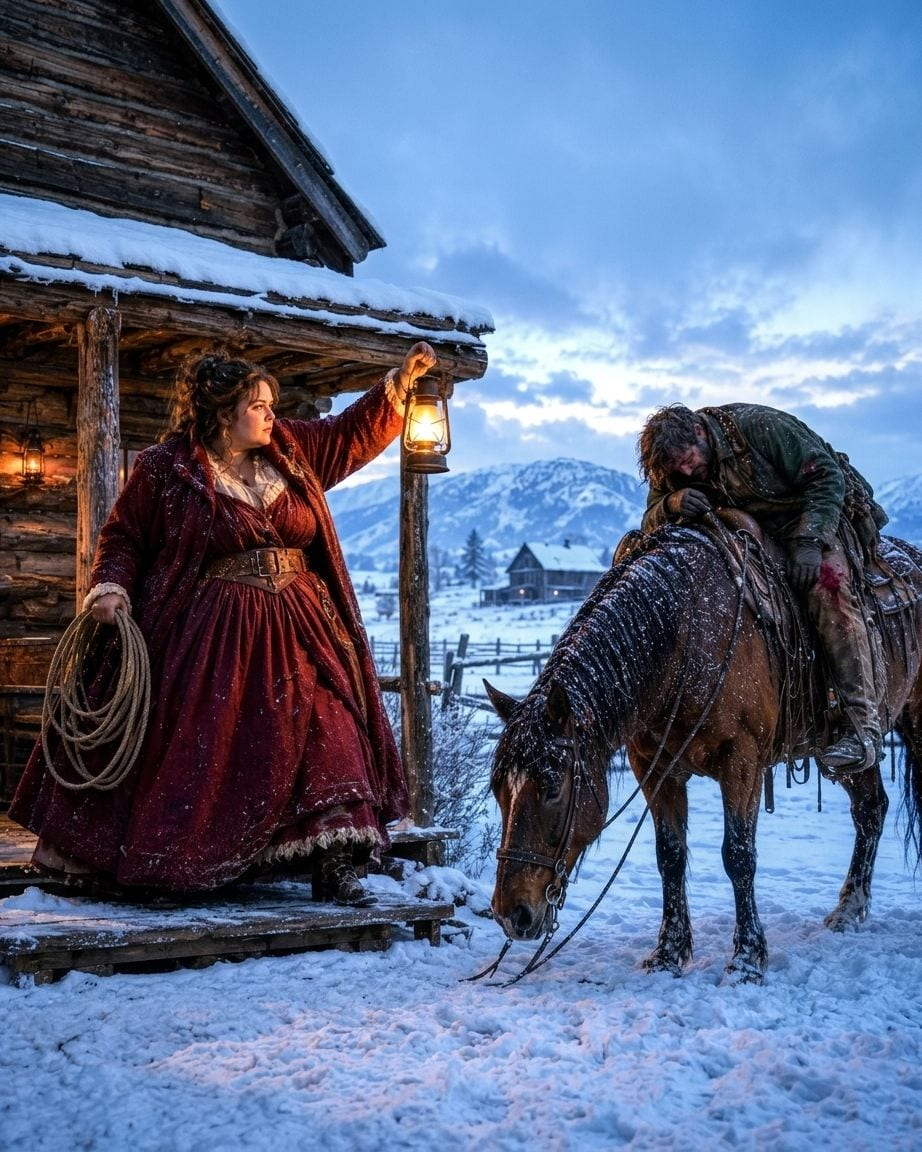
I caught the reins of a dying man's horse as it stumbled against my porch.
"Easy! Don't you fall now!"
When I pulled the unconscious stranger from the saddle, I found a leather field notebook tucked beneath his blood-soaked coat.
Three words had been scratched into its cover.
RED WILLOW. SOUTH DITCH. BELL.
I suddenly understood that the storm had brought something much more dangerous than an injured traveler to my door.
The horse nearly went down before I reached it.
Its front legs buckled in the deep snow, and the animal lurched sideways, dragging its reins through the frozen mud beneath my porch. I caught the bridle with both hands and planted my boots against the wooden step.
"Easy, sweetheart. Easy."
The horse blew a cloud of steam into my face.
Its coat was dark brown, almost black beneath the snow. Ice clung to its mane, and one stirrup swung loose against its side.
At first, I thought the saddle was empty.
Then I saw the man's arm.
It hung over the horse's neck, completely limp. His gloved fingers brushed the animal's shoulder with every unsteady step.
"Lord help us."
I pulled the lantern closer.
The stranger was enormous. Even folded over the saddle, he looked broader than most men I had known. His heavy charcoal coat was covered in snow, and a dark stain spread from his left shoulder down toward his ribs.
Blood.
Not the bright red kind I had seen from a small cut or a broken nose.
This blood had soaked into the wool and frozen almost black.
I glanced toward the road.
Nothing.
There was no wagon, no second horse, no lantern moving through the storm.
Only the white darkness swallowing the valley.
I had lived at Red Willow Station long enough to understand what a December blizzard could do to a person.
A man who wandered into it without shelter might not survive an hour.
A wounded man could die even faster.
"Can you hear me?"
I touched his shoulder.
His head moved slightly, but he gave no answer.
I tried again.
"Sir?"
Nothing.
The horse shifted beneath him.
That was when I stopped asking questions and started working.
I led the animal toward the barn, keeping one hand firmly around the bridle. The stranger's weight pulled against the saddle, and every few steps his body slipped farther to one side.
I couldn't allow him to fall.
Not before I knew how badly he was hurt.
The barn doors resisted the wind. I pushed them open with my shoulder and guided the horse inside.
Warmth was a generous word for what waited in that building, but at least the animal was out of the worst of the storm.
I secured the doors and led the horse into an empty stall.
Its breathing was rapid.
"You're all right," I whispered. "We'll see about your rider."
I rubbed the animal's neck, then examined the stranger again.
His left hand was clenched around something beneath his coat.
I couldn't see what it was.
I also couldn't waste time finding out.
The man needed to come down from the saddle without further injury.
I looked toward the overhead beam.
A block and tackle hung near the feed storage, left there by my father years earlier. He had used it to lift heavy equipment and move things that would have broken a man's back if he had tried to carry them alone.
I had used it often enough to understand its value.
My father used to tell me that a sensible person never confused strength with the ability to lift something heavy.
"Find a better way," he always said.
I gathered a thick horse blanket, a length of rope, and the pulley.
The stranger's size made the work difficult, but I took my time.
I secured the rope over the beam and arranged the blanket beneath his upper body. The horse shifted nervously while I adjusted the sling.
"Just a little longer," I told him.
I wasn't sure whether I was speaking to the horse or the man.
The pulley creaked.
Slowly, the stranger's weight came away from the saddle.
I lowered him inch by inch until his boots touched the wooden floor.
He was heavier than I had expected.
His head rolled against the blanket, and a low sound escaped his throat.
Pain.
He was alive.
That was enough.
I placed him on a wooden door I had removed from an unused storage partition. With two grain boxes supporting it, the door made a crude stretcher.
I dragged it toward the cabin.
The journey from the barn to the house was short, but the snow had already begun accumulating around the steps.
By the time I reached the door, my arms were shaking.
I pushed it open with my hip.
The cabin greeted us with the familiar smell of burning pine, old wood, and coffee left too long beside the stove.
I had never been especially fond of the cold, but I had learned to live with it.
I had also learned to live without anyone coming to help.
I dragged the stranger toward the large wooden table near the fireplace and positioned the stretcher beside it.
His coat was stiff with frozen snow.
I removed his gloves first.
His hands were enormous, rough, and scarred from years of work. There were old cuts across his knuckles and a pale mark near his right thumb.
Not a city man's hands.
Not a man who spent his days writing letters or counting other people's money.
I began removing his outer coat.
The fabric resisted where the blood had frozen.
I stopped whenever he moved and waited for his breathing to settle.
The bullet wound was high along his left side, near the shoulder and ribs. The projectile appeared to have passed through the flesh without lodging, but the bleeding had been substantial.
I wasn't a doctor.
I had no intention of pretending otherwise.
But ranch life had taught me how to clean wounds, apply pressure, recognize shock, and keep injured people warm until proper help became possible.
I heated water.
I gathered clean cloth.
I washed my hands.
Then I began.
The stranger groaned when I pressed the folded cloth against his side.
"I'm sorry," I murmured. "I know it hurts."
His face tightened.
For a moment, his eyes opened.
They were a pale gray-blue, though the pain made them look almost colorless.
He stared at me without recognition.
Then his eyelids fell.
I continued working.
Outside, the wind struck the cabin so hard that the window glass trembled.
The fire crackled.
A kettle began to whistle.
I changed the cloth when it became soaked and secured the fresh dressing around his shoulder and upper chest.
The bleeding gradually slowed.
That was when I noticed something unusual.
The man's coat had an inner pocket that seemed heavier than the others.
I reached inside carefully.
My fingers touched leather.
I withdrew a small rectangular notebook.
It was old, weather-stained, and scraped nearly white at one corner.
I turned it over.
Three words had been scratched into the cover.
RED WILLOW. SOUTH DITCH. BELL.
My hands went still.
There were plenty of Bells in the county.
But there was only one Bell family whose name could make my stomach tighten.
Gideon Voss Bell.
My uncle.
The same man who had nailed a legal notice to my father's headgate earlier that month.
The same man who had stood in front of two neighboring ranchers and suggested that a woman of my size couldn't possibly manage a property like Red Willow.
The same man who had looked directly at me and promised that by spring, the water would belong to someone who knew what to do with it.
I looked again at the notebook.
South Ditch.
My father's south ditch.
The waterway that fed the lower pasture and kept our cattle alive through the dry months.
I opened the cover.
The first pages contained measurements.
Numbers.
Hand-drawn lines.
Distances between fence posts and water markers.
Some entries were dated several months earlier.
Others were so recent that the pencil marks still looked dark.
I recognized the bend of the creek near the northern boundary.
I recognized the old stone marker beside the western pasture.
But I didn't recognize the markings beside the words written in the margin.
A series of small crosses.
A few numbers.
And a name.
H. VOSS.
My uncle's initials.
I stared at the page.
Why would an injured stranger be carrying measurements of my ranch?
Why would he have my uncle's name written in a notebook hidden beneath his coat?
And why had someone shot him?
A faint movement came from the table.
I closed the notebook.
The stranger's fingers twitched.
I stepped closer.
"Can you hear me?"
His breathing changed.
His eyes opened halfway.
He looked at the notebook in my hand.
Then he looked at me.
His expression changed so quickly that I nearly stepped backward.
He wasn't simply confused.
He was frightened.
He tried to lift his arm.
I caught his hand before he could disturb the dressing.
"Don't move. You've been shot."
His fingers closed around my wrist.
The grip was surprisingly strong for a man who had nearly died in the snow.
"Where..." His voice cracked.
"You're at Red Willow Station."
His eyes moved toward the notebook.
"Bell?"
I swallowed.
"Which Bell?"
He attempted to speak again, but the words seemed to disappear beneath his pain.
His hand tightened.
"Don't let Bell find the book."
I stared at him.
For a moment, I could hear nothing but the wind.
"What did you say?"
His eyes held mine.
"Don't..."
He stopped.
His grip weakened.
"Find the book..."
His fingers slipped from my wrist.
Then his eyes closed.
I stood there, holding the notebook.
The fire continued burning.
The kettle continued singing.
And the man who had brought those three words into my home had fallen unconscious again.
I looked toward the window.
Snow had covered the tracks between the barn and the porch.
The storm was erasing everything.
I returned to the table and examined the notebook more carefully.
The first page was filled with ordinary field measurements. The second contained a rough map of the valley.
The third made my stomach turn.
It showed the South Ditch.
But someone had drawn another channel running beneath the existing waterway, cutting across the boundary between my property and the Bell holdings.
Beside it was a date.
December 18.
Three days from now.
I checked the calendar hanging beside the stove.
December 15.
Someone had planned something.
Something involving my water.
And the injured stranger had known enough to risk his life carrying the evidence.
I wanted to wake him.
I wanted to demand his name, his business, and the reason my uncle's initials were written across his notebook.
But his breathing had become shallow again.
I couldn't question a dying man.
I needed a doctor.
The nearest physician lived several miles away, beyond the western ridge.
Under ordinary conditions, the trip would take less than an hour.
In that storm, it might take half a day.
I looked toward the barn.
The horse was exhausted, and I wasn't about to put it back into the blizzard.
I would have to wait for the wind to ease.
I returned to the stove and placed another log on the fire.
Then I checked the stranger's dressing.
The bleeding had slowed.
His skin was still cold, but the warmth of the cabin was beginning to help.
I pulled another blanket over him.
That was when I noticed something beneath his collar.
A thin leather cord.
It disappeared into his shirt.
I hesitated before carefully drawing it out.
Attached to the cord was a small brass object.
A military-style compass.
Its glass was cracked.
The needle was stuck.
On the back, someone had engraved two initials.
H.B.
I had seen those initials before.
Not on the ranch.
Not in my uncle's paperwork.
On a photograph.
An old photograph my father had kept in his desk for years.
A younger man stood beside him near the South Ditch. The picture was faded, but the initials on the back had been written in my father's handwriting.
H.B.
I stared at the compass.
Then I looked at the stranger.
Who were you?
What had my father known?
And why had this man come to Red Willow carrying evidence that could connect my uncle to something happening beneath my own land?
A sudden sound interrupted my thoughts.
Three knocks.
Not from the window.
Not from the barn.
From the front door.
I froze.
Nobody should have been traveling in this weather.
I picked up the lantern and moved toward the entrance.
Another three knocks followed.
Then a man's voice came through the wood.
"Martha Bell?"
I didn't answer.
The voice came again.
"Open the door. I know you've got company."
I looked back toward the table.
The stranger remained unconscious.
His notebook lay beside the lantern.
And outside, someone had just called my name.
I reached for the door latch.
Then the man spoke again.
"Before you make a mistake, Martha, you ought to know whose blood is on your floor."
I stopped breathing.
Because I recognized that voice.
It belonged to Gideon.
And he wasn't alone.






Comments 0