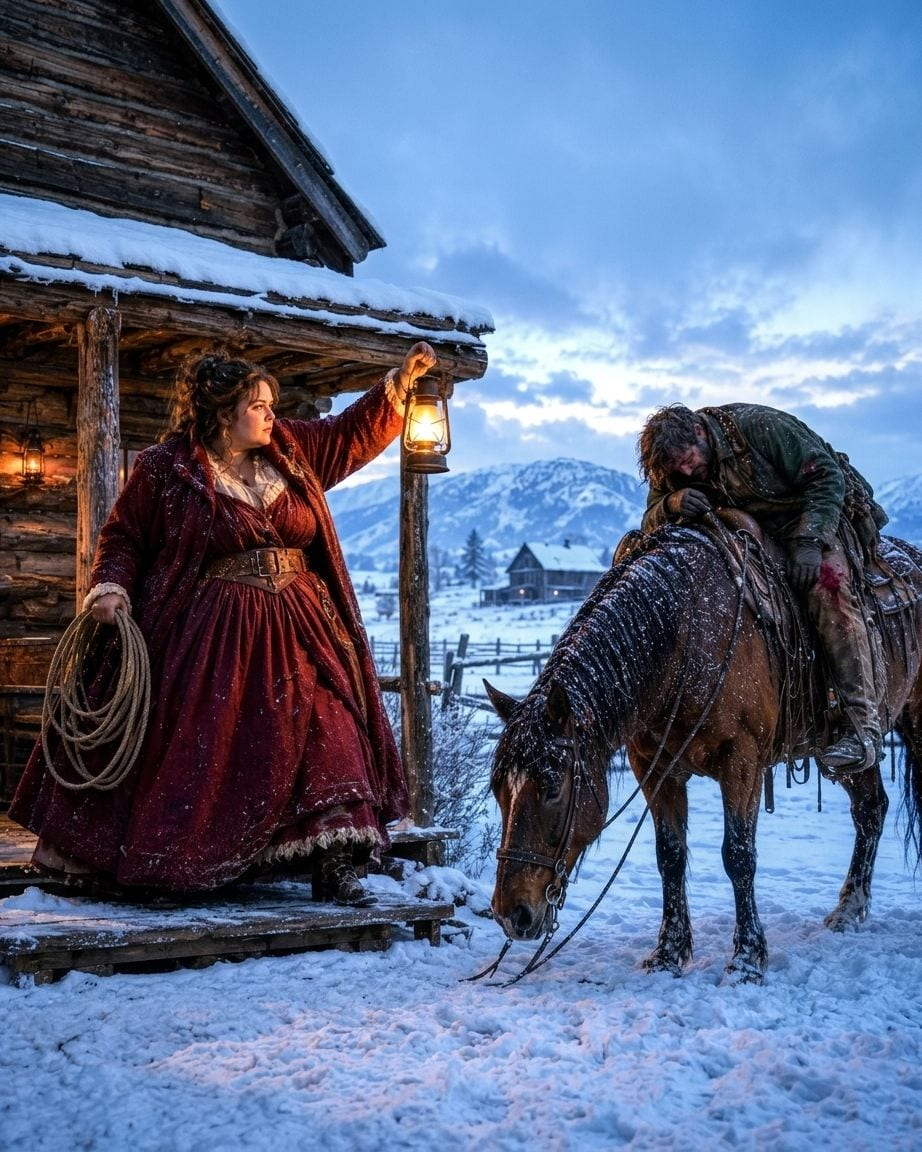
"Martha Bell. Open the door."
The voice outside was unmistakable.
I stood beside the kitchen table, holding the folded photograph in one hand and the injured stranger's coat in the other.
The man lying beneath the blankets had gone completely silent.
His gray-blue eyes were fixed on the entrance.
"Who is he?" I whispered.
The stranger swallowed.
"Silas Crowe."
I knew the name.
Silas had been the county surveyor for nearly twenty years. He was a narrow-shouldered man with silver hair, a permanent squint, and an unfortunate habit of appearing whenever someone had trouble with property boundaries.
He had surveyed our northern fence twice, measured the creek three times, and once spent an entire afternoon arguing with my father over the placement of a stone marker.
But I hadn't seen him in almost six months.
"What does he want?" I asked.
The stranger attempted to raise his head.
"Don't let him see the book."
I glanced toward the counter.
The leather notebook was wrapped in a clean cloth beside the stove.
"I know."
"No," he whispered. "You don't."
His hand moved toward mine.
"He's not here to help you."
Three more knocks sounded.
"Martha, I know you're inside."
I took a breath and placed the photograph inside my dress pocket.
Then I moved toward the door.
I wasn't going to let a wounded stranger's fear make decisions for me. But I also wasn't about to forget what Gideon had said, what Wade had warned, or what the surveyor's unexpected arrival might mean.
I opened the door.
Silas Crowe stood on the porch, his hat pulled low over his forehead.
He was perhaps sixty years old, with a thin gray beard and a long black coat. A leather document case hung from his left hand.
Snow covered his shoulders.
Behind him stood a young man holding two horses.
Silas looked past me.
"Good evening."
"It's nearly midnight."
"Then I suppose it is a late evening."
He attempted a smile.
I didn't return it.
"What brings you here?"
"Business."
"Business can wait until morning."
"Not this business."
He lifted the document case.
"I have something that belonged to your father."
My fingers tightened around the door.
"What?"
"An original survey record."
I remembered the note on the photograph.
Never trust the measurements after the third marker.
"Which survey?"
Silas glanced toward the darkness behind me.
"The South Ditch."
I felt my heartbeat change.
"Why would you bring that here?"
"Because your uncle has been asking questions."
That answer surprised me.
I studied his face.
"Uncle Gideon?"
"Yes."
"What kind of questions?"
Silas lowered his voice.
"Questions about the original measurements. Questions about the western channel. Questions about what your father recorded before he died."
I didn't move.
For years, Gideon had insisted that my father had made mistakes when he established the ranch boundaries.
He had repeatedly claimed that the original water agreement was incomplete.
Now Silas was telling me that he had an original survey.
And he had brought it to my doorstep in the middle of a blizzard.
"Why didn't you take it to the courthouse?" I asked.
His expression became uncomfortable.
"Because someone has been going through the records."
"Who?"
"I don't know."
"Then how do you know?"
He glanced over his shoulder.
The young man holding the horses shifted nervously.
Silas lowered his voice again.
"Your father's survey disappeared from the county archive three months ago. I found it yesterday in a locked cabinet that should have been empty."
I stared at him.
"You're the county surveyor. How could a document disappear from your own archive?"
His jaw tightened.
"That's precisely why I came."
I looked at the document case.
Then at the man standing behind him.
"Who is that?"
"Thomas Reed. My assistant."
Thomas nodded politely.
He looked younger than thirty, with a narrow face and a dark wool cap pulled down over his ears.
I recognized neither his face nor his horse.
"Is there a reason you brought him?"
Silas hesitated.
"He's helping me with the records."
I didn't like the answer.
But I stepped aside just enough to let Silas enter the porch.
Not the house.
The porch.
"Show me the document."
He opened the case.
Inside was a thick envelope wrapped in oilskin.
A faded red seal remained attached to its edge.
I recognized the handwriting.
My father's.
For a moment, I forgot the storm.
I forgot the stranger lying injured inside.
All I could see was the familiar shape of the letters.
My father had written the same way on everything from cattle receipts to birthday notes.
I reached for the envelope.
Silas pulled it back slightly.
"Before you read it, I need to know whether anyone else has been here tonight."
I looked at him.
"Why?"
"Because I believe the man who stole the records has already discovered that I recovered them."
I felt the air become colder.
"Did someone follow you?"
"I don't know."
"Did you see anyone?"
He hesitated.
Then he looked past my shoulder again.
His eyes settled on something inside the cabin.
I followed his gaze.
The stranger's boots were visible beside the table.
Silas's face changed.
He knew.
"Who is that?" he asked.
"A traveler."
"What's his name?"
"I don't know."
Silas looked at me for a long moment.
Then he closed the document case.
"Martha, listen carefully. If that man is who I think he is, you need to understand something."
"What?"
"Your uncle isn't the only person looking for him."
Before I could respond, a gust of wind struck the porch.
The lantern swung violently.
Thomas turned toward the road.
"Mr. Crowe?"
Silas looked back.
"What is it?"
Thomas pointed toward the northern fence.
A faint light moved between the trees.
Then disappeared.
Silas's expression hardened.
"Get inside."
I didn't need to be told twice.
I stepped backward and allowed him into the cabin.
Thomas remained outside with the horses.
Silas shut the door and placed the document case on the table.
His eyes immediately found the injured man.
"Good Lord."
He approached the table.
The stranger's eyes opened.
For several seconds, neither man spoke.
Then Silas whispered a name.
"Gideon Bell?"
The stranger shook his head weakly.
"No."
Silas looked confused.
Then the injured man spoke again.
"Not Gideon."
He swallowed.
"Harlan."
Silas went pale.
I looked from one man to the other.
"Who is Harlan?"
Neither answered.
The stranger closed his eyes.
Silas slowly removed his hat.
"How long has he been here?"
"Since before sunset."
"Who brought him?"
"His horse."
Silas looked at the wound.
"Has he been examined?"
"I cleaned it and stopped the bleeding. I couldn't get a doctor through the storm."
Silas nodded.
He was quiet for a moment.
Then he looked at me.
"Martha, I need to tell you something about your father."
I almost laughed.
Not because anything was funny.
Because that sentence had become the beginning of every terrible conversation I had endured since his death.
"What now?"
Silas pulled a chair closer to the table.
"Your father wasn't simply trying to establish the South Ditch boundary when he made those measurements."
I crossed my arms.
"Then what was he doing?"
"Investigating a diversion."
"Of what?"
"Water."
The word seemed to echo through the cabin.
Silas opened his document case.
He removed several sheets of paper.
The first showed a map of Red Willow Station and the surrounding properties.
The second contained a series of handwritten measurements.
The third was a copy of an old water agreement.
He spread them across the table.
"Your father discovered that the water flowing through the South Ditch was not reaching the lower pasture in the quantities it should have."
I leaned closer.
"That's impossible. I've checked the headgate every season."
"That's what he thought too."
Silas pointed to a line on the map.
"Here."
A narrow channel ran beneath the southern boundary.
It was marked with a dotted line.
I recognized the creek above it.
But I had never seen that channel before.
"What's this?"
"A diversion route."
"Where does it lead?"
Silas looked at me.
"Bell Ranch."
My mouth went dry.
"You're saying someone built a second waterway beneath my land?"
"Not beneath the entire ranch. It follows an old natural drainage channel. Your father believed someone had modified it."
"Who?"
Silas looked toward the injured stranger.
"He might know."
I turned to the man on the table.
His eyes were open again.
He was watching us.
"Who are you?" I asked.
He struggled to speak.
"Caleb."
"Caleb what?"
"Rourke."
Silas closed his eyes briefly.
I noticed.
"You know him?"
Silas didn't answer immediately.
Then he nodded.
"He's a mountain scout. He was hired to survey the upper ridge."
"By whom?"
Caleb answered before Silas could.
"Your father."
I stared at him.
"My father died years ago."
"I know."
"Then how could he have hired you?"
Caleb's breathing became uneven.
"Before he died, he paid me to keep watching the water."
I felt something shift inside me.
My father had never mentioned hiring a mountain scout.
Not once.
"How long have you been doing this?"
"Since the summer of eighty-three."
I calculated the years.
It had been more than three years.
Three years of watching the upper ridge.
Three years of measuring the creek.
Three years of following water that should have belonged to my family.
"Why didn't you come to me?"
Caleb looked ashamed.
"Because your father told me to wait."
"Wait for what?"
He looked toward the notebook.
"For proof."
I picked up the leather field notebook and unwrapped it.
Silas immediately reached toward it.
"Where did you get that?"
"From Caleb's coat."
He stared at the cover.
Then his expression changed.
"That's the original field book."
I looked at him.
"Original?"
"Your father used a similar one during the first survey. This one contains the measurements made afterward."
I opened it.
Silas began examining the pages.
He turned several sheets carefully, comparing them with the documents spread across the table.
Then he stopped.
"Here."
His finger rested beside a small pencil mark.
Three crosses.
A line.
And a date.
"December eighteenth," I whispered.
Silas nodded.
"That's when the diversion was supposed to become operational."
I looked at the map.
"Three days from now."
"Yes."
"Why would anyone wait until December to change a water channel?"
Silas looked at me with an expression I couldn't understand.
"Because the ground is frozen."
I frowned.
He pointed to the lower section of the map.
"When the surface freezes, the original creek becomes difficult to inspect. If someone opens the diversion gate beneath the ridge, the water will flow through the underground channel before anyone realizes the main ditch has been altered."
I stared at the paper.
"And by spring?"
"By spring, the damage could be permanent."
I thought of the lower pasture.
The cattle.
The wells.
The old stone markers my father had placed.
If the water disappeared, the ranch would be nearly impossible to maintain.
Gideon had spent months telling everyone that I was incapable of managing Red Willow.
He had made it sound as though he wanted to protect the property from my mistakes.
But if Silas was telling the truth, Gideon might have been preparing to destroy the very thing he claimed to protect.
I looked at the surveyor.
"Why would my uncle do this?"
Silas folded his hands.
"Because water is worth more than land in this valley."
I waited.
He continued.
"Several ranches have been struggling. The western holdings have almost no reliable supply. If Gideon controls the South Ditch, he controls the lower valley."
"And if he controls my water, he controls me."
Silas nodded.
I looked at the old agreement.
A signature appeared near the bottom.
Gideon Voss Bell.
But something was wrong.
The signature looked different from the one on the legal notice he had nailed to my headgate.
The letters were too narrow.
The final stroke was too long.
I brought the papers closer to the lantern.
"Silas?"
"Yes?"
"Who signed this?"
He examined it.
"Your uncle."
"Are you certain?"
He looked uncomfortable.
"I witnessed the document being submitted."
"Did you witness him signing it?"
Silas didn't answer.
I looked at him.
"That's what I thought."
He rubbed his forehead.
"I was younger then. The clerk handled the paperwork."
"Which clerk?"
"Edwin Marsh."
I recognized the name.
Edwin had retired years ago.
He lived in the eastern part of the county.
My father had never trusted him.
I remembered one argument between them.
I had been perhaps twenty years old, sitting on the porch steps while my father stood near the fence with a stack of papers.
He had said something about a signature.
Something about a man who had forgotten what he had sworn.
At the time, I hadn't understood.
Now I wondered whether that argument had been about the South Ditch.
I returned to the table.
"Show me the original measurements."
Silas opened another envelope.
He removed a thin sheet of paper, folded several times.
The paper was yellow with age.
Its edges were brittle.
Across the top, my father's handwriting identified it as the original survey of Red Willow Station.
I recognized the layout immediately.
The north ridge.
The creek.
The upper pasture.
The lower pasture.
And the South Ditch.
But something was different.
The ditch did not follow the route shown on Gideon's legal notice.
The original line ran farther east.
It included an additional strip of land.
A narrow section that connected directly to the spring beneath the ridge.
I looked at the map again.
Then I looked at the legal notice in my memory.
My uncle wasn't simply trying to take the water.
He was trying to take the land that controlled its source.
I sat down slowly.
For years, I had believed our disagreement concerned the boundary of a ditch.
It was much bigger than that.
Silas watched me.
"Now do you understand why I came?"
I shook my head.
"No."
He seemed surprised.
I pointed toward the document.
"You've shown me an old survey. You've shown me a questionable agreement. You've told me my uncle might be diverting water."
I leaned closer.
"But you haven't told me why Caleb was shot."
Silas looked toward the injured man.
Caleb's jaw tightened.
He struggled to move his right hand.
I reached for it.
"Don't."
He ignored me.
"Tell her."
Silas looked away.
"Caleb was following a freight shipment."
"What shipment?"
"Pipe. Timber. Heavy gate equipment."
I remembered the waybill.
The one hidden inside Caleb's coat.
I retrieved it and placed it on the table.
Silas studied the paper.
His face went pale.
"Where did you find this?"
"In his coat."
He read the delivery address.
Then he sat down.
"Good Lord."
"What?"
He looked at me.
"This shipment wasn't supposed to arrive at Bell Ranch."
I felt a cold pressure behind my ribs.
"Then where was it going?"
Silas turned the document toward the lantern.
The address was partially covered by a stain.
He carefully moved the paper.
Underneath was a second line.
A location.
Not Bell Ranch.
Not the South Ditch.
It was an old property name that had disappeared from county maps decades earlier.
"Who owns this place?" I asked.
Silas looked at me.
"Nobody."
"That doesn't make sense."
"It was abandoned after the old mining company closed."
I looked at the map.
The property was marked near the northern ridge.
Directly above the source of the South Ditch.
Caleb tried to speak.
"There's a gate..."
Silas leaned closer.
"What gate?"
Caleb swallowed.
"The old mining gate."
I looked at the map again.
A memory surfaced.
My father had once taken me to the northern ridge when I was a child. He had shown me a narrow opening between two rocks and told me never to enter it.
I had asked why.
He had said it was dangerous.
I had never asked again.
Now I wondered what lay beyond those rocks.
"Caleb," I said quietly. "Did you find the gate?"
He nodded.
"Yes."
"What was inside?"
His eyes moved toward the window.
"Water."
Silas went completely still.
"How much water?"
Caleb looked at me.
"Enough to feed every ranch in the valley."
I stared at him.
The room seemed suddenly smaller.
If that was true, the South Ditch was not simply a creek.
It was part of a much larger underground water system.
And someone had discovered it.
Someone had built equipment to control it.
Someone had arranged for a shipment of materials.
Someone had tried to kill the man who knew where the gate was.
I looked at Gideon's name on the freight document.
Then I looked at the injured stranger.
"Why didn't you go to the sheriff?"
Caleb gave a weak laugh.
It turned into a cough.
When he recovered, he answered.
"I did."
I waited.
"Three weeks ago."
"What happened?"
He closed his eyes.
"Nothing."
Silas looked down at the table.
I turned toward him.
"You knew?"
He didn't answer.
"Silas."
The surveyor rubbed his hands together.
"I suspected something was wrong."
"That's not what I asked."
He looked at me.
"Yes. I knew Caleb had tried to report the diversion."
"And?"
"The sheriff told him there was insufficient evidence."
I stared at him.
"Was there?"
Silas glanced toward the notebook.
"Not then."
Caleb shifted painfully.
"Now there is."
I looked at the documents.
The notebook.
The freight waybill.
The old survey.
The photograph.
For the first time, the pieces seemed to fit together.
But they didn't explain everything.
I still didn't know who had shot Caleb.
I didn't know why my father had hidden the original survey.
And I didn't know why Gideon was so certain that he could take the water before spring.
I gathered the papers.
"We need to get these to the courthouse."
Silas shook his head.
"Not tonight."
"Why?"
"Because someone has already been there."
He opened his document case and removed a final sheet.
It was a handwritten statement.
The ink had smeared across the bottom.
I read the first sentence.
It was dated three months earlier.
The writer claimed to have witnessed the construction of an underground water gate near the old mining property.
The statement was signed.
Henry Pike.
I knew that name.
Henry had been a carpenter and ranch hand who had worked for my father years earlier.
He had replaced the oak brace on the South Ditch headgate.
He had also been the man who hauled the timber.
According to my father's receipt, he had been paid fourteen dollars for the work.
I looked at Silas.
"Where is Henry now?"
Silas hesitated.
"He's dead."
"When?"
"Last month."
I looked at the statement again.
"How?"
"His cabin burned."
I felt the room tilt slightly.
"An accident?"
Silas didn't answer.
Caleb opened his eyes.
"No."
His voice was weak, but certain.
"Someone wanted him quiet."
I looked at the injured man.
"Did you see who did it?"
He shook his head.
"But I found something near the cabin."
"What?"
He struggled to breathe.
I leaned closer.
"A piece of iron."
"What kind?"
"From the gate."
I looked toward the notebook.
Then at the freight waybill.
The cabin fire.
The missing survey.
The shooting.
It was no longer possible to believe these events were unrelated.
I stood and walked toward the window.
Outside, the blizzard had weakened slightly.
Snow still moved across the yard, but the wind had begun to settle.
Beyond the fence, the darkness seemed endless.
Then I noticed something.
A faint light near the barn.
I turned.
"Silas?"
He looked up.
"Yes?"
"Was Thomas supposed to remain outside?"
Silas frowned.
"He was watching the horses."
I looked through the window again.
The horses were still there.
But Thomas wasn't.
I moved toward the door.
Silas stood immediately.
"Don't."
I stopped.
"Why?"
He picked up his lantern.
"Because I just remembered something."
"What?"
Silas's face had lost all color.
"When I found your father's survey yesterday, there was another document in the same cabinet."
I waited.
"It was a list of everyone who had examined the original records."
"Who was on it?"
He looked toward the door.
"Your uncle."
"And?"
Silas swallowed.
"Me."
I stared at him.
He continued.
"And the third name..."
A sound came from the barn.
One sharp metallic crash.
Then silence.
Silas slowly turned toward the window.
The injured stranger began struggling to sit up.
"Martha," he whispered.
I looked at him.
"What?"
His eyes were fixed on the door.
"Don't let them take the compass."
I reached for the brass object on the table.
But it was gone.
I turned toward the window.
A shadow stood outside.
Someone was holding a lantern.
And in the glass, reflected beside my own face, I saw a hand slowly lifting the latch from the outside.
The door was already opening.






Comments 0