For several seconds, nobody spoke.
I stared at the signature beneath my father's name.
Martha Bell.
It was unmistakably my name.
But I had never signed that document.
Thomas stood beside the desk, watching my reaction with an expression that was almost sympathetic.
Almost.
"Where did you get this?" I asked.
He closed the notebook.
"From the original archive."
"That's impossible. I never went near the archive."
"Your signature was submitted three years ago."
I looked at my mother.
She had gone completely still.
Then I looked at Silas.
He wouldn't meet my eyes.
"Explain," I said.
Thomas placed the notebook on the desk.
"Your father prepared the agreement before he died. He knew Gideon would eventually try to take control of the spring. He needed someone else to hold the original authorization."
"Someone else meaning me?"
Thomas nodded.
"But you were too young to understand what it meant."
I shook my head.
"I was forty years old when that document was supposedly signed."
"Your father prepared the legal papers years earlier. The county accepted the authorization after a private review."
"Without me?"
Thomas looked uncomfortable.
"Your father had a legal power of attorney arrangement established while you were still a child. It allowed him to preserve your inheritance and protect the original water rights."
My mother stepped forward.
"That's not the whole truth."
Thomas turned.
"Margaret, please."
"No. She deserves to know."
My mother looked at me.
"Your father never intended to use your name to take control of the water. He intended to make sure nobody could sell it without your consent."
I examined the signature again.
It looked genuine.
But something was wrong with the date.
"Why is this dated September 1883?"
Thomas answered.
"Because that was when the original agreement was created."
I looked at him.
"Then why does it carry my signature?"
He hesitated.
My mother took the notebook and turned several pages.
"Because the signature isn't yours."
She pointed to a small mark beside the name.
A narrow letter.
A.
I leaned closer.
"What's that?"
"Authorized witness."
My mother looked at Thomas.
"Who witnessed it?"
He didn't answer.
Silas finally spoke.
"Edwin Marsh."
I turned toward him.
"Edwin?"
Thomas nodded.
"Edwin witnessed the original authorization. The document was copied into the county records decades later. The signature was never intended to represent Martha's personal approval."
I looked at the page again.
The mystery wasn't that someone had forged my signature.
It was that the document had been deliberately written to make anyone who found it believe I had already agreed to something.
I turned toward Thomas.
"Why did you bring it here?"
He looked at the notebook.
"Because Gideon believes it gives him control of the reservoir."
"And does it?"
Thomas shook his head.
"No."
My mother closed the book.
"The authorization protects the water. It doesn't give anyone ownership of it."
I looked toward the red door.
Outside, I could hear Gideon shouting.
"Thomas! Get that key!"
Thomas looked toward the staircase.
Then back at me.
"He's running out of time."
I stepped closer.
"Why have you been helping him?"
Thomas lowered his eyes.
"I haven't."
I frowned.
"Then why did Caleb say your name?"
He swallowed.
"Because I changed the pressure settings."
My mother raised the key.
"You could have killed everyone in this valley."
"I know."
"Why?"
Thomas looked at her.
"Because the original mechanism was already failing. Someone had opened the upper valve, and the reservoir was building pressure. I changed the settings to keep the lower chamber from collapsing."
My mother stared at him.
"Without telling me?"
"I couldn't reach you."
"Why not?"
Thomas looked toward Silas.
"Because Silas had been watching the pressure line."
Silas's expression hardened.
Thomas continued.
"I knew the surveyor was working with Gideon. I also knew that if Gideon discovered the emergency release, he'd try to destroy it."
I looked at Silas.
"Is that true?"
He nodded slowly.
"Yes."
"How long?"
"Since the original diversion was rebuilt."
I felt anger rise again.
"How many people knew what was happening?"
Silas looked down.
"Too many."
My mother approached the iron door.
"We don't have time for this. The lower chamber is still filling."
She inserted the larger brass key.
It turned with a heavy metallic click.
The iron door opened several inches.
A cold draft rushed through the passage.
Behind it was a narrow stone corridor descending into darkness.
At the far end, I could hear rushing water.
My mother took a lantern.
"Thomas, you stay here."
He nodded.
I stepped toward her.
"I'm coming."
She looked at me.
"Martha, it's dangerous."
"So is standing here while the reservoir floods."
She studied my face.
Then she handed me the second lantern.
"Stay close."
Silas moved toward us.
"I'll go too."
My mother turned sharply.
"No."
"Margaret, I know the original measurements."
"And you know how to falsify them."
He accepted the accusation without argument.
I looked at him.
"You're coming because we need someone who understands the survey. But if you lie to me again, I will leave you behind."
Silas nodded.
We entered the passage.
The stone steps were wet.
Water ran along the edges, gathering in narrow channels before disappearing through openings in the floor.
Every few feet, an iron bracket held an old lantern.
Some were rusted.
Others had been replaced recently.
I noticed fresh scratches on the stone wall.
Someone had been here recently.
"How far?" I asked.
My mother pointed ahead.
"About forty feet."
We continued.
The sound of water grew louder.
Then the corridor opened into a circular chamber.
I stopped.
It was enormous.
A natural underground reservoir occupied most of the space.
Dark water stretched beneath the stone ceiling, reflecting the lantern light.
A heavy iron wheel stood beside a raised platform.
Two control levers extended from opposite sides of the chamber.
One was marked MAIN.
The other RELEASE.
I approached the platform.
"Is this the gate?"
My mother nodded.
"This is where your father and I worked."
I looked at the machinery.
It was old but carefully maintained.
A series of pipes ran along the walls, disappearing into the rock.
A large pressure gauge stood beside the main wheel.
Its needle was dangerously close to the red marking.
Silas examined it.
"We have very little time."
My mother moved toward the controls.
"Thomas was right. The lower valve is holding too much pressure."
I looked at the second lever.
"What happens if we release it?"
"The water will return to the original distribution channel."
"All of it?"
"Enough to restore the South Ditch."
"And the western channel?"
"It will close gradually."
I looked at the gauge.
"Then do it."
My mother shook her head.
"We need two people."
I stepped beside the main wheel.
"Tell me what to do."
She pointed to the iron handle.
"Keep this steady. Don't force it. When I turn the release lever, you'll feel the pressure change."
I gripped the wheel.
The metal was freezing.
My mother moved to the opposite side.
Silas examined the gauge.
"Wait."
We stopped.
He pointed toward the pressure line.
"Someone has installed a secondary lock."
I looked.
A new metal plate had been bolted over the original mechanism.
My mother examined it.
"Gideon."
She touched the plate.
"He didn't want the emergency release to operate."
Silas moved closer.
"There's a locking pin behind it."
I looked at him.
"Can you remove it?"
"Yes, but I need a wrench."
My mother pointed toward a toolbox.
I retrieved it.
Silas worked quickly.
The first bolt came loose.
Then the second.
The plate shifted.
A narrow iron pin appeared beneath it.
Silas pulled.
It didn't move.
He tried again.
Nothing.
My mother looked at the gauge.
The needle continued rising.
"Silas, we need that pin out."
"I'm trying."
I moved closer.
"Let me."
He stepped aside.
I examined the mechanism.
The pin was bent slightly.
It had caught against the edge of the plate.
I remembered something my father had taught me when I was young.
Never fight a stuck hinge by pulling harder. Find the angle that lets it move.
I adjusted the wrench.
Applied pressure from below.
Then twisted slightly.
The pin came free.
Silas stared at me.
"Well done."
I returned to the main wheel.
My mother took her position.
"Ready?"
I nodded.
"On three."
She counted.
"One."
I tightened my grip.
"Two."
The pressure gauge trembled.
"Three."
We turned the controls together.
At first, nothing happened.
Then a deep mechanical groan traveled through the chamber.
The wheel resisted.
I felt the metal vibrating beneath my hands.
My mother continued turning.
"Keep it steady!"
I pushed.
The mechanism moved another inch.
A tremendous rush of water filled the chamber.
The pressure gauge dropped slightly.
Then the needle began moving toward the safe range.
My mother looked at me.
"Don't stop!"
We kept turning.
A loud crack echoed through the stone ceiling.
Small pieces of rock fell into the water.
Silas shouted.
"Move away from the wall!"
I stepped backward but kept my hands on the wheel.
The release lever began rotating.
The water changed direction.
I could hear it rushing through the pipes toward the original channel.
Then the pressure gauge dropped sharply.
The red warning line disappeared.
My mother let go of her lever.
"It's working."
I released the wheel.
For a moment, we simply stood there.
The sound of the machinery gradually settled.
The reservoir was no longer pulling water toward the western diversion.
It was returning to its original course.
My mother closed her eyes.
A quiet sob escaped her.
I had never heard her cry before.
I reached for her hand.
She held it tightly.
"We did it," I whispered.
She nodded.
"Your father would have been proud."
I looked at the water.
"Then let's make sure nobody ever does this again."
We returned through the passage.
When we reached the red door, voices were coming from outside.
Gideon was shouting.
Wade was arguing with him.
And another voice was speaking calmly.
"Put the weapon down, Mr. Bell."
I recognized the voice.
Sheriff Daniel Harper.
I opened the door.
Several lanterns illuminated the clearing.
The sheriff stood beside two deputies.
Gideon was facing them with his hands raised.
Wade stood near his horse.
A revolver lay in the snow.
Thomas emerged behind me.
The sheriff looked at him.
"Are you injured?"
Thomas shook his head.
"No."
Then the sheriff turned toward Gideon.
"Mr. Bell, we need you to come with us."
Gideon looked at me.
"You did this."
I said nothing.
He shook his head.
"You have no idea what you've destroyed."
I stepped forward.
"I restored the water."
"You've ruined years of work."
"No. I stopped years of theft."
His face tightened.
"You think people will thank you?"
"I don't need them to."
The sheriff approached.
"Mr. Bell, you're under arrest for attempted theft of protected water rights, falsification of public records, unlawful entry, and conspiracy involving the destruction of property."
Gideon looked toward Silas.
"You tell them!"
Silas stepped forward.
For a moment, I thought he would defend my uncle.
Instead, he removed his silver ring.
He placed it in the sheriff's hand.
"I'll testify."
Gideon's expression changed.
"You coward."
Silas looked at him.
"I've been a coward long enough."
Wade tried to move toward his horse.
One of the deputies stopped him.
He resisted briefly, but the sheriff ordered him to stand still.
Then the deputy found a folded collection of documents inside his coat.
They included the freight orders, altered surveys, and correspondence bearing Gideon's signature.
The sheriff examined them.
His expression hardened.
"Looks like we have enough to begin."
I looked toward Edwin.
He stood near the barn, his head lowered.
He approached me slowly.
"Martha."
I turned.
"I know I don't deserve forgiveness."
I waited.
He continued.
"I should have protected your father. I should have told the truth when the first documents were altered. And I should have given you his letter years ago."
I looked at him.
"Why didn't you?"
"Fear."
He sighed.
"I was afraid of losing my position. Then I was afraid of losing my home. Eventually, I became so afraid that telling the truth seemed more dangerous than living with the lie."
I looked toward Gideon.
"That's how people like him survive."
Edwin nodded.
"Yes."
I didn't forgive him that night.
But I didn't turn him away either.
He agreed to give a full statement to the sheriff and surrender every remaining county record connected to the water agreement.
Silas made the same promise.
And this time, I believed they understood what it meant.
The following weeks changed Red Willow Station.
The storm finally passed.
Snow melted from the roofs, and the creek returned to its proper course.
The lower pasture was damaged, but not destroyed.
Several sections of fencing needed rebuilding.
The headgate had to be replaced.
The barn roof required repairs.
I hired two local ranch hands to help with the work.
Not because I was incapable of doing it myself.
Because running a ranch was never supposed to mean doing everything alone.
Caleb recovered slowly.
The bullet wound had caused more damage than we initially realized, and the doctor insisted he remain indoors for several weeks.
He spent most of that time sitting near the kitchen window, reading the field notebook.
My mother stayed with me.
At first, we struggled.
There were too many unanswered questions.
Too many lost years.
Sometimes I woke during the night and found her sitting quietly beside the fireplace.
She would look at me as though she were afraid I might disappear.
One morning, I finally asked her the question I had carried since childhood.
"Did you think about me?"
She put down her cup.
"Every day."
"Even when you couldn't come back?"
"Especially then."
I looked toward the window.
"Did you ever consider returning?"
"Thousands of times."
"Why didn't you?"
She reached for my hand.
"Because I knew Gideon was watching the ranch. Your father had convinced him that I no longer had the key. If I returned, he would have known that the original mechanism was still protected."
I looked at her.
"Was that worth losing all those years?"
She didn't answer immediately.
Then she shook her head.
"No."
Her eyes filled.
"No, sweetheart. It wasn't."
I leaned forward and held her.
For the first time, I didn't feel as though I was embracing a stranger.
I was holding the woman who had given birth to me.
The woman who had once carried me through the ranch when I was too tired to walk.
The woman who had disappeared because she believed it was the only way to keep me safe.
We couldn't recover the years.
But we could stop losing the ones we still had.
The investigation continued into the spring.
Gideon was formally charged after the county uncovered additional evidence of fraudulent land transfers and illegal water diversion.
Wade admitted his involvement in the break-in at my cabin and the theft of the compass.
He also confirmed that he had been instructed to intimidate Caleb and recover the field notebook.
Silas provided the original survey records.
Edwin produced the missing county documents.
Thomas explained how he had altered the pressure settings to prevent the reservoir from collapsing.
Caleb's testimony established the connection between the freight shipments and the underground gate.
The evidence was overwhelming.
The court eventually ruled that the original water agreement remained valid.
The spring could not be privately owned or permanently diverted.
The ranches along the valley retained their lawful access.
And Red Willow Station remained mine.
But I didn't want the victory to belong only to me.
I wanted the agreement restored exactly as my father and mother had intended.
I worked with the county to establish a shared water management committee.
Every ranch had a representative.
Every change to the system required documented approval.
The original surveys were copied and placed in a secure public archive.
No single person would ever again be able to alter the water records without leaving a trace.
When the new headgate was installed, I asked the workers to preserve the old iron cross.
They mounted it above the wooden control platform.
Not as a decoration.
As a reminder.
By the time spring arrived, the ranch had begun to look like itself again.
The grass returned to the lower pasture.
The creek ran clear.
Young cattle wandered near the fence while the horses grazed beside the barn.
Caleb was finally strong enough to ride.
One afternoon, I found him standing beside the new headgate.
He was examining the iron cross.
"Your father would have liked this," he said.
I stood beside him.
"I think he would have complained about the workmanship."
Caleb laughed.
"Probably."
He looked toward the house.
"Your mother says you've been trying to repair the northern fence alone."
"Your mother says too much."
"She's worried."
"She can worry from the porch."
Caleb smiled.
For the first time since he had arrived during the blizzard, he looked completely at ease.
He had planned to leave once he recovered.
He told me he had work waiting in the mountains.
But the longer he stayed, the more often I found him helping with repairs, checking the horses, or sharing coffee with my mother.
One evening, I found him sitting on the porch with his hat resting beside him.
"Still planning to leave?" I asked.
He looked at the valley.
"I was."
"And now?"
He took a moment.
"Your father once told me that a man should know when he's found a place worth staying."
I sat beside him.
"He said that?"
"More than once."
I smiled faintly.
"Sounds like him."
Caleb turned toward me.
"I don't want to stay because I owe your family anything."
"Good."
"I want to stay because I like the life here."
I looked at him.
"And the company?"
He smiled.
"That too."
I rested my hands on my knees.
"Then there's plenty of work."
He laughed.
"I was hoping you'd say that."
I didn't know exactly what the future would bring.
But for the first time, the thought didn't frighten me.
On the first warm Sunday of May, we held a small gathering beside the creek.
The neighboring ranchers came.
Henry Pike's widow arrived in a dark blue dress, carrying a box of old photographs.
She was alive, well, and considerably less pleased with the county than anyone else in attendance.
She told the story of how my father had hidden the original survey beneath the headgate.
She also explained that the red door had been built as a safe entrance to the underground survey station.
The room had never been intended as a hiding place for secrets.
It had been built to protect information that belonged to everyone.
My mother stood beside me as the water moved through the new wooden gate.
Edwin had brought the original agreement.
Silas had brought the corrected county survey.
Thomas had brought a repaired pressure gauge from the underground chamber.
Caleb stood near the fence, talking with the ranchers.
For a moment, I watched them all.
People who had once been separated by suspicion now stood together beside the same creek.
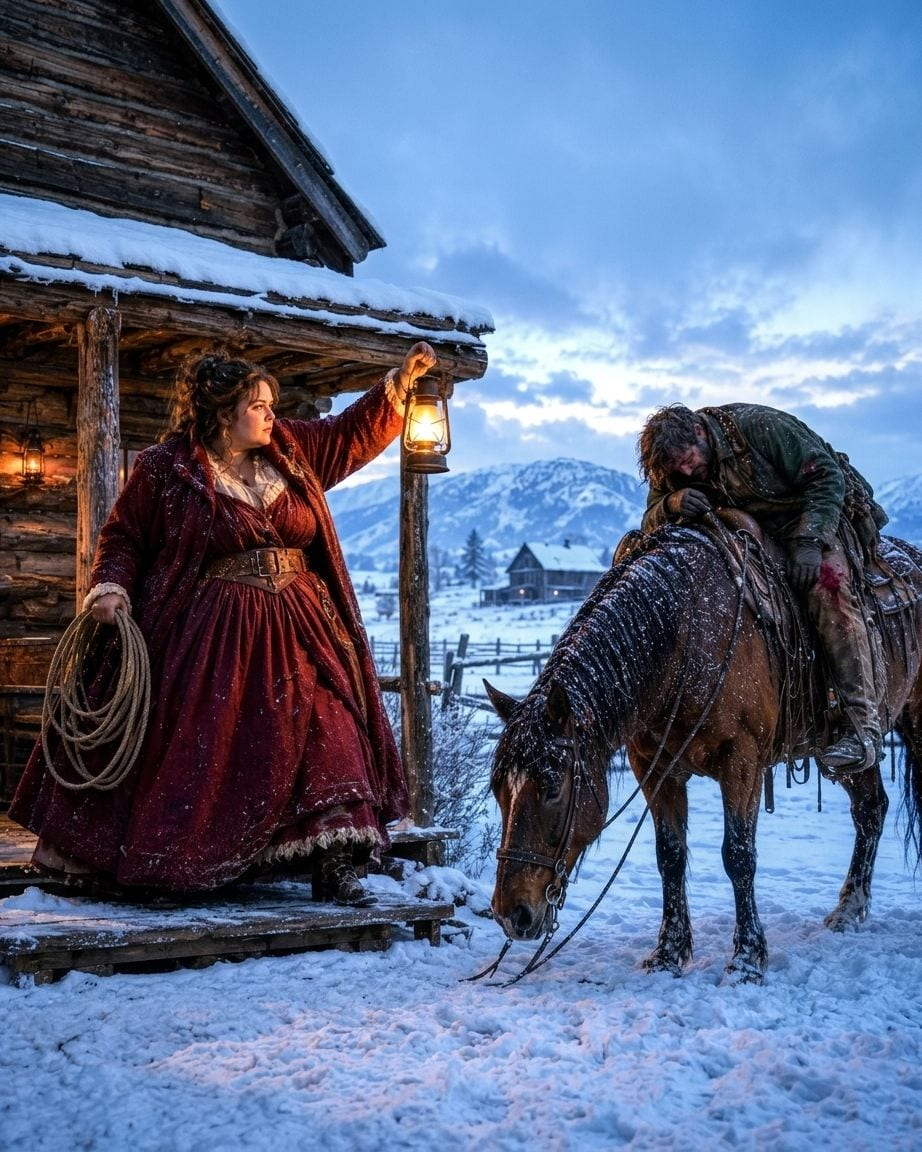
I thought about the night the stranger had arrived at my door.
The blood on his coat.
The storm.
The hidden notebook.
The warning.
Don't let Bell find the book.
I had believed I was rescuing an injured man.
In truth, he had brought the final piece of a story my family had spent decades trying to finish.
My mother slipped her hand into mine.
"Your father would be happy."
I looked at her.
"I wish he could see this."
She nodded.
"Me too."
We stood quietly.
Then she reached into her coat and removed the old photograph.
My father.
My mother.
And me.
The three of us outside the red door.
She handed it to me.
"I kept this all these years."
I studied the little girl in the photograph.
I barely recognized myself.
But I recognized the happiness on my parents' faces.
I looked at my mother.
"Let's take another one."
She smiled.
This time, I smiled too.
Caleb joined us.
Then Henry's widow.
Then Thomas and the neighboring ranchers.
Someone set the camera on the porch railing.
The afternoon sun illuminated the creek behind us.
For the first time in many years, nobody was hiding anything.
The photograph was taken.
And when I looked at it later, I realized something.
The old photograph had shown a family standing beside a secret.
The new one showed a family standing beside the truth.
That evening, I walked alone to the South Ditch.
The water moved steadily through the restored channel.
The wooden headgate stood firm.
The iron cross remained above the western support.
I touched it with my fingertips.
My father had once believed that the land needed a capable hand.
Gideon had mistaken capability for strength, and strength for control.
But the ranch had never survived because one person could dominate everyone else.
It had survived because people cared enough to protect what they shared.
I looked toward the house.
Warm light shone through the kitchen windows.
My mother was preparing supper.
Caleb was repairing a chair beside the fireplace.
The sound of their laughter carried across the yard.
I took one final look at the creek.
Then I walked home.
There was still work to do.
There would always be fences to mend, cattle to feed, gates to inspect, and storms to prepare for.
But I no longer faced those responsibilities with the feeling that the entire world was waiting for me to fail.
Red Willow was safe.
The water belonged to the valley.
My mother had come home.
And the man who had once arrived at my door half-dead in a blizzard had found something he hadn't expected to find in the mountains.
A place to belong.
As I stepped onto the porch, Caleb looked up.
"You're late for supper."
I glanced at the clock.
"By about five minutes."
"Your mother says that's unacceptable."
From the kitchen, my mother called, "I heard that!"
I laughed.
It was an ordinary sound.
An ordinary evening.
And after everything that had happened, ordinary felt like the greatest gift I could have received.
The spring kept flowing. The ranch remained ours. And for the first time in decades, Red Willow Station was finally home to everyone who loved it.






Comments 0