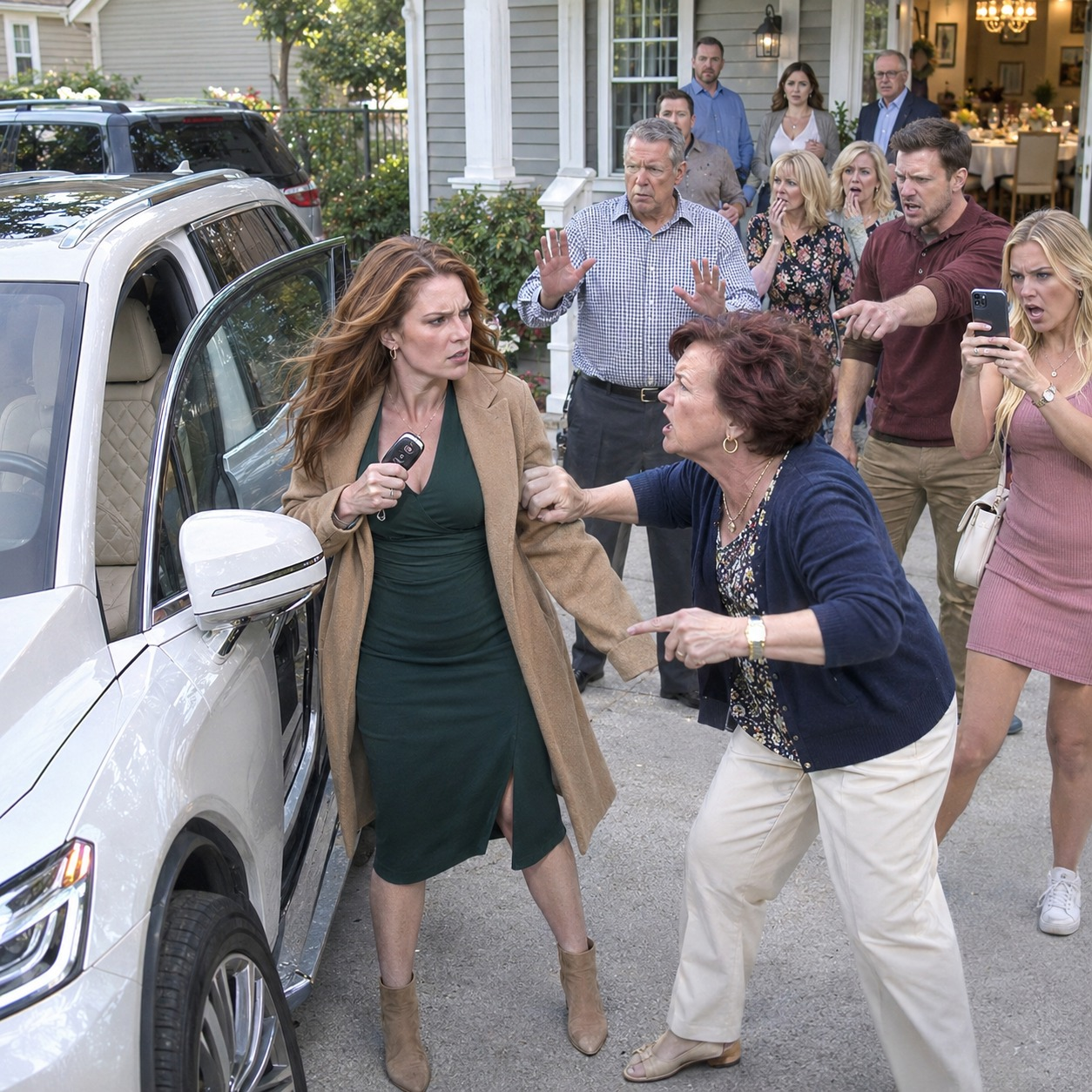
"Get back in that car and return it!" my mother shouted, grabbing my sleeve.
My younger brother, Brandon, stood behind her holding a black leather folder.
A yellow sticky note protruded from its edge.
Three words were written across it.
Natalie signs tonight.
I suddenly understood that my family dinner had never been about dinner.
Three minutes earlier, I had been happy.
Not the kind of happiness that makes you want to scream or dance in the street. It was quieter than that. The kind that settles somewhere deep in your chest when you finally do something for yourself after spending years convincing yourself that everyone else's needs are more important.
I had driven my brand-new Mercedes into my mother's driveway with both hands on the steering wheel and a ridiculous smile on my face.
One hundred thousand dollars.
That was approximately what the car had cost me.
I knew exactly how much money that was. I knew how many hours I had worked to earn it, how many business trips I had taken, how many weekends I had spent fixing software problems for clients who considered every minor inconvenience an emergency.
I also knew what my mother would say.
Or at least I thought I did.
She might complain that the car was extravagant. She might remind me that a reliable used vehicle could get me to work just as easily. She might ask whether I had negotiated the price.
I was prepared for all of that.
I wasn't prepared for her to look at my first major personal purchase as though I had stolen something from her.
My name is Natalie, and at thirty-eight years old, I had spent twelve years building a career as a software consultant in Austin, Texas.
I wasn't born wealthy.
I wasn't handed a company.
I didn't marry into money or inherit a fortune.
I built my career one contract at a time, starting with a tiny apartment, an unreliable laptop, and a secondhand sedan that overheated whenever the temperature climbed above ninety degrees.
By my early thirties, I had developed a reputation for rescuing complicated technology projects. Businesses hired me when their systems were failing, their deadlines were collapsing, and their executives were beginning to panic.
The work paid well.
It also demanded nearly everything I had.
There were months when I barely saw my friends. Years when I postponed vacations because another client needed something. Birthdays spent in airport lounges. Holidays interrupted by conference calls.
And through all of it, there was my family.
My mother, Diane.
My younger brother, Brandon.
And the house my father had once worked so hard to keep.
After Dad died, everything changed.
He had been the steady one. The person who checked the tires before a road trip, remembered everybody's birthdays, and somehow knew when something was bothering me before I said a word.
He worked hard, saved what he could, and believed that family meant showing up when someone needed help.
I loved that about him.
Unfortunately, my mother had a different interpretation of the same principle.
To her, family meant that whoever had the most money should always be expected to give the most.
And that person was usually me.
When Dad passed away, Mom struggled with the mortgage.
At first, I helped with a payment here and there.
Then it became several payments.
Then the property taxes.
Then a major plumbing repair.
Eventually, she admitted that she was months behind and might lose the house.
I couldn't bear the thought.
That house held every childhood Christmas, every birthday dinner, every memory of my father sitting at the kitchen table with his reading glasses balanced on the end of his nose.
So I found a solution.
I purchased the property from my mother at a professionally appraised price. The outstanding mortgage was paid off at closing, and she received the remaining proceeds.
I became the legal owner.
She continued living there rent-free.
I paid the property taxes, homeowners insurance, and major repairs.
On top of that, I sent her fifteen hundred dollars every month for living expenses.
It was an arrangement that allowed her to remain in the home without worrying about housing costs.
At the time, I thought she appreciated it.
Now, standing beside my new Mercedes, I was beginning to wonder whether she had ever appreciated anything I did.
"Well?" Mom demanded.
I blinked.
She was standing close enough that I could smell her familiar floral perfume.
Her short silver hair was perfectly arranged, and she wore a dark plum cardigan over a cream blouse.
Behind her, Brandon stood with his wife, Ashley.
Brandon was thirty-two, six years younger than me, and had always possessed a remarkable ability to turn his problems into somebody else's responsibilities.
He owned a restaurant on the other side of Austin.
It had opened three years earlier.
I had helped him with startup expenses.
I had also helped him through two difficult periods when cash flow became tight.
Each time, he promised it would be the last.
Each time, Mom reminded me that successful people were supposed to help their families.
Ashley stood beside him in a pale blue dress, studying my Mercedes with an expression I couldn't quite read.
"Mom," I said carefully, "what are you talking about?"
She laughed.
Not a warm laugh.
A short, dismissive sound that made several relatives standing near the porch turn toward us.
"Maybe it's time you stopped living so comfortably, Natalie."
I stared at her.
"What?"
"Your brother has real responsibilities. Employees. A wife. A business to run. And apparently, you have money to waste."
For a moment, I genuinely thought she was joking.
I glanced at Brandon, expecting him to say something.
He didn't.
He looked at the Mercedes, then at me.
"Pretty expensive car," he said.
"Yes," I answered.
"Must be nice."
I waited.
Nothing.
No congratulations.
No smile.
Not even a polite acknowledgment that I had worked hard for something I wanted.
Just three words.
Must be nice.
I looked past him toward the porch.
Several relatives had gathered near the entrance for our family dinner. My aunt Carol stood beside a cousin, holding a glass of iced tea. An older uncle looked uncomfortable. Another relative had stopped halfway down the steps.
Everyone was watching.
I felt suddenly foolish.
I had imagined arriving, showing my family the car, maybe letting my mother sit inside and admire the cream leather seats.
Instead, I was standing in the driveway defending a purchase I had made with my own money.
"I've wanted this car for years," I said.
Mom crossed her arms.
"Well, wanting something doesn't mean you should buy it."
"I can afford it."
"That's exactly the attitude I'm talking about."
"What attitude?"
"Thinking only about yourself."
The words landed harder than I expected.
I thought about the money I had transferred to her account just four days earlier.
Fifteen hundred dollars.
Like clockwork.
I thought about the property insurance renewal I had paid the previous month.
I thought about the contractor who had replaced the home's aging air-conditioning system two summers earlier.
I thought about Brandon's restaurant.
The checks.
The emergencies.
The promises.
And suddenly, I was tired.
Not angry yet.
Just tired.
"Mom, I don't think buying myself a car makes me selfish."
She stepped closer.
"Of course you don't. That's the problem."
Brandon sighed loudly.
"Can we just go inside? We're supposed to be having dinner."
I looked at him.
"Then why are we having this conversation?"
He exchanged a glance with Mom.
It was quick.
Almost invisible.
But I noticed.
I'd spent enough years sitting across conference tables from executives trying to conceal bad news to recognize a coordinated look.
Something had been discussed before I arrived.
Something involving me.
Mom released my sleeve and smoothed her cardigan.
"Fine," she said. "We'll talk inside."
There was something about the way she said it that made my stomach tighten.
Not we can talk inside.
We'll talk inside.
As though a decision had already been made.
As though my participation was merely a formality.
I reached into the Mercedes and retrieved my handbag.
For a brief moment, I considered leaving.
I could have closed the car door, driven home, and spent the evening enjoying the expensive leather seats and quiet cabin without having to justify myself to anyone.
But I didn't.
My aunt Carol had driven in for dinner.
Several cousins were there.
And despite everything, I still wanted to believe that this was a misunderstanding.
Maybe Mom was having a bad day.
Maybe Brandon was stressed about the restaurant.
Maybe I was reading too much into a few unpleasant remarks.
I closed the driver's door and followed everyone toward the house.
The familiar porch steps creaked beneath my heels.
Inside, the dining room was already prepared.
My mother had set out her best dishes.
There were roasted vegetables, mashed potatoes, salad, and a large platter of chicken.
The chandelier glowed above the table.
Everything looked normal.
That somehow made me more uneasy.
I took my usual seat.
Brandon sat across from me.
Ashley settled beside him.
Mom occupied the chair at the head of the table, the same place my father used to sit.
I had never quite gotten used to seeing her there.
For the first fifteen minutes, conversation stayed harmless.
My aunt talked about a neighbor's wedding.
A cousin mentioned a promotion.
Someone asked whether the restaurant had been busy lately.
That was when Brandon straightened in his chair.
"Actually," he said, "I've got some pretty exciting news."
Ashley immediately smiled.
"Oh, tell them."
Brandon reached for his phone.
"We're looking at opening a second location."
Several relatives congratulated him.
Mom beamed.
I set down my water glass.
"A second restaurant?"
"That's right."
"Where?"
"North Austin. Great neighborhood. Lots of growth. The location's perfect."
Ashley passed her phone around, showing photographs of a commercial space with large windows and an outdoor patio.
It looked attractive.
It also looked expensive.
"Have you signed a lease?" I asked.
"Not yet," Brandon replied.
"What's the projected startup cost?"
He hesitated.
Mom gave me a warning look.
"Natalie, can't you just be happy for your brother?"
"I am happy for him. I'm asking a reasonable question."
Brandon leaned back.
"We've worked out the numbers."
"With an accountant?"
His smile tightened.
"With people who know the restaurant business."
I nodded slowly.
I had heard that answer before.
Three years earlier, Brandon had assured me that his first restaurant would become profitable within six months.
It took nearly two years.
Even then, he occasionally called me when payroll was due.
I didn't mention any of that.
Not yet.
Ashley retrieved her phone and placed it beside her plate.
"The new location could really change our lives," she said.
"I'm sure it could," I answered.
Mom looked at me.
Then at Brandon.
Then back at me.
She folded her napkin carefully.
And I knew.
I knew before she opened her mouth.
"We need you to contribute one hundred thousand dollars," she said.
The room went quiet.
I looked at her.
"I'm sorry?"
"One hundred thousand," she repeated. "For Brandon's expansion."
My fork rested halfway between my plate and my mouth.
I lowered it.
"Mom, that's not something I'm going to do."
She frowned.
"You haven't even heard the proposal."
"I've heard the amount."
Brandon leaned forward.
"It's an investment, Natalie."
"Then you should present it as an investment, with financial statements and a proper agreement."
He waved a hand.
"Don't make this complicated."
I looked from him to Mom.
Then I understood why she had reacted so strongly to the Mercedes.
"You want me to return my car."
Mom lifted her chin.
"That would be the responsible thing."
I almost laughed.
Not because it was funny.
Because the absurdity of it was overwhelming.
I had spent years paying for this house.
Years helping my brother.
Years postponing things I wanted.
And now, the first time I had bought something expensive for myself, my family had gathered around a dinner table to tell me I didn't deserve it.
"No," I said.
Mom's face hardened.
"Excuse me?"
"No. I'm not returning the car, and I'm not giving Brandon a hundred thousand dollars."
Brandon stared at me.
"You haven't even looked at the business plan."
"Then why did Mom already decide how much I should contribute?"
He looked away.
Ashley shifted in her chair.
My aunt Carol stopped eating.
Mom leaned forward.
"After everything this family has done for you—"
I felt something tighten in my chest.
"What exactly have you done for me that makes you entitled to control my money?"
The question came out quietly.
But it changed the room.
Mom's cheeks flushed.
"How dare you speak to me that way?"
"I'm asking you a question."
"I raised you!"
"And I'm grateful you raised me. But that doesn't mean I owe Brandon a second restaurant."
Brandon pushed his chair back.
"Unbelievable."
I turned toward him.
"What's unbelievable?"
"That you're sitting here acting like we're asking for charity."
"A hundred thousand dollars is a substantial amount of money."
"It's not like you don't have it."
I stared at him.
There it was.
The sentence that explained so much.
Not whether I could afford the investment.
Not whether I wanted to make it.
Not whether his business was financially sound.
Just the assumption that because I had money, he should have access to it.
Mom placed her palm against the table.
"Brandon has already made commitments based on this."
My stomach dropped.
"What commitments?"
She didn't answer.
Brandon looked annoyed.
"Mom, it's fine."
I turned toward him.
"What commitments, Brandon?"
He rubbed his forehead.
Then he said something that made the entire room seem to tilt.
"Mom's already offered the house as collateral. We just need your signature and the rest of the money."
I stared at him.
For several seconds, I couldn't speak.
The house.
My house.
The property I had legally purchased years earlier.
The home I maintained, insured, and paid taxes on.
My mother was sitting at the head of its dining table, casually discussing using it to secure a business loan.
Without asking me.
Without telling me.
Without apparently considering that she didn't own it.
I looked at her.
"Mom?"
She continued cutting her chicken.
"Yes?"
"Did you tell Brandon he could use this house as collateral?"
She took another bite.
Then she looked up.
"We're trying to help your brother."
"That wasn't my question."
Her expression sharpened.
"Don't start."
"Did you tell him he could use my property as collateral?"
Brandon made an impatient noise.
"Why do you keep calling it your property? It's the family house."
"Because I own it."
Mom set down her knife.
"Don't be dramatic."
I stared at her.
Dramatic.
That was what she called it.
I had purchased the house through a legitimate real estate transaction, paid the mortgage balance at closing, and assumed responsibility for every major expense.
Yet somehow, acknowledging those facts was dramatic.
Brandon reached down beside his chair.
He lifted the black leather folder I had noticed in the driveway.
"Look," he said, "we've already got most of the paperwork started."
He slid it across the table.
The folder stopped beside my plate.
I didn't touch it immediately.
Something about the way Brandon watched me made my skin prickle.
It wasn't the expression of a man asking for help.
It was the expression of someone waiting for a signature he believed he was already entitled to receive.
I opened the folder.
Inside were printed projections, a proposed financing structure, and preliminary loan documents.
I recognized the property address immediately.
My mother's house.
My house.
Listed as an available asset.
I turned another page.
There was my name.
Natalie.
Under a section identifying prospective loan guarantors.
My pulse quickened.
I read the line again.
Then a third time.
Nobody had asked me to guarantee a loan.
Nobody had requested permission to include my property in a financing proposal.
Nobody had even told me the proposal existed.
I looked up.
"Who prepared this?"
Brandon shrugged.
"Our financing contact."
"Who gave them my information?"
Mom sighed.
"Oh, for heaven's sake."
I ignored her.
"Brandon. Who gave them my information?"
He looked at Ashley.
Ashley looked down.
My aunt Carol shifted in her chair.
The silence became unbearable.
Then Mom leaned across the table.
"Don't embarrass us, Natalie. Your aunt has already invested twenty-five thousand dollars because we told her you were backing the business."
I slowly turned toward Aunt Carol.
Her face had gone pale.
"Carol," I said, "you invested twenty-five thousand dollars?"
She nodded uncertainly.
"Your mother said you were helping Brandon again."
I looked back at Mom.
"You told her that?"
"We assumed you'd do the right thing."
I closed the folder.
Very slowly.
My hands were steady.
My voice was steady.
But inside, something had changed.
I had come to dinner believing my family resented my new car.
Now I understood that the car had merely exposed a much larger problem.
They hadn't simply wanted my money.
They had already started making promises with it.
And they had apparently expected me to cooperate once those promises became impossible to undo.
I pushed my chair back.
"Nobody is using my house as collateral," I said.
Brandon stood.
"You can't just walk away from this."
I looked directly at him.
"Watch me."
I picked up the folder.
Mom rose from her chair.
"That paperwork stays here."
"No," I said. "It doesn't."
I walked toward the dining room doorway.
Behind me, Brandon muttered something to Ashley.
Mom called my name.
I kept walking.
Then my phone vibrated inside my handbag.
I stopped near the front entrance and checked the screen.
It was an email from a commercial lending company I had never contacted.
The subject line read:
URGENT: Confirmation Required Regarding Your Personal Guarantee
Beneath it was a preview of the first sentence.
Dear Ms. Natalie, we are following up on the authorization recently submitted in connection with your family's property...
I opened the message.
At the bottom was a document attachment.
Its filename contained my full name.
And when I tapped it, the first page displayed a signature that looked exactly like mine.






Comments 0