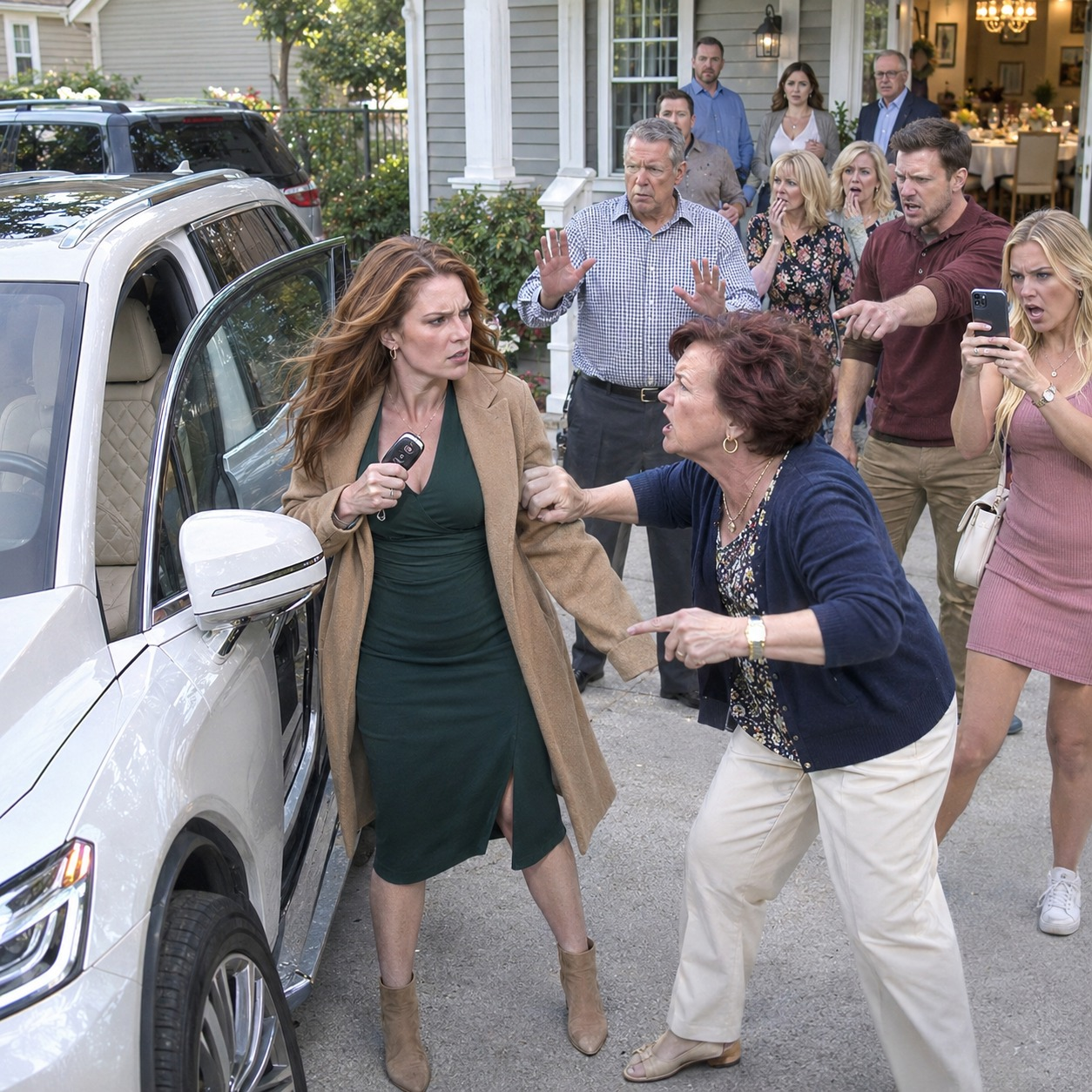
Ashley Bennett stood beside my brother's truck, holding the envelope my father had left behind.
And Brandon was waiting for her.
I stared at the security photograph on Rebecca's phone, unable to make sense of what I was seeing.
For days, Ashley had been helping me.
She had photographed financial documents, warned me about Brandon's behavior, and told me things my mother had spent years trying to conceal.
Now she appeared to be delivering the most important evidence we had found straight into my brother's hands.
"She lied to me," I whispered.
Rebecca didn't answer immediately.
She studied the image.
"Maybe. But we don't know what happened after this photograph was taken."
I looked at her.
"Brandon is standing right there."
"I see him."
"And Ashley has the package."
"Yes."
I felt my chest tighten.
"Then what else is there to know?"
Rebecca placed her phone on the table.
"Whether she got into the truck. Whether she gave him the package. Whether she was acting voluntarily. We need facts before conclusions."
I wanted to argue.
Instead, I looked toward my mother.
She was sitting on the edge of the spare bed, staring at the floor.
"Did you know Ashley was involved?" I asked.
Mom shook her head.
"No."
"Did Brandon tell you she could retrieve Dad's documents?"
"No."
I stared at her.
For once, I couldn't tell whether she was lying or genuinely frightened.
Rebecca's phone rang.
She glanced at the screen.
"It's the storage company."
She answered immediately.
"Rebecca Shaw."
I watched her expression.
"Yes, I'm with Natalie Bennett."
A pause.
"Is Ms. Bennett's sister-in-law still there?"
Another pause.
Rebecca straightened.
"Thank you. Please preserve the security footage and the release records. We'll follow up in writing."
She ended the call.
I stepped closer.
"What happened?"
Rebecca looked at me.
"Ashley didn't leave with Brandon."
I froze.
"What?"
"She went back inside the storage facility."
I stared at her.
"Then why was she standing beside his truck?"
"Apparently, Brandon intercepted her outside. The employee who called us says Ashley returned to the reception desk and asked for assistance."
My heart began pounding.
"Is she safe?"
"She's inside with the manager. Brandon left after being told the police had been contacted."
I closed my eyes.
Relief washed through me so suddenly that my knees felt weak.
Then Rebecca continued.
"There's another important detail. Ashley didn't actually receive the original sealed package."
I frowned.
"But the photograph—"
"She was carrying an envelope containing a copy of the release paperwork. The package itself was still secured."
I stared at her.
"Why did the earlier message say she'd taken possession?"
"Because the employee misunderstood what had been released. The manager checked the transaction log."
I exhaled.
For once, a misunderstanding had worked in our favor.
I reached for my phone.
Ashley answered immediately.
"Natalie?"
Her voice was shaking.
"Are you okay?"
"Yes."
"Where are you?"
"Still at the storage facility."
I closed my eyes.
"Rebecca told me."
Ashley began crying.
"Brandon followed me."
My stomach tightened.
"Why were you there?"
She took a shaky breath.
"Because I found something in his old files."
I waited.
"A copy of your father's storage instructions. My name was listed as an alternate contact."
I frowned.
"Why would Dad list you?"
"He didn't."
I went still.
"What?"
"The original release instruction listed a different person. My name was added later."
I looked at Rebecca.
She was already listening.
Ashley continued.
"Brandon told me years ago that it was routine paperwork. I didn't think anything of it until I saw the storage company's name in his folder."
I felt cold.
"Did you know about the package?"
"No. Not until this week."
"Then why did you go?"
"Because I thought Brandon was trying to take it."
I swallowed.
"And you wanted to get there first."
"Yes."
I closed my eyes.
"Why didn't you tell me?"
Ashley hesitated.
"Because I thought you wouldn't trust me."
I looked at the photograph again.
Brandon beside the truck.
Ashley holding the envelope.
The image had seemed to prove betrayal.
But it had shown only a moment.
Not the decision she made afterward.
"I'm sorry," I whispered.
Ashley began crying harder.
"I didn't give him anything, Natalie."
"I know."
"He said if I didn't cooperate, he'd tell everyone I helped him forge the documents."
My stomach tightened.
"Did you?"
"No."
Her answer came immediately.
"But I did help with bookkeeping. I signed forms without reading them carefully. I ignored things I should have questioned."
I took a breath.
"Then tell Rebecca everything."
"I will."
Rebecca stepped closer.
"Ashley, stay with the manager until you've arranged safe transportation. Don't meet Brandon alone."
"I won't."
After we ended the call, I looked at my mother.
She was crying silently.
For the first time, I didn't feel responsible for making her stop.
I sat beside Rebecca and looked at the documents spread across the table.
The original agreement.
The missing pages.
My father's letters.
The suspicious bank statements.
The altered beneficiary instructions.
The forged authorizations.
And the photograph of Charles Denton.
I had spent days chasing one revelation after another.
Now I wanted answers that could survive more than a conversation.
I wanted records.
Originals.
Independent verification.
And an end to the nightmare.
Rebecca seemed to understand.
"We're going to do this systematically," she said.
I nodded.
"Okay."
"First, we secure the remaining records. Second, we notify the institutions involved that the authorizations are disputed. Third, we work with Laura Chen to reconstruct the transactions."
I looked at Mom.
"And the original agreement?"
"We'll obtain a complete authenticated copy from the appropriate custodian, including the missing pages."
Mom lowered her head.
Rebecca continued.
"Then we determine which rights belong to you, which payments were properly made, and which transfers need to be challenged."
I took a breath.
"And Brandon?"
Rebecca looked at me.
"Brandon will have to answer for his own actions."
For years, that sentence would have terrified me.
Now it sounded like the beginning of something necessary.
The following morning, Rebecca called me at eight seventeen.
I had slept less than four hours.
But when I saw her name, I answered immediately.
"Natalie?"
"I'm here."
"The storage company has confirmed that the original package is intact."
I sat upright.
"And?"
"Their legal department has agreed to preserve it pending verification of the release instructions. They've also provided us with copies of the deposit records through the appropriate authorization process."
My heart began pounding.
"What do they say?"
Rebecca paused.
"Your father arranged the deposit before his final hospitalization."
I closed my eyes.
"He knew something was wrong."
"It appears he was concerned about document integrity."
I swallowed.
"Who was originally authorized to receive it?"
"You."
I stopped breathing.
"Me?"
"Yes. The original instructions name Natalie Bennett as the primary recipient, subject to identity verification."
I looked toward the window.
For years, I had wondered why Dad hadn't simply told me everything.
Now I was beginning to understand.
He had tried to preserve the truth somewhere it couldn't easily be altered.
Rebecca continued.
"The later paperwork adding Ashley and Charles Denton appears to have been submitted after his death. The storage company has no record of a valid authorization from you approving those changes."
I closed my eyes.
"Then Ashley wasn't supposed to be able to retrieve it."
"Correct. She received only preliminary paperwork before the discrepancy was identified."
I nodded.
"And Charles?"
"His request was rejected."
I exhaled.
Rebecca's voice softened.
"Natalie, we also found something in the deposit inventory."
"What?"
"A recording."
I sat still.
"What kind of recording?"
"An audio recording your father made shortly before he died."
My throat tightened.
For a moment, I couldn't speak.
Then I whispered, "Can I hear it?"
"Yes. We'll arrange a supervised review of the original materials."
I looked down at my hands.
Dad's voice.
I hadn't heard it in years.
I still remembered how he said my name.
How he laughed when I told him about difficult clients.
How he always ended our calls by reminding me to eat something other than takeout.
The thought of hearing him again made my chest ache.
"I want to hear it," I said.
Rebecca paused.
"Then we'll do that."
Three days later, I sat in Rebecca's conference room with Thomas Whitaker, Laura Chen, and an independent records specialist.
A complete copy of my father's original agreement lay on the table.
The missing pages had been recovered from the storage package.
Pages forty-three through forty-six.
Four pages that explained more than years of family conversations ever had.
The agreement established a continuing contractual financial interest arising from Dad's sale of his construction supply business stake.
It wasn't simply an inheritance sitting in a bank account.
It involved deferred payments, distribution instructions, and rights that survived his death under specific terms.
Dad had designated a protected portion for me.
He had also provided substantial financial assistance to Brandon through separate arrangements during his lifetime.
The original documents made that clear.
My brother hadn't been forgotten.
He hadn't been cheated.
He hadn't been left with nothing.
Dad had helped him repeatedly.
And Dad had deliberately kept my interest separate from Brandon's obligations.
Laura pointed to a provision on page forty-four.
"This is the critical restriction."
I leaned forward.
The provision required verified beneficiary authorization before certain rights could be assigned, pledged, or redirected.
It also limited post-death changes to the distribution instructions.
The purported amendment dated three weeks after Dad's funeral didn't satisfy those requirements.
Worse, it carried a signature attributed to Dad on a date when he was already dead.
Rebecca looked at me.
"The document was not a valid authorization from your father."
I stared at the page.
For days, I had feared that Dad had changed his mind.
That he'd decided Brandon needed the money more.
That Mom had simply followed his wishes.
Now I had the original agreement in front of me.
And it said otherwise.
"Who prepared the amendment?" I asked.
Laura opened another folder.
"The transaction records and correspondence identify Harold Vance as the person who processed it. Charles Denton supplied supporting paperwork. Diane signed the beneficiary-change request."
I looked down.
My mother.
My brother.
Harold.
Charles.
Different roles.
Different decisions.
But the same result.
Money intended to remain protected had been redirected through disputed documents.
Rebecca continued.
"That doesn't mean every transaction is automatically recoverable, but we have a strong basis to challenge the unauthorized transfers."
I nodded.
Then Laura opened the next file.
"The accounts."
My stomach tightened.
The account ending 4419 had been opened eight months earlier using identification and authorization materials submitted in my name.
The bank's investigation confirmed that the opening documents did not match its verified records for me.
The second account had been used to receive payments described as beneficiary distributions.
Some of those funds had been transferred to Cedar Ridge Financial Services LLC.
The company Mom controlled.
Laura had reconstructed the available transaction history using bank records, payment confirmations, and the administrator's files.
She explained each movement carefully.
Some money had gone toward Brandon's restaurant.
Some had been used to service private loans.
Some had paid administrative fees to entities connected with Harold and Charles.
Other amounts remained under review.
But the overall pattern was no longer a mystery.
My identity had been used to make unauthorized transactions appear legitimate.
I looked at Laura.
"Why did the older document also end in 4419?"
She turned to another page.
"That was a separate account maintained years earlier under the original arrangement. The matching last four digits were coincidental. They were different accounts at different institutions."
I exhaled.
One mystery resolved.
Then another.
"The Cedar Ridge reference in Dad's memorandum?" I asked.
Laura nodded.
"Inserted later."
She showed me the authenticated original.
The suspicious payment table was absent.
The scanned copy I'd received anonymously had been altered.
"The original memorandum didn't mention Cedar Ridge because the company didn't exist," Laura said.
I looked at the documents.
"Who altered the copy?"
Rebecca answered.
"The available electronic records point to a file prepared through Harold's office. We can't establish who personally made every edit, but the altered version was circulated during the later financing efforts."
I nodded.
That distinction mattered.
I was no longer interested in accusing people based on what seemed likely.
I wanted to know what could actually be proved.
Thomas shifted in his chair.
"There's something I need to say."
We looked at him.
His face was pale.
"Richard trusted me to protect the original arrangement. I should have questioned the changes sooner."
I didn't answer.
He continued.
"When Brandon approached me about financing, I believed the documents were genuine. I released part of my investment commitment without confirming directly with Natalie."
He looked at me.
"I'm sorry."
For years, I might have told him it was fine.
I might have minimized the mistake to spare his feelings.
But it wasn't fine.
His failure to verify the documents had helped create the situation.
"I appreciate your apology," I said. "But I need you to cooperate fully with Rebecca."
"I will."
And he did.
The recording was played that afternoon.
I sat alone with Rebecca.
The room was quiet.
A small speaker rested on the table.
Rebecca looked at me.
"Ready?"
I nodded.
She pressed play.
For a moment, there was only a faint rustling sound.
Then I heard him.
My father.
"Natalie."
My hand flew to my mouth.
His voice was weaker than I remembered.
But it was unmistakably his.
"If you're hearing this, it means I wasn't able to finish something important."
Tears filled my eyes.
He paused.
"I want you to know that I love you. I have always been proud of you."
I began crying.
Rebecca quietly placed a box of tissues beside me.
Dad continued.
"I discovered financial documents bearing your name that you did not authorize. I asked you directly, and you told me the truth. I believe you."
I closed my eyes.
He believed me.
Even then.
Even before I understood what was happening.
"I have preserved the original agreement and the records I could obtain. I don't know yet how far the problem goes. But I know your financial interest was never intended to secure your brother's debts."
His breathing was audible.
Then he said something that made me sit straighter.
"Brandon brought me the first authorization. He said Charles had prepared it and that Diane understood the arrangement. I confronted Charles because I wanted to know why anyone thought they could use your signature."
I stared at the speaker.
Dad continued.
"Brandon admitted he had supplied copies of your personal information. He claimed he didn't know the signature was false. I don't know whether that is true."
My chest tightened.
There it was.
The first authorization.
The document that had started everything.
Brandon had supplied my information.
Charles had prepared the paperwork.
And Dad had discovered the signature wasn't mine.
Then Dad's voice softened.
"I also want you to know something about your mother."
I stopped breathing.
"Diane has been frightened for a long time. She believes helping Brandon means preventing him from failing. I have tried to explain that we cannot save him by taking from you."
I wiped my eyes.
"I hope she understands one day."
There was a pause.
Then his voice became firmer.
"But whether she understands or not, you must protect yourself."
I pressed a tissue against my mouth.
Dad continued.
"You are not responsible for the choices other people make. You are not required to surrender your future because someone else has spent theirs."
I cried harder.
Then he said the words I would remember for the rest of my life.
"Your success is not a debt you owe your family."
The recording ended a few moments later.
I sat motionless.
Rebecca didn't speak.
For years, I had carried the quiet fear that Dad might have been disappointed in me.
That he might have thought I was selfish for refusing Brandon.
That perhaps Mom knew something about his wishes that I didn't.
Now I had heard his voice.
And he had told me exactly what he wanted.
I looked at Rebecca.
"I needed that."
She nodded.
"I know."
The investigation into Dad's collapse took longer.
There was no dramatic revelation that he had been murdered.
No hidden medical report proving Charles Denton had physically attacked him.
The records showed that Dad suffered a serious medical emergency after the confrontation.
The hospital documentation and emergency dispatch records helped establish the timeline.
Mom's account of a delay before calling for help was troubling.
But the medical review couldn't determine that the delay caused his death.
And there was no reliable evidence that Charles had struck him.
That truth was painful.
I had wanted a single person to blame.
A single act that would explain everything.
Instead, Dad's death remained a medical tragedy surrounded by secrecy, fear, and terrible decisions.
Peter Lawson confirmed that he had met Dad earlier that day.
He had warned him about discrepancies in the payment records.
Charles arrived later.
The argument followed.
Peter also supplied correspondence showing Dad had demanded explanations for unauthorized transfers.
The evidence supported what Dad had said in his recording.
Charles had been involved in preparing disputed financial paperwork.
Harold had processed transactions without proper verification.
And Brandon had supplied personal information that should never have been used.
The investigation into the financial misconduct proceeded separately.
That was where the strongest evidence lay.
The banks preserved their records.
The lender maintained its suspension of the fraudulent financing application.
No loan secured by my townhouse had been approved.
No valid lien had been placed against it.
And the draft deed purporting to transfer my property to Mom had never become an effective conveyance.
My house remained mine.
My credit reports were corrected after the disputed accounts were investigated.
The banks formally recognized the identity-theft claims and closed the unauthorized accounts associated with my name.
The financial institutions and relevant authorities received the evidence concerning the forged signatures and false notarial acknowledgments.
Margaret Ellis cooperated fully.
Her old commission records confirmed that she hadn't been authorized to notarize the recent documents.
The certificate Mom had sent Harold had been reused improperly.
Margaret's emails and travel records helped establish that she had not witnessed my signatures.
I called her after Rebecca confirmed the findings.
"I'm sorry I doubted you," I said.
Margaret was quiet for a moment.
"Natalie, you had every reason to ask questions."
I swallowed.
"Still."
She sighed.
"Your father would be proud that you insisted on the truth."
I looked toward the window.
"I hope so."
"I know so."
Friday came.
The deadline Brandon and Harold had been discussing.
The proposed transaction involving the remaining rights under Dad's agreement did not close.
Rebecca had sent formal notices disputing the authorization.
The institutions involved required independent verification.
And the supposed signatures could not withstand scrutiny.
Charles Denton and Harold Vance were no longer able to move the transaction forward using the documents they had presented.
Their professional and legal troubles grew as investigators reviewed the records.
Eventually, both faced formal proceedings arising from the financial-document misconduct.
The exact consequences took time to resolve.
But the important part was settled long before every proceeding ended.
They could no longer use my identity to move money.
Brandon's situation was different.
He had helped supply personal information, participated in the financing efforts, and benefited from transfers that were now being challenged.
He couldn't simply claim he knew nothing.
His restaurant closed.
I hated that part.
Not because I believed I should have rescued it.
Because real people lost jobs.
Employees who had worked hard.
Suppliers who had extended credit.
Investors who had trusted promises that weren't true.
Aunt Carol was among them.
Rebecca helped her find independent counsel, and Carol joined the appropriate recovery process.
Thomas pursued the portion of his investment he had released based on the disputed documents.
The restaurant's remaining assets were handled through an orderly legal process.
Some creditors recovered part of what they were owed.
Others suffered losses.
There was no magical fund that made everyone whole.
But the losses were finally being acknowledged instead of hidden behind another desperate loan.
I made one decision that surprised everyone.
I contacted the restaurant's former manager and offered to fund a short, independently administered job-placement program for displaced employees.
The assistance went directly toward résumé support, training expenses, and emergency transportation for workers seeking new jobs.
It didn't go through Brandon.
It didn't pay his debts.
And it didn't require me to guarantee anything.
Several employees found new positions within weeks.
The manager later sent me a photograph of three former coworkers celebrating their first day at a new restaurant.
I smiled when I saw it.
Helping people didn't have to mean surrendering control of my life.
I wished I'd understood that years earlier.
Mom asked to see me two weeks after the restaurant closed.
I agreed.
But we met at Rebecca's office.
Not at my townhouse.
Not at the family house.
And not alone.
Mom looked smaller than I remembered.
She sat across from me, twisting a tissue between her fingers.
For a long time, neither of us spoke.
Then she said, "I owe you an apology."
I waited.
She swallowed.
"I used your money because I thought Brandon needed it more."
My chest tightened.
She continued.
"I told myself you wouldn't miss it. That you had a successful career and a nice home and a car you loved. I convinced myself that made it acceptable."
I stared at her.
"It wasn't."
"I know."
She began crying.
"I kept thinking I could replace everything before you found out."
I looked down.
"Mom, you didn't just take money."
She nodded.
"I know."
"You let people use my identity."
"Yes."
"You gave them my documents."
"Yes."
"You treated my home as though it belonged to you."
Her voice broke.
"Yes."
I took a breath.
"And every time I asked a question, you made me feel guilty."
She covered her face.
"I did."
For the first time, she wasn't arguing.
She wasn't telling me Brandon had suffered more.
She wasn't reminding me how much she'd sacrificed as a mother.
She was simply acknowledging what had happened.
It didn't erase anything.
But it mattered.
"Why?" I asked.
She lowered her hands.
"Because I was afraid that if Brandon failed, it would mean I'd failed him."
I looked at her.
"And what did you think would happen to me?"
She began crying again.
"I thought you'd always be okay."
I felt tears gather.
"Mom, being capable doesn't mean I can't be hurt."
She nodded.
"I know that now."
We sat quietly.
Then I told her what I had decided.
She would no longer receive the monthly fifteen-hundred-dollar payment.
She would no longer have access to my financial information.
She would cooperate with the recovery process and provide a full accounting of the money she had received or redirected.
And she would move out of the house I owned.
Not immediately.
I gave her a reasonable period to arrange alternative housing, documented through the proper legal process.
She had some retirement income and savings of her own.
It wasn't the lifestyle she'd grown accustomed to, but it was enough to establish a modest home with careful planning.
She looked devastated.
"You're making me leave?"
I took a breath.
"I'm ending an arrangement that has become unhealthy for both of us."
She began crying.
"Where will I go?"
"You have options, Mom. Rebecca can give your attorney the timeline and documentation."
She stared at me.
"You're really doing this."
"Yes."
For years, I had feared that saying no would make me a bad daughter.
Now I understood that a relationship built entirely on my willingness to give could never become healthy until that expectation changed.
Mom wiped her eyes.
Then she whispered, "I understand."
I didn't know whether she truly did.
But for once, I didn't need to persuade her.
Brandon contacted me a month later.
He asked to meet.
I agreed to a conversation with Rebecca present.
He looked exhausted.
The confident restaurant owner I remembered was gone.
He wore jeans and an old jacket.
His face was thinner.
For a moment, I saw the little boy who used to follow me around the backyard.
The brother who begged me to help him build forts.
The boy who cried when Dad left for business trips.
Then he sat down and looked at me.
"I guess you got what you wanted."
I felt a familiar sting.
But I didn't apologize.
"What I wanted was for you to stop using my name."
He looked away.
"I didn't think it would get this bad."
I waited.
He rubbed his hands together.
"Charles said the financing would fix everything."
"And you believed him?"
"I wanted to."
I nodded.
The same words Mom had used.
He looked at me.
"I didn't forge every signature."
"I know the evidence distinguishes what different people did."
He swallowed.
"But I gave them your documents."
"Yes."
"And I knew you hadn't agreed to the loans."
I felt my chest tighten.
"Yes."
He lowered his head.
"I'm sorry."
For years, I had imagined how satisfying those words would feel.
Instead, I felt sad.
Because they came after so much damage.
"Brandon," I said quietly, "I loved you before you had a restaurant."
He looked up.
"I know."
"I loved you when you were broke."
His eyes filled with tears.
"And I would have loved you if the business failed honestly."
He began crying.
I continued.
"But you made me responsible for preventing that failure. And when I refused, you tried to take away my choice."
He nodded.
"I know."
I took a breath.
"I can't fix this for you."
He wiped his eyes.
"I know."
"And I won't give you money."
He nodded again.
"I didn't come to ask."
For the first time, I believed him.
He told me he had begun cooperating with the financial investigation.
He was working with independent counsel.
He had taken temporary work outside the restaurant industry.
And he had started addressing his debts instead of hiding them.
None of that erased what he'd done.
The legal process would continue.
But it was the first time I'd heard him describe a plan that didn't involve my bank account.
Before he left, he looked at me.
"Do you think we'll ever be normal again?"
I considered the question.
"No," I said.
His face fell.
Then I added, "But maybe we can build something more honest."
He nodded slowly.
It wasn't forgiveness.
Not yet.
But it was a beginning.
The financial recovery took longer than I wanted.
There were document reviews, disputes, negotiations, and proceedings.
Some funds had already been spent.
Some were traceable to accounts that could be restrained or recovered.
Others required settlements and repayment arrangements.
The final accounting confirmed that substantial payments intended for my protected interest had been improperly redirected.
Under the agreements and resolutions reached, the remaining contractual rights were recognized in my name, and the improper beneficiary instructions were set aside.
I recovered a meaningful portion of the diverted funds.
Additional repayment obligations were established for amounts that could not be returned immediately.
I didn't recover every dollar.
But I recovered something I had almost lost entirely.
Control.
My legal identity was mine again.
My financial decisions were mine.
And my father's intentions had finally been recognized.
Laura Chen sent me the completed reconciliation report on a rainy Thursday afternoon.
I opened it at my desk.
For the first time, the numbers made sense.
No unexplained accounts.
No mysterious transfers disguised as family agreements.
No forged authorizations being treated as though they represented my consent.
I called Rebecca.
"Is this really finished?"
"The core financial claims are resolved," she said. "There are still scheduled payments and administrative follow-up, but your rights are established."
I closed my eyes.
"Thank you."
She laughed softly.
"You did the difficult part."
I looked at the report.
"No. I just stopped saying yes."
"Sometimes that's the difficult part."
Six months after the first argument about my Mercedes, I drove to the family house one final time.
Mom had moved into a small apartment near Aunt Carol.
She had returned the keys.
The locks had been changed.
The house was empty.
I stood on the front porch, looking at the oak tree Dad planted when I was twelve.
Its branches stretched across the yard.
I remembered him standing beside the little sapling, telling me it would grow taller than the house someday.
I had laughed.
I hadn't believed him.
Now its branches reached over the roof.
I unlocked the front door.
Inside, the rooms were quiet.
No arguments.
No demands.
No financial documents spread across the dining table.
Just sunlight falling across the hardwood floors.
I walked into Dad's old study.
The room where he had confronted Charles Denton.
The room where he'd suffered his final medical emergency.
For months, I had been afraid to enter it.
Now I stood beside his desk.
The walls were bare.
The shelves empty.
But I could still imagine him sitting there, reading the newspaper with a cup of coffee beside him.
I placed the wooden box on the desk.
Thomas had returned the silver pocket watch after the records review.
The hidden compartment contained a small folded note.
Nothing financial.
No account numbers.
No secret instructions.
Just a few words in Dad's handwriting.
For Natalie. Keep your own time.
I smiled through tears.
For years, I'd lived according to everyone else's emergencies.
Brandon's bills.
Mom's expectations.
The restaurant's problems.
The next crisis.
The next request.
The next reason I was supposed to put my life on hold.
Dad had left me something simpler than another financial document.
Permission to live.
I picked up the watch.
Its case was cool against my palm.
Then I placed it carefully back inside the box.
I had decided to sell the house.
Not because I hated it.
Because I no longer needed to preserve it at the expense of my peace.
A young couple had made an offer.
They were expecting their first child.
They loved the oak tree.
They wanted to turn Dad's study into a nursery.
When I heard that, I cried.
Then I accepted.
On the day the sale closed, Aunt Carol invited me to dinner.
Ashley was there.
So was Margaret, visiting from Colorado.
Thomas stopped by with a bottle of sparkling cider.
Mom came too.
She looked nervous when she arrived.
But she brought a homemade apple pie.
It was the first family gathering in years that hadn't begun with someone asking me for money.
We talked about ordinary things.
Carol's garden.
Margaret's trip.
Ashley's new bookkeeping position with a small nonprofit.
Thomas's retirement plans.
Mom's apartment.
There were awkward moments.
Of course there were.
Some wounds didn't disappear because everyone sat around the same table.
But nobody pretended the past hadn't happened.
Nobody asked me to pay for dinner.
Nobody told me I owed Brandon another chance.
And when Mom asked whether I was happy, I didn't feel the need to hide the answer.
"Yes," I said.
She smiled sadly.
"I'm glad."
Later, as I was leaving, she walked me to the door.
"Natalie?"
I turned.
She hesitated.
"I know things will never be exactly the same."
I nodded.
"No."
She swallowed.
"But I'm grateful you're still willing to speak to me."
I looked at her.
"I want a relationship with you, Mom."
Her eyes filled with tears.
"But it has to be different."
She nodded.
"I understand."
This time, I believed she was beginning to.
We hugged.
It wasn't the kind of embrace that erased years of hurt.
It was quieter.
More careful.
But it was real.
A year after everything began, I bought myself something.
Not another car.
Not a larger house.
Not expensive jewelry.
I booked a monthlong trip to Italy.
I'd wanted to go since college.
Every year, something had come up.
Brandon needed help.
Mom had an expense.
Work was busy.
The timing wasn't right.
There was always a reason to wait.
This time, I didn't wait.
I spent mornings walking through old streets.
I drank coffee at little outdoor tables.
I visited museums.
I took photographs of buildings older than anything I'd ever seen in Texas.
And for the first time in years, I stopped checking my phone every few minutes.
One evening, I sat beside a quiet canal in Venice.
The sun was setting.
The water reflected the warm lights from the buildings.
I opened my handbag and took out Dad's pocket watch.
I had brought it with me.
Not because I needed to know the time.
Because I wanted him to be part of the journey.
I opened the case.
The hands moved steadily.
I smiled.
Then my phone vibrated.
A message from Brandon.
For a moment, my old anxiety returned.
The familiar tightening in my chest.
The expectation of another emergency.
But when I opened the message, there was no request.
Just a photograph.
He was standing outside a small warehouse, wearing a work uniform.
Underneath, he'd written:
First full month at the new job. Paid my own bills. Thought you'd like to know.
I stared at the photograph.
Then smiled.
I typed:
I am proud of you.
A few seconds later, he replied.
Thanks, Nat.
I put the phone away.
No money transferred.
No promises made.
No crisis to solve.
Just a brother sharing something good with his sister.
I looked at the watch again.
Then I thought about the day this entire nightmare began.
Mom standing in my kitchen.
Brandon demanding I return my Mercedes.
The accusation that I was selfish for buying something with money I'd earned.
I remembered how small I'd felt.
How guilty.
How confused.
I had almost believed them.
Almost convinced myself that keeping the peace mattered more than protecting my future.
But saying no had uncovered the truth.
And the truth had given me something I hadn't known I was missing.
Freedom.
I closed the watch.
Across the canal, a couple laughed as they stepped into a small restaurant.
A waiter carried plates toward an outdoor table.
Somewhere nearby, a church bell rang.
I breathed in the evening air.
For once, I wasn't thinking about what anyone needed from me.
I was thinking about what I wanted.
And the answer was simple.
I wanted to enjoy the life I'd worked so hard to build.
I wanted relationships based on love instead of obligation.
I wanted to help people because I chose to, not because they believed they owned my success.
And I wanted to remember my father without the shadow of secrets hanging over his name.
I looked toward the fading sunlight.
"Thank you, Dad," I whispered.
Then I slipped the watch into my handbag and stood.
There was a little restaurant around the corner I'd been meaning to try.
I walked toward it without checking my phone.
Without calculating what I might need to save for someone else's emergency.
Without feeling guilty about spending my own money.
The waiter greeted me at the entrance.
"Table for one?"
I smiled.
"Yes, please."
He led me to a table beside the window.
I ordered dinner.
A glass of wine.
And dessert.
When the bill arrived, I paid it myself.
Not because I had to prove anything.
But because I could.
Outside, the city glowed beneath the evening sky.
I took one last photograph and sent it to Aunt Carol.
Having the best time. Wish you could see this.
She replied almost immediately.
Your dad would have loved knowing you finally made this trip.
I smiled.
Then another message appeared.
And so do I.
I placed the phone face down.
For the first time, the people who loved me weren't asking me to sacrifice something.
They were simply happy that I was happy.
I finished my wine and watched the lights shimmer across the water.
My father's words came back to me.
Your success is not a debt you owe your family.
He had been right.
I could love my mother without financing her mistakes.
I could care about Brandon without rescuing his business.
I could forgive slowly, trust carefully, and still choose kindness.
Most importantly, I could build a future that belonged to me.
And that was exactly what I intended to do.






Comments 0