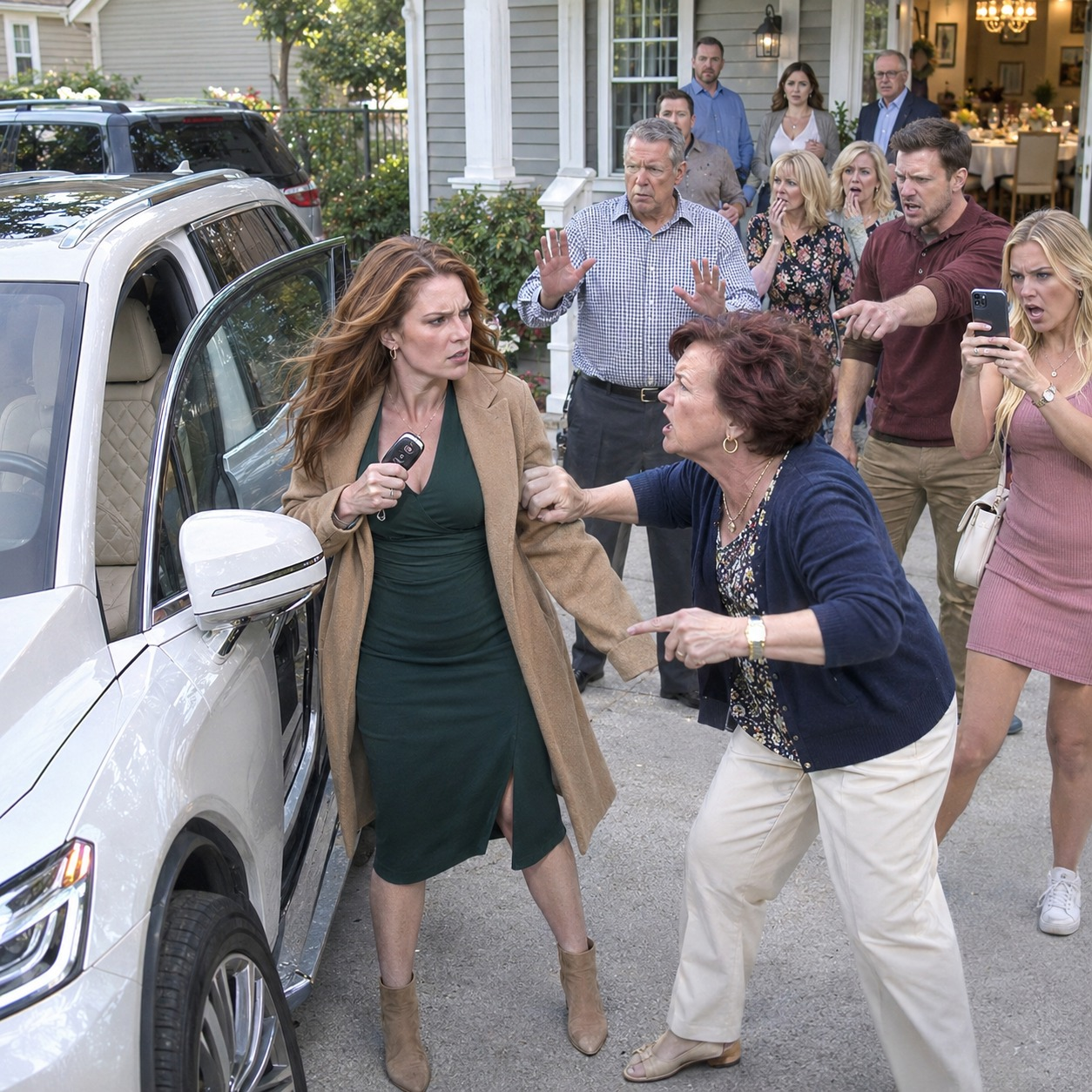
The signature was mine.
At least, it looked like mine.
The long upward stroke of the N.
The way the final letters of my first name connected.
The slightly exaggerated loop I had developed years earlier while signing contracts in a hurry.
Whoever had placed that signature on the document had either copied it from something I had signed before or knew my handwriting well enough to imitate it.
I stood in my mother's entryway, staring at the screen.
Behind me, the dining room conversation had resumed in low, uneasy voices.
I could hear silverware touching plates.
Someone cleared their throat.
My mother said something I couldn't make out.
For one strange moment, the ordinary sounds of dinner felt more disturbing than the argument itself.
My family was sitting twenty feet away, continuing their meal while I looked at a document that appeared to commit me to a financial obligation I had never agreed to accept.
I enlarged the attachment.
The document was labeled as a preliminary guarantor acknowledgment.
It referenced Brandon's proposed restaurant expansion, a commercial lending application, and the family home's address.
My name appeared in several places.
My email address.
My professional title.
An estimate of my annual income.
And a signature.
I hadn't signed it.
I knew that with absolute certainty.
I had never seen the document before.
I had never spoken to the lender.
And I had never agreed to guarantee Brandon's business debt.
I scrolled to the final page.
There was a date beside the signature.
Three days earlier.
Three days earlier, I had been sitting in my office reviewing a software implementation proposal for a client in Dallas.
I remembered the day because I had stayed late to finish the presentation.
I had also received a text from Mom that afternoon.
Don't forget dinner on Sunday. Brandon has exciting news.
At the time, I'd smiled.
Now the message felt different.
I saved a copy of the attachment to my phone.
Then I forwarded the email to my personal account.
I wasn't going to confront anyone until I understood exactly what I was looking at.
That was something my career had taught me.
When a complicated system failed, the worst thing you could do was start changing things before identifying the problem.
You preserved the evidence.
You documented the timeline.
You separated assumptions from facts.
And you never trusted the person who insisted everything was fine without showing you the records.
"Natalie?"
I looked up.
Ashley stood in the hallway.
She had followed me from the dining room.
Her pale blue dress moved slightly as she folded her arms.
"Are you leaving?"
"Yes."
She glanced at the folder in my hand.
"Brandon's really upset."
I waited.
Ashley sighed.
"He was counting on you."
"Then he should have spoken to me before counting on my money."
She looked uncomfortable.
"It's not that simple."
"Actually, Ashley, it is."
She lowered her voice.
"You know how hard he's worked."
"I do."
"He wants to build something for our future."
"Then he needs to build it with financing he can legally obtain."
She frowned.
"You make it sound like he's doing something wrong."
I held up my phone.
"Did you know my name was on loan documents?"
Her eyes moved toward the screen.
For a fraction of a second, her expression changed.
It was subtle.
But I saw it.
Recognition.
Then caution.
"I knew there was paperwork."
"What paperwork?"
"Business paperwork."
"Did you know someone had signed my name?"
She went still.
"What?"
I watched her carefully.
"There's a signature on a guarantor document. It looks like mine. I didn't put it there."
Ashley's face lost some of its color.
"Brandon said you were going to help."
"That wasn't my question."
She looked toward the dining room.
"Maybe you should talk to him."
"I already did."
"Natalie—"
"Did you know?"
She hesitated.
Then she whispered, "I knew your mother was helping with the application. I didn't know about a signature."
I believed she was frightened.
I didn't yet know whether I believed the rest.
Before I could ask another question, Brandon appeared behind her.
"There you are."
His expression was irritated.
"Mom's getting upset."
I almost smiled.
"That's unfortunate."
He looked at the folder.
"Can I have that back?"
"No."
"Natalie, those are my business documents."
"They contain my personal information and a proposed guarantee in my name."
He rolled his eyes.
"You're making a huge deal out of preliminary paperwork."
"Then you won't mind explaining why my signature is on it."
His expression changed.
Not dramatically.
His eyes narrowed, and his mouth stopped moving.
"What signature?"
I turned the phone toward him.
He glanced at it.
Then he looked away.
"That's just part of the application."
"Did you sign my name?"
"No."
"Did Mom?"
"I don't know."
"Who submitted it?"
He exhaled sharply.
"Why are you interrogating me?"
"Because someone submitted a document with my signature on it."
"It's not final."
"That doesn't answer my question."
He stepped closer.
"You know what your problem is?"
I said nothing.
"You think because you make more money than everybody else, you're better than us."
The accusation was so familiar that it barely surprised me.
Whenever I questioned a financial request, Brandon accused me of arrogance.
Whenever I asked for repayment, Mom said I was keeping score.
Whenever I wanted to establish a boundary, somebody claimed I had forgotten where I came from.
It was a system that worked beautifully for everyone except me.
"I don't think I'm better than you," I said. "I think I'm allowed to decide what happens to my money and my property."
Brandon laughed bitterly.
"That house was Dad's."
"Yes."
"And Mom's."
"It was jointly owned by them. After Dad died, Mom became the owner. Then I purchased it from her."
"You're talking like a lawyer."
"I'm talking like the person whose name is on the deed."
He looked past me toward the driveway.
"All this over a stupid car."
I felt something settle inside me.
The anger was still there, but it had become clearer.
"This isn't about the car anymore."
Brandon didn't answer.
I walked past him.
Mom was waiting near the front door.
She had followed the conversation closely enough to know that something was wrong.
"Where do you think you're going?" she asked.
"Home."
"We haven't finished talking."
"I have."
Her eyes moved to the folder.
"Give that to Brandon."
"No."
"Natalie."
"Mom, did you put my name on a loan application?"
She stared at me.
Then she said, "We were trying to get things moving."
My heart sank.
"What does that mean?"
"It means your brother has an opportunity, and we didn't want to lose it while you made up your mind."
"Did you sign my name?"
Her mouth tightened.
"Don't accuse me of something ugly."
"Then answer the question."
She looked offended.
"I have spent my entire life putting my children first."
I waited.
She continued.
"I sacrificed everything for you and Brandon. I worked. I cooked. I cleaned. I made sure you had opportunities."
"I know you did."
"And now you stand in my home and treat me like a criminal?"
I looked at her for a long moment.
Then I said, "Mom, this is my home. Legally, it has been for years."
Her face changed.
"Don't you dare throw that in my face."
"I'm not throwing anything in your face. I'm explaining why you can't pledge it as collateral."
She stepped back.
For the first time that evening, she seemed to understand that I wasn't going to apologize.
I walked outside.
The air was cooler than it had been when I arrived.
My Mercedes sat beneath the trees, polished white paint reflecting the porch lights.
I opened the driver's door.
Before getting inside, I looked back at the house.
My father had planted the large oak tree near the driveway when I was ten.
I remembered helping him carry bags of mulch.
I remembered him telling me that trees needed time, patience, and strong roots.
I wondered what he would have said if he had witnessed that dinner.
I didn't know.
And I refused to use his memory as an excuse to tolerate what was happening.
I got into the car and locked the doors.
Then I called my attorney.
Her name was Rebecca Shaw.
She had helped me structure several consulting contracts and had reviewed the paperwork when I purchased Mom's house.
It was Sunday evening, so I expected to leave a voicemail.
Instead, she answered on the fourth ring.
"Natalie?"
"Rebecca, I'm sorry to call so late."
"What's wrong?"
I looked toward the illuminated dining room windows.
"I think someone may have submitted a loan guarantee using my name without permission."
There was a pause.
"Tell me exactly what happened."
I explained everything.
The dinner.
The hundred-thousand-dollar demand.
The house.
The folder.
The email.
The signature.
Rebecca listened without interrupting.
When I finished, she asked, "Have you signed anything related to Brandon's business expansion?"
"No."
"Have you authorized anyone to use the property as collateral?"
"Absolutely not."
"Have you ever given your mother power of attorney?"
"No."
"Good. Don't sign anything. Don't delete any messages. Preserve the documents and send them to me."
"I already saved copies."
"Excellent."
She paused.
"Do you know whether the lender has funded anything?"
"No."
"Then our first priority is to find out exactly what has been submitted and stop any unauthorized transaction before it progresses."
I closed my eyes.
"Rebecca, could they actually do this?"
"They cannot lawfully grant a lien on property they don't own simply by claiming they can. But inaccurate applications and unauthorized signatures can create serious problems. We need to address them immediately."
I nodded, although she couldn't see me.
"Okay."
"I'll review what you send tonight. Tomorrow morning, we'll contact the lender and request the relevant records."
"Thank you."
"And Natalie?"
"Yes?"
"Do not let anyone pressure you into signing a document to make this situation disappear."
I looked toward the house again.
"I won't."
After the call, I forwarded Rebecca the email, the attachment, and photographs of the paperwork in Brandon's folder.
Then I sat in silence.
I expected to feel relieved.
Instead, I felt a grief I couldn't quite explain.
For years, I had believed my family's financial dependence was temporary.
I had told myself that Mom would eventually become more comfortable managing her expenses.
That Brandon's restaurant would stabilize.
That one day, they would stop needing me to solve every emergency.
But now I was beginning to see a possibility I had never seriously considered.
Maybe the emergencies were not always unavoidable.
Maybe the expectation that I would rescue everyone had become so deeply embedded that they no longer felt obligated to ask.
Maybe my success had stopped being something they celebrated and become something they believed they owned.
My phone rang.
Mom.
I let it go to voicemail.
She called again.
Then Brandon.
Then Mom.
I finally switched the phone to silent.
I started the Mercedes and pulled out of the driveway.
The car moved smoothly onto the residential street.
I had imagined this drive home would be one of the happiest evenings of my life.
Instead, I was trying to remember every document I had ever signed in my mother's presence.
Every time she'd asked me to fill out paperwork.
Every time Brandon had requested a copy of a financial statement.
Every time I had trusted them because they were family.
At a red light, another message appeared.
It was from Aunt Carol.
Natalie, I'm sorry about dinner. I didn't know you hadn't agreed to invest.
I stared at the message.
Then another arrived.
Your mother told me you'd already committed the money. She said Brandon just needed to finish the paperwork.
I pulled into a parking lot and called her.
Carol answered immediately.
"Natalie, honey, I'm so sorry."
"Carol, I need to ask you something."
"Of course."
"When did Mom tell you I was investing?"
"About three weeks ago."
Three weeks.
Long before I bought the Mercedes.
"Did she tell you anything else?"
Carol hesitated.
"She said you were helping Brandon secure financing."
"Did she mention the house?"
"Yes."
I gripped the steering wheel.
"What did she say?"
"She said the property would be used as part of the financing package."
I closed my eyes.
"Carol, did you know I own the house?"
There was a long silence.
Then she said, "Natalie, your mother told me you had transferred it back to her last year."
My eyes opened.
"What?"
"She said you'd only held the title temporarily while she got her finances straightened out."
I felt cold.
"That's not true."
"Oh, honey."
"I still own the house. I've never transferred it back."
Carol's breathing became audible.
"Then something is very wrong."
I looked down at the folder resting on the passenger seat.
"Carol, did Mom show you any documents?"
"She showed me a copy of something. I thought it was a property record."
"Do you still have it?"
"I think so."
"Please send it to me."
"I will."
We ended the call.
I sat motionless.
My mother hadn't merely assumed I would help Brandon.
She had apparently been telling relatives a false story about ownership of the house.
A story that made it easier for them to believe she had the authority to offer it as collateral.
My phone vibrated again.
Carol had sent a photograph.
I opened it.
It showed what appeared to be a property-related document.
The formatting was familiar.
The address was correct.
My mother's name appeared prominently.
But something was missing.
I enlarged the image.
Then I noticed the heading.
It wasn't a deed.
It was a draft transfer document.
And at the bottom, beneath a blank notary section, was another signature that looked like mine.
Before I could examine it further, a new message arrived from an unfamiliar number.
Ms. Natalie, this is Daniel Mercer with the commercial lending team. We need to speak with you urgently about an ownership discrepancy in the financing application.
A second message followed.
There is also an additional document bearing your name that we need you to verify.
Then my phone rang.
The caller ID displayed the lender's number.
I answered.
Daniel Mercer introduced himself, confirmed that he was calling about Brandon's application, and asked whether I was somewhere private.
"Yes," I said.
He took a breath.
"Ms. Natalie, before we go any further, I need to ask whether you authorized someone to act on your behalf."
"No."
There was a pause.
Then he said, "In that case, you need to know what was submitted to us this afternoon."
I tightened my grip on the phone.
"What was submitted?"
He hesitated.
And then he began to read the name of the person who had supposedly witnessed my signature...






Comments 0