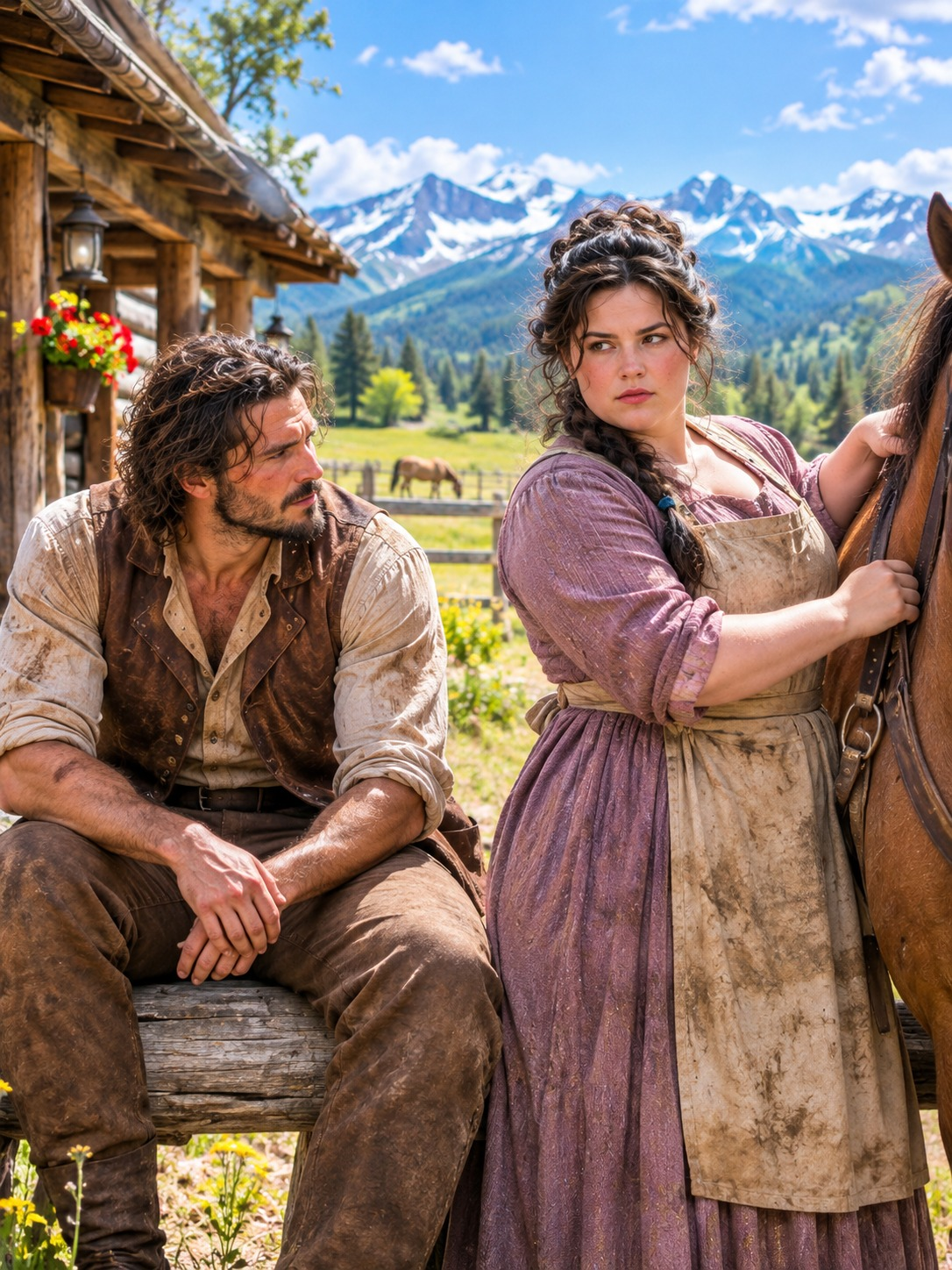
"Your wife knew who killed Lydia."
Richard Voss stood beside the burning barn, holding Eleanor's envelope between two fingers.
Crane Ashford stared at him.
For four years, he had believed his wife's death was a terrible accident of fate. Now Richard was suggesting that Eleanor had known something about Lydia Old's death—and had kept it from him.
Thomasine stood beside Copper, clutching the photograph.
"Open the envelope," she demanded.
Richard looked at her.
"You're very much like your mother."
"Stop talking about my mother."
"She was stubborn too. Unfortunately, stubborn people sometimes make enemies they cannot afford to have."
Crane moved forward.
"Give me the envelope."
Richard laughed quietly.
"You're hardly in a position to make demands, Crane."
Crane's injured knee trembled, but he refused to step back.
"That doesn't mean I've forgotten how to deal with men like you."
Richard's smile faded.
For several seconds, the two men stared at each other.
Then Richard placed the envelope on the fence.
"Read it carefully. You'll understand why Eleanor spent her final days trying to protect you."
He turned toward his truck.
Thomasine reached for the envelope.
"Wait!"
Richard stopped.
She looked directly at him.
"Did you kill my mother?"
He did not turn around.
"No."
"Then who did?"
Richard glanced over his shoulder.
"Ask the man who buried her."
He climbed into his truck.
The engine started.
And within seconds, he was disappearing down the ranch road.
Crane reached for the envelope.
But Thomasine took it first.
Her fingers shook as she opened the flap.
Inside was a single folded page.
The handwriting belonged to Eleanor.
At the top were three words.
For Crane. Read alone.
Thomasine looked at the rancher.
"She wrote this for you."
Crane unfolded the letter.
He read the first paragraph.
Then his face changed.
"What's wrong?" Thomasine asked.
He did not answer.
He read the final lines again.
And when he finally looked up, his voice was barely audible.
"Eleanor knew Lydia was going to die."
The fire continued burning behind them.
Beck and Yule managed to stop it from spreading to the main barn, but the eastern section was badly damaged.
The old storage room was gone.
Several roof beams had collapsed.
And the wooden floor above the hidden compartment had burned through.
Crane watched the remaining smoke rise into the November sky.
He had lost the place where Eleanor had hidden her secrets.
He had also lost the possibility of ever asking her why.
Thomasine stood beside him.
"Can I read the letter?"
Crane looked down.
For a moment, he seemed reluctant.
Then he handed it to her.
The first lines were addressed to him.
My darling Crane,
If you are reading this, then Richard has finally returned to the ranch. I hoped I would be able to stop him before that happened.
I need you to understand something. Lydia Old did not die because she was careless, unlucky, or sick.
Thomasine stopped.
Her eyes moved across the page.
She died because she discovered the original land transfer documents and learned who had altered them.
I knew she was in danger. I tried to convince her to leave the province, but she refused to abandon the evidence.
Two days before her death, Lydia told me that she had identified the person responsible for the thefts.
She also told me that this person had been inside her house.
Thomasine's breathing became shallow.
She continued.
I begged her to tell the police. She said she would, but only after she had secured the original ledger.
The following morning, she was found unconscious.
I have never believed it was an accident.
Thomasine lowered the page.
"Who was it?"
Crane took the letter back.
He read the remaining paragraph.
Then he looked toward the house.
"I think we need to find Silas."
Silas returned shortly after sunset.
He walked into the kitchen without knocking.
His coat was wet.
His face looked older than it had that morning.
Crane was waiting at the table.
Thomasine stood near the window.
Beck remained by the doorway.
Silas looked at the documents spread across the table.
Then he looked at the letter.
"You found it."
Crane nodded.
"Why didn't you tell me?"
Silas removed his hat.
"I thought it was safer not to."
"Safer for whom?"
Silas looked down.
"For everybody."
Crane pushed the letter toward him.
"Read it."
Silas did not move.
"I already know what it says."
Thomasine stepped forward.
"Then tell us who killed my mother."
Silas closed his eyes.
For several seconds, he seemed unable to speak.
Then he looked at her.
"Your mother was killed because she discovered the original land agreement."
Thomasine's voice was cold.
"Who did it?"
Silas swallowed.
"Richard Voss arranged the theft. But he didn't personally go to your mother's house."
Crane leaned forward.
"Who did?"
Silas looked toward the hallway.
Then he said a name.
"Margaret Hale."
Thomasine stared at him.
"Margaret?"
Silas nodded.
"She was Richard's legal adviser. She had access to the original documents, and she knew where Lydia kept her copies."
Crane shook his head.
"Why would Eleanor trust her?"
"Because Eleanor didn't know what Margaret had done."
Silas explained that Margaret had initially helped Eleanor and Lydia investigate the missing money.
She had been responsible for reviewing the original contracts.
But somewhere along the way, she had begun working with Richard.
She copied the documents.
Changed the ownership records.
And arranged for several payments to be transferred through Ashford Land Holdings.
Lydia discovered the altered signatures.
She confronted Margaret.
Three days later, Lydia was dead.
Thomasine held the edge of the table.
"You're saying Margaret killed her?"
Silas nodded.
"She went to Lydia's house that evening. They argued. Lydia threatened to expose her."
"What happened?"
Silas looked at Thomasine.
"Margaret pushed her down the kitchen steps."
Thomasine felt the room tilt.
"Did my mother die immediately?"
"No."
Silas lowered his head.
"She was still alive when Margaret left."
Thomasine's eyes filled.
"Then why didn't anybody help her?"
Silas could not answer.
Crane's voice became sharp.
"Why didn't you tell the police?"
Silas looked at him.
"Because Richard told us the original evidence would disappear, and that he would make sure Lydia's death was blamed on an existing medical condition."
Thomasine stared at him.
"Who is us?"
Silas looked toward Beck.
Beck immediately shook his head.
"Don't look at me."
Silas turned back to Crane.
"Me. Richard. And one other person."
Crane's face tightened.
"Who?"
Silas looked at Thomasine.
Then he spoke.
"Your father."
Thomasine stepped away from the table.
"No."
Silas did not move.
"No," she repeated.
Daniel Old had abandoned her.
He had allowed her mother to raise her alone.
But she had never believed he had been involved in her death.
"You're lying."
Silas shook his head.
"Daniel knew Margaret had visited Lydia."
"Then why didn't he stop her?"
"Because he wasn't there."
"Then what did he do?"
Silas looked at the floor.
"He helped Richard hide what happened afterward."
Thomasine's expression changed.
"How?"
"He took the original medical report and replaced it with another document. He told the authorities that Lydia had suffered a sudden medical emergency."
Crane stared at him.
"You expect us to believe Daniel helped cover up a murder?"
Silas nodded.
"He was frightened. Richard had threatened to destroy his family."
Thomasine shook her head.
"He was already gone. He wasn't part of our family."
Silas looked at her.
"Your mother knew he had been involved. That's why she never told you he was alive."
Thomasine looked toward the door.
She needed air.
She needed distance from the man who had just told her that her father had helped conceal her mother's death.
But before she could leave, Crane spoke.
"Where is Margaret now?"
Silas looked up.
"I don't know."
"Don't lie to me."
"I'm not."
Crane slammed his hand against the table.
"Then why did you tell us her name?"
"Because she has returned."
Silence.
Thomasine slowly turned.
"What?"
Silas looked toward the window.
"I saw her yesterday."
"Where?"
"Near the northern boundary."
Crane leaned forward.
"Why didn't you tell me?"
"Because she wasn't alone."
Silas hesitated.
Then he added:
"She was with Richard."
Daniel arrived at the ranch the following morning.
He looked exhausted.
Crane had called him shortly after Silas's confession.
Thomasine was waiting in the living room.
She did not greet him.
She did not offer coffee.
She simply stood with her arms folded.
Daniel looked at her.
"I suppose you know."
Thomasine nodded.
"Silas told us."
Daniel closed his eyes.
"I wanted to explain."
"Then explain."
He removed his coat.
For a moment, he seemed unable to decide where to sit.
Finally, he chose the chair opposite her.
"Your mother and I had been separated for several months when the investigation began."
Thomasine stared at him.
"Why?"
"Because I was afraid."
"Of Richard?"
"Yes."
"And you thought leaving was easier than protecting your family?"
Daniel looked down.
"I thought disappearing would make you both safer."
Thomasine's voice became sharper.
"That's not what I asked."
Daniel swallowed.
"I made a terrible decision."
"Did you know Margaret was going to see my mother?"
"Yes."
"Did you know she was dangerous?"
"I knew she had been working with Richard."
Thomasine's hands tightened.
"Then why didn't you warn Lydia?"
Daniel looked at her.
"I tried."
"When?"
"The evening before she died."
Thomasine went still.
"What did you tell her?"
"I told her Margaret was coming to the house."
"And?"
"She said she wanted to speak with her."
Thomasine shook her head.
"Why would she do that?"
"She believed Margaret would confess if confronted with the original ledger."
"Did you go there?"
Daniel hesitated.
"Yes."
"When?"
"After midnight."
Thomasine stared at him.
"Was my mother alive?"
Daniel's face crumpled.
"Yes."
The room became silent.
Thomasine slowly sat down.
"What did you do?"
"I found her at the bottom of the kitchen steps. She was unconscious."
"Did you call an ambulance?"
Daniel looked away.
"No."
Thomasine felt her heart pounding.
"Why?"
"Because Richard was already there."
She stared at him.
"What?"
Daniel continued.
"Richard told me he had called for help. He said the police would arrive shortly. He told me to leave before they came."
"And you listened?"
"I was terrified."
"Of what?"
"Of being blamed."
Thomasine stood.
"You left my mother on the floor."
Daniel's eyes filled.
"I thought help was coming."
"But you didn't stay."
"No."
She looked at him with a mixture of disbelief and anger.
"You let her die alone."
Daniel covered his face.
"I know."
Thomasine walked toward the window.
She could not look at him.
After a long silence, she asked:
"Did you ever find out whether help arrived?"
Daniel nodded.
"Yes."
"When?"
"Several hours later."
Thomasine turned.
"Several hours?"
Daniel's voice broke.
"Richard told me the ambulance had already taken her to the hospital. I didn't know he was lying."
She stared at him.
Then she whispered:
"Who actually called for help?"
Daniel looked at her.
"I never found out."
Crane had been listening from the hallway.
He stepped into the room.
"That's enough."
Daniel stood.
Crane's face was pale with anger.
"You helped cover up what happened to Lydia."
"I know."
"And you left her there."
"I thought she would be rescued."
Crane shook his head.
"You have no idea what that means to her."
Daniel looked at Thomasine.
"I know I don't deserve forgiveness."
Crane pointed toward the door.
"Then stop asking for it."
Daniel nodded.
He picked up his coat.
Before leaving, he turned toward Thomasine.
"There's one thing I haven't told you."
She did not respond.
Daniel continued.
"Your mother left something with me that night."
Thomasine looked up.
"What?"
"A recording."
Crane stepped forward.
"What recording?"
Daniel reached into his coat.
He removed a small black cassette.
"I found it in Lydia's kitchen after Margaret left."
Thomasine stared at the cassette.
"Why didn't you give it to the police?"
Daniel looked at her.
"Because I was afraid it would expose everything I had done."
Crane took the cassette.
"What's on it?"
Daniel shook his head.
"I never listened to the whole thing."
Thomasine looked at him.
"Why?"
"Because the first few seconds were enough to tell me that Lydia knew she was in danger."
He placed the cassette on the table.
Then he left.
Thomasine watched him walk across the yard.
She did not call him back.
That afternoon, Crane arranged for the recording to be played.
Beck found an old cassette player in the office.
The machine made a grinding sound before the tape began.
Then Lydia's voice filled the room.
"Margaret, I know what you did."
A faint noise followed.
Then another voice.
Margaret's.
"You don't understand what you're involved in."
"I understand perfectly."
"Then you should understand that this cannot continue."
Lydia's voice became firmer.
"You forged the documents. You moved the money. You used my daughter's future to threaten me."
Thomasine closed her eyes.
Her mother's voice sounded exactly as she remembered.
Calm.
Strong.
Determined.
Margaret spoke again.
"Give me the ledger."
"No."
"You're making a terrible mistake."
"I've already sent copies to Eleanor."
Silence.
Then Margaret said something that made Crane look sharply at the recorder.
"Then Eleanor will have to disappear too."
The recording continued.
There was the sound of movement.
A chair scraping.
Lydia spoke.
"Don't come any closer."
Margaret answered.
"You should have listened."
Then came a sudden crash.
A gasp.
And the recording ended.
Thomasine stood motionless.
Nobody spoke.
Crane slowly switched off the machine.
Beck looked toward the desk.
"That's enough to establish that Margaret threatened her."
Crane nodded.
"And the recording proves she was at Lydia's house."
Thomasine looked at the cassette.
"Can we give it to the police?"
"Yes," Crane answered.
"Then we should."
He nodded.
But before they could move, Beck's phone rang.
He answered.
His expression changed.
"What?"
He listened.
Then looked at Crane.
"It's Margaret."
Crane took the phone.
"Where?"
Beck pointed toward the window.
"At the main gate."
Margaret Hale stood beside a silver car.
She wore a dark coat and carried a leather handbag.
Her short blond hair was carefully arranged.
She looked older than she did in the photograph, but Thomasine recognized her immediately.
The silver brooch was still pinned near her collar.
The same brooch.
The same woman.
The woman who had stood beside her mother and Eleanor.
The woman whose voice had just threatened Lydia on the recording.
Crane walked toward the gate.
Thomasine followed.
Beck remained several steps behind them.
Margaret smiled when she saw Crane.
"Hello, Crane."
He did not return the greeting.
"You're a long way from town."
"I came to discuss the property transfer."
Crane stared at her.
"You should have brought a lawyer."
Margaret's smile disappeared.
"I am a lawyer."
"Not anymore."
She glanced toward Thomasine.
"Ah. So you've met her."
Thomasine stepped forward.
"You knew my mother."
Margaret looked at her.
"Yes."
"You went to her house."
"Yes."
"You threatened her."
Margaret's expression remained composed.
"Your mother was involved in matters she didn't understand."
Thomasine felt her anger rising.
"She understood enough to expose you."
Margaret looked toward Crane.
"I see you've been listening to old recordings."
Crane's voice was cold.
"We have the original ledger too."
For the first time, Margaret looked genuinely unsettled.
Then she recovered.
"That ledger is not admissible proof of anything."
"We'll let the authorities decide."
Margaret laughed softly.
"You're making a mistake."
Thomasine stepped closer.
"Did you kill my mother?"
Margaret looked at her for a long moment.
Then she said:
"Your mother died because she refused to understand the consequences of her choices."
Thomasine felt her knees weaken.
Crane moved between them.
"That's enough."
Margaret adjusted her handbag.
"I have one final offer."
Crane stared at her.
"What?"
"Withdraw your objections to the land transfer. Give Richard the northern parcel. In exchange, every document connected to your ranch will disappear."
Crane almost laughed.
"You think I'm going to sell my wife's legacy to you?"
Margaret's expression hardened.
"Then you should prepare for what comes next."
She turned toward her car.
Thomasine watched her reach for the door handle.
Then she noticed something.
The handbag had fallen slightly open.
Inside was a photograph.
A photograph of Eleanor.
But this one was different.
Eleanor was standing beside Margaret.
And behind them stood another man.
Thomasine recognized him immediately.
It was Richard.
But the photograph was not from four years ago.
It was dated six weeks before Eleanor's death.
And on the back, in Eleanor's handwriting, were the words:
MARGARET WAS NEVER THE REAL TARGET.
That evening, Crane placed the photograph beside the cassette.
Thomasine sat opposite him.
Beck stood near the office door.
Nobody had been able to explain Eleanor's final message.
If Margaret was not the target, who was?
And why had Eleanor kept the photograph?
Crane examined the date.
Six weeks before her death.
He remembered that period.
Eleanor had become increasingly worried.
She had stopped sleeping properly.
She had begun locking the office.
And she had asked him several times whether he trusted the people working on the ranch.
He had thought she was simply anxious about the business.
Now he wondered whether she had been trying to tell him something much bigger.
Thomasine looked at the photograph.
"There's something written on the front."
Crane leaned closer.
Beneath Eleanor's hand, almost hidden by the edge of her coat, was a small inscription.
A set of initials.
R.A.
Crane frowned.
"Those aren't Richard's initials."
Thomasine looked at him.
"Who else's could they be?"
Crane turned the photograph over.
On the back, beneath Eleanor's warning, was another line.
The person who ordered everything was already inside the family.
Crane slowly lowered the photograph.
Then Beck's phone rang again.
This time, the caller was Dr. Angel.
Beck answered.
Listened.
His face drained of color.
"What happened?"
He looked at Thomasine.
Then at Crane.
"Dr. Angel says Copper has been moved."
Crane gripped his cane.
"By whom?"
Beck swallowed.
"Somebody came with your authorization."
Crane stared at him.
"I didn't authorize anything."
Beck nodded.
"That's what I told him."
He paused.
Then added:
"The person who collected Copper showed him a signed document."
Crane's face hardened.
"Whose signature?"
Beck looked down at the phone.
Then he answered.
"Yours."
Crane stood abruptly.
His injured knee nearly gave way.
Thomasine caught his arm.
But before either could speak, Beck received a second message.
He read it.
Then looked up in horror.
"The document also names the person who legally owns Copper."
Thomasine stared at him.
"Who?"
Beck slowly turned the phone around.
The name on the screen was not Crane Ashford.
It was Lydia Old.
And beneath her name was a date that had been entered only yesterday.






Comments 0